Table of contents

Key Takeaways
The fitness ecommerce sector on Shopify is expanding rapidly, with 36,560 dedicated Sports & Fitness stores now active on the platform (StoreInspect). The global sports ecommerce market is valued at $280 billion, growing 10–14% annually (EasyApps). Fitness nutrition stores grew 12% month-over-month in 2026 (Bootleads), and top sports Shopify stores achieve 3–5% conversion rates by building authentic athletic communities. Below are the numbers every fitness ecommerce operator needs to benchmark against.
Fitness Shopify Market Overview
Shopify powers over 915,000 active stores globally (StoreInspect), and Sports & Fitness accounts for 4% of all Shopify stores — roughly 36,560 stores. The broader Health & Wellness category, which includes fitness supplements and wellness gear, adds another 41,570 stores (4.5%). Combined, fitness-adjacent stores represent 8.5% of Shopify's entire ecosystem.
The global sports and fitness ecommerce market hit $280 billion in 2025 and continues to grow 10–14% annually, fueled by home workout adoption, niche athletic communities, and the mainstreaming of fitness culture (EasyApps). Beauty & Fitness is the second-largest category among top 1,000 Shopify stores by revenue, with a median revenue of $154 million (OptiMonk).
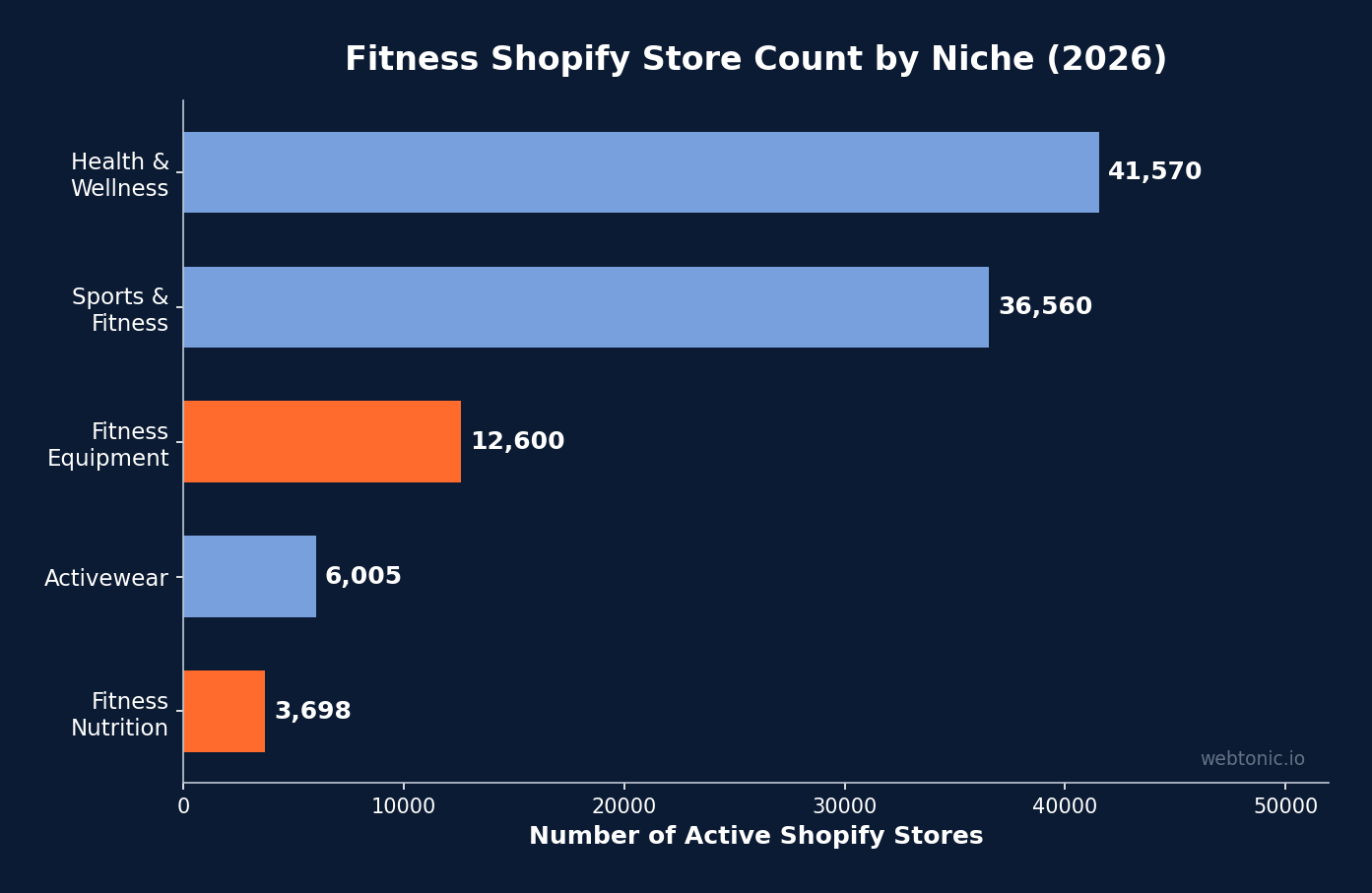
Fitness Shopify Store Count by Niche
| Niche | Active Stores | Monthly Growth | Source |
|---|---|---|---|
| Fitness Equipment | 12,600+ | 5% (566 new/mo) | Bootleads |
| Activewear / Athleisure | 6,005 | Stable | Bootleads |
| Fitness Nutrition / Supplements | 3,698 | 12% (435 new/mo) | Bootleads |
| Sports & Fitness (overall) | 36,560 | 4% category share | StoreInspect |
| Health & Wellness (total) | 41,570 | 4.5% category share | StoreInspect |
Fitness nutrition leads in growth velocity. 435 new Shopify fitness nutrition stores launched per month in 2026, reflecting a 12% monthly growth rate (Bootleads). Equipment stores are the largest niche at 12,600+ stores, adding 566 new stores per month at a 5% growth clip (Bootleads).
Conversion Rate Benchmarks for Fitness Shopify Stores
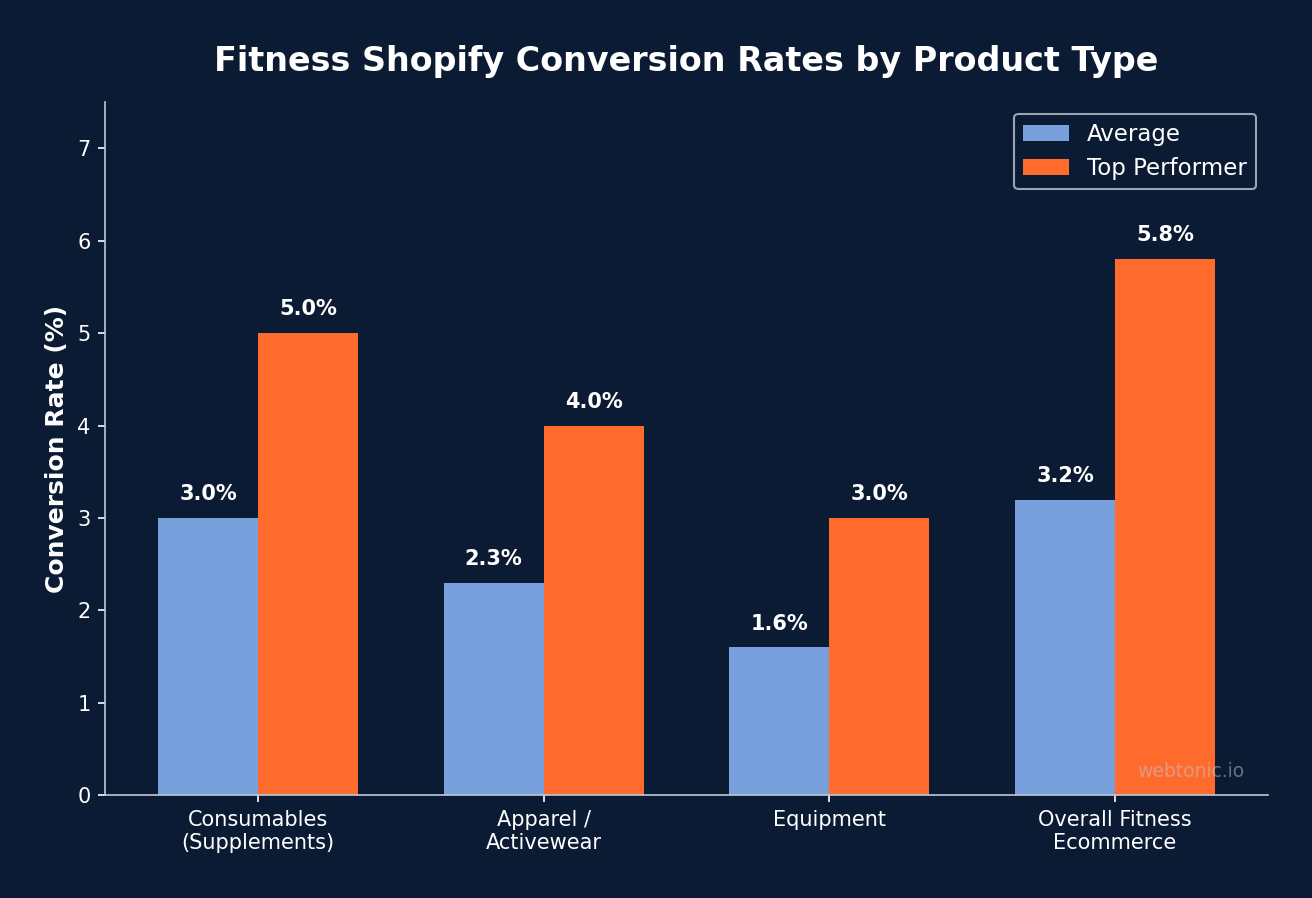
Conversion rate is the make-or-break metric for fitness ecommerce. Here is how fitness stores on Shopify compare across product types:
| Product Type | Avg. Conversion Rate | Top Performer Range | Return Rate |
|---|---|---|---|
| Consumables (supplements) | 2.5–3.5% | 3–5% | 3–6% |
| Apparel / Activewear | 1.8–2.8% | 3–4% | 15–22% |
| Equipment | 1.2–2.0% | 2–3% | ~10% |
| Overall Fitness E-commerce | 3.2% | 5.8% | Varies |
Consumables outperform equipment and apparel because repeat-purchase products benefit from subscription flows and lower purchase hesitation. The overall fitness ecommerce average conversion rate is 3.2%, with the top 10% hitting 5.8% (CuFinder). Meanwhile, apparel stores face the highest return rates at 15–22% due to sizing issues (EasyApps).
App and Tech Stack Adoption
Fitness Shopify stores run an average of 5.2 detected apps per store (StoreInspect). However, 8.1% of stores have zero detected apps, suggesting a significant portion of fitness merchants are underutilizing the platform's ecosystem.
The top adoption leaders are Cart Drawer (21.4%), Klaviyo (17.6%), and Judge.me Reviews (17.4%). For fitness brands specifically, review apps and email marketing tools dominate because social proof and retention-focused email sequences are critical for supplement and apparel brands alike.
- 27.3% of Shopify stores run 8+ apps, correlating with higher operational maturity
- Klaviyo leads email marketing with 160,680 stores (17.6%) — its segmentation and lifecycle flows make it the default for fitness DTC brands
- Judge.me Reviews (158,905 stores) is the most popular review app, essential for supplement and equipment credibility
- 58% of fitness consumers now consider environmental impact when purchasing (EasyApps)
Revenue and Market Performance
Among the top 1,000 Shopify stores globally, Beauty & Fitness generates a median revenue of $154 million, placing it second only to Apparel (OptiMonk). On ecomm.design, Beauty & Fitness ranks as the third-largest Shopify category by store count, behind Apparel and Home & Garden.
The subscription economy plays an outsized role in fitness ecommerce. Supplement brands using Shopify subscription apps see repeat purchase rates 30–50% higher than one-time purchase models, driving substantially higher lifetime values (EasyApps). Shopify Payments processes these transactions at scale, powering over $235 billion in GMV across the platform (ZeroToWP, citing WooCommerce comparisons).
Competitive Landscape and Market Share
Shopify's overall CMS market share stands at 4.6% of all websites and 29% of ecommerce sites (Colorlib). In the fitness vertical specifically, Shopify dominates DTC brands while SEO-driven fitness websites serves content-heavy fitness businesses like coaching platforms, gym websites, and membership portals.
| Platform | Fitness Use Case | Strength | Global CMS Share |
|---|---|---|---|
| Shopify | DTC fitness products | Checkout, payments, apps | 4.6% |
| WooCommerce | Fitness content + commerce | Flexibility, SEO, plugins | 6.5% |
| Wix | Solo trainer websites | Ease of use, booking | 3.6% |
| Squarespace | Boutique studio branding | Design, scheduling | 1.8% |
Growth Strategies That Drive Fitness Shopify Success
The fitness ecommerce winners on Shopify share common growth patterns backed by data:
- Community-driven marketing outperforms generic advertising — niche sport communities (CrossFit, pickleball, trail running) convert at 2–3x the rate of broad fitness audiences
- Athlete influencer partnerships drive high-intent traffic, with fitness influencer collaborations showing 2.8x social media ROI (Zipdo)
- Gamified email capture (spin-to-win, quiz funnels) increases opt-in rates by 30–40% compared to standard popups
- Bundle upsells on equipment and supplement stores increase AOV by 15–25%
- Seasonal urgency campaigns (New Year, summer, back-to-school) concentrate 40% of annual fitness ecommerce revenue into Q1 and Q3
Fitness brands succeeding on Shopify focus on building growth marketing engines that compound subscriber lists and repeat purchase rates — not just one-time acquisition.
Key Takeaways for Fitness Ecommerce Operators
- The fitness Shopify ecosystem is large and growing fast: 36,560 sports stores plus 41,570 health & wellness stores, with nutrition growing 12%/month
- Conversion rates vary dramatically by product type: supplements (2.5–3.5%) outperform equipment (1.2–2.0%)
- The top revenue tier ($154M median for Beauty & Fitness in top 1K stores) proves the category's commercial viability
- App adoption correlates with performance: stores running 8+ apps tend to operate more mature retention and conversion stacks
- Seasonal demand patterns mean Q1 and Q3 capture ~40% of annual revenue, requiring proactive paid media planning
Geographic Distribution of Fitness Shopify Stores
Fitness ecommerce on Shopify is concentrated in English-speaking markets, but global adoption is accelerating. The United States accounts for 227,730 Shopify stores overall — roughly 25% of the global total — followed by the UK (55,476), Australia (29,836), and Canada (28,425) (StoreInspect).
The Sports & Fitness category follows a similar geographic pattern, with North America and Western Europe dominating. Germany (18,162 stores) leads the Continental European market, reflecting the country's strong fitness culture and growing DTC appetite. Japan's 12,071 Shopify stores signal that fitness ecommerce is gaining traction in Asia-Pacific markets traditionally dominated by local platforms like Rakuten and BASE.
For fitness brands eyeing international expansion, Shopify's multi-currency and multi-language support reduces the friction of cross-border selling. Auto Currency Switcher is already used by 6.3% of all Shopify stores (StoreInspect), and fitness equipment brands targeting European markets should consider currency localization as a baseline requirement rather than an optional feature.
DTC Fitness Brand Success on Shopify
Shopify has become the platform of choice for the most successful direct-to-consumer fitness brands. Gymshark, one of the world's largest fitness apparel brands, built its empire on Shopify before eventually moving to a custom setup at scale. Alo Yoga, Vuori, and Fabletics all leverage Shopify's infrastructure for rapid product launches and community-driven sales events.
The DTC model works particularly well in fitness because the purchase is tied to identity. A runner doesn't just buy shoes — they identify as a runner. This emotional connection creates extraordinary brand loyalty and high repeat purchase rates (EasyApps). Subscription-based supplement brands on Shopify see repeat purchase rates 30–50% higher than one-time purchase models, driving substantially higher customer lifetime values.
The paid media strategies that fuel DTC fitness growth typically combine Meta Ads prospecting with email retention workflows — which explains why Klaviyo (17.6%) and Mailchimp (9%) are among the most adopted apps across Shopify stores. Fitness brands that pair strong acquisition channels with automated lifecycle email sequences achieve the highest LTV-to-CAC ratios in the ecommerce space.
Seasonal Patterns and Revenue Concentration
Fitness ecommerce follows predictable seasonal demand cycles that directly impact Shopify store revenue planning. Q1 (January–March) and Q3 (July–September) collectively account for approximately 40% of annual fitness ecommerce revenue, driven by New Year's resolutions and summer body preparation (EasyApps).
- January peak — the single largest sales month for supplements, equipment, and activewear as consumers act on fitness resolutions
- April–May ramp — spring fitness spending picks up ahead of summer, especially in activewear and outdoor fitness gear
- September boost — back-to-routine spending after summer vacations drives gym membership sign-ups and home equipment purchases
- November Black Friday/Cyber Monday — fitness brands report BFCM as a top revenue event, particularly for high-ticket equipment and annual supplement subscriptions
Successful fitness Shopify stores plan their ad strategy around these peaks, front-loading creative production and inventory for January and scaling back during quieter months like June and December. This seasonal intelligence is critical for optimizing ad spend and inventory management.
The fitness Shopify landscape is evolving rapidly. WhatsApp Business Chat is used by 4.6% of stores (StoreInspect), reflecting a shift toward conversational commerce in markets where WhatsApp dominates consumer messaging. Retention.com adoption at 5.2% signals that fitness DTC brands increasingly invest in visitor identification technology to recover anonymous traffic and feed retargeting audiences — a sophisticated growth tactic that complements standard paid media campaigns. The combination of community-driven acquisition and technology-enabled retention defines the competitive edge for fitness brands scaling on Shopify in 2026.
Related reading
- Electrical Services Shopify Statistics
- Fertility & IVF Shopify Statistics: E-Commerce Benchmarks for Wellness Brands (2026)
- Financial Advisory Shopify Statistics: E-Commerce, Digital Products & Subscription Data (2026)
- Custom Web Development services at Web Tonic
FAQ
How many fitness stores are on Shopify?
There are approximately 36,560 Sports & Fitness stores on Shopify, plus 41,570 Health & Wellness stores that include fitness supplements and wellness products. Combined, they represent about 8.5% of all Shopify stores (StoreInspect).
What is the average conversion rate for a fitness Shopify store?
The overall fitness ecommerce conversion rate averages 3.2%, with top performers reaching 5.8% (CuFinder). Consumable products like supplements convert higher (2.5–3.5%) than equipment (1.2–2.0%) due to lower purchase friction and subscription models (EasyApps).
Is Shopify or WooCommerce better for fitness businesses?
It depends on your business model. Shopify excels for DTC product brands (supplements, apparel, equipment) thanks to its checkout, payment processing, and app ecosystem. WooCommerce is stronger for content-driven fitness businesses (coaching platforms, gym websites, membership portals) that need deep SEO control and custom functionality. Many fitness brands use both — Shopify for commerce, content and digital marketing.
Which fitness niche is growing fastest on Shopify?
Fitness nutrition and supplements is the fastest-growing fitness niche on Shopify, with a 12% monthly growth rate and 435 new stores launching per month (Bootleads). Equipment stores add 566 new stores monthly but at a lower 5% growth rate.
What is the market size of fitness ecommerce?
The global sports and fitness ecommerce market is valued at approximately $280 billion, growing 10–14% annually (EasyApps). The subscription model (supplements, meal plans) is a key growth driver, with repeat purchase rates 30–50% higher than one-time models.
Sources
storeinspect.com/report/state-of-shopify
bootleads.com — Fitness Nutrition Stores
bootleads.com — Fitness Equipment Stores
bootleads.com — Activewear Stores
easyappsecom.com — Shopify Sports & Fitness Guide
optimonk.com — Shopify Benchmark Report 2026
ecomm.design — How Many Shopify Stores
cufinder.io — Fitness Benchmarks 2026
colorlib.com — CMS Market Share 2026
zipdo.co — Fitness Marketing Statistics