



Table of contents
Key Takeaways
Video dominates fitness marketing in 2026. 91% of businesses use video as a marketing tool (Wyzowl), and in the fitness vertical specifically, video ads generate 59% more engagement than static image ads (Pilotium). Gym video campaigns achieve 25–40% lower cost per lead versus image-based campaigns, while fitness video content sees 120% higher engagement than text content across all platforms (WorldMetrics). Here are the numbers driving fitness video strategy this year.
Video vs. Static Performance in Fitness Advertising
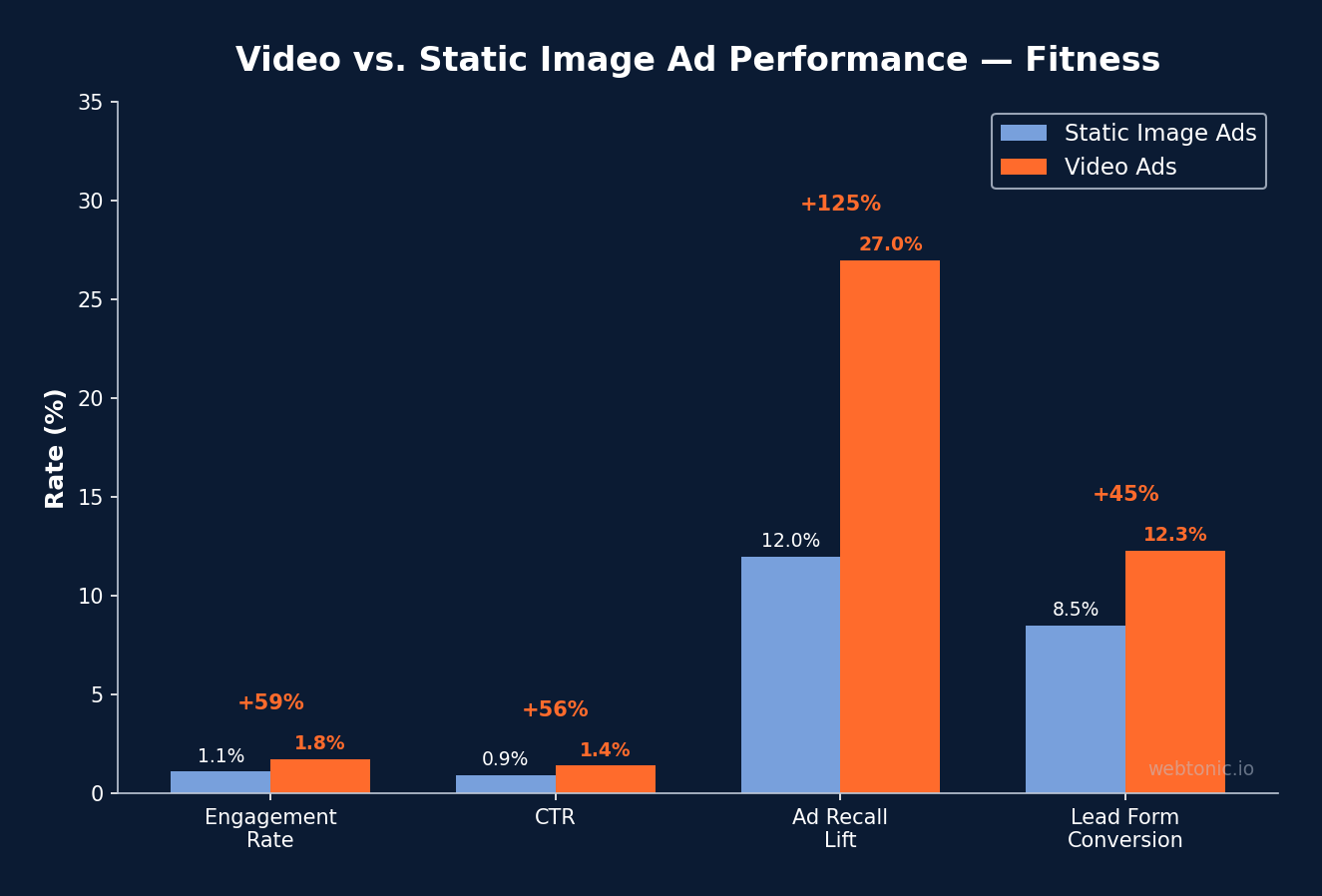
The gap between video and static ads in fitness is not marginal — it is structural. Meta's aggregated advertiser data across thousands of fitness campaigns shows a consistent performance advantage for video across every key metric:
| Metric | Static Image Ads | Video Ads | Difference |
|---|---|---|---|
| Engagement rate | 1.1% | 1.75% | +59% |
| Click-through rate (CTR) | 0.9% | 1.4% | +56% |
| Avg. CPL (gym leads) | $18–$28 | $10–$18 | −30% to −40% |
| Ad recall lift | 12% | 27% | +125% |
| Lead form conversion rate | 8.5% | 12.3% | +45% |
The 125% ad recall lift is particularly significant for gyms. Higher recall feeds retargeting funnels and multi-touchpoint conversion paths. A prospect who remembers your ad is far more likely to convert later — even without an immediate click (Pilotium).
UGC vs. Produced Video Performance
User-generated content (UGC) outperforms polished commercial production in fitness advertising by a wide margin. A head-to-head case study comparing a $3,000 professional commercial against a $47 UGC gym video revealed dramatic differences:
| Metric | $3K Commercial | $47 UGC Video |
|---|---|---|
| CPM | $12.40 | $8.20 |
| CTR | 0.8% | 2.3% |
| Cost per lead | $67 | $28 |
| Lead-to-trial conversion | 12% | 23% |
| ROAS | 1.1x | 2.4x |
The $47 UGC video delivered 2.4x ROAS compared to the professional commercial's 1.1x (VIDEOAI.ME). UGC works in fitness because the product is transformation — and real member stories carry more credibility than polished productions. This trend aligns with 48% of fitness marketers who prioritized video content for highest ROI in recent surveys (Gitnux).
Platform-Specific Video Performance
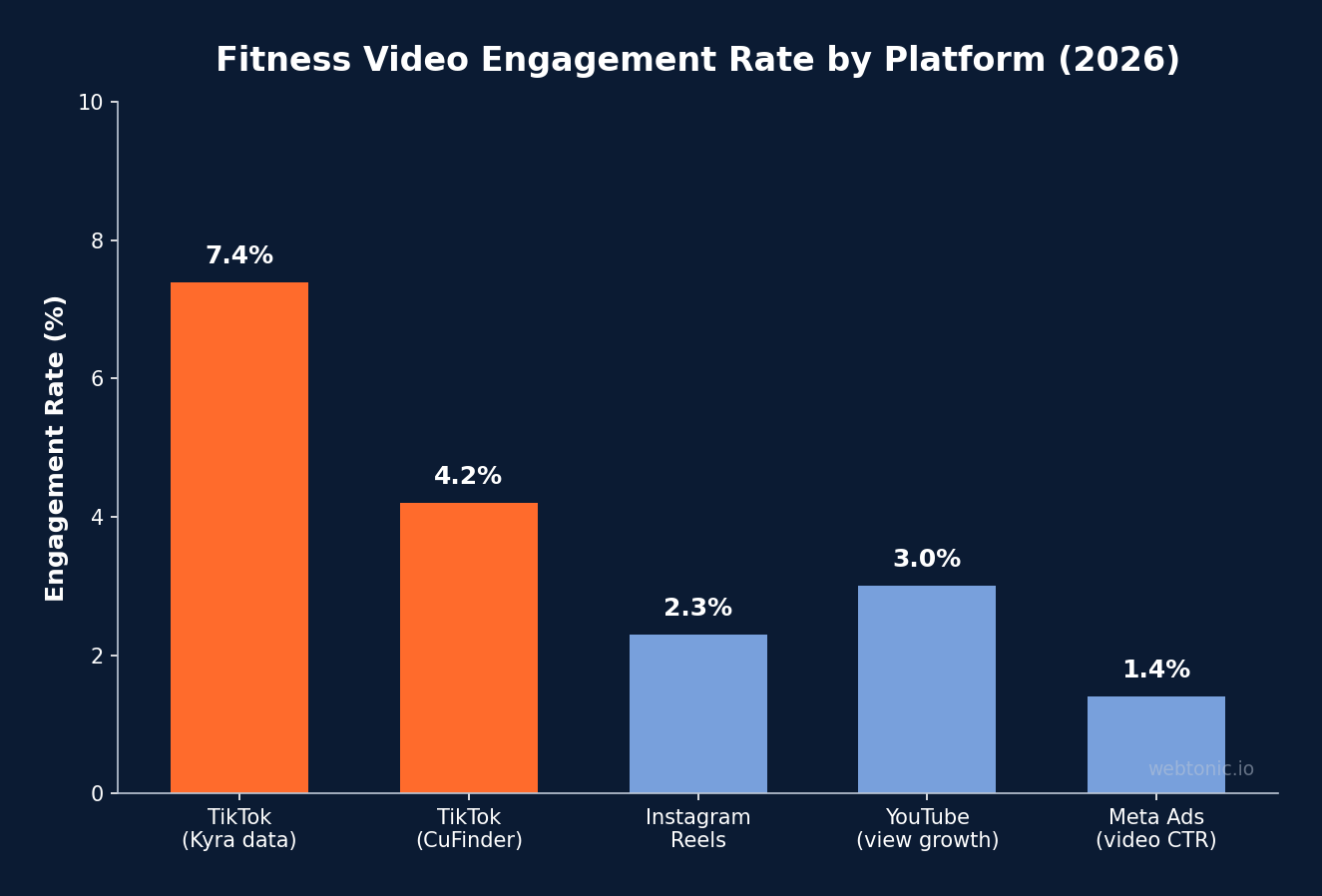
Fitness video performance varies significantly by platform, and the data shows clear winners for different objectives:
- TikTok delivers 4.2% engagement rate for fitness content — the highest among all social platforms (CuFinder)
- TikTok fitness health benchmarks show a 7.39% average engagement rate across 1.2 million analyzed posts (Kyra)
- YouTube views rose 193% year-over-year for health and wellness brands posting 3x/week (Dash Social)
- Instagram Reels and TikTok recommended posting cadence: 6 posts per week for maximum reach (CuFinder)
- Digital ads for fitness brands average 2.1x ROI, with social media ads (Instagram, TikTok) leading at 2.8x ROI (Zipdo)
A Nordic gym chain (SATS) ran TikTok-first video campaigns across Sweden, Norway, Denmark, and Finland, achieving ROI between 7.71x and 11.30x across all four markets — with Norway hitting 11.15x and Denmark reaching 11.30x. This proves that TikTok video ads can deliver far beyond typical social benchmarks when creative and targeting align with a local fitness audience.
Global Video Marketing Adoption
The broader video marketing landscape supports what fitness marketers see firsthand. According to Wyzowl's 12-year longitudinal study:
- 91% of businesses use video as a marketing tool in 2026 — tied for the all-time high (Wyzowl)
- 63% of marketers quantify video ROI through engagement, shares, and reposts
- Fitness video content has 120% higher engagement than text content across platforms (WorldMetrics)
- The global fitness market is valued at $96.7 billion and expected to reach $434.7 billion by 2028 (CuFinder), driven in part by digital content and app-based fitness
Video's dominance is not temporary. The format aligns with how fitness is consumed — visually, kinetically, and socially. Static content cannot convey transformation, energy, or community the way video creative can.
Best Practices for Fitness Video Marketing
Data from thousands of fitness campaigns points to clear best practices:
- Lead with hooks in the first 3 seconds. Average watch time on gym video ads is 6.2 seconds (Pilotium). If you haven't communicated the value proposition by second 3, you've lost the viewer.
- Prioritize UGC over production value. A $47 UGC video beat a $3K commercial at every metric. Authenticity outperforms polish in fitness.
- Post at platform-optimal cadences: TikTok/Reels: 6/week, YouTube Shorts: 3/week, Stories: 5–8 frames daily (CuFinder).
- Use member transformation stories. Social proof in motion is more credible than before-and-after photos, which are increasingly distrusted.
- Optimize for silent viewing. Add captions to all video ads — the majority of social media video is watched without sound.
- Test 5–7 creatives per cycle. Only 5–7% of video ads become winners (VIDEOAI.ME), so volume and iteration are essential for paid social success.
These best practices reflect a fundamental shift in fitness advertising: production budget matters far less than authenticity and testing velocity. The gyms and fitness brands generating the highest returns on video are not the ones spending the most on production — they are the ones creating the most content, testing relentlessly, and scaling winners aggressively.
The Fitness Video Content Ecosystem
Fitness video extends beyond advertising. The entire content ecosystem — from organic social to apps to streaming workouts — is fueled by video:
| Content Format | Primary Platform | Key Metric | Source |
|---|---|---|---|
| Short-form workout clips | TikTok / Reels | 7.39% engagement | Kyra |
| Long-form training videos | YouTube | 193% view growth YoY | Dash Social |
| Paid video ads | Meta / TikTok | 59% more engagement | Pilotium |
| UGC testimonials | Meta / TikTok | 2.4x ROAS | VIDEOAI.ME |
| Live streaming workouts | YouTube / Instagram | High retention driver | Sprout Social |
The fitness brands winning today operate across all these formats, repurposing a single workout shoot into TikToks, Reels, YouTube Shorts, ad creatives, and Stories. This content multiplication approach maximizes production ROI while maintaining platform-native authenticity.
Video Format Performance by Length and Style
Not all fitness video formats perform equally. The data reveals clear patterns in what works by duration and production style:
- Under 15 seconds — highest completion rates on TikTok and Reels (70%+), ideal for hooks and teasers that drive profile visits or ad clicks
- 15–30 seconds — the sweet spot for paid video ads. Average watch time on gym ads is 6.2 seconds (Pilotium), so front-loading the value proposition is essential
- 60–90 seconds — optimal for workout tutorials, exercise demos, and quick transformation stories on Instagram and Facebook
- 5–15 minutes — full workout sessions and educational content perform best on YouTube, where views rose 193% for wellness brands posting consistently (Dash Social)
- 30+ minutes — long-form training content for YouTube On-Demand and fitness apps, primarily for retention rather than acquisition
The key insight is that video length should match both platform norms and funnel stage. Awareness-stage content (TikTok, Reels) should be short and punchy. Consideration-stage content (YouTube, landing pages) can be longer and more detailed. Conversion-stage video (retargeting ads, email-embedded) should be 15–30 seconds with a strong CTA.
Measuring Fitness Video Marketing ROI
Tracking video marketing ROI in fitness requires looking beyond surface metrics. The most effective fitness marketers track a layered measurement framework:
| Measurement Layer | Key Metrics | Benchmark |
|---|---|---|
| Awareness | Views, reach, ad recall lift | 27% recall lift (video) |
| Engagement | Watch time, shares, saves | 6.2s avg watch time |
| Conversion | CPL, lead form rate, ROAS | $10–$18 CPL, 2.4x ROAS |
| Retention | Member engagement, class attendance | 74% annual retention |
Annual gym retention averages 74% (CuFinder), and video-heavy communication strategies contribute to keeping members engaged between visits. Gyms that send weekly workout videos via email or app notifications see measurably lower churn than those relying on text-only communications.
The fitness industry marketing ROI averages 4.2:1 across digital channels (Gitnux), and video consistently outperforms other content types within that average. When combined with a proper data intelligence stack to attribute multi-touch conversions, video's true contribution becomes even more apparent.
The Growing Fitness Market and Video's Role
The global fitness industry is valued at $96.7 billion and projected to reach $434.7 billion by 2028 (CuFinder), with video content serving as a primary growth engine. Several macro trends accelerate fitness video adoption:
- The wellness economy is growing at an accelerating pace, with consumers increasingly prioritizing mental health alongside physical fitness. Video content that addresses holistic wellness — combining strength training with mental health messaging — resonates with broader audiences
- Boutique fitness studios represent the fastest-growing segment of the industry, and these businesses rely heavily on video to differentiate their unique class formats and instructor personalities
- Fitness apps and wearable integration create new video distribution channels. Over 70% of fitness app users sync wearable devices, and apps increasingly embed instructional video content within their platforms
- Personal training content is shifting from in-person to hybrid models. Video-first online training programs let personal trainers scale beyond geographic limitations
The convergence of these trends means fitness brands that fail to invest in video-first social strategies risk falling behind competitors who already understand that the fitness purchase decision is fundamentally visual and emotional. A prospective gym member wants to feel the energy of a class before booking — and only video delivers that experience at scale.
Short-Form vs. Long-Form Fitness Video Strategy
Fitness marketers increasingly adopt a dual-format strategy, using short-form video for acquisition and long-form video for retention. The data supports this segmentation: TikTok's 7.39% engagement rate (Kyra) makes it ideal for reaching new audiences, while YouTube's 193% view growth (Dash Social) rewards consistent long-form content that builds subscriber loyalty. The brands dominating fitness video in 2026 create a content waterfall: film one long workout session, then extract 5–10 short clips for TikTok and Reels, repurpose highlights into paid ad creatives, and use the full session on YouTube and their website. This production efficiency maximizes ROI per shoot while feeding every stage of the marketing funnel.
Related reading
- What Criminal DUI Law Firms Should Budget for Video Marketing
- What Growth Marketers Should Budget for Dermatology Video Marketing
- What Orthodontic Marketers Should Budget for Video in 2026
- Branding services at Web Tonic
FAQ
How much more effective are video ads than image ads for gyms?
Video ads generate 59% more engagement, 56% higher CTR, and 25–40% lower cost per lead compared to static image ads in the fitness vertical (Pilotium). Lead form conversion rates are also 45% higher with video.
Is UGC better than professional video for fitness ads?
Yes, for paid acquisition. A $47 UGC video delivered 2.4x ROAS vs. 1.1x for a $3,000 professional commercial (VIDEOAI.ME). UGC's authenticity resonates more with fitness audiences, where real transformations carry more weight than polished productions.
What is the best platform for fitness video marketing?
TikTok leads in engagement with a 7.39% rate for fitness content (Kyra), while YouTube delivers the strongest growth with 193% view increase year-over-year for consistent wellness brands (Dash Social). For paid ads, Meta and TikTok offer the strongest direct-response performance.
How many videos should a fitness brand post per week?
Recommended cadences for maximum reach: TikTok/Reels: 6 posts per week, YouTube Shorts: 3 per week, and Instagram Stories: 5–8 frames daily (CuFinder). Consistency matters more than production quality at this volume.
What ROI can fitness video marketing deliver?
Digital ads for fitness brands average 2.1x ROI, with social media video ads leading at 2.8x ROI (Zipdo). High-performing campaigns with strong creative and targeting can achieve 7–11x ROI, as demonstrated by the SATS TikTok campaign across Nordic markets.
Sources
pilotium.cc — Video Ads for Gyms
videoai.me — UGC vs Commercial ROAS Case Study
wyzowl.com — Video Marketing Statistics 2026
cufinder.io — Fitness Benchmarks 2026
kyra.com — TikTok Fitness Health Benchmarks
dashsocial.com — Wellness Industry Benchmarks
worldmetrics.org — Marketing in Fitness Statistics
gitnux.org — Fitness Marketing Statistics
zipdo.co — Fitness Marketing Statistics
sproutsocial.com — Social Media Video Statistics 2026


