Table of contents
No study prices an orthodontic video marketing budget directly - so this page builds the budget case from Wyzowl's 2026 cross-industry video survey, Align Technology's own investor disclosures on the patient segments video usually targets, and the ad costs that make creative quality worth paying for. Every cross-industry figure below is labeled as such.
Key Takeaways
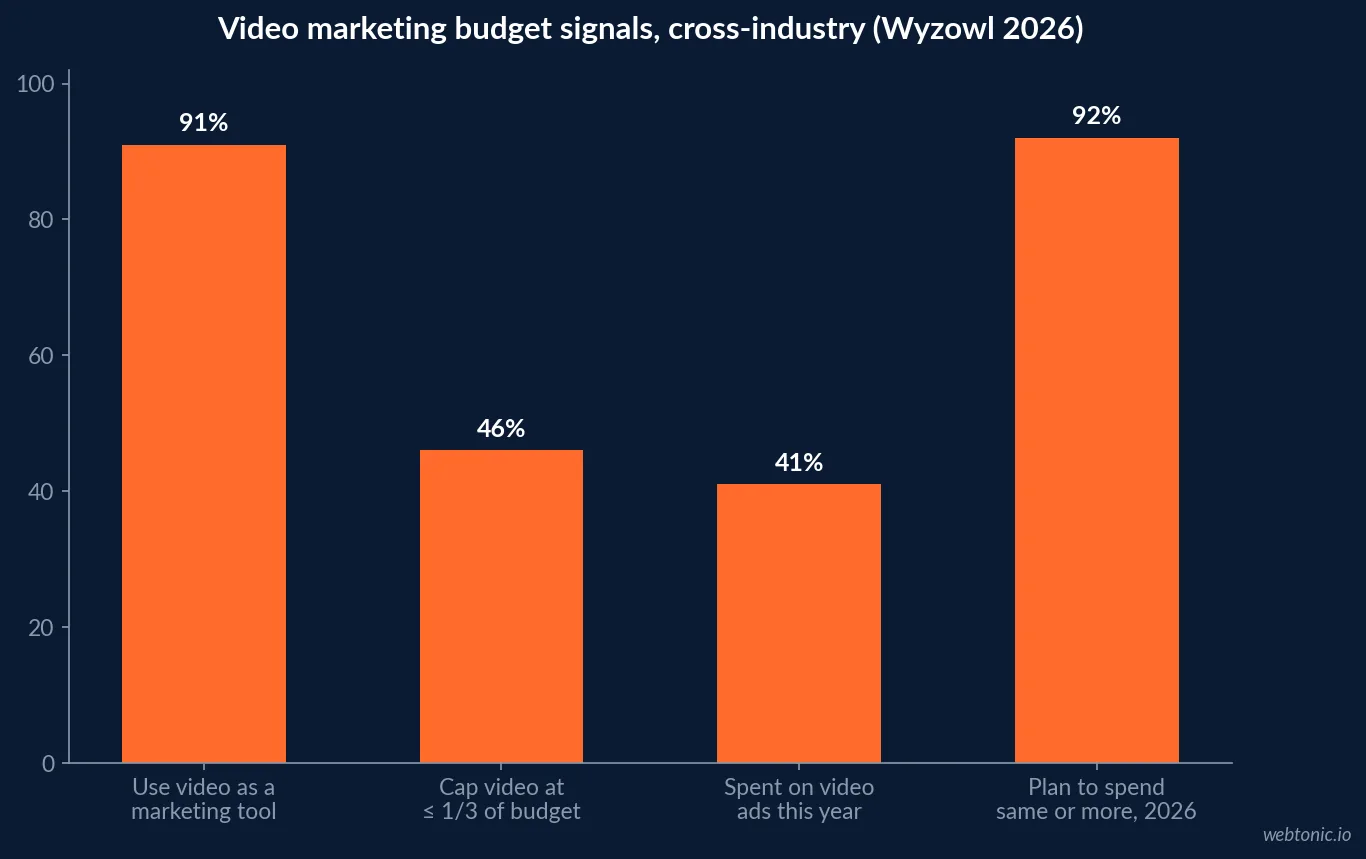
- 91% of businesses use video as a marketing tool in 2026, per Wyzowl - a cross-industry high.
- 46% of marketers allocate a third or less of their budget to video.
- 17% of marketers are not tracking their video spend closely enough to know it.
- 92% plan to spend the same or more on video in 2026 than in 2025.
- 41% have spent money on video ads this year, up from 36% a year earlier.
- 85% of video marketers say video helped them generate leads.
- 83% say video has directly increased sales.
- 82% say video increased both web traffic and time on site.
- 57% say video reduced support queries.
- 96% of consumers have watched an explainer video before buying a product or service.
- YouTube is marketers' most-used video platform at 70%, ahead of Instagram (69%) and Facebook (66%); TikTok sits at 40%.
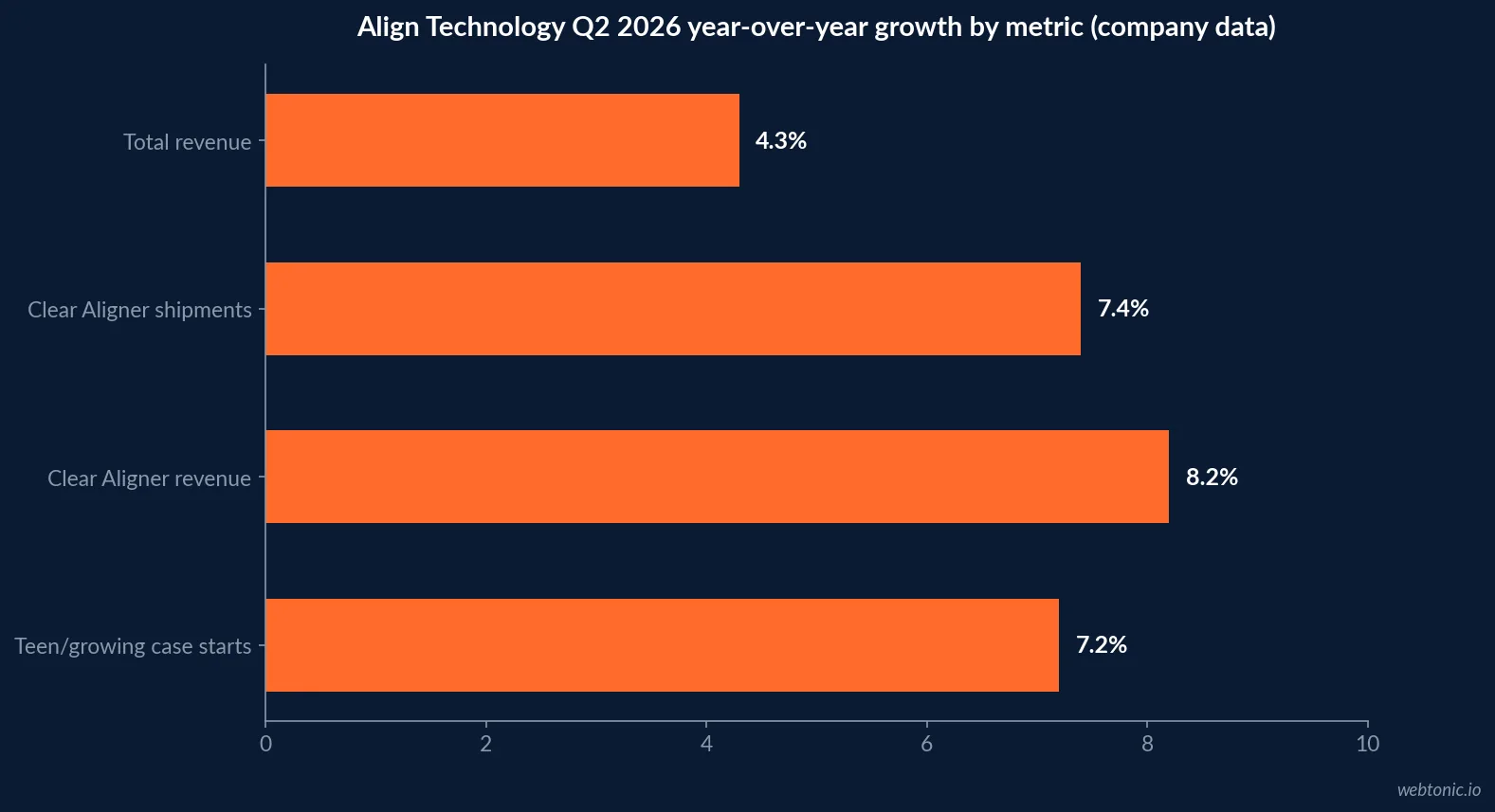
- Align Technology's teen/growing-patient case starts rose 7.2% year-over-year to 240,000 cases in Q2 2026 (company data).
- Align's Clear Aligner shipments hit a record 691,800, up 7.4% year-over-year (company data).
- Adult patients in AAO-member treatment reached 1.91 million in 2024, up from 1.64 million in 2022.
- Dentists pay a $9.78 average CPC on Facebook lead ads, the highest of 20 WordStream-tracked industries, up 139% year-over-year.
What businesses actually budget for video, cross-industry
Wyzowl's State of Video Marketing 2026 report, based on a survey of 266 marketing professionals and consumers in late 2025, found 91% of businesses use video as a marketing tool, back to a joint all-time high after a slight 2025 dip. On budget specifically, 46% of marketers allocate a third or less of their overall marketing spend to video, while 17% admit they are not tracking the number closely enough to say - a meaningful share of the market running video without a clear line item. Looking ahead, 92% plan to spend the same or more on video in 2026, and 41% have specifically put money into video ads this year, up from 36% the year before. None of this is orthodontics-specific; it is the cross-industry baseline every vertical, including ortho, is spending against.
| Wyzowl 2026 video budget metric | Figure |
|---|---|
| Businesses using video as a marketing tool | 91% |
| Marketers allocating ≤ 1/3 of budget to video | 46% |
| Marketers unsure how much they spend on video | 17% |
| Marketers planning to spend the same or more in 2026 | 92% |
| Marketers who have spent on video ads this year | 41% (vs. 36% prior year) |
What marketers say video actually returns
The same Wyzowl survey found 85% of video marketers say video helped them generate leads, 83% say it directly increased sales, and 82% say it increased both web traffic and time spent on the site. 57% say it reduced support queries, and on the consumer side, 96% say they have watched an explainer video to learn about a product or service before buying it. For a category built on a visual transformation - a smile before and after treatment - an explainer or testimonial format is a closer fit to how consumers already say they research a purchase than a static image ad.
Platform choice follows usage, not necessarily effectiveness: YouTube is the most-used video marketing platform among marketers at 70%, ahead of Instagram (69%), Facebook (66%) and webinars (56%); TikTok trails at 40%, which matters for budget sequencing - most marketers are still building YouTube and Instagram video libraries before TikTok-specific creative.
| Video marketing platform (Wyzowl 2026) | Share of marketers using it |
|---|---|
| YouTube | 70% |
| 69% | |
| 66% | |
| Webinars | 56% |
| TikTok | 40% |
| X (Twitter) | 29% |
The patient segments video is actually reaching, per Align's own numbers
Align Technology, Invisalign's parent company, does not publish orthodontic video ad-spend data, but its Q2 2026 earnings call transcript shows exactly which patient segments are growing: total revenue hit a record $1.06 billion, up 4.3% year-over-year, Clear Aligner shipments reached a record 692,000 cases, up 7.4% year-over-year, and management's own Q2 2026 earnings call reported teen and growing-patient case starts rose 7.2% year-over-year to 240,000 cases, led by growth in China, Japan, Turkey, India and Brazil. That is company-reported data, not a video study, but it is the clearest signal available on where orthodontic patient volume is actually moving - and both teens and adults (the AAO put adult patients in treatment at 1.91 million in 2024, up from 1.64 million in 2022) are audiences that respond to a video-native transformation story more readily than to a static before/after image.
| Align Technology Q2 2026 metric (company data) | Figure | YoY change |
|---|---|---|
| Total revenue | USD 1.06 billion | +4.3% |
| Clear Aligner revenue | USD 870.9 million | +8.2% |
| Clear Aligner shipments | 691,800 cases | +7.4% |
| Teen & growing-patient case starts | 240,000 cases | +7.2% |
| Invisalign-trained doctors | 89,175 | +3.4% |
Why the click video has to earn is expensive
WordStream's 2025 Facebook Ads Benchmarks Report found dentists and dental services pay a $9.78 average cost per click on lead-generation campaigns - the highest of the 20 industries it tracks, and up 139% year-over-year, the single biggest CPC increase in the report. Every click a static ad wastes on a non-converting visitor is now close to ten dollars gone; that is the specific cost pressure that makes testing video creative against a static control worth the production budget, not a nice-to-have.
What a video actually has to show, given the audience
Wyzowl's data on what video formats consumers respond to is not orthodontics-specific, but it lines up with what a transformation-based treatment sells. Consumers in the same survey ranked testimonial and explainer formats among the most trusted before a purchase, and 96% say they have watched an explainer video specifically to understand a product or service before buying it. For a category where the entire sale is a visible before/after change, that argues for budgeting toward patient-testimonial and process-explainer formats first, ahead of purely promotional spots, and validating the choice against a practice's own lead and booking data rather than assuming the cross-industry number transfers directly.
The AAO's patient-volume data gives a sense of scale for that testing: with an estimated 6.66 million patients in active treatment across AAO members and 696 active patients per member in 2024, even a modest lift in video-driven consultation requests compounds across a large existing patient base referring friends and family, on top of new-patient acquisition.
| Video format (cross-industry, Wyzowl-informed) | Why it fits a transformation-based sale |
|---|---|
| Patient testimonial | Matches the 96% who say they watched an explainer/testimonial before buying |
| Before/after process explainer | Carries the visual transformation static images compress into one frame |
| Doctor-led FAQ video | Targets the 85% lead-generation lift video marketers report |
| Short-form platform cut (Reels/TikTok) | Repurposes proven long-form assets into lower-cost variants |
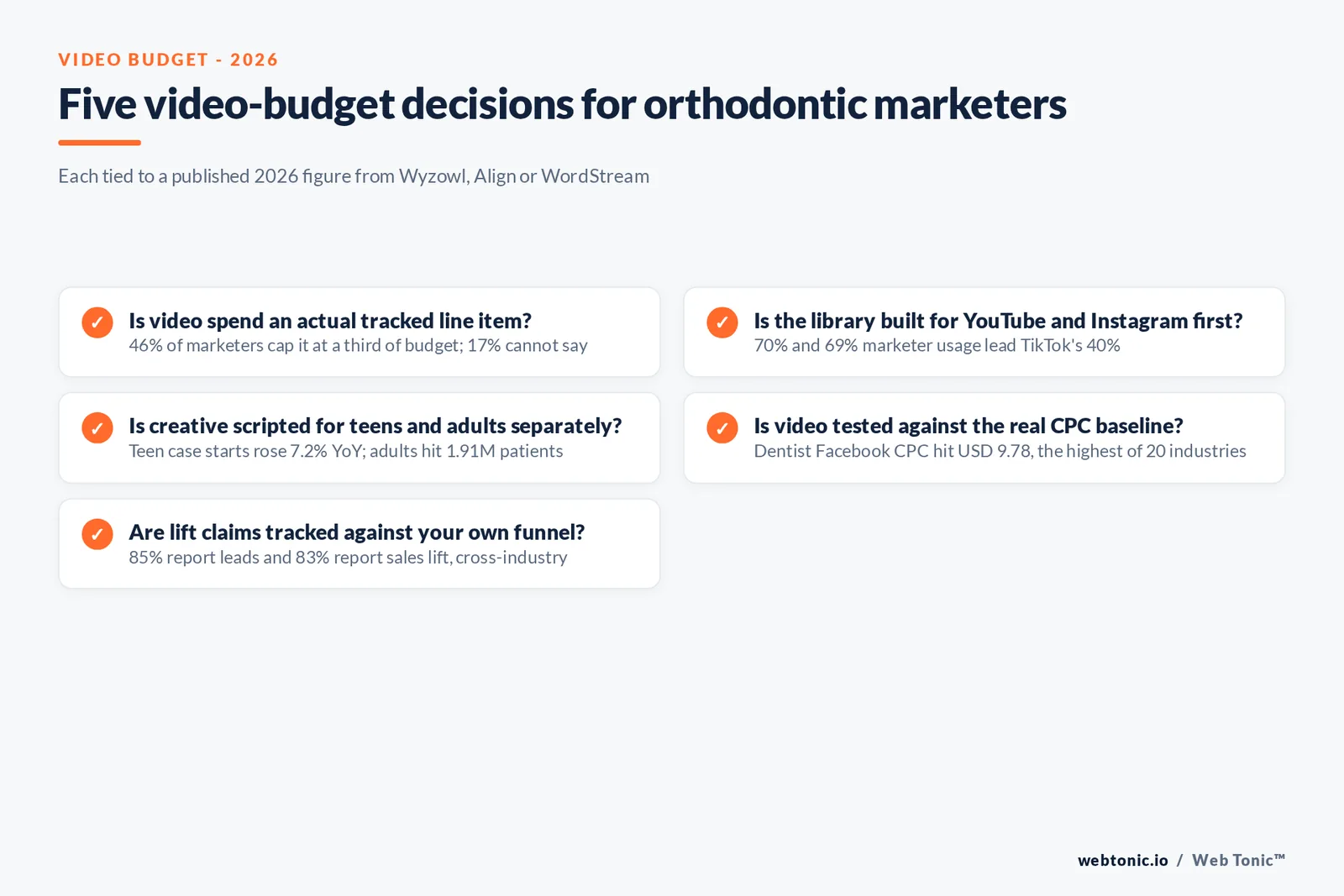
Five video-budget decisions worth making before Q1
- Set a tracked video line item - joining the 46% who cap spend at a third of budget beats the 17% who cannot say what they spend.
- Build for YouTube and Instagram before TikTok - 70% and 69% marketer usage against TikTok's 40% suggests sequencing, not exclusion.
- Script separately for teens and adults - Align's 7.2% teen case-start growth and the AAO's 1.91 million adult patients are different buying journeys.
- Test video against your $9.78 CPC baseline - a format proven to hold attention (per Wyzowl's 82% dwell-time finding) has a real dollar case at that cost per click.
- Track the 85%/83% lead-and-sales lift claims against your own funnel before assuming Wyzowl's cross-industry averages transfer directly to ortho.
Our performance creative team builds and tests video concepts against benchmarks like these, and our breakdown of what Facebook ads cost is a useful companion read for the media budget that video creative runs on. Talk to us if the testing plan above needs a production partner.
Frequently Asked Questions
Is there a published study on orthodontic video marketing budgets specifically?
No. Wyzowl's State of Video Marketing report surveys marketers and consumers across industries, not orthodontics specifically, and no dental or ortho association publishes a video ad-spend benchmark. This page uses Wyzowl's cross-industry figures alongside Align Technology's own investor disclosures on case-start growth - company data on where orthodontic patient volume is actually moving - and labels each figure by what it measures.
How much of a marketing budget do businesses typically put toward video?
Wyzowl's 2026 survey of 266 respondents in late 2025 found 46% of marketers allocate a third or less of their overall marketing budget to video, and 17% said they are not tracking video spend closely enough to know. 92% plan to spend the same or more on video in 2026, and 41% have specifically spent money on video ads this year, up from 36% the year before - a cross-industry benchmark, not an orthodontic-specific budget line.
What does video marketing actually change for the businesses that use it, per Wyzowl?
Across Wyzowl's respondent base, 85% of video marketers say video has helped them generate leads, 83% say it has directly increased sales, 82% say it increased both web traffic and time spent on the site, and 57% say it reduced support queries. Separately, 96% of consumers say they have watched an explainer video to learn more about a product or service before buying.
Why would an orthodontic practice specifically need video, versus static ads?
Align Technology's own Q2 2026 results show teen and growing-patient case starts increased 7.2% year-over-year to 240,000 cases, and total adult patients in AAO-member treatment reached 1.91 million in 2024, up from 1.64 million in 2022 - two growing segments (teens and adults) that respond differently to a smile-transformation story, which is a video-native format, more than a static image can carry. Neither figure is a video-specific study, but both describe the audience video content is built to reach.
Does a higher ad cost make video creative more or less important for orthodontics?
More, by the available evidence. WordStream's 2025 Facebook Ads Benchmarks Report found dentists and dental services pay a $9.78 average cost per click on lead-generation ads - the highest of the 20 industries it tracks, up 139% year-over-year - which raises the cost of every wasted impression and makes creative that actually holds attention (Wyzowl's data points to video for that) worth testing against a static control.
Sources
Wyzowl - State of Video Marketing 2026
Align Technology - Q2 2026 Earnings Call Transcript (StockAnalysis)
Align Technology - Q2 2026 Earnings Call Transcript (The Motley Fool)
WordStream by LocaliQ - Facebook Ads Benchmarks 2025
American Association of Orthodontists - 2025 Economics of Orthodontics and Patient Census Survey
Web Tonic - Performance Creative
Web Tonic - How Much Do Facebook Ads Cost