Table of contents
No published study prices video production for dermatology or plastic surgery specifically, so this page builds a budget range from the closest real evidence: Wyzowl's 2026 cross-industry marketer survey, and the American Academy of Dermatology's and ASPS's own specialty-level campaign data. Every cross-industry figure below is labeled as such.
Key Takeaways
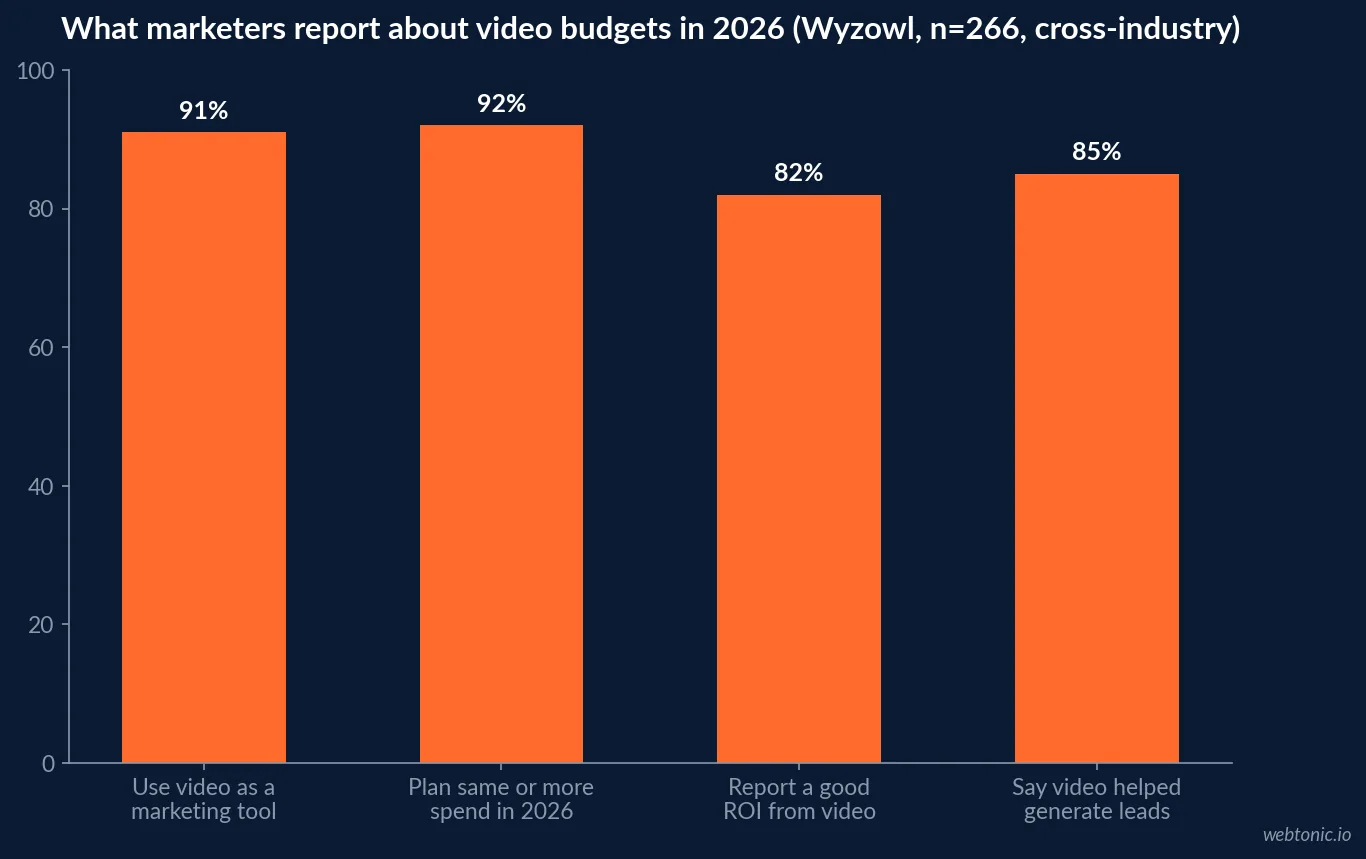
- 91% of businesses use video as a marketing tool in 2026 (cross-industry, Wyzowl).
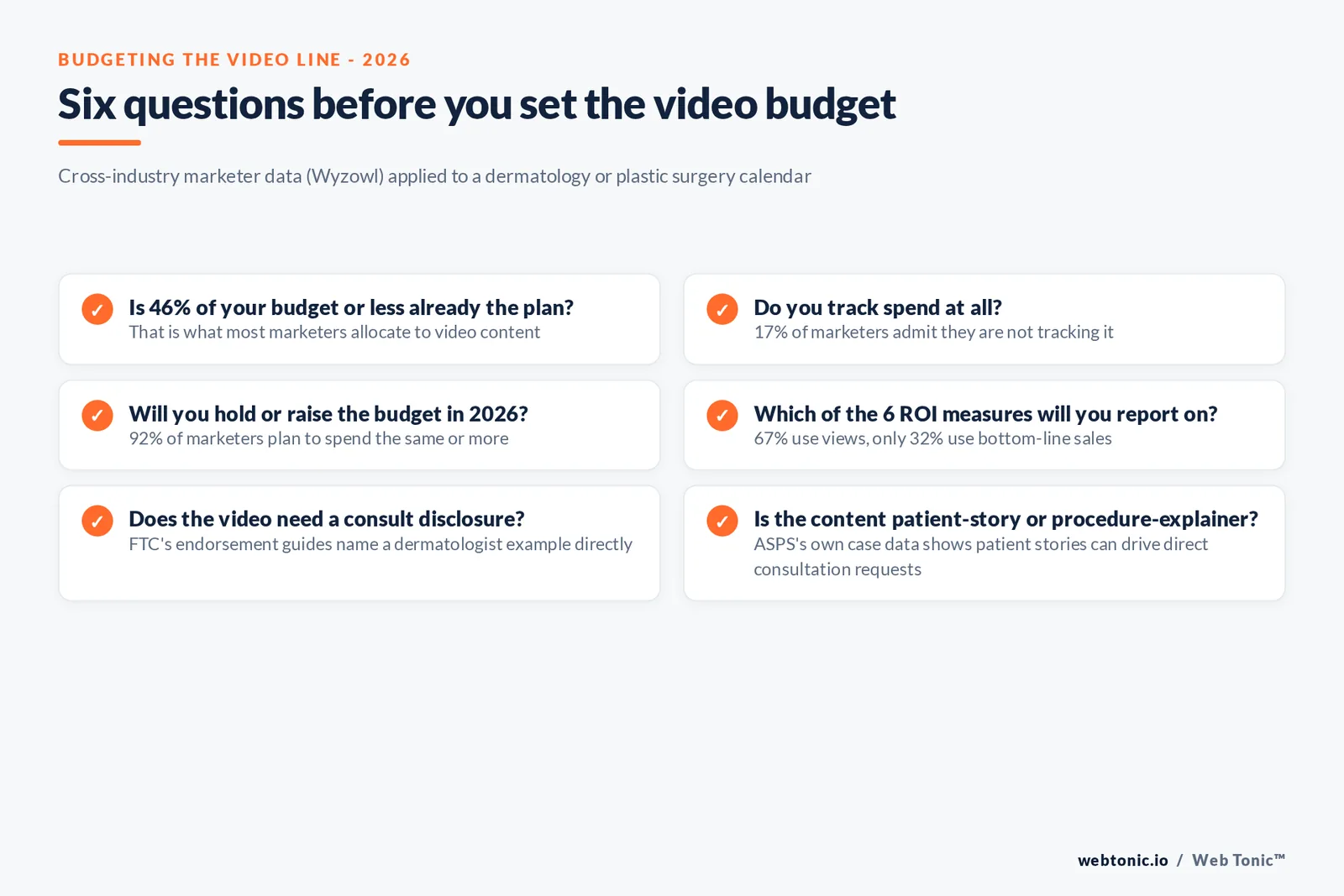
- 46% of marketers allocate a third of their budget or less to video content.
- 17% of marketers do not track their video spend at all.
- 92% plan to spend the same or more on video marketing in 2026.
- 82% of video marketers report a good ROI, down from 93% the year before.
- 85% say video has helped them generate leads for their business.
- 83% say video has directly increased sales in their organization.
- 67% measure ROI through video views, only 32% through bottom-line sales.
- 71% believe 30-second to 2-minute videos perform best.
- Dermatology patients exposed to AAD's own video campaign were 55% more likely to have seen a dermatologist.
- The AAD campaign targets women aged 25-35, the group most likely to be family health decision-makers.
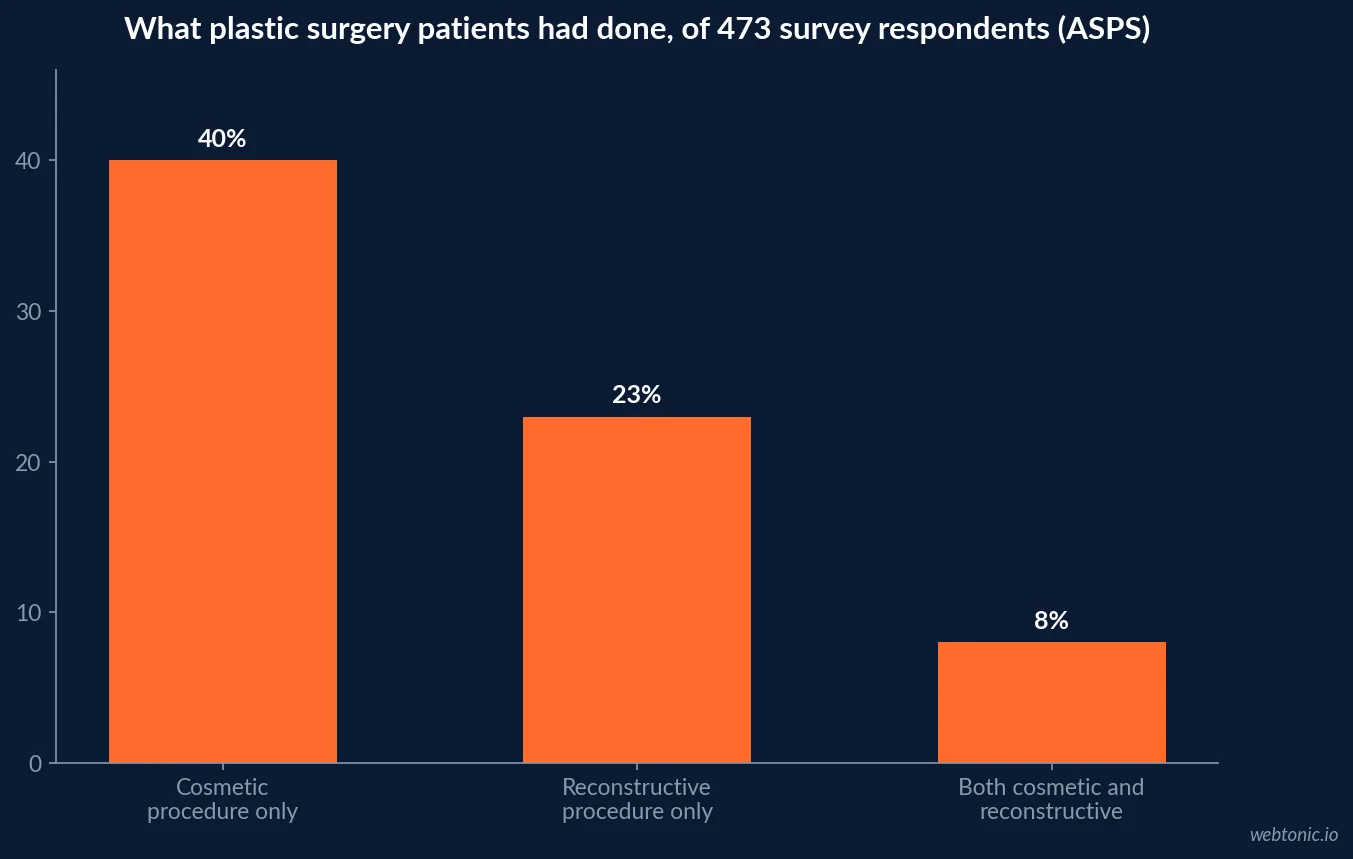
- Of 473 plastic surgery patients surveyed by ASPS, 40% had a cosmetic procedure, 23% reconstructive, 8% both.
- One ASPS-documented patient video drew over 20 consultation requests, per the surgeon's own account.
- The FTC's endorsement guides name a dermatologist scenario as a worked compliance example.
Why there is no dermatology-specific video budget benchmark
Video marketing spend is surveyed at the marketer level, not the specialty level. Wyzowl's 2026 State of Video Marketing survey, covering 266 marketers and consumers in late 2025, is the closest thing to a standing benchmark, and it does not break results out by healthcare vertical. So this page treats Wyzowl's numbers as the budget floor and shape, and layers in the American Academy of Dermatology's and ASPS's own specialty research for what actually happens when dermatology and plastic surgery run video campaigns.
| Cross-industry figure (Wyzowl 2026) | Value | What it means for a specialty budget |
|---|---|---|
| Businesses using video | 91% | Not using video is now the outlier position |
| Share of budget on video, typical | A third or less (46% of marketers) | A reasonable starting allocation |
| Marketers not tracking video spend | 17% | Track it from day one; do not join this group |
| Plan to spend same or more in 2026 | 92% | Budgets are not being cut back on this line |
| Believe costs are rising | 38% | Lock in production partners before costs climb further |
What actually happens when dermatology runs video: the AAD's own data
The American Academy of Dermatology's "Your Dermatologist Knows" campaign is the clearest specialty-specific evidence available. Targeted at women aged 25-35, who the Academy identifies as the primary healthcare decision-makers for their families, the campaign combines social and traditional media. In the Academy's own follow-up survey, respondents who had seen the campaign's social content were 55% more likely to have seen a dermatologist in the past three years than those who had not, and the Academy has since expanded onto TikTok as part of the same strategy.
That is one association-level campaign, not a per-practice benchmark, but it is real dermatology-specific outcome data rather than a marketer's self-reported opinion of ROI.
| AAD "Your Dermatologist Knows" campaign fact | Detail | Source |
|---|---|---|
| Target audience | Women aged 25-35, primary family health decision-makers | AAD |
| Channel mix | Social media plus traditional media | AAD |
| Measured outcome | 55% more likely to have seen a dermatologist among those exposed | AAD 2024 follow-up survey |
| Platform expansion | New TikTok profile launched within two years of the campaign start | AAD |
| Why it was built | Member concern that non-physician clinicians had too favorable a public image | AAD |
What actually happens when plastic surgery runs video: ASPS's own patients
The American Society of Plastic Surgeons has published two relevant pieces of its own research. In a survey of 473 respondents, about 70% had undergone some form of plastic or reconstructive surgery, split 40% cosmetic, 23% reconstructive and 8% both, and the study found that social media use, measured on a modified empowerment scale, correlated with patients asking more informed questions during their consultation.
Separately, in ASPS's own published account, a surgeon describes a single patient sharing her surgery story on social media generating over 20 consultation requests, half asking for her exact procedure "down to the implant size." That is an anecdote from one practice, cited here as an illustration, not as a statistic to plan a media budget against.
Turning the two data sets into a budget plan
The practical model: start with Wyzowl's cross-industry shape (a third of the marketing budget or less on video, tracked from day one), then weight the content mix toward what the specialty-specific evidence supports. For dermatology, that means investing in the kind of consistent, credibility-building content the AAD's own campaign used. For plastic surgery, ASPS's own data points toward patient-story content over generic procedure explainers, provided the testimonial and disclosure rules below are followed.
| Budget decision | Dermatology guidance | Plastic surgery guidance |
|---|---|---|
| Primary content type | Educational, credibility-building content | Patient-story and outcome content |
| Audience to target first | Women 25-35 (AAD's own targeting) | Prior consultation inquirers, retargeting |
| Platform to prioritize | Where the audience already is; AAD added TikTok | Longer-form video for consideration-stage buyers |
| ROI measure to track | Consultation requests, not just views | Consultation requests tied to specific content |
| Compliance step before publishing | Standard claims review | FTC endorsement disclosure on testimonials |
The compliance layer video adds that text ads do not
Video testimonials carry more of the FTC's attention than static ad copy because they read as more personal and more credible. The FTC's endorsement guides, 16 CFR Part 255, use a dermatologist scenario directly: a dermatologist paid to promote a pharmaceutical company's acne treatment posts that it is "clinically proven," without having actually reviewed a flawed underlying study. The guide holds the dermatologist personally liable for the false claim given their medical expertise, and the company liable too if the paid relationship was not disclosed.
The FTC's Health Products Compliance Guidance applies the same substantiation standard to every marketing channel, video included, not just traditional ads.
Where the video actually gets watched
Wyzowl's 2026 data also breaks down which channel formats marketers lean on, and the pattern matters for a healthcare budget specifically. 71% of marketers believe videos between 30 seconds and 2 minutes perform best, well short of the polished, multi-minute brand films a practice's first instinct is often to commission. For a dermatology or plastic surgery account, that argues for a higher volume of short, single-topic clips, one condition or one procedure per video, over a smaller number of expensive long-form pieces.
The AAD's own published account of its campaign's growth into a dedicated TikTok presence, layered on top of its original social and traditional media mix, is consistent with that shift: the association added a short-form channel rather than replacing its existing content with longer pieces.
| Format decision | Cross-industry guidance (Wyzowl) | Specialty-specific evidence |
|---|---|---|
| Ideal length | 30 seconds to 2 minutes, per 71% of marketers | AAD added TikTok alongside its existing channels |
| Volume vs. polish | Consistency favored by budget-constrained marketers (46% under a third of budget) | AAD's campaign ran over multiple years, not one campaign burst |
| Content source | In-house or hybrid production common | ASPS's own account features patient-generated content, not agency-produced film |
What this means for the growth marketer setting the budget
Treat Wyzowl's cross-industry numbers as the shape of a reasonable video budget, not a dermatology-specific target, since no study prices the specialty directly. Treat the AAD's and ASPS's own research as the reason to spend on video at all in this category, since both associations found real, specialty-specific engagement from their own campaigns. And treat the FTC's dermatologist-specific compliance example as non-negotiable before a single testimonial video goes live.
Our performance creative team builds that substantiation file alongside the video brief so a compliance review never blocks a launch date. For the paid media budget behind the video, see our breakdown of what paid social currently costs, or talk to us about the specific channel mix.
Frequently Asked Questions
How much of a dermatology marketing budget should go to video?
No specialty-specific benchmark prices this line item directly, so the honest starting point is cross-industry: Wyzowl's 2026 survey of 266 marketers reports that 46% allocate a third of their budget or less to video, while 17% are not even tracking the spend. A dermatology or plastic surgery practice competing on video for the first time should start inside that third-of-budget range and grow it only once a channel (YouTube, TikTok, in-office screens) shows it can convert.
Does video marketing actually drive dermatology consultations?
The best specialty-specific evidence comes from the American Academy of Dermatology's own 'Your Dermatologist Knows' campaign: survey respondents who had seen the campaign's social content were 55% more likely to have seen a dermatologist in the past three years than those who had not. That is one association's paid campaign result, not a universal conversion rate, but it is a real dermatology-specific outcome rather than a cross-industry marketer's self-report.
What ROI do marketers report from video in general?
Wyzowl's 2026 survey, a cross-industry sample of 266 marketers and consumers, found 82% of video marketers say video has given them a good return, down from a record 93% the year before but still a dominant result. Most who see success measure it through views (67%) or engagement (63%), and fewer through direct sales (32%), so the practice should decide in advance which of those measures it will actually track before spending on production.
Should the video be a patient testimonial or a procedure explainer?
ASPS's own published account of one surgeon's experience describes a single patient sharing her surgery story on social media generating over 20 consultation requests, half asking for the same procedure by name. That is an anecdote from one practice, not a study, but it does point at patient narrative content outperforming generic procedure explainers for driving direct inquiries, which matches Wyzowl's finding that 85% of marketers say video has helped them generate leads.
Are there legal limits on what a dermatology video can claim?
Yes. The FTC's endorsement guides, 16 CFR Part 255, use a dermatologist scenario as a worked example: an expert who states a treatment is 'clinically proven' without having verified the underlying study is personally liable for a false claim, and the company that paid for the video shares that liability if the relationship is not disclosed. Any patient-testimonial or influencer video needs the same substantiation file behind it that a written ad claim would need.
Sources
Wyzowl - Video Marketing Statistics 2026 (12 Years of Data)
American Academy of Dermatology - Your Dermatologist Knows campaign results
American Society of Plastic Surgeons - Social Media Use May Help to Empower Plastic Surgery Patients
American Society of Plastic Surgeons - Transparency in Procedures
U.S. Government Publishing Office - 16 CFR Part 255, FTC Endorsement Guides
Federal Trade Commission - Health Products Compliance Guidance