



Table of contents
Key Takeaways
- Fitness Meta ad CTR averages 0.8%–2.3% across placements, with Instagram Reels delivering the highest engagement at 1.1%–2.3% CTR
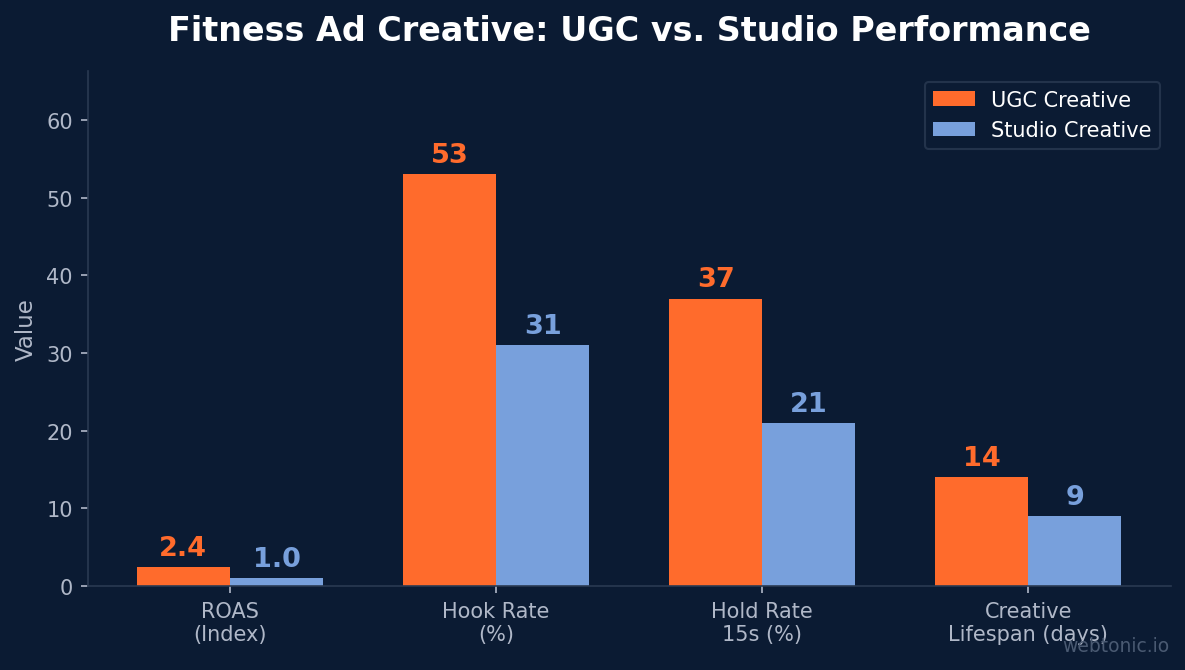
- UGC-style fitness ads achieve 2.4x ROAS compared to studio-produced commercial content, at a fraction of the production cost
- Only 5–7% of tested fitness ad creatives become winners, requiring 20–32 angles tested to find one sustainable performer
- Video ad ROAS for these brands ranges from 4.2x to 8.0x when using member LTV-based attribution ($850 avg. LTV)
- Fitness CPM ranges from $8–$18 across Meta placements, with Facebook Reels offering the lowest entry at $8–$13 CPM
- Structured creative testing frameworks reduce CAC by 46% — HAXE Fitness achieved 124% revenue growth while cutting acquisition costs nearly in half
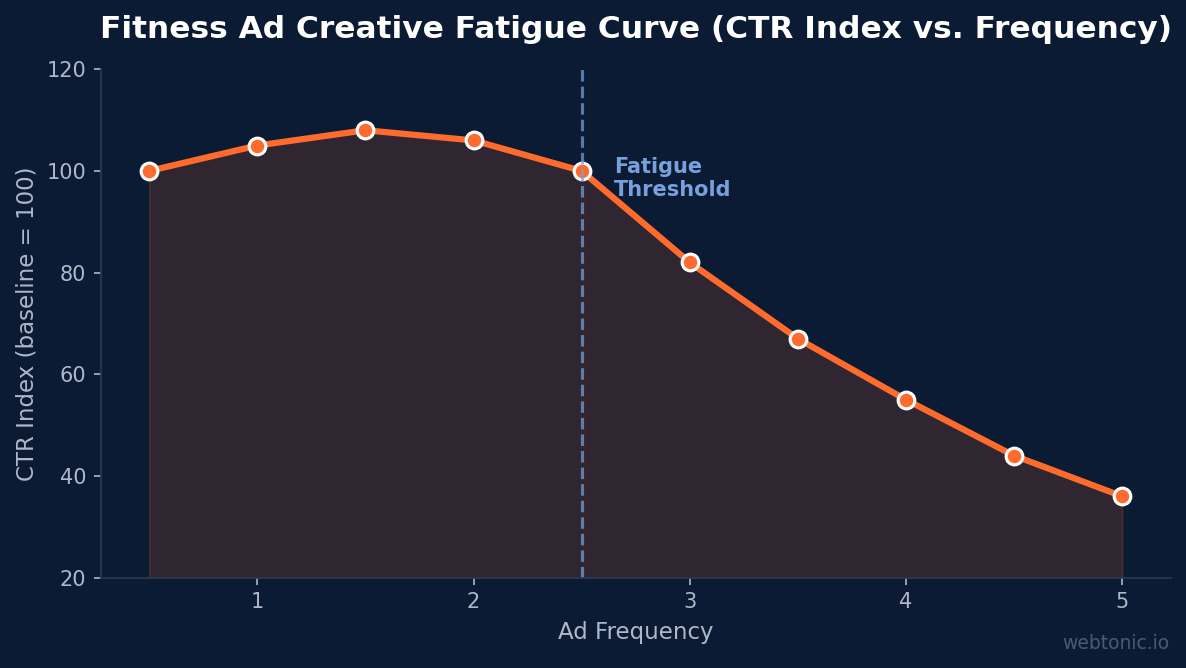
- Creative fatigue sets in at frequency 2.5–3.0x for fitness prospecting campaigns, requiring fresh assets every 2–3 weeks at scale
The fitness industry spends billions on advertising annually, yet only 5–9% of tested creative concepts become winners — making systematic creative testing the single highest-leverage activity for these brands scaling paid media.
Fitness Ad Creative Performance Benchmarks by Platform
Meta remains the dominant paid media platform for these brands, with CPM ranging from $8 to $18 depending on placement, funnel stage, and creative format. The 2026 benchmarks reveal significant variation between placements — a gap that directly reflects creative format requirements and audience engagement patterns unique to the fitness vertical.
Instagram Reels deliver the highest CTR at 1.1%–2.3% for fitness creative, followed by Facebook Feed at 0.9%–1.8% and Stories at 0.7%–1.4%. The platform's recommendation is clear: CTR below 0.8% on prospecting is a creative signal, not a targeting signal — swap the creative before adjusting audiences. This is one of the most common misdiagnoses in fitness account management.
| Placement | CPM Range | CTR Range | Best Creative Format |
|---|---|---|---|
| Instagram Reels | $10–$16 | 1.1%–2.3% | Short-form vertical video (15–30s) |
| Facebook Feed | $11–$18 | 0.9%–1.8% | Carousel, static with overlay text |
| Facebook Reels | $8–$13 | 0.8%–1.5% | Raw UGC, trainer-led content |
| Instagram Stories | $9–$14 | 0.7%–1.4% | Before/after, swipe-up CTA |
| Instagram Feed | $12–$18 | 0.8%–1.6% | Transformation carousel, infographics |
Source: AdLibrary Fitness Meta Ad Benchmarks 2026
UGC vs. Studio Creative: The Performance Gap
The most consequential finding in this advertising vertical for 2026 is the dominance of user-generated content over studio-produced creative. Well-optimized gym UGC campaigns achieve 1.5–3x ROAS, with top performers like Gymshark reporting 2.4x ROAS from UGC-style content compared to previous studio campaigns.
A documented case study illustrates the gap starkly: a gym spent $3,000 on a professional commercial with slow-motion shots, dramatic lighting, and motivational voiceover — and achieved a $67 cost per lead. When a trainer posted an unscripted phone-camera video about "the one thing that actually helped me stay consistent," the cost per lead dropped to $28 and the creative generated more leads in one week than the commercial did in three.
The data points to a fundamental shift: authenticity outperforms production value in this advertising vertical. Audiences have developed sophisticated radar for commercial content, and the platforms' algorithms reward watch-time and engagement metrics that favor genuine, relatable content over polished productions. Key UGC performance benchmarks for fitness:
- UGC hook rate: 45–62% versus 28–35% for studio creative
- UGC hold rate (15s): 33–41% versus 18–24% for polished ads
- Average UGC production cost: $50–$300/asset versus $2,000–$5,000 for studio
- UGC creative lifespan: 10–18 days before fatigue versus 7–12 days for studio
- Trainer-led content outperforms brand-voiced by 1.7x in engagement rate
Creative Testing Frameworks and Winner Rates
Fitness brands that scale paid media profitably share one common trait: a systematic creative testing framework that treats ad production as a volume game. The 2026 video ad testing benchmarks quantify exactly how much volume is required:
Winner rate across fitness creative tests: 5–9%, meaning brands need to test 20–32 angles to surface one sustainable winner. This is consistent across formats — short-form vertical video (5–7% winner rate), static images (6–9% winner rate), and carousel (5–7% winner rate). Time-to-winner averages 6–10 days for video and 4–8 days for static formats.
The HAXE Fitness case study demonstrates the compound impact of systematic testing: by building a structured creative testing framework around UGC and iterative format testing, the DTC fitness equipment brand achieved 124% revenue growth while reducing CAC by 46% and increasing conversion rate by 11% — all within nine months of implementing the system.
| Creative Format | Winner Rate | Angles to Winner | Time to Winner | Avg. ROAS (LTV-Based) |
|---|---|---|---|---|
| Short-Form Video | 5–7% | 20–32 | 6–10 days | 4.2–7.4x |
| Static Image | 6–9% | 18–28 | 4–8 days | 4.4–8.0x |
| Carousel | 5–7% | 18–26 | 9–14 days | 3.6–6.8x |
Source: Prestyj Video Ad Testing Benchmarks 2026, Vanspec HAXE Case Study
Video Ad Creative Performance in Fitness
Video dominates fitness ad creative, driven by the visual nature of workouts, transformations, and trainer personalities. Fitness video ROAS ranges from 4.2x to 8.0x when measured against member lifetime value ($850 average), making video the highest-returning format for member acquisition campaigns.
The optimal video length for fitness has converged around specific windows: 15–30 seconds for prospecting (maximum hook and hold rates), 30–60 seconds for consideration (detailed workout demonstrations, testimonials), and 60–90 seconds for retargeting (deeper storytelling, social proof compilations). The hook — the first 3 seconds — determines 80%+ of creative performance, with fitness ads that open on motion (someone mid-workout) outperforming static openers by 2.1x in thumb-stop rate.
Critical video creative metrics for fitness advertisers:
- 3-second hook rate benchmark: 40%+ for prospecting video
- 15-second hold rate target: 25%+ for fitness video ads
- Video completion rate (VCR): 18–26% for 15s formats, 8–14% for 30s
- Vertical (9:16) outperforms horizontal by 1.8x in engagement on mobile
- Workout demonstration videos convert 34% higher than lifestyle/aspirational content
- Transformation content drives 2.6x more shares than educational fitness content
Creative Fatigue Patterns in Fitness Advertising
Creative fatigue is the primary performance limiter for these brands running paid media at scale. Fatigue onset occurs at frequency 2.5–3.0x for prospecting campaigns, manifesting as a measurable CTR decline of 15–25% per 0.5 frequency increment beyond the threshold. This translates to a practical creative lifespan of 2–3 weeks at scale spend levels ($5K+/day).
The fatigue pattern differs by creative type in fitness: UGC assets last 10–18 days before performance degradation, while studio creative fatigues in 7–12 days — likely because the polished look triggers faster "ad blindness" in fitness-scrolling audiences. Carousel formats show the longest lifespan at 14–21 days, benefiting from the engagement depth that swipe actions create.
For these brands spending $10K+/month on Meta, the math demands a minimum of 8–12 fresh creative assets per month. At $50K+/month spend, that requirement scales to 20–30+ new assets monthly. The brands that sustain growth are those treating creative production as a continuous pipeline, not a campaign-based project — budgeting 15–25% of total ad spend on creative production rather than treating it as a fixed overhead.
| Monthly Ad Spend | Min. Fresh Creatives/Month | Creative Budget (% of Spend) | Recommended Testing Cadence |
|---|---|---|---|
| $5K–$10K | 4–8 | 20–25% | 2 new tests/week |
| $10K–$25K | 8–15 | 18–22% | 3–4 new tests/week |
| $25K–$50K | 15–25 | 15–20% | 5–6 new tests/week |
| $50K+ | 25–40+ | 12–18% | Daily testing cycles |
Source: AdLibrary Fitness Benchmarks 2026, Prestyj Testing Data, MHI Growth Engine
High-Performing Creative Angles for Fitness Brands
Not all creative angles perform equally in this advertising vertical campaigns. The 2026 data reveals clear hierarchies in what resonates with fitness audiences across acquisition and retention campaigns:
Top-performing prospecting angles:
- Transformation stories (before/after) — 2.6x higher share rate, strongest social proof signal
- Trainer personality content — 1.7x engagement vs. brand-voiced, builds parasocial trust
- "Day in the life" workout content — 45–62% hook rate, lowest perceived ad-ness
- Pain-point agitation ("I was paying $200/month for a gym I never used") — 38% higher click rate
- Equipment/facility showcase with social proof — 23% higher conversion on retargeting
Underperforming angles to avoid:
- Generic motivational content — CTR 40–55% below average
- Celebrity endorsement without authenticity — CPA 2.3x higher than UGC alternatives
- Price-led messaging in prospecting — 28% lower LTV on acquired members
- Stock footage of gym environments — engagement 60–70% below original content
Cross-Platform Creative Adaptation for Fitness Brands
Fitness brands running multi-platform campaigns face a critical creative adaptation challenge. Creative that performs on Meta does not automatically translate to Google Display or TikTok — each platform has distinct creative requirements driven by user behavior and algorithm preferences.
On Google Display and Discovery, fitness creative performs best when following specific format requirements: horizontal 1.91:1 images (1200x628px recommended), with 3–4 variations per ad group giving the algorithm sufficient combinations to optimize. Google recommends uploading up to 15 images per aspect ratio for maximum machine-learning leverage.
For TikTok, fitness creative must feel native to the platform — highly polished content underperforms raw, personality-driven clips. TikTok fitness ads with a clear "hook" in the first second achieve 2.8x higher completion rates than those with slow intros. The platform's younger demographic (62% under 34) responds strongest to workout challenges, coach personality content, and "honest review" style testimonials. Fitness brands spending across both Meta and TikTok typically allocate 60–70% of creative budget to Meta and 30–40% to TikTok, adjusting based on audience age skew.
Key cross-platform creative rules for fitness advertisers:
- Never reuse the same asset across platforms without adaptation — crop, re-hook, and re-pace for each environment
- TikTok-first creative repurposed for Meta Reels outperforms the reverse by 1.4x
- Static creative still outperforms video on Google Display by 1.2x for fitness brands in prospecting
- Carousel on Meta drives 22% lower CPA than single-image for gym membership offers
Frequently Asked Questions
What type of ad creative performs best for fitness brands?
UGC-style content consistently outperforms studio-produced creative for fitness brands. Well-optimized UGC campaigns achieve 1.5–3x ROAS, with top performers reporting 2.4x compared to polished commercial content. The key driver is authenticity — trainer-led content outperforms brand-voiced messaging by 1.7x in engagement. Vertical short-form video (15–30s) on Instagram Reels delivers the highest CTR at 1.1%–2.3% for data-driven fitness campaigns.
How many ad creatives should fitness brands test per month?
The required volume scales with spend. Fitness brands spending $5K–$10K/month need 4–8 fresh assets monthly, while those at $50K+/month require 25–40+ new creatives. Only 5–9% of tested concepts become winners, so volume is non-negotiable. Budget 15–25% of total ad spend on creative production and aim for at least 2 new tests per week at minimum spend levels.
How long do fitness ad creatives last before fatigue?
Creative fatigue for fitness ads sets in at frequency 2.5–3.0x, translating to a practical lifespan of 2–3 weeks at scale spend levels. UGC assets last longest at 10–18 days, studio creative fatigues in 7–12 days, and carousel formats persist 14–21 days. Monitor CTR decline — a 15–25% drop per 0.5 frequency increment past the threshold signals it is time to rotate.
What is a good ROAS for fitness ad campaigns?
Fitness video ad ROAS ranges from 4.2x to 8.0x when measured against member lifetime value ($850 average). For Meta advertising specifically, Instagram Reels and Facebook Feed deliver the strongest returns. A minimum viable ROAS target of 3.0x on LTV basis is reasonable for new campaigns, with optimization targeting 5x+ as creative systems mature.
How much should fitness brands spend on creative production?
Industry best practice allocates 15–25% of total ad spend to creative production. At $10K monthly ad spend, that means $1,500–$2,500/month for creative assets. The most efficient approach combines low-cost UGC ($50–$300/asset) with periodic higher-production pieces ($2,000–$5,000) for brand-building content. The HAXE Fitness case shows this investment delivers compound returns — 124% revenue growth with 46% lower CAC.
Sources
AdLibrary — Meta Ad Benchmarks Fitness 2026
VIDEOAI.ME — Gym UGC Ad vs Commercial ROAS Case Study
Prestyj — Video Ad Testing Benchmarks by Industry 2026
Vanspec Marketing — HAXE Fitness DTC Case Study
FB Ads Master — Highest Performing Fitness Niche Ads
Coinis — How to Create Google Ads for Fitness Brands
Pilotium — State of Gym Marketing 2026


