Table of contents
No published study prices "DUI law firm video marketing" as a product, so this page builds a budget from video-industry adoption and ROI data plus what legal consumers say they actually watch. The honest answer is a range tied to production scope, not a flat rate.
Key Takeaways
- No benchmark prices DUI video marketing as a line item directly.
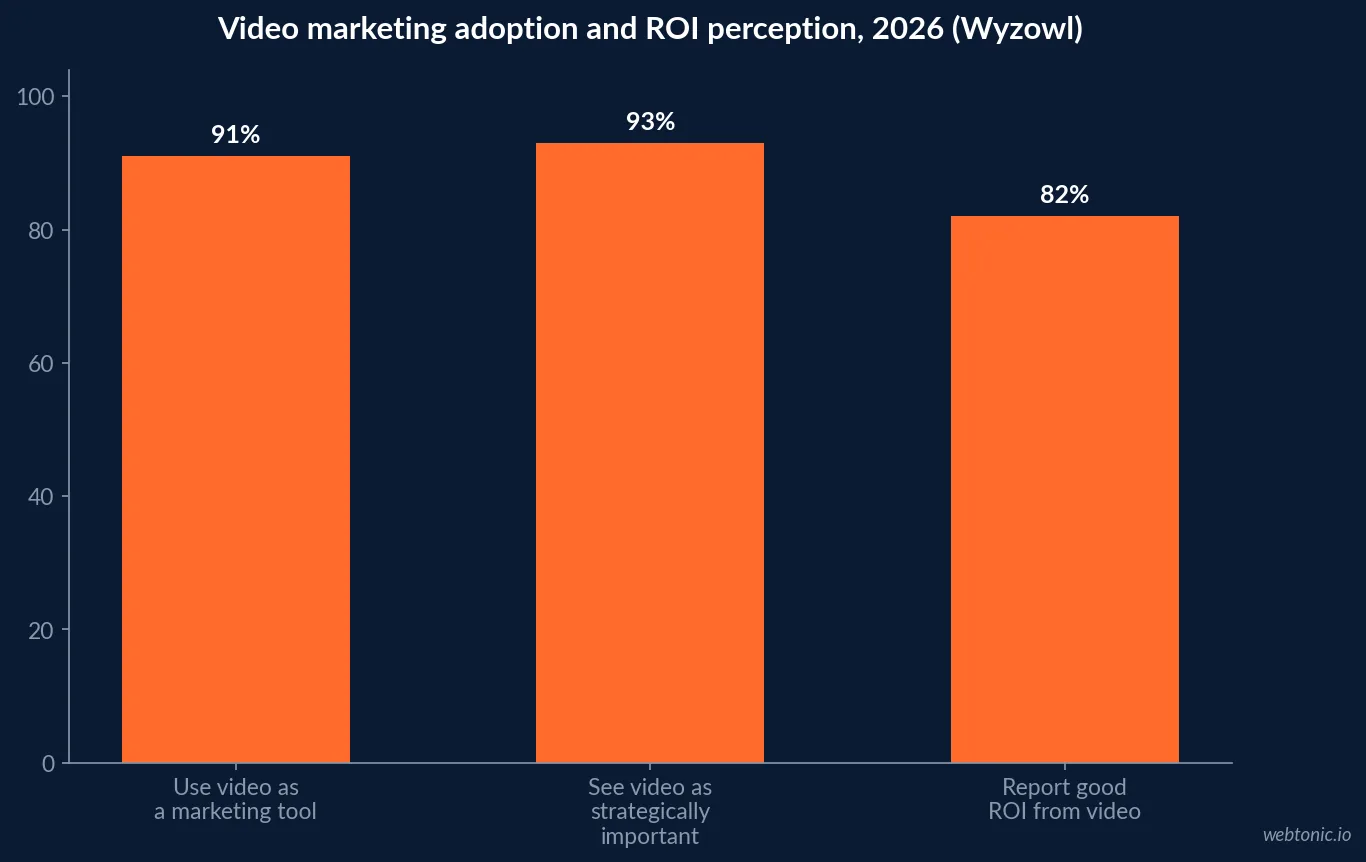
- 91% of businesses use video as a marketing tool in 2026 (Wyzowl).
- 93% of video marketers call it an important part of strategy.
- 82% say video marketing gives a good ROI, down from a 93% high in 2024.
- 67% of non-users plan to start video in 2026.
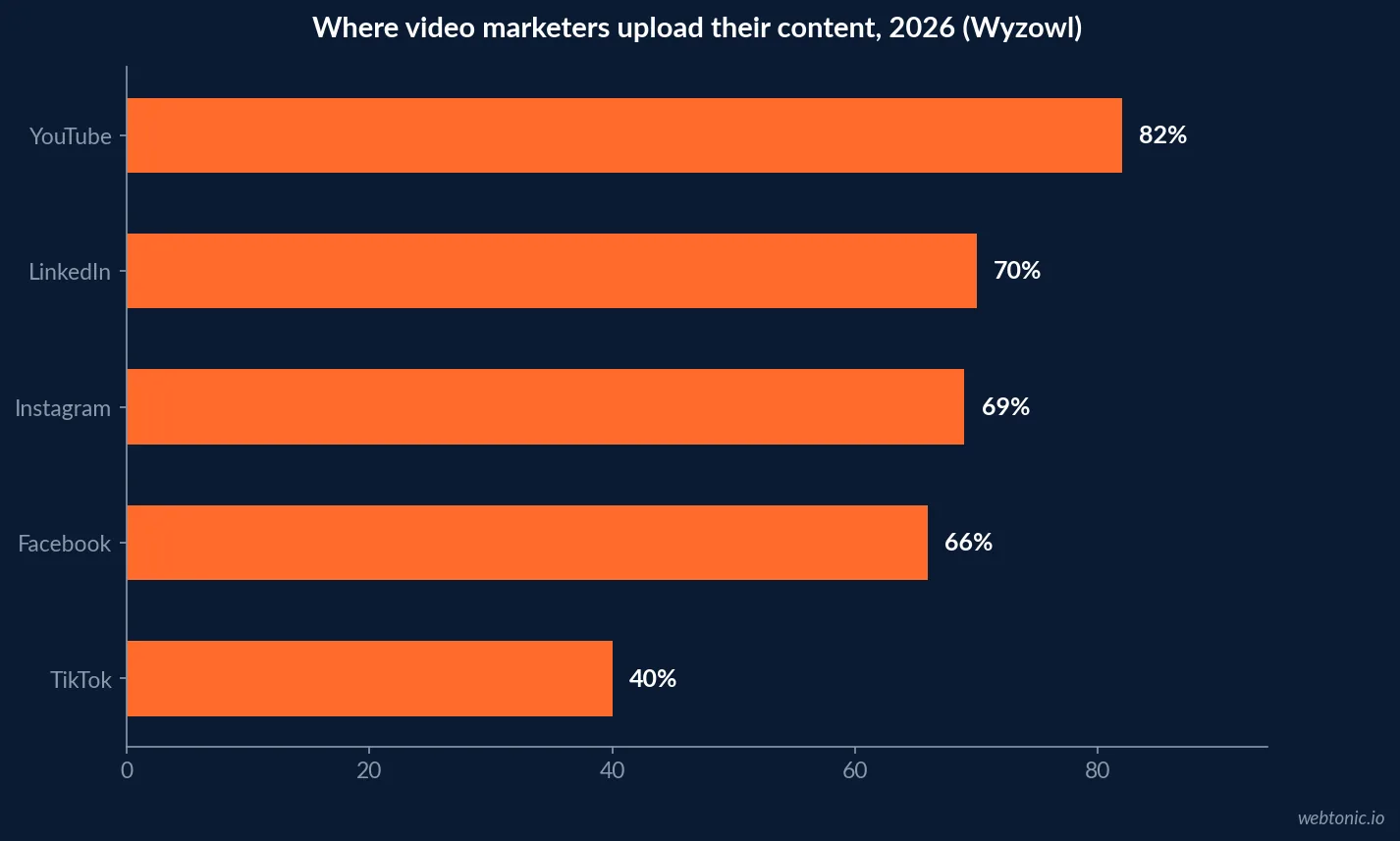
- YouTube is the top upload platform at 82% of video marketers.
- LinkedIn follows at 70%, ahead of Instagram at 69%.
- Facebook sits at 66% and TikTok at 40%.
- 687,396 DUI arrests were logged across the US in 2023 (FBI UCR).
- 12,429 people died in alcohol-impaired crashes in 2023 (NHTSA).
- That is one death every 42 minutes on US roads.
- 92.4% of legal consumers research their issue online before hiring (Martindale-Avvo).
- Attorneys' Meta lead-ad conversion rate is 10.53%, the format video often feeds.
- 70% of people who hired a lawyer say it was easy to find one (Clio 2025).
Why there is no rate card for this specifically
Video marketing is measured by adoption and channel, not by legal practice area, so a "DUI video marketing statistics" search returns adjacent evidence rather than a direct answer. Wyzowl's 2026 State of Video Marketing survey, now in its 12th consecutive year, is the closest thing to an industry-wide benchmark: it tracks usage, ROI perception and platform choice across marketers and consumers, but it does not break results out by legal vertical or by the criminal-defense niche specifically.
That gap is why this page treats every figure below as an input to a budget model, not a quote.
| Video adoption metric (2026, Wyzowl) | Figure | What it signals |
|---|---|---|
| Businesses using video as a marketing tool | 91% | Video is now a default channel, not a test |
| Marketers who see video as strategically important | 93% | Budget owners already believe in the format |
| Marketers reporting good ROI from video | 82% | Down from a 93% high; expectations are normalizing |
| Non-users planning to start video in 2026 | 67% | Remaining holdouts are shrinking fast |
| Marketers who increased video spend last year | n/a - not broken out by vertical | Legal-specific data does not exist |
Where video actually sits in a DUI consumer's research path
Martindale-Avvo's 2024 Legal Consumer Report found that 92.4% of legal consumers research their issue online before hiring an attorney, and that among people who search, video sits behind text search and reviews but ahead of print or referral-only research for a meaningful share of the funnel. That ordering argues for video as a trust-building layer - an attorney explaining what happens after a DUI arrest, in their own voice - rather than as the first thing a panicked, just-arrested searcher finds at 2 a.m.
Reviews still rank as the single most helpful factor at nearly 70% in the same survey, ahead of responsiveness and reputation, which is the case a video has to make: showing the attorney, not just claiming credibility in text.
| Where video fits vs. other research channels | Legal consumer behavior | Source |
|---|---|---|
| Text search / Google | 92.4% research their issue online first | Martindale-Avvo 2024 |
| Online reviews | ~70% cite reviews as most helpful factor | Martindale-Avvo 2024 |
| Video (YouTube and social) | Secondary but present in the research mix | Martindale-Avvo 2024 |
| Referral from friend/family | Still a top channel, but consumers turn to web more | Clio 2025 Legal Trends Report |
Platform allocation: where the video budget should actually go
Wyzowl's 2026 data on where video marketers upload gives a rough allocation model even without legal-specific numbers: YouTube leads at 82% of video marketers, followed by LinkedIn at 70%, Instagram at 69%, Facebook at 66% and TikTok at 40%. For a DUI defense practice, YouTube doubles as both a hosting platform (for embedding on the firm's own site) and a search surface in its own right, which makes it the highest-leverage first stop for a limited budget.
| Platform (2026 upload share, Wyzowl) | Share of video marketers | Fit for DUI defense video |
|---|---|---|
| YouTube | 82% | Best first stop - hosting + search surface |
| 70% | Weak consumer fit; better for referral-partner trust | |
| 69% | Good for short case-process explainers | |
| 66% | Still a large reach pool for local targeting | |
| TikTok | 40% | Restricted for several legal ad categories - see TikTok data |
Sizing the audience the videos are written for
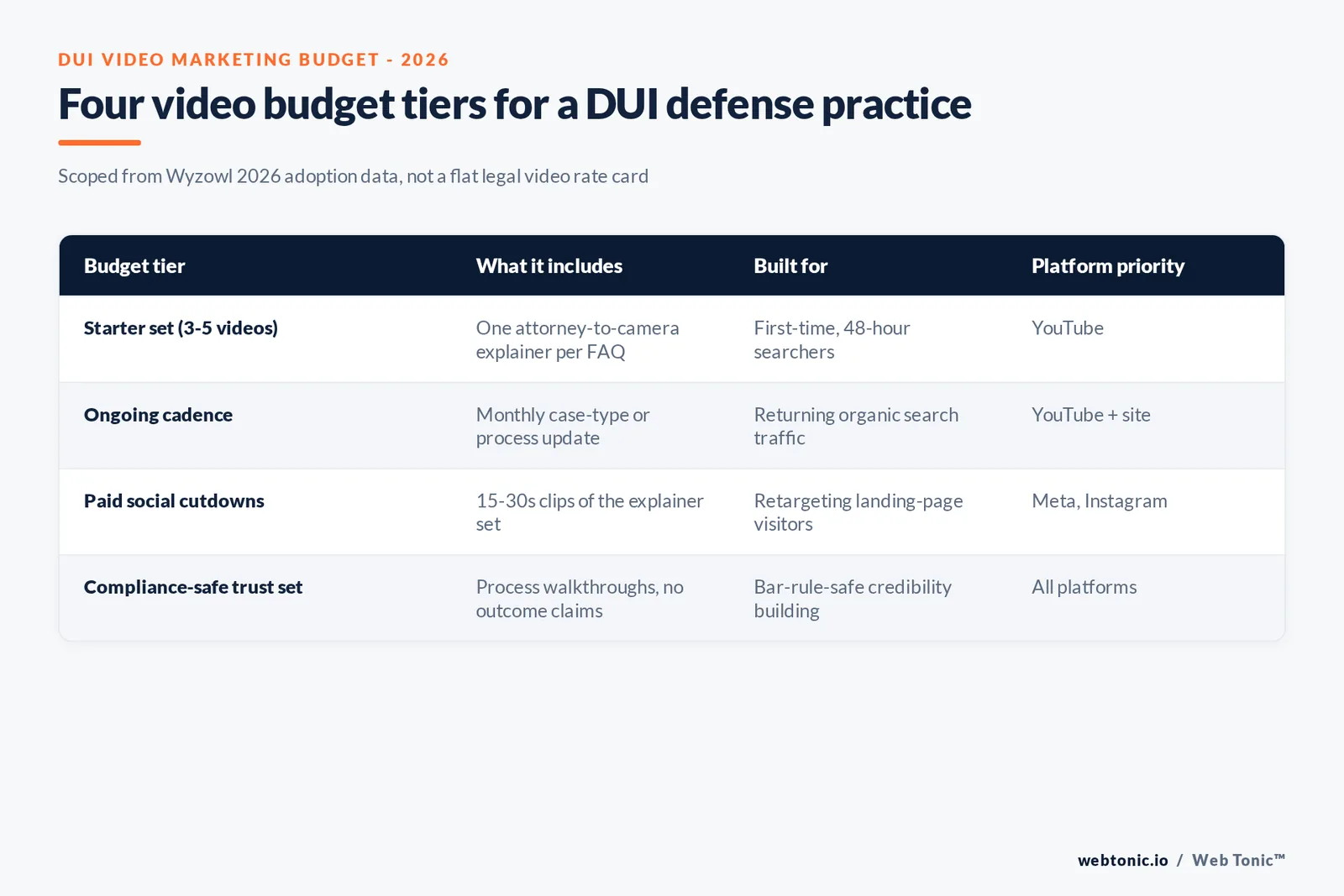
The volume behind DUI search demand is not small. The FBI's Uniform Crime Reporting Program recorded 687,396 DUI arrests across the US in 2023, concentrated heavily in a handful of states, while NHTSA's 2023 Traffic Safety Facts recorded 12,429 alcohol-impaired-driving deaths - roughly one every 42 minutes. A three-to-five-video content set answering "what happens in the first 48 hours after a DUI arrest," "what a first-offense DUI actually costs," and "how a breath test can be challenged" maps directly onto that search volume, without needing case-specific claims that would cross bar advertising rules.
| Video budget scope | What it typically includes | Who it is built for |
|---|---|---|
| Starter set (3-5 videos) | One attorney-to-camera explainer per common question | First-time searchers, 48-hour research window |
| Ongoing content cadence | Monthly case-type or process update | Returning organic + YouTube search traffic |
| Paid social cutdowns | 15-30s clips of the explainer set for Meta/Instagram | Retargeting after a landing-page visit |
| Courtroom-safe testimonial alternative | Process walkthroughs, not outcome guarantees | Compliance-safe trust building |
What the paid-social side of the same budget costs
Video content rarely stays organic - most firms cut it down for paid social once it exists, which puts it inside the same cost structure as any other legal ad. LocaliQ's Facebook Advertising Benchmarks report puts Attorneys & Legal Services at a USD 0.86 cost per click and a 1.76% click-through rate on Meta - cheaper per click than search, which is exactly why a video cutdown built for a feed placement can stretch a limited production budget further than the same spend on search alone.
That also means the video and paid-social lines of a DUI marketing budget should be planned together, not separately: the explainer video pays for itself twice, once as organic YouTube content and again as the creative behind a lower-cost Meta placement.
| Where the video budget re-appears as paid spend | 2026 figure | Source |
|---|---|---|
| Meta (Facebook) legal CPC | USD 0.86 | LocaliQ Facebook Advertising Benchmarks |
| Meta (Facebook) legal CTR | 1.76% | LocaliQ Facebook Advertising Benchmarks |
| Meta lead-ad conversion rate, legal | 10.53% | WordStream 2026 Benchmarks |
| Search CPC, legal (for comparison) | USD 9.87 | WordStream/LocaliQ 2026 Benchmarks |
The AI-search wrinkle video content now has to answer
Clio's 2025 Legal Trends Report found that more than half of consumers have used or would consider using AI to answer a legal question, and that of those who did, 28% were directed by the AI to contact a lawyer. A video that directly answers a specific, narrow question - "what happens at a DUI arraignment," "can a breath test result be challenged" - is more likely to be the source an AI summarizer surfaces than a generic firm-overview video, which gives video a second job beyond YouTube search: feeding the answer engines that are increasingly the first stop before a human ever searches at all.
What growing firms are doing with the budget they already have
Clio's 2025 Legal Trends Report found that 70% of people who recently hired a lawyer say it was easy to find and hire one, and that more consumers now expect to turn to the internet - not just referrals - for their next legal need. Video is one of the few formats that can carry both a firm's expertise and its approachability at once, which is exactly the gap between "easy to find" and "easy to trust" that a text-only landing page cannot close on its own. Pair a video budget with a page built to the response-time expectations a DUI intake page needs. See our breakdown of whether paid social is worth the spend before allocating video budget to it. Our performance creative team builds explainer video sets scoped to this exact budget model, or talk to us about a video-first DUI content plan.
Frequently Asked Questions
Is there a published rate card for DUI law firm video marketing?
No. Wyzowl's State of Video Marketing survey and the legal-consumer research cited here measure adoption, ROI perception and platform habits, not price per video or per practice area. Anyone quoting a single DUI video marketing number without naming the shot list, edit count and cadence behind it is quoting a guess, not a benchmark. Build the budget from production scope (see the table below), not from a headline figure.
Do legal consumers actually watch video when researching a DUI charge?
Some of them, yes, though it is a secondary channel behind search and reviews. Martindale-Avvo's 2024 Legal Consumer Report finds that among consumers who searched online for legal information, YouTube was the most popular video source and social video ranked close behind. That puts video in a support role - reinforcing trust once someone has already found the firm through search - rather than as the first touchpoint for a same-day DUI search.
What does the video ROI data say about whether it's worth the spend?
82% of marketers surveyed by Wyzowl in 2026 say video marketing has given them a good return on investment, and 93% see video as an important part of their overall strategy. Those figures are cross-industry, not DUI-specific, so treat them as evidence that video is a defensible line item, not proof that a specific DUI video will convert. The honest reading: video earns its budget on brand trust and case-explainer content, not as a direct-response lead generator.
Which platforms should a DUI firm actually post video to?
Wyzowl's 2026 data shows video marketers uploading most to YouTube (82%), followed by LinkedIn (70%), Instagram (69%), Facebook (66%) and TikTok (40%). For a DUI practice specifically, YouTube and a firm's own site carry the least platform risk - TikTok restricts several legal-services ad categories outright (see our separate breakdown of DUI TikTok ads), so organic YouTube explainer content is the safer starting point for video budget.
How big is the audience this content is actually built for?
Large. The FBI's Uniform Crime Reporting Program recorded 687,396 DUI arrests across the US in 2023, and NHTSA's 2023 Traffic Safety Facts counted 12,429 deaths in alcohol-impaired crashes that same year - both figures point to sustained, geographically concentrated search demand that case-explainer and process videos (what happens after an arrest, what a DUI costs in fines and license time) are built to answer.
Sources
Wyzowl - State of Video Marketing Statistics 2026
Martindale-Avvo - Understanding the Legal Consumer Report, 2024
Clio - 2025 Legal Trends Report
FBI Crime Data Explorer - DUI arrests by state (UCR Arrest data), 2023
NHTSA - Traffic Safety Facts 2023: Alcohol-Impaired Driving
WordStream - Conversion Rate Benchmarks for Your Industry, 2026