



Table of contents

For a SaaS company, the choice between a fractional CMO and an in-house marketing leader comes down to how many hours of real leadership demand exist each week and how quickly a decision must be defensible to a board. Under roughly 20 hours a week, fractional usually wins on cost and speed; above 30, a permanent hire does.
This page compares both options on the dimensions that actually decide it: loaded cost, time to impact, decision authority, tenure risk and exit cost.
Key Takeaways
- Fractional retainers cluster at $5,000–$25,000 a month, most commonly $10,000–$12,000.
- Median SaaS VP of Marketing base pay is $157,500; full CMO compensation reaches $293,575–$316,076 and loaded cost often exceeds $400,000.
- SaaS and startup marketing chiefs average about 1.8 years in seat — tenure risk sits on the permanent side of the ledger.
- A fractional engagement starts in 1–3 weeks; an executive search plus notice period plus ramp commonly consumes 2 quarters.
- Crossover point in practice: about 20–30 leadership hours per week of genuine demand.
- Median B2B SaaS CAC payback of 16 months means neither option proves itself inside one quarter.
The comparison that matters
Most build-or-buy debates stall because the two options are priced on different bases — a monthly fee against a base salary. Compare loaded cost against loaded cost, and include the cost of the months you spend without a leader at all.
| Dimension | Fractional CMO | In-house leader |
|---|---|---|
| Cost shape | Fixed monthly retainer, no benefits or equity loading | Base plus bonus, equity, benefits, recruiter fee |
| Time to first output | 1–3 weeks | 3–5 months to offer, plus notice and ramp |
| Availability | Scheduled hours, shared with other clients | Full-time, immediate, unlimited |
| Breadth of pattern | Many companies, many motions seen recently | Deep in one context, learned over time |
| Team management | Oversight and coaching, rarely line management | Full line management and culture ownership |
| Exit cost | Notice period, commonly 30 days | Severance, re-search, a stalled quarter |

The availability row is where fractional arrangements genuinely give something up, and it is worth being plain about it. If your sales team needs an answer within an hour on most days, scheduled hours will frustrate everyone. If the real cadence is a weekly planning rhythm plus a monthly board view, scheduled hours cost you nothing.
What each option costs in 2026
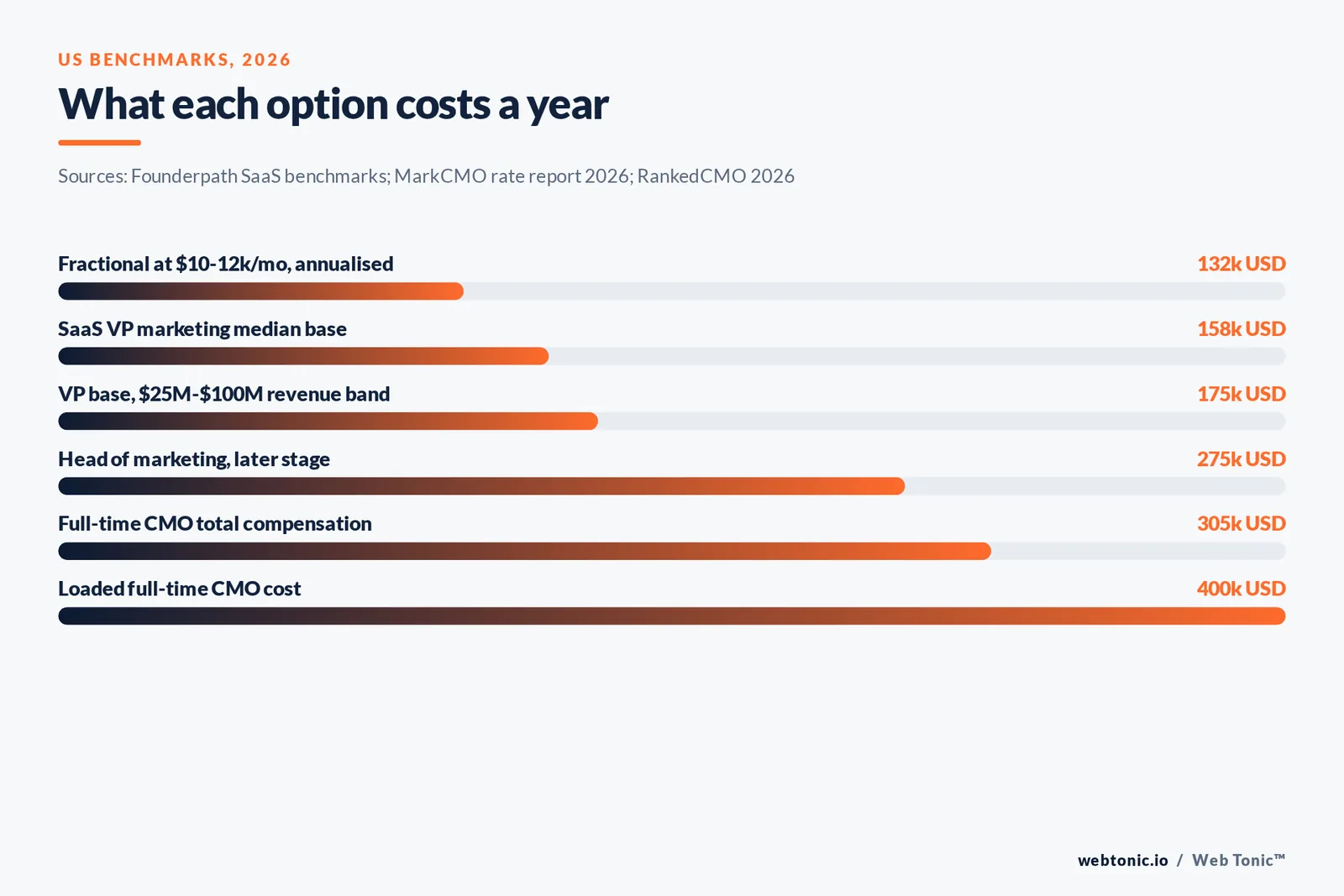
Start with the permanent side. SaaS salary benchmarks put median VP of Marketing base at $157,500, typical range $137,000–$173,617, from 120 verified salaries. A 2026 compensation guide shows base bands by company size: $125,000–$175,000 under $25M revenue and $150,000–$200,000 at $25M–$100M, with total packages reaching $225,000–$375,000. Head-of-marketing benchmarks for B2B SaaS and AI startups report most between $180,000 and $275,000 base at later stages.
Now the fractional side. 2026 pricing data reports $5,000–$25,000 monthly or $200–$500 hourly, describing this as roughly 50–70% cheaper than a full-time CMO. A separate rate report centres retainers at $10,000–$12,000 a month — about $60,000–$180,000 annualised — against full-time CMO compensation of $293,575–$316,076 and loaded cost frequently past $400,000.
Stage-matched retainers make the comparison sharper still. Retainer research reports seed companies paying $5,000–$10,000 for 15–20 hours a month, Series A at $8,000–$15,000, and growth-stage past $30M ARR at $15,000–$25,000. B2B SaaS structure analysis notes fixed monthly retainers dominating in 2026, which makes budgeting predictable in a way percentage-of-spend models never were.
The hours test that settles it
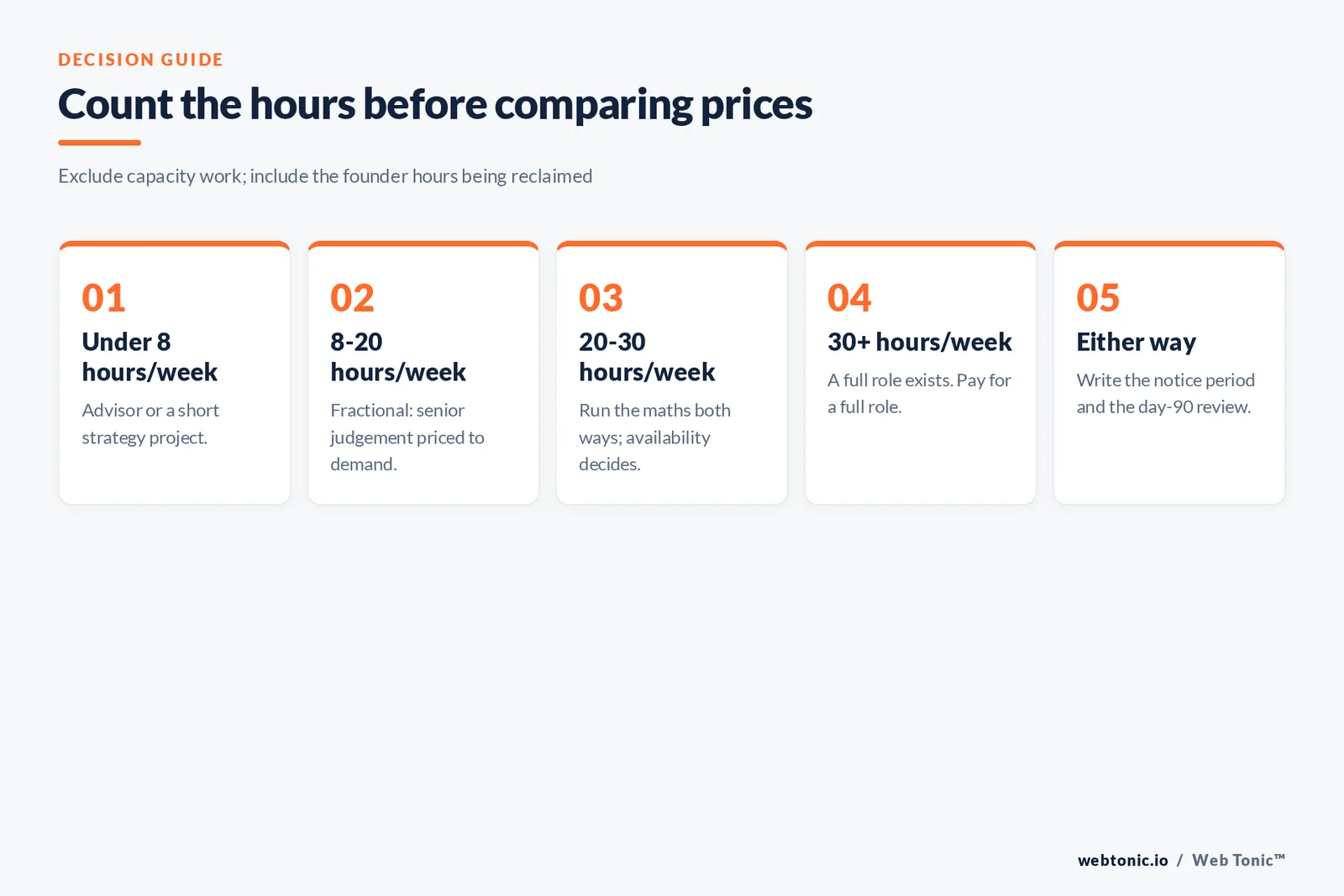
Forget the labels for a moment and count last quarter's real leadership demand: strategy sessions, budget arbitration, agency and vendor management, board preparation, hiring, and the arguments only a senior person can end.
| Weekly leadership hours | Best fit | Why |
|---|---|---|
| Under 8 | Advisor or short strategy project | Not enough surface for a retainer to pay back |
| 8–20 | Fractional CMO | Senior judgement priced to actual demand |
| 20–30 | Either — run the maths both ways | Cost gap narrows; availability starts to matter |
| 30+ | Full-time hire | You are buying a full role; pay for one |
Two corrections to the count. Do not include work a competent manager or agency should own — that is capacity, not leadership. And do include the hours the founder currently spends on marketing decisions, because those are the hours being reclaimed.
Tenure risk sits on the permanent side
The risk profile is not symmetrical. Data on 14,000 executives shows CMOs and CROs averaging 1.8 years, the shortest tenure of any function. Spencer Stuart's 2026 snapshot records 4.1 years in the S&P 500 versus 5.0 years for all C-suite roles there, and sector analysis places B2B SaaS at 3.0–3.5 years under pipeline pressure.
A 2026 Couch & Associates study of 3,773 marketing leaders reports a median 3.1 years in seat, falling to 2.6 years at smaller companies, with a quarter of leaders under 19 months. Set against a 3–5 month search and a ramp quarter, a permanent hire in software often delivers around two productive years before the cycle restarts.
None of this argues against hiring. It argues for pricing the risk: a fractional arrangement with a 30-day notice period is a cheap option on being wrong, and the supply side has grown to support it — the fractional work market reported profile and posting growth of 149% year over year.
What neither option can promise
Speed on unit economics. Median B2B SaaS CAC payback is 16 months according to the 2026 Aleph and Benchmarkit dataset of 342 companies, with the top quartile at 6 months and the bottom beyond 24. Blended CAC ratio work puts spend at $1.30 per $1 of ARR, and $1.63 for new-name revenue.
So a fair evaluation window is two to three quarters, whichever model you choose, with leading indicators reviewed monthly. Anyone promising a payback shift inside 90 days is describing a reporting change, not an economics change.
Hidden costs on both sides of the ledger
Both options carry costs that never appear in the proposal or the offer letter. Listing them changes the answer often enough to be worth an hour of work.
| Hidden cost | Fractional | In-house |
|---|---|---|
| Vacancy cost | Near zero — starts in 1–3 weeks | 3–5 months of unowned decisions |
| Recruiter fee | None | Commonly 20–30% of first-year base |
| Ramp | Days, if the diagnosis is scoped first | A quarter before real decisions land |
| Context switching | Real — several clients share the week | None |
| Knowledge loss on exit | High unless handover artifacts are contracted | High unless documentation is a habit |
| Wrong-hire cost | One notice period | Severance plus a repeated search and lost quarter |
The vacancy line is the one finance teams miss. Three to five months without a marketing owner does not pause spend; it usually means budget keeps running against last quarter's plan. Against a median payback of 16 months, a lost quarter of arbitration is expensive in a way no salary line captures.
On the fractional side, context switching is the honest counterweight. It is managed with scheduled slots, a written decision log and a named backup — not with promises of responsiveness. Ask how many clients the operator holds and what happens during a two-week absence before comparing fees.
Hybrid models that work in SaaS
The build-or-buy framing hides the three arrangements that most software companies actually end up with, and all three are legitimate when chosen deliberately rather than by drift.
- Fractional leader plus in-house manager. The most common pattern at $2M–$10M ARR: senior arbitration on retainer, a mid-level manager owning daily execution and team rhythm. Cheaper than one senior hire and usually faster.
- Fractional bridge during a search. Keeps decisions owned across the 3–5 month hiring gap and hands the incoming leader a scorecard, a stop list and clean definitions. Often the search improves because the role spec is finally specific.
- Full-time leader plus specialist advisory. After a permanent hire, a narrow advisory line on measurement, paid media or lifecycle covers the gaps in one person's toolkit without another headcount.
What does not work is an unlabelled hybrid: a retainer that quietly becomes execution capacity, or a permanent hire who is still waiting for founder sign-off on every budget shift. In both cases the failure is decision rights, not the model. Write down who decides what, review it at day 90, and either arrangement can be made to hold.
A three-week decision process
Run this before writing either a job spec or a retainer scope, and the choice usually makes itself.
- Week 1 — count. Log actual leadership hours by category. Most teams overestimate by a third once capacity work is excluded.
- Week 1 — define the number. Pick the one metric the leader owns: payback, qualified pipeline, expansion revenue. One, not four.
- Week 2 — price both. Loaded permanent cost including recruiter fee and ramp, versus 12 months of retainer at the hours you counted.
- Week 2 — test the market. Interview two candidates of each type against the same brief and the same metric.
- Week 3 — decide and write the exit. Notice period, day-90 review, and the artifacts you keep either way.

Web Tonic sits on the fractional side of this comparison and is straightforward about the trade: scheduled senior hours, a written scorecard, and pattern recognition across many accounts, with execution handled by specialists rather than by the leader personally. That is how our fractional CMO engagements are scoped, with growth marketing and data intelligence attached when the diagnosis calls for build work. If you want the hours counted with you rather than at you, start there — and more of our thinking is on the blog.
How to write the scope either way
Whichever side you land on, the document that decides the outcome is the scope, not the contract value. Four elements do the work. First, one owned metric with its current value written down — qualified pipeline, CAC payback or expansion revenue, at the number it stands at today. Second, decision rights: which budget shifts, vendor changes and hiring calls the leader makes without asking, and which need the founder. Third, a cadence: a weekly planning slot, a monthly review against the scorecard, and a quarterly re-cut of priorities. Fourth, the handover list — definitions, scorecard, vendor briefs, hiring plan — held in your systems, not the leader's.
For a permanent hire, the same four elements become the first 90-day plan and the compensation review criteria. For a retainer, they become the statement of work. In both cases the scope should be short enough that everyone has read it, and specific enough that a missed quarter produces a conversation about causes rather than about whether the role was ever clear.
Related reading
- Fractional CMO: vs hiring in-house
- Fractional CGO / Head of Growth: vs hiring in-house
- Fractional CMO Statistics: Hiring vs Outsourcing
- Fractional CMO services at Web Tonic
Frequently Asked Questions
Is a fractional CMO cheaper than hiring?
At 10–20 hours a week, materially — market analyses describe 50–70% savings versus a full-time CMO. At 30+ hours a week the gap closes and full-time availability becomes the better buy.
Can we start fractional and hire later?
That is the most common sequence in SaaS. The engagement should produce the role definition, scorecard and hiring plan the permanent leader inherits, which shortens the eventual search and raises the quality bar.
Will a fractional CMO manage our marketing team?
Usually oversight and coaching rather than formal line management. If you need daily people management for a team of five or more, budget for an in-house manager underneath the fractional leader.
How do we compare candidates fairly?
Same brief, same metric, same evidence request: one engagement where the ratio moved, with a starting number. Ask both types what they would stop doing in month one.
What if we choose wrong?
Price that risk up front. A 30-day notice on a retainer against severance and a repeated 3–5 month search is the real asymmetry between the two options.
Sources: Founderpath SaaS salary benchmarks · JRG Partners VP of Marketing salary guide 2026 · WithAgility head of marketing compensation 2026 · RankedCMO fractional CMO cost 2026 · MarkCMO fractional CMO rate report 2026 · Fractional Pulse retainer guide 2026 · SaaSHero retainer structure 2026 · SaaStr executive tenure analysis · Spencer Stuart CMO Tenure 2026 · Behind the CMO tenure statistics 2026 · Couch & Associates State of the CMO 2026 · Aleph × Benchmarkit SaaS & AI benchmarks 2026 · Growth Centr B2B SaaS CAC benchmarks 2026.


