Table of contents

Hiring in-house buys you a full-time marketing leader with total focus and a long-term commitment. A fractional CMO buys senior marketing leadership in week one at roughly 25% to 50% of the full-time cost. The right answer depends on how much leadership work your marketing function actually generates each week.
Key Takeaways
- Below about 20 hours a week of genuine leadership work, a fractional CMO is usually the better economic answer; above three days a week, hiring in-house wins.
- The full-time comparison point: average US CMO total compensation is $293,575 (Built In, 2026), with an all-in employer cost of $300,000 to $500,000 a year (Treetop, 2026).
- Fractional retainers run $5,000 to $25,000 a month for 10 to 20 hours a week, with no benefits load, search fee or severance exposure.
- A permanent hire is not permanent: average CMO tenure in the S&P 500 is 4.1 years versus 5.0 years for all C-suite roles (Spencer Stuart, 2026).
- Speed is the underrated variable. A full-time CMO search plus notice period plus ramp commonly runs 2 to 6 months; a fractional chief marketing officer starts diagnosing in days.
- The models are not mutually exclusive — many companies run fractional marketing leadership for 12 to 24 months, then hire in-house with a proven plan.
The two models, side by side
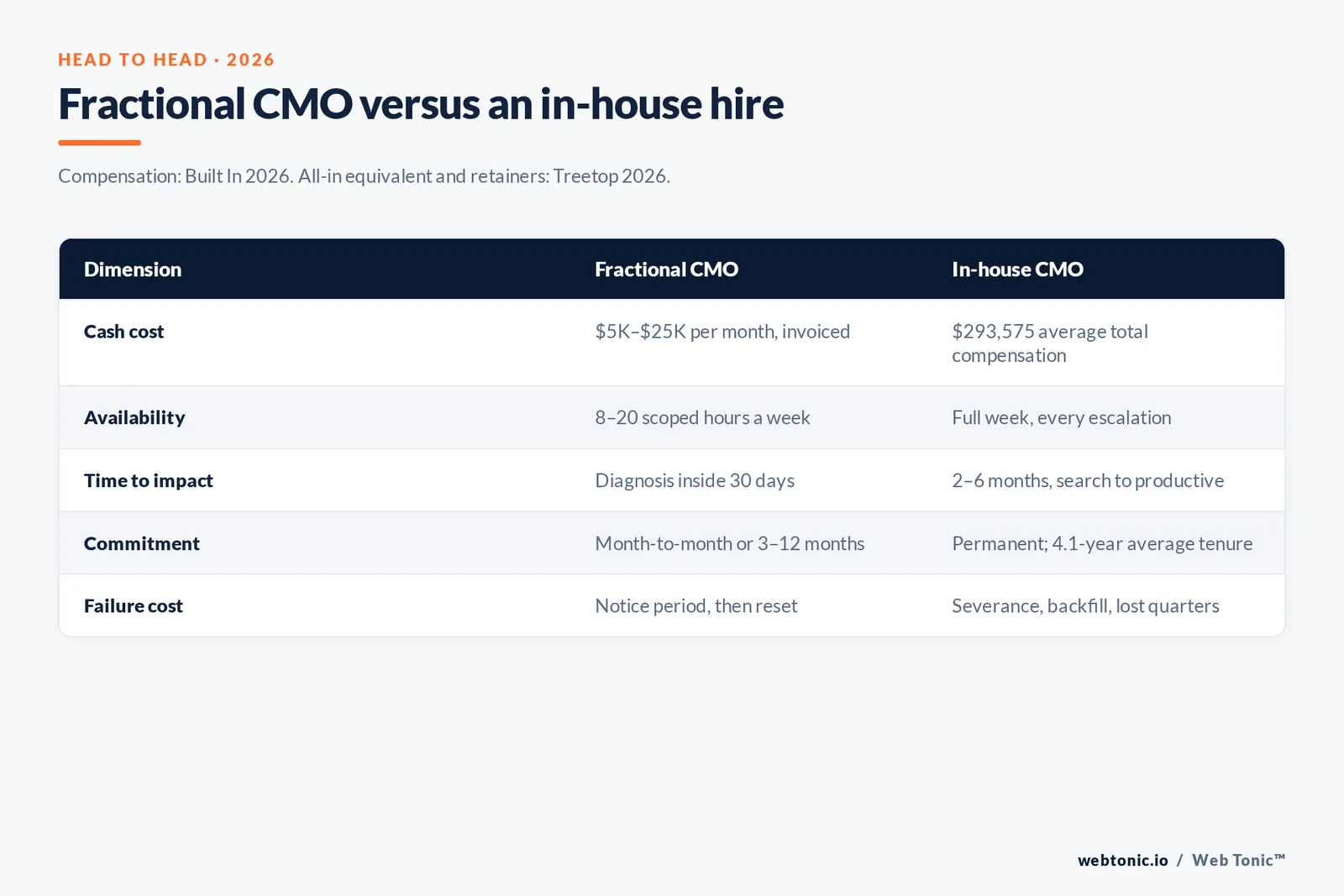
Both options put an experienced marketing leader in charge of strategy. What differs is availability, cost structure, depth of company knowledge and how fast you can change your mind.
| Dimension | Fractional CMO | In-house CMO |
|---|---|---|
| Cost | $5K–$25K per month, invoiced as a vendor | $293,575 average total compensation, plus 20–30% benefits and payroll load |
| Availability | 8–20 scoped hours a week across 2–5 clients | Full week, in every meeting, on every escalation |
| Time to impact | Diagnosis within 30 days | 2–6 months from search to productive |
| Company depth | Cross-company pattern recognition | Deep product, customer and cultural knowledge |
| Commitment | Month-to-month or 3–12 months | Permanent role; 4.1-year average tenure |
| Risk if it fails | Notice period, then reset | Severance, backfill, lost quarters |
| Team building | Designs the team, hires with you | Builds and manages the team daily |
The cost comparison, honestly
Built In's 2026 salary data puts average US CMO base salary at $225,908, additional cash compensation at $67,667 and total compensation at $293,575. PayScale reports an average of $191,624 across a wider band of company sizes, from roughly $99,000 to $298,000. Treetop's 2026 pricing report models the all-in full-time equivalent — salary, bonus, benefits, overhead — at $300,000 to $500,000 a year, against fractional CMO retainers of $8,000 to $25,000 a month for one to two days a week.
Practitioner surveys sit lower still. The FRAK State of Fractional survey of 250 fractional professionals found 40% charging $5,000 to $8,000 a month and 29.5% under $5,000 — with 73% of those executives carrying 15+ years of experience. In other words, the seniority gap between the two models is far smaller than the cost gap.
Recruiting cost belongs in the comparison too. A retained executive search typically costs a meaningful share of first-year compensation and consumes weeks of your leadership team's attention, and none of that is recoverable if the hire does not work out.
Where hiring in-house genuinely wins
Cost is not the only variable, and there are real advantages a part-time CMO cannot replicate.
- Total focus. An in-house CMO thinks about your business all week. Cross-functional problems — pricing, product marketing, sales enablement — get continuous attention rather than scheduled attention.
- Daily team leadership. Hiring, coaching, performance management and culture require presence. Once the marketing team passes roughly eight people, part-time management starts to strain.
- Institutional memory. Two years in, an in-house marketing leader knows why the 2024 repositioning failed and which enterprise customer will object to a new message.
- Internal authority. An employee sits inside the org chart. That matters when marketing needs to win an argument with sales or engineering.
- Long-term commitment. Compounding strategy — brand, category creation, community — rewards an owner who is still there in year three.
These advantages are real, and they are why the CMO mandate keeps expanding across brand, demand generation, customer experience and data at larger organisations. The question is whether your company currently generates enough of that work to justify the seat.
Where the fractional model wins
- Speed. You can have an experienced marketing leader diagnosing your funnel next week instead of next quarter.
- Seniority per dollar. At a $10,000 monthly retainer, most companies buy a level of experience they could not employ full time at their stage.
- Reversibility. If the fit is wrong, you end a contract rather than a career, and you learn what you actually need from the role.
- Cross-company pattern recognition. An operator running two to five engagements sees what is working across markets right now.
- Scalable scope. Start at eight hours a week during a planning cycle, step up to twenty for a launch, step back down afterwards.
The market has moved decisively in this direction. Lightcast counted at least 34,000 US workers with "fractional" in their job title in 2025, up 265% since 2019, with 97% of 2026 fractional job postings coming from small and mid-size companies rather than Fortune 1000 firms. A survey of 340 founders and SMB owners found 9% already working with or planning to hire a fractional CMO within 12 months, up from 5% a year earlier, with cost-effectiveness and access to high-level expertise as the top reasons.
The decision test: count the leadership hours
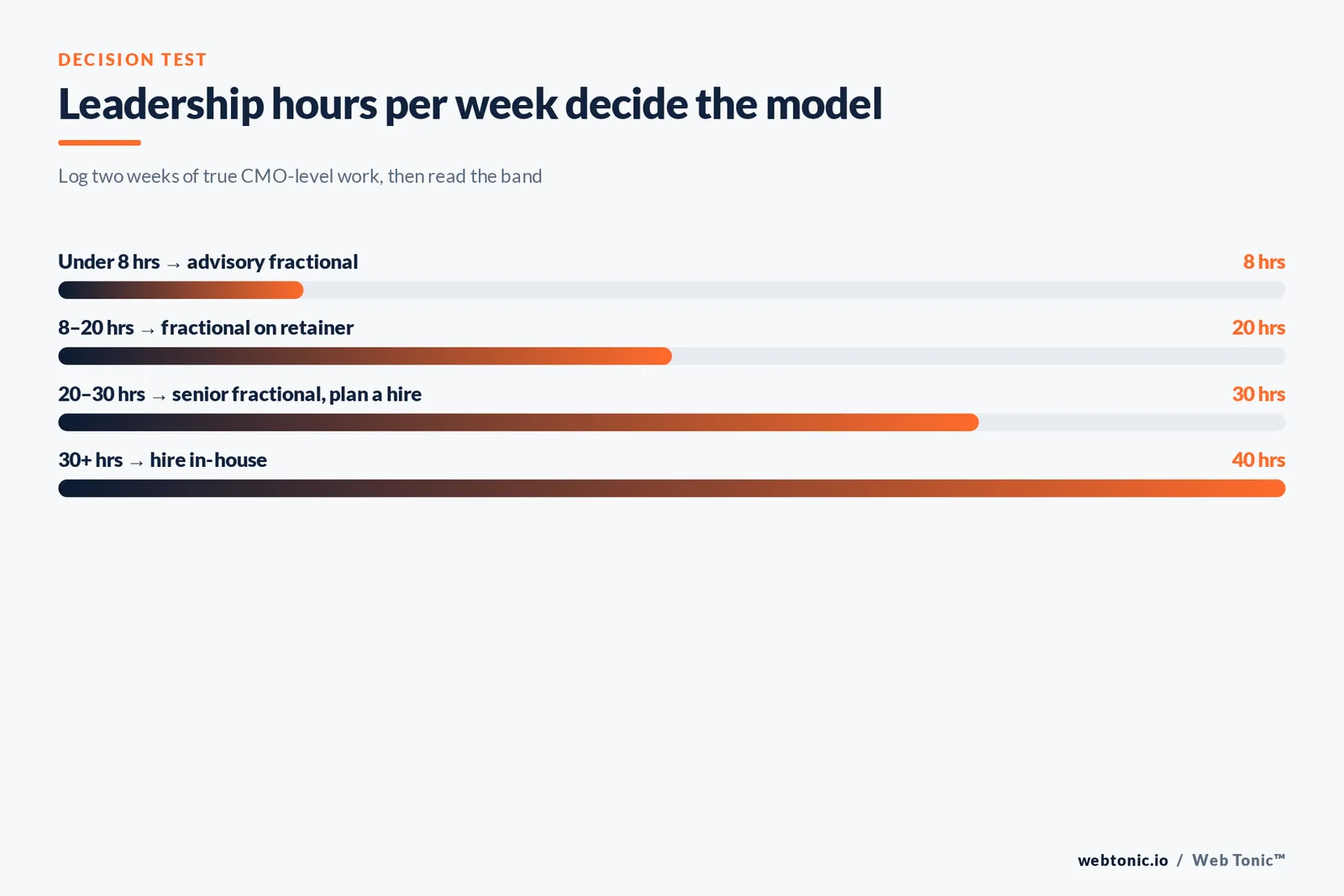
Skip the philosophy and count. Over two typical weeks, log every hour of work that genuinely requires a chief marketing officer: strategy, budget allocation, positioning, pipeline review, team direction, executive alignment. Exclude execution — campaign builds, content production, reporting assembly. Then read the result.
| Leadership hours per week | Best model | Why |
|---|---|---|
| Under 8 | Advisory fractional CMO | You need judgement and prioritisation, not a seat |
| 8–20 | Fractional CMO on retainer | Full ownership of strategy without a full-time salary |
| 20–30 | Senior fractional or interim, planning a hire | The workload is trending toward a permanent role |
| 30+ | Hire in-house | Part-time cost approaches full-time cost without full-time presence |
Two secondary tests refine the answer. First, team size: past roughly eight direct and indirect reports, daily management wins. Second, strategic horizon: if the next 18 months are about compounding brand and category work, weight the in-house option; if they are about fixing acquisition economics and choosing where to spend, weight the fractional option.
The hybrid path most growth companies actually take
The two models sequence well. A fractional chief marketing officer builds the plan, the measurement layer and the team design, then either hands over to a full-time hire or scales down to advisory once an internal marketing leader is in place. Companies that do this hire better, because the job spec is written from evidence rather than aspiration, and the first 90 days of the permanent CMO start from a working operating model instead of a blank page.
It also de-risks the timing question. Spencer Stuart measures average S&P 500 CMO tenure at 4.1 years — shorter than every C-suite role except COO — and Adweek notes the figure has hovered near four years since 2022. Hiring in-house too early, then unwinding it, is more expensive than starting fractional and upgrading on evidence.
Whichever model you pick, the leadership layer only pays off if execution keeps pace. That is why we pair the advisory layer with in-house delivery: our fractional CMO service sets the strategy, our growth marketing and performance creative teams ship against it, and data intelligence keeps everyone reading the same numbers.
How the choice changes by industry and business model
The same hour count leads to different answers in different industries, because the strategies that drive revenue are not equally demanding of a senior marketing leader's time.
| Business type | Typical best option | Reasoning |
|---|---|---|
| B2B SaaS, $2M–$20M ARR | Fractional CMO | Pipeline strategies and marketing sales alignment need senior judgement more than daily presence; agency partners cover campaigns |
| Ecommerce and DTC | Fractional, then in-house | Media buying expertise sits with specialists; the leadership job is margin, mix and retention strategy |
| Professional services | Fractional CMO | Positioning and reputation drive revenue; execution volume is low relative to strategic weight |
| Regulated (finance, healthcare) | Depends on review load | Compliance-heavy campaigns generate constant internal decisions best made in-house |
| Consumer brands with retail | In-house CMO | Cross-functional work with sales, supply chain and retail partners is continuous |
| Sponsor-owned portfolio businesses | Fractional across the portfolio | One senior operator standardises reporting and growth strategies across several companies |
Industry expertise is also the most transferable thing a fractional CMO brings. An operator who has run demand generation for six SaaS businesses arrives with specific benchmarks — what a healthy pipeline coverage ratio looks like, what a realistic customer acquisition cost is at your price point — that an excellent in-house generalist would have to learn on your budget.
What each option costs you when it goes wrong
Both options fail in predictable ways, and the failure cost belongs in the decision.
- Fractional engagement fails. Usually because the scope was execution-shaped, the fractional CMO had no authority over budget, or nobody owned execution between sessions. Cost: a notice period and a lost quarter of momentum.
- In-house hire fails. Usually because the role was defined before the strategy was clear, or the company hired for a channel skillset and needed a leader. Cost: search fees, salary, severance, and often a full year before the business admits it.
- Doing neither. The most expensive option for many businesses. Budget keeps flowing to campaigns nobody has evaluated, and no senior person is accountable for revenue contribution.
The cheapest way to protect either option is the same: write down the two or three business outcomes the marketing leader owns, agree how they will be measured, and review them monthly with the leadership team. Companies that do this typically know within one quarter whether the model is working, regardless of which option they chose.
How to run the comparison in practice
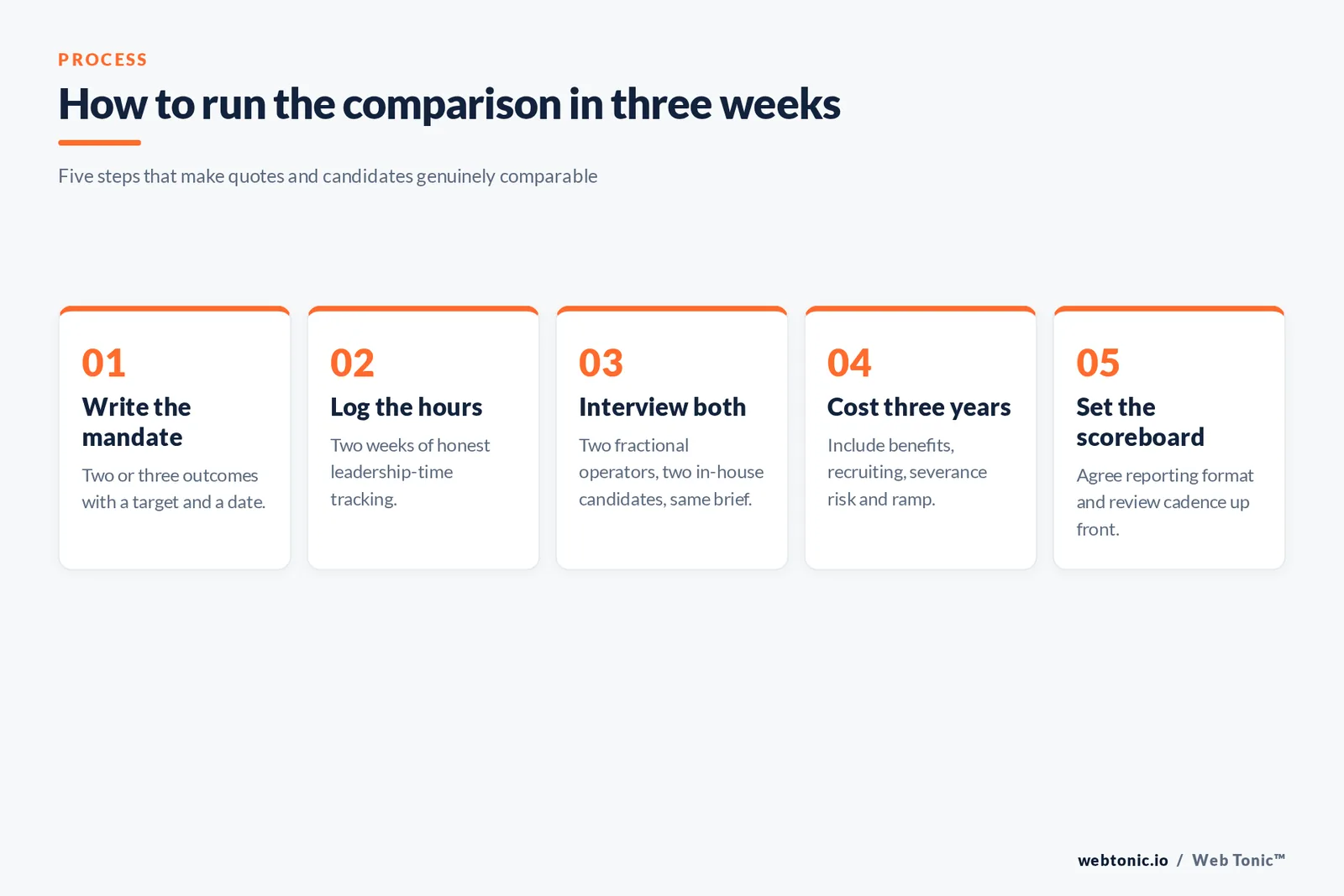
Turn the choice into a short, evidence-led process instead of a debate. Most leadership teams can complete it in three weeks.
- Write the mandate first. Two or three outcomes — qualified pipeline, blended acquisition cost, entry into a specific market segment — with a target and a date. The mandate, not the employment model, should decide who you talk to.
- Log the leadership hours. Two weeks of honest time tracking against that mandate gives you the number that drives the decision.
- Interview both options against the same brief. Speak to two fractional CMOs and two in-house candidates. Ask each for a 90-day plan. The quality gap between candidates is usually larger than the gap between models.
- Cost both over three years. Include benefits, recruiting, severance risk and ramp for the in-house option, and step-ups and handover for the fractional option. Single-month comparisons flatter fractional; three-year comparisons are fair to both.
- Decide how you will know it is working. Agree the reporting format and the review cadence before anyone starts. This is the single strongest predictor of a successful engagement, in either model.
One caution on the interview stage: experienced fractional CMOs sell strategy well, because strategy is what they sell all day. Ask specifically what they will personally do in weeks one to four, who executes, and what they expect from your team. Vague answers there predict a slow start regardless of pedigree.

Frequently Asked Questions
Is a fractional CMO better than hiring in-house?
Neither is universally better. A fractional CMO wins on speed, cost and reversibility when the business generates fewer than about 20 hours a week of true leadership work. Hiring in-house wins on focus, daily team management and long-term compounding once marketing is the company's primary growth engine.
How much cheaper is a fractional CMO than a full-time CMO?
Typically 50% to 75% cheaper in cash terms: $5,000–$25,000 a month against an all-in full-time equivalent of $300,000–$500,000 a year, with no benefits load, search fee or severance exposure.
Can a fractional CMO manage an in-house marketing team?
Yes, and most do. Benchmarks put 12 to 20 hours a week as the realistic band when the fractional CMO is directing an internal team plus agencies. Beyond roughly eight people, daily management usually argues for a permanent leader.
When should we replace our fractional CMO with a full-time hire?
When leadership work consistently exceeds three days a week, when the team outgrows part-time management, or when the board wants the marketing owner in the building every day. A good fractional operator will flag the threshold and help you hire.
Do investors object to a fractional CMO?
Rarely, when the mandate and metrics are clear. Fractional leadership is now common enough in small and mid-size companies — 97% of 2026 US fractional job postings come from that segment — that boards judge the plan and the pipeline, not the employment structure.
Sources
Built In — CMO salary in US (2026)
PayScale — Chief Marketing Officer salary (2026)
Treetop — 2026 Fractional Executive Pricing Report
Randy Wattilete — Fractional CMO cost, incl. FRAK survey data
Lightcast — The Rise of Fractional Leadership
Rick Ramos — State of Fractional CMO Engagement
Spencer Stuart — CMO Tenure 2026
Adweek — Why CMO Tenure Remains Stubbornly Short
Marketing Dive — CMO-plus roles report