Table of contents
Facebook ad objectives are the six campaign-level goals inside Meta Ads Manager — awareness, traffic, engagement, leads, app promotion and sales — that tell the delivery system which action to buy. The objective you pick, and the optimization event you pick under it, decide who ever sees the ad.
Key Takeaways
- Meta consolidated the original 11 Facebook campaign objectives into 6, and new campaigns could no longer be built on legacy objectives from January 2024 onward.
- The campaign objective sets the buying type; the optimization event inside the ad set is what actually shapes delivery, and one objective can hold 4 to 6 different events.
- Cost tracks the event, not the platform: Meta traffic buys averaged $0.70 CPC versus $1.92 CPC for lead campaigns in 2025 benchmark data.
- Average cost per lead was $27.66, ranging from $3.16 (restaurants and food) to $76.71 (dental services).
- Awareness buys are priced on CPM, so judging them on cost per purchase is the single most common planning mistake.
The six goals at a glance
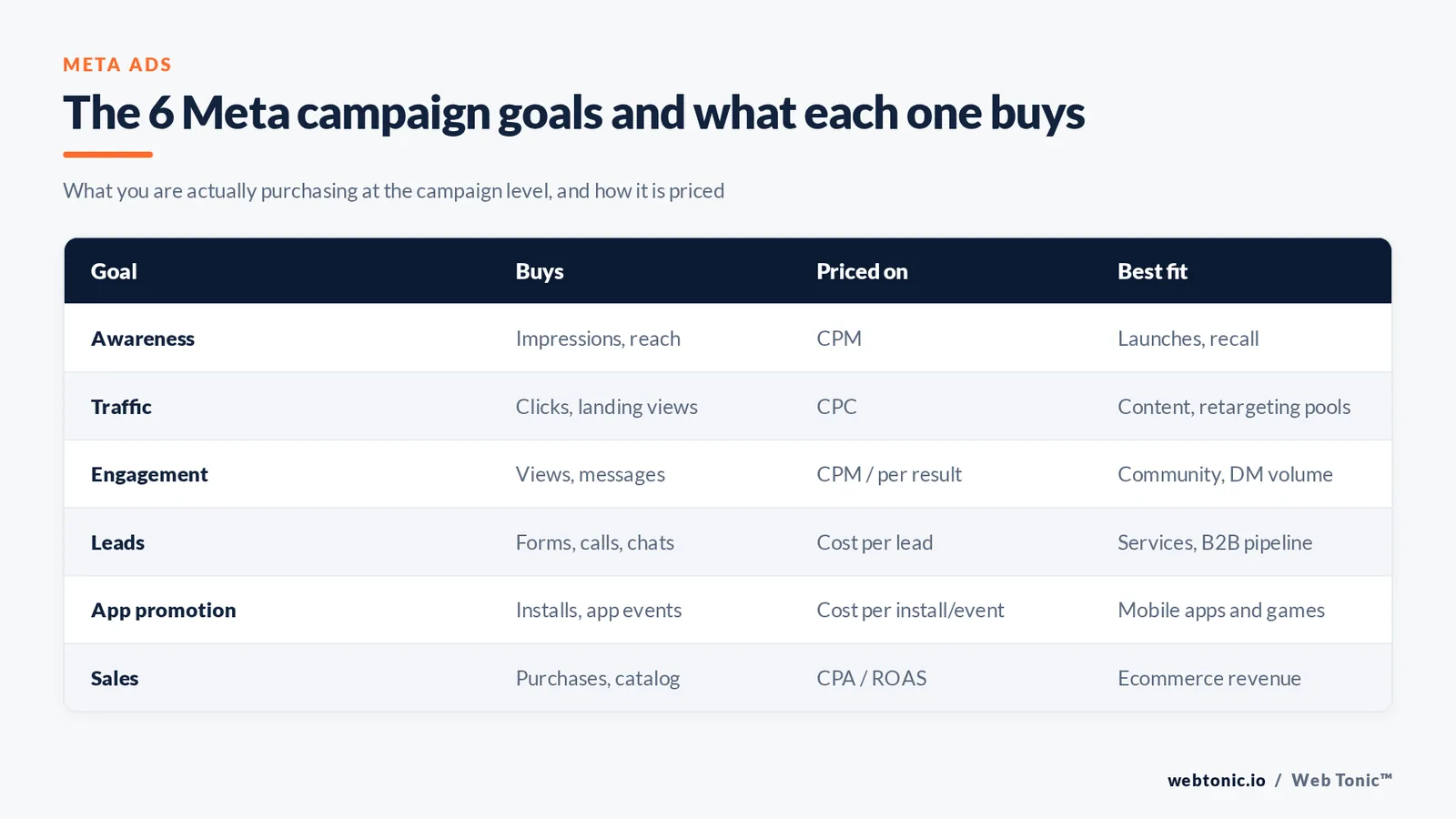
Every new Meta campaign starts with one of six. The table below is the fastest way to map a business goal to the right one before you touch a budget field.
| Goal | Buys | Priced on | Typical business goal | Wrong for |
|---|---|---|---|---|
| Awareness | Impressions and reach | CPM | Launches, brand recall, local footprint | Direct response and lead volume |
| Traffic | Clicks and landing page views | CPC | Content distribution, retargeting pool building | Buying purchases cheaply |
| Engagement | Interactions, views, messages | CPM or cost per result | Community growth, video watch time, DM volume | Website sales |
| Leads | Form fills, calls, chats, sign-ups | Cost per lead | Service businesses, B2B pipeline | Ecommerce checkout |
| App promotion | Installs and in-app events | Cost per install or event | Mobile apps and games | Anything without an app and SDK |
| Sales | Purchases and catalog sales | Cost per purchase or ROAS | Ecommerce revenue, subscriptions | Cold accounts with no pixel data |
The choice is not cosmetic. Meta bids into its own auction for the event you name, so a build asking for cheap link clicks and one asking for purchases will be shown to two different slices of the same audience. Our performance creative team treats this dropdown as the first creative brief input, not a settings-page afterthought.
What that top-level setting actually controls
Advertisers over-attribute results to that dropdown and under-attribute them to the ad set. Here is the honest division of labour.
| Layer | What you set here | Effect on delivery | Changeable after launch? |
|---|---|---|---|
| Campaign goal | One of six goals, buying type, budget if using CBO | Defines which auction the campaign enters and which events are even selectable | No — you must build a new campaign |
| Optimization event | The specific action Meta buys (link click, landing view, lead, purchase) | Strongest single lever on who sees the ad | Yes, but it resets the learning phase |
| Conversion location | Website, app, instant form, calls, Messenger, WhatsApp | Determines where the tracked action happens | Yes, with a learning reset |
| Attribution setting | Click and view windows used for reporting and bidding | Changes reported volume, not delivery quality | Yes |
| Audience and placements | Who is eligible and where ads run | Narrows the pool the objective optimises inside | Yes |
| Creative | Formats and messaging | Decides whether the bought impression converts | Yes |
Two figures worth committing to memory before you change anything: an ad set needs roughly 50 optimization events per week to exit the learning phase, and Meta's minimum viable spend for a conversion event is whatever gets you there. If your $20/day budget cannot buy 50 purchases a week, optimise for an earlier event instead of blaming the setup. The same maths drives the automation choices in Meta Advantage+.
Optimization events inside each goal
This is the table most guides skip. The goal is the door; the optimization event is the room.
| Objective | Optimization events available | Best default | Why |
|---|---|---|---|
| Awareness | Reach, impressions, ad recall lift, video views (ThruPlay, 2-second continuous) | Reach with a frequency cap | Ad recall lift needs scale; reach is measurable at any budget |
| Traffic | Link clicks, landing page views, Messenger or WhatsApp conversations, calls | Landing page views | Filters out accidental and bot-like clicks that never load the page |
| Engagement | Post engagement, page likes, event responses, video views, conversations, on-site conversions | Video views or conversations | Page likes rarely correlate with revenue |
| Leads | Website conversions, instant forms, calls, Messenger or Instagram chats, app events | Website conversion if the pixel fires 50+ times/week | Site leads are usually higher intent than instant forms |
| App promotion | App installs, app events, value optimization | App events | Installs alone attract users who never activate |
| Sales | Website conversions, catalog sales, messaging conversions, calls, in-app purchases | Purchase (value optimization once data allows) | Anything earlier than purchase trains the model on the wrong buyer |
Landing page views versus link clicks is the cheapest fix in the list. A click is counted when the ad is tapped; a landing page view is counted when the page renders. On slow mobile sites the gap between the two can be brutal, which is why Google's own guidance on bounce and engagement measurement is worth reading alongside your Meta numbers.
Awareness: reach, brand awareness and video views
Rule 1 — never judge an awareness flight on cost per purchase. It is bought on CPM and should be judged on reach, frequency and lift.
| Event | What it optimises for | Sensible KPI | Frequency guardrail |
|---|---|---|---|
| Reach | Maximum unique people | Cost per 1,000 people reached | Cap at 1-2 per 7 days |
| Impressions | Total served impressions | CPM | Cap at 3 per 7 days |
| Ad recall lift | People likely to remember the ad | Estimated ad recall rate | Needs 4+ week flights |
| Video views (ThruPlay) | Views to completion or 15 seconds | Cost per ThruPlay | Refresh creative every 3-4 weeks |
Reference points for the reach you are buying: Facebook still carries roughly 3.07 billion monthly active users according to DataReportal's global social snapshot, and organic reach cannot substitute for it — Socialinsider's study of 25 million posts across 130,683 pages found the average Facebook engagement rate flat at 0.15%. Paid awareness is how brands buy the attention organic no longer supplies. Video is the strongest awareness vehicle; see Facebook video ads for format specs.
Traffic: link clicks versus landing page views
Limit 2: traffic buys visits, never revenue. Use them to distribute content and build retargeting pools, then let a sales or leads build close.
| Use case | Event to pick | Watch this metric | Benchmark |
|---|---|---|---|
| Blog and content distribution | Landing page views | Cost per landing page view | Meta traffic CPC averaged $0.70 |
| Retargeting pool building | Landing page views | Pool growth per $100 spent | Aim for 1,000+ users before retargeting |
| Store or event page visits | Link clicks | CTR | A healthy Facebook CTR sits at 1-3% |
| Messenger or WhatsApp enquiries | Conversations | Cost per conversation | Compare against your CPL |
| Call-driven services | Calls | Cost per call over 60 seconds | Compare against sales-qualified rate |
Benchmark data from WordStream's Meta cost study puts the all-industry click cost at $0.70, with shopping and gifts cheapest at $0.34 and finance and insurance most expensive at $1.22. For context, the average Google Ads CPC in the same research was $5.26 — a spread we unpack in Meta ads vs Google Ads.
Engagement: which interaction is worth buying
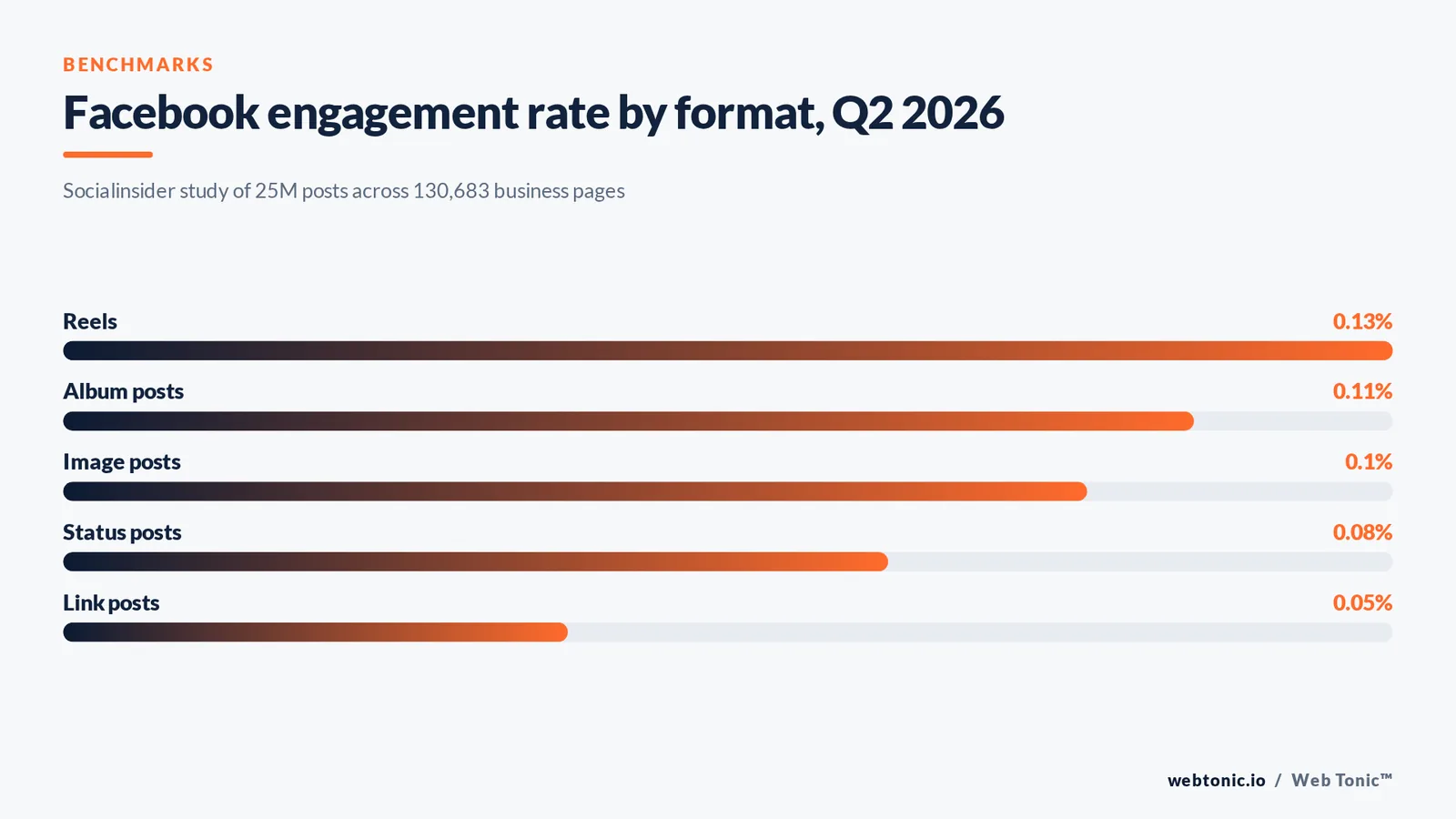
Trap 3 — buying page likes. Socialinsider's data shows brands cut Facebook posting volume by 22% year over year to about 39 posts per month, and engagement rates fell across nearly every format in Q2 2026: Reels 0.13%, albums 0.11%, images 0.10%, status posts 0.08%, links 0.05%. A bought like buys you access to a feed that barely delivers.
| Engagement event | What it is worth | Business case | Verdict |
|---|---|---|---|
| Conversations (Messenger, WhatsApp, IG DM) | High — a reply is a lead | Service, travel, high-ticket retail | Use |
| Video views | Medium — builds retargeting depth | Any brand with 15s+ creative | Use |
| Post engagement | Low — social proof on an ad | Warming a new creative before scaling | Situational |
| Page likes | Very low — reach is pay-to-play | Almost none | Avoid |
| Event responses | Medium — only with a real event | Local venues, webinars, launches | Use for events only |
If community is a genuine goal, treat it as a support layer and hold your revenue expectations in the sales build. Our growth marketing engagements usually cap engagement spend at 10-15% of the Meta budget.
Leads: forms, calls, chats and site conversions
Fact 4 — instant forms convert at a higher rate and a lower quality than website forms, almost without exception. The right pick depends on which side of that trade you can absorb.
| Conversion location | Volume | Lead quality | Best for | Setup requirement |
|---|---|---|---|---|
| Instant form (on Facebook) | Highest | Lowest — pre-filled fields | Top-of-funnel lists, high-volume services | Add 1-2 qualifying questions |
| Website form | Medium | High | B2B, considered purchases | Pixel plus Conversions API |
| Calls | Low | Highest | Emergency and local services | Call tracking and staffed phones |
| Messenger or Instagram chat | Medium-high | Medium | Bookings, quotes, travel | Someone to answer within minutes |
| App event sign-up | Medium | Medium | App-first products | SDK events configured |
Cost expectations by industry, from the same 2025 benchmark set: an all-industry Meta cost per lead of $27.66, restaurants and food at $3.16, dentists at $76.71, and a leads-campaign CPC of $9.78 for dental against $0.74 for restaurants. Compare that with search: WordStream's search benchmarks put the all-industry Google Ads CPL at $66.69 with a $5.42 CPC. Lead quality reconciliation is a data intelligence problem, not a Meta problem.
App promotion: installs, app events and value
Rule 5 — optimise for an in-app event, not the install, as soon as the SDK reports it reliably. Installs are cheap and hollow; activated users are the asset.
| Event | Buys | Signal quality | When to use |
|---|---|---|---|
| App installs | Downloads | Low — many never open the app | Cold launch weeks 1-2 only |
| App events | A defined in-app action | High | As soon as the event fires 50+ times/week |
| Value optimization | Highest predicted in-app revenue | Highest | Once purchase values are passed back |
| Advantage+ app campaigns | Automated creative and audience | Depends on volume | Established accounts with steady spend |
App campaigns also carry the platform's tracking constraint. Apple's App Tracking Transparency framework means opted-out iOS users are measured through aggregated, delayed reporting, so a 1-day attribution view and a 7-day one can disagree materially on the same campaign. Read your privacy label requirements before promising in-app data to a client.
Sales: purchases, catalog and messaging conversions
Limit 6: a purchase-optimised ad set with fewer than 50 weekly purchases will never leave the learning phase, and its CPA will read as noise.
| Event | Best for | Data requirement | Common failure |
|---|---|---|---|
| Purchase | Standard ecommerce and subscriptions | 50+ purchases/week per ad set | Under-fed ad sets stuck in learning |
| Value (ROAS bidding) | Wide AOV spreads | Accurate value parameter on every event | Mismatched currency or tax-inclusive values |
| Catalog sales | Large SKU counts | Clean, approved product feed | Out-of-stock items still being served |
| Add to cart | Low-volume accounts bridging to purchase | 15-25 events/week | Cheap carts that never check out |
| Messaging conversions | High-ticket or consultative sales | Human response capacity | Slow reply times killing conversion |
Two accounting notes. First, Meta and your analytics platform will not agree — Meta credits view-through and cross-device conversions your last-click reports do not, which is why Google's own conversion-tracking documentation and Meta reporting should be reconciled at the blended level. Second, if your feed is the campaign, feed hygiene is the campaign: broken links and stale prices show up as CPA inflation, not as an error message.
The legacy 11 and where they went
Older tutorials, agency templates and screenshots still reference the pre-consolidation names. Use this mapping to translate them.
| Legacy name | Now lives under | As which event | Notes |
|---|---|---|---|
| Brand awareness | Awareness | Ad recall lift | Needs scale to report meaningfully |
| Reach | Awareness | Reach | Unchanged in practice |
| Traffic | Traffic | Link clicks or landing page views | Landing page views now the better default |
| Post engagement | Engagement | Post engagement | Retained, rarely worth buying |
| Page likes | Engagement | Page likes | Deprioritised by Meta's own guidance |
| Event responses | Engagement | Event responses | Still the right pick for real events |
| Video views | Awareness or engagement | ThruPlay or 2-second views | Split across two objectives |
| Lead generation | Leads | Instant form | Now sits beside site leads and calls |
| Messages | Engagement, leads or sales | Conversations | Placement depends on the goal |
| Conversions | Sales or leads | Website conversion | Split by whether the action is a sale |
| Catalog sales | Sales | Catalog sales | Feed-driven |
| Store traffic | Awareness | Reach with a local radius | Store visits reporting is limited |
The consolidation happened in 2023, and Meta stopped allowing new campaigns on legacy objectives from January 2024, requiring existing ones to be duplicated and converted. WordStream's objective rundown documents that timeline, and PPC Land tracks the platform changes that followed.
Which setting for which brief
Nine common briefs, and the setting plus event pair we would launch with.
| Business goal | Objective | Optimization event | First KPI |
|---|---|---|---|
| Launch a new consumer brand | Awareness | Reach, frequency cap 2/7 days | Cost per 1,000 reached |
| Sell a $45 product online | Sales | Purchase | CPA and ROAS |
| Sell a $4,000 service | Leads | Website conversion | Cost per qualified lead |
| Fill a local appointment book | Leads | Calls plus instant form | Booked-appointment rate |
| Grow a newsletter | Leads | Instant form with 1 qualifier | Cost per confirmed subscriber |
| Promote a mobile game | App promotion | App events | Cost per day-1 retained user |
| Push webinar registrations | Leads | Website conversion | Cost per attendee, not registrant |
| Build a retargeting audience | Traffic | Landing page views | Cost per new site user |
| Drive DM enquiries for a salon | Engagement | Conversations | Cost per booked conversation |
Notice how often the answer is not the most obvious objective. “Brand awareness” briefs frequently want lead volume, and “we need sales” accounts frequently lack the 50 weekly purchases to support a purchase-optimised ad set. Write the KPI first, then reverse into the setting. If you want that mapped to your own account, talk to us.
Benchmarks to judge each goal against
Set the expectation before launch, in writing. These are the current public reference points.
| Objective | Metric | Benchmark | Source year |
|---|---|---|---|
| Traffic | CPC | $0.70 all industries | 2025 |
| Traffic | CTR | 1-3% healthy range | 2025 |
| Leads | CPC | $1.92 all industries | 2025 |
| Leads | Cost per lead | $27.66 all industries | 2025 |
| Leads | Cheapest vertical CPL | $3.16 restaurants and food | 2025 |
| Leads | Priciest vertical CPL | $76.71 dentists | 2025 |
| Engagement | Organic engagement rate | 0.15% flat YoY | 2026 |
| Engagement | Best organic format | Reels at 0.13% in Q2 2026 | 2026 |
| Awareness | Addressable audience | ~3.07B monthly Facebook users | 2026 |
| Sales | Search comparison CPC | $5.26 average Google Ads CPC | 2025 |
Cost seasonality matters too: auction prices climb through late Q3 and Q4 as ecommerce demand peaks, so a Q4 CPA is not comparable with a Q2 one. Broader spend context sits in eMarketer's digital advertising insights and IAB research.

Six selection mistakes that waste real budget
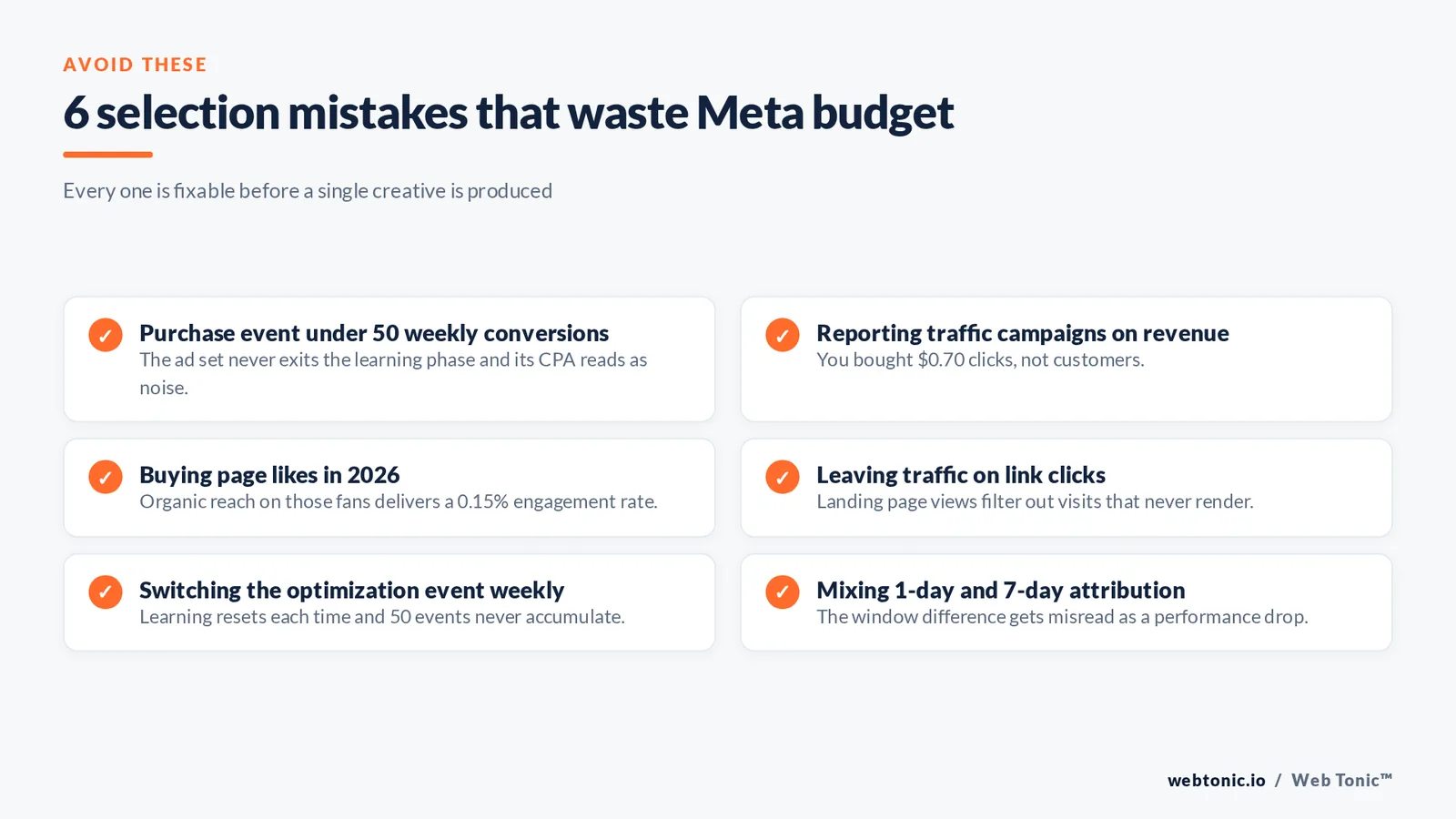
- Mistake 1 — optimising for purchases on fewer than 50 weekly events, then killing the ad set inside the learning phase.
- Mistake 2 — running traffic and reporting it on revenue; the objective bought clicks at $0.70, not customers.
- Mistake 3 — buying page likes in 2026, when organic reach on those fans delivers a 0.15% engagement rate.
- Mistake 4 — leaving traffic on link clicks instead of landing page views and paying for visits that never render.
- Mistake 5 — switching the optimization event weekly, resetting learning every time and never accumulating the 50 events needed for stability.
- Mistake 6 — comparing a 1-day attribution window in one report against a 7-day window in another and calling the difference a performance drop.
Every one of those is a setup-layer error, fixable before a single creative is produced. That is the argument for treating this choice as strategy: read our wider marketing blog or the full setup walkthrough in how to advertise on Facebook.
FAQ
What are the Facebook ad objectives in 2026?
There are six: awareness, traffic, engagement, leads, app promotion and sales. They replaced the original 11 objectives during the 2023 consolidation, and from January 2024 new campaigns can only be built on the six.
Which Facebook ad objective is best for sales?
The sales objective with a purchase optimization event, but only if the ad set can generate roughly 50 purchases a week. Below that volume, optimise for add to cart or use the leads objective, then graduate to purchase once data allows.
What is the difference between awareness and engagement objectives?
Awareness buys impressions and unique reach and is priced on CPM; engagement buys an interaction such as a video view, a comment or a message. Awareness is judged on reach and frequency, engagement on cost per interaction.
Can I change a campaign objective after launch?
No. The campaign objective is fixed at creation, so you must duplicate the campaign to change it. You can change the optimization event inside the ad set, but that restarts the learning phase.
Do Facebook ad objectives affect cost?
Substantially. Meta prices the event you ask for, so 2025 benchmark data showed $0.70 average CPC on traffic campaigns against $1.92 on leads campaigns, with an average cost per lead of $27.66.