Table of contents
67% of shoppers now research a product online before buying it in a physical store, and 69% say they purchased a new product in-store in the past year - up 11 points from early 2025. The 2026 data does not describe online replacing stores. It describes one shopping journey that crosses both channels, and this page maps the research behind it.
Key Takeaways
- 67% of shoppers webroom - research online, then buy in-store (Salsify 2026).
- 53% of shoppers showroom - browse in-store, then buy online (Salsify 2026).
- 69% of shoppers purchased a new product in a physical store, up 11 points YoY (Salsify 2026).
- 68% purchase through online marketplaces, narrowly behind physical retail (Salsify 2026).
- E-commerce was about 17% of total US retail sales in Q2 2026 (U.S. Census Bureau).
- 63.1% of in-store shoppers cite better prices than online as a visit driver (RetailNext 2026).
- 27.4% cite immediate in-stock availability and 27.0% cite in-store-only deals (RetailNext 2026).
- 62% of shoppers bought after seeing an in-store screen ad (Grocery TV 2026).
- In-store displays are the most influential retail media format at 35%, ahead of online ads at 22% (dunnhumby 2026).
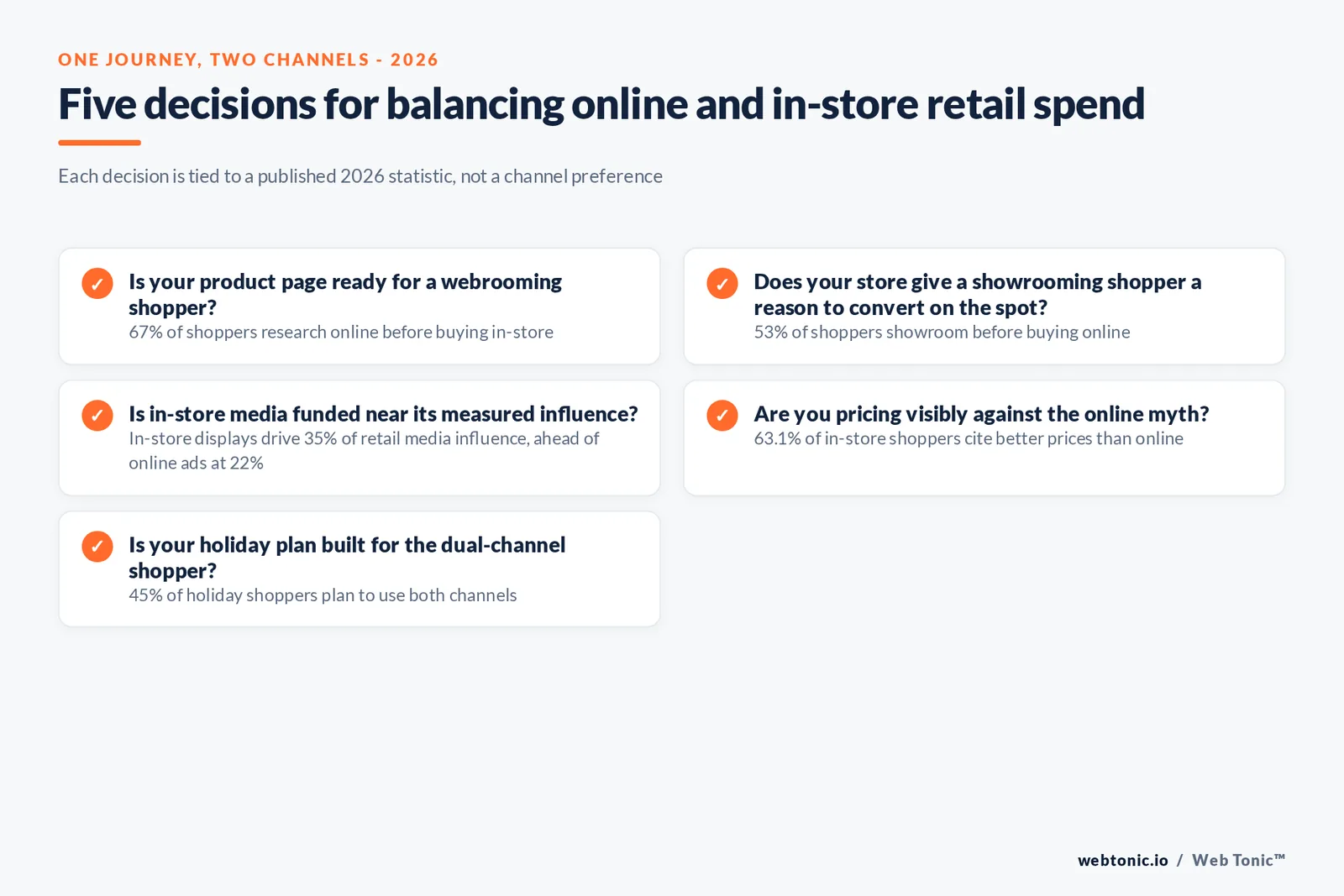
- 45% (71.6 million) of US holiday shoppers plan to shop both channels, up from 44% (NRF).
- 29% (46.2 million) plan to shop exclusively in-store this holiday season (NRF).
- US retail sales are forecast to grow 4.4% to USD 5.6 trillion in 2026 (NRF).
- 37.6% of indoor mall visits now last more than 75 minutes, ahead of open-air centers (Placer.ai 2026).
- Only 30% of shoppers say stores excel at inspiring them, despite valuing the in-store experience (Placer.ai 2026).
- Nearly four in ten consumers regularly move between digital and physical shopping in one trip (Zeta Global 2026).
The channels are merging, not competing
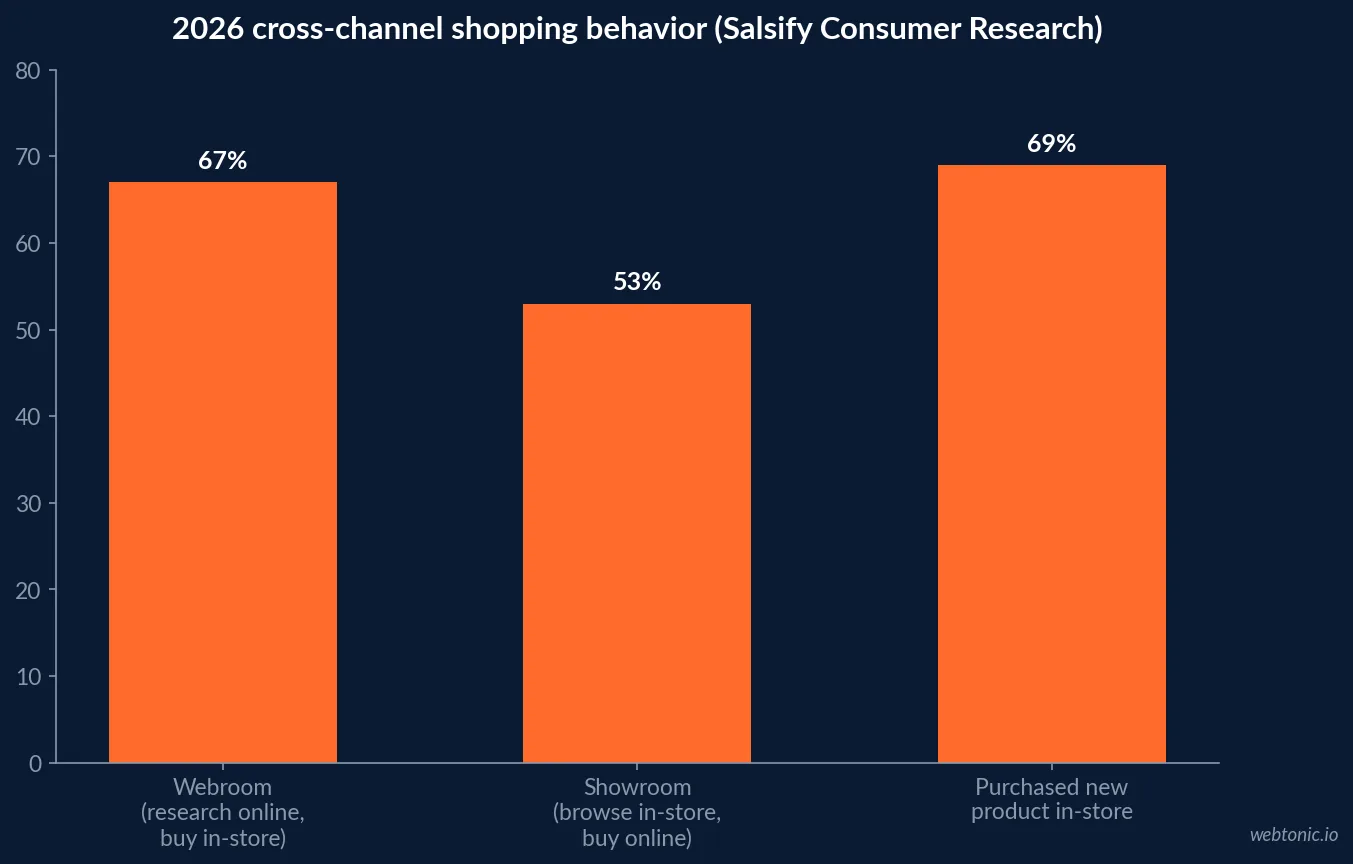
Salsify's 2026 Consumer Research, a survey of nearly 3,000 shoppers across the US, UK and Canada, is the clearest evidence of this. 67% of shoppers webroom - research a product online, then buy it in a store - while 53% showroom, browsing in a store before buying online. Most shoppers do both depending on the category, which means a "channel" budget split misreads how the purchase decision actually happens.
The store itself is gaining ground on the discovery side too: 69% of shoppers say they purchased a new product in a physical retail store in the past year, up 11 points from early 2025 data, narrowly ahead of online marketplaces like Amazon at 68%.
| 2026 shopper behavior | Share of shoppers | Source | What it means |
|---|---|---|---|
| Webroom (research online, buy in-store) | 67% | Salsify 2026 Consumer Research | Dominant cross-channel pattern |
| Showroom (browse in-store, buy online) | 53% | Salsify 2026 Consumer Research | Reverse pattern, still common |
| Purchased a new product in a physical store | 69%, up 11pts | Salsify 2026 Consumer Research | Store discovery is rising |
| Purchased through an online marketplace | 68% | Salsify 2026 Consumer Research | Near parity with physical retail |
| E-commerce share of total US retail sales, Q2 2026 | ~17.1% | U.S. Census Bureau | Online remains the minority channel by dollars |
Why the store still wins the purchase moment
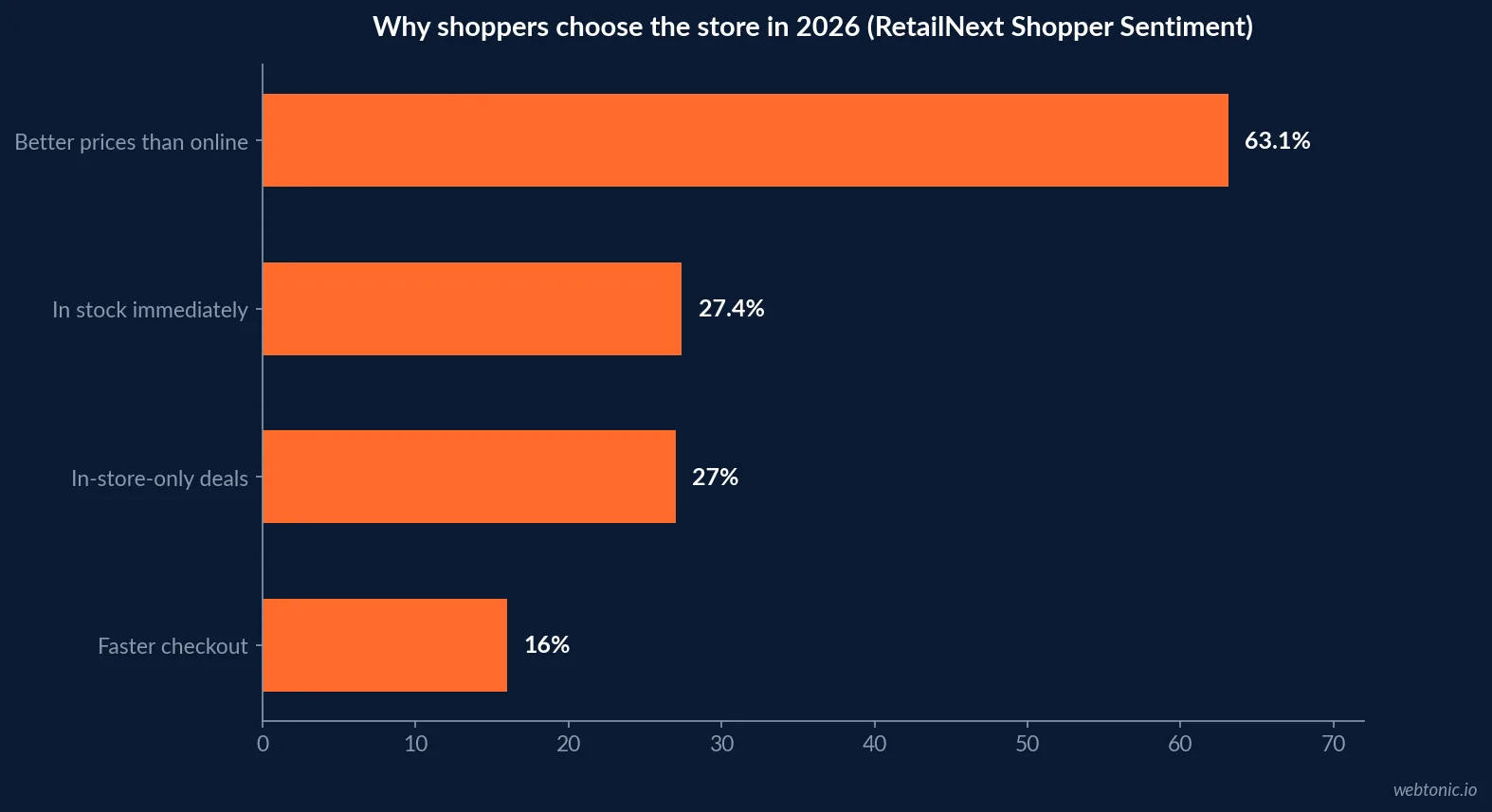
It is not nostalgia. RetailNext's 2026 Shopper Sentiment Report finds 63.1% of in-store shoppers cite better prices than online as a reason for the visit - a reversal of the assumption that online is always cheaper. 27.4% cite immediate in-stock availability and 27.0% cite in-store-only deals or exclusives, while 16.0% say faster checkout influences the decision.
Mood Media's 2026 In-Store Influence Survey, conducted with Dynata across 1,000 US shoppers, adds the sensory layer: the ability to see and touch a product before buying, and the in-store experience itself, are recurring reasons shoppers give for visiting a store even when the same item is available online. Placer.ai's 2026 data backs this up on the discovery side - yet finds only 30% of shoppers say stores currently excel at inspiring them, a clear gap between what shoppers want from a store visit and what most retailers deliver.
| Reason for choosing the store (2026) | Share of shoppers | Source |
|---|---|---|
| Better prices than online | 63.1% | RetailNext 2026 Shopper Sentiment Report |
| Items in stock and available immediately | 27.4% | RetailNext 2026 Shopper Sentiment Report |
| In-store-only deals or exclusives | 27.0% | RetailNext 2026 Shopper Sentiment Report |
| Faster checkout | 16.0% | RetailNext 2026 Shopper Sentiment Report |
| Stores seen as excelling at inspiration | 30% | Placer.ai 2026 |
In-store media is closing the gap with digital ads
The screen at the shelf is doing measurable work. Grocery TV's 2026 In-Store Shopper Perception Report found 62% of shoppers have purchased a product directly after seeing it advertised on an in-store screen, with receptivity increasing significantly across every major store zone compared to the company's 2023 baseline. dunnhumby's 2026 retail media report ranks in-store displays as the single most influential retail media format at 35%, ahead of online ads at 22% and personalized recommendations at 18% - even though ad spend remains heavily concentrated online.
The mismatch between where the influence happens and where the budget goes is the single most actionable finding in the 2026 experiential retail research: in-store media is under-resourced relative to what it delivers.
How much of retail is even online yet
Zoom out from behavior to dollars and the online share is smaller than the webrooming and showrooming numbers might suggest. The U.S. Census Bureau's Quarterly Retail E-Commerce Sales Report put second-quarter 2026 e-commerce sales at roughly USD 340.2 billion, an increase of 3.8% from the first quarter, against total retail sales of USD 1,986.5 billion for the same quarter - meaning online sales represent around 17% of total retail dollars even as the research-and-purchase journey crosses channels for most shoppers. EMARKETER's 2026 holiday chart tracks the same split seasonally, confirming in-store still carries the majority of holiday transaction volume even as online research increasingly precedes it.
Read against the 67%/53% webrooming and showrooming figures, the picture is consistent: online channels dominate the research phase of the journey, but the transaction itself, and the majority of retail dollars, still land in a physical store.
| US e-commerce vs total retail, Q2 2026 | Figure | Source |
|---|---|---|
| Quarterly e-commerce sales | USD 340.2 billion | U.S. Census Bureau |
| Quarterly change in e-commerce sales | +3.8% | U.S. Census Bureau |
| Total quarterly retail sales | USD 1,986.5 billion | U.S. Census Bureau |
| E-commerce share of total retail | ~17% | U.S. Census Bureau |
What holiday shopping data says about channel mix
NRF's holiday shopping data put a record 159 million consumers shopping on Super Saturday, with 45% (71.6 million) planning to shop both in-store and online - up from 44% (69.5 million) the prior year. Of the remainder, 29% (46.2 million) planned to shop exclusively in-store and 26% (41.1 million) exclusively online. NRF's 2026 forecast, built with Oxford Economics, projects total US retail sales growing 4.4% to USD 5.6 trillion this year - growth that both channels share in, rather than one taking share from the other.
| 2026 holiday channel plan | Consumers | Share | Source |
|---|---|---|---|
| Shop both online and in-store | 71.6 million | 45%, up from 44% | NRF |
| Shop exclusively in-store | 46.2 million | 29% | NRF |
| Shop exclusively online | 41.1 million | 26% | NRF |
| Total consumers shopping Super Saturday | 159 million (record) | - | NRF |
| 2026 US retail sales forecast | USD 5.6 trillion | +4.4% YoY | NRF / Oxford Economics |
Where physical retail is winning attention beyond the transaction
Placer.ai's 2026 mall data shows the dwell-time gap between formats that lean into experience and those that do not: 37.6% of indoor mall visits lasted more than 75 minutes in 2025, compared with 33.4% for open-air centers and 34.6% for outlets. Zeta Global's 2026 holiday research separately finds nearly four in ten consumers now regularly moving between digital and physical shopping within a single purchase journey, making the "omnichannel shopper" the largest single group in the market rather than a niche segment.
Read together, the pattern is consistent: retailers that give shoppers a reason to linger - discovery, experience, exclusives - are capturing more of both the online research phase and the offline purchase phase, not one at the expense of the other.
What this means for retail marketing budgets
- Stop budgeting online and in-store as competitors. With 67% of shoppers webrooming, a strong product page is part of the in-store sales funnel, not a separate channel.
- Fund in-store media closer to its measured influence. A 35% influence share against a much smaller ad-spend share is the clearest under-investment signal in this data set.
- Design for dwell time, not just footfall. The formats capturing 75-minute-plus visits are winning the discovery phase that increasingly precedes an online purchase too.
- Price-match visibly. 63.1% of in-store shoppers cite price as a reason to visit, which means "online is cheaper" is now a myth worth correcting at the shelf.
- Plan holiday and peak-season budgets for the 45% dual-channel shopper as the largest single segment, not as an edge case between two "pure" channels.
Building the creative and campaigns that bridge both channels
Getting the online half of this journey right takes the same creative and targeting discipline as any paid channel. Our performance creative team builds product and campaign assets that hold up across both the research phase and the purchase phase, and our take on whether paid social is worth it in 2026 is a useful read if online discovery is currently feeding your in-store traffic without credit in your reporting. Talk to us about connecting the two.
Frequently Asked Questions
Is in-store shopping actually growing in 2026?
Its share is holding, and engagement is rising even as e-commerce grows too. Salsify's 2026 Consumer Research, surveying nearly 3,000 shoppers across the US, UK and Canada, found 69% now say they purchase new products in physical retail stores, up 11 points year over year and narrowly ahead of online marketplaces at 68%. Meanwhile the U.S. Census Bureau's Quarterly Retail E-Commerce Sales Report puts online sales at roughly 17% of total retail in Q2 2026 - both channels are expanding off a mostly stable split, not swapping places.
What is webrooming and how common is it?
Webrooming is researching a product online, then buying it in a physical store. Salsify's 2026 data puts webrooming at 67% of shoppers, making it the single most common cross-channel behavior measured. Showrooming - the reverse, browsing in-store then buying online - sits at 53%. Most shoppers do both depending on the category, which is why treating online and in-store as separate budgets misreads how the purchase actually happens.
Why do shoppers still choose the store over online?
Price and immediacy, not just habit. RetailNext's 2026 Shopper Sentiment Report finds 63.1% of in-store shoppers cite better prices than online as a reason for the visit, 27.4% cite in-stock availability, and 27.0% cite in-store-only deals or exclusives. Mood Media's 2026 In-Store Influence Survey adds a sensory dimension: shoppers repeatedly cite the ability to see and touch a product and the in-store experience itself as reasons to visit, even when they could buy the same item online.
Does in-store advertising actually change purchase behavior?
Yes, and receptivity is rising. Grocery TV's 2026 In-Store Shopper Perception Report found 62% of shoppers have purchased a product directly after seeing it advertised on an in-store screen, with receptivity increasing across every major store zone compared to Grocery TV's 2023 baseline. Dunnhumby's 2026 retail media report separately finds in-store displays are the single most influential retail media format at 35%, ahead of online ads at 22% and personalized recommendations at 18%.
What should retailers actually prioritize based on this data?
Design for the merged journey rather than optimizing either channel alone. That means matching online product content to what a webrooming shopper will check before their store visit, building in-store moments (screens, sampling, staff knowledge) that a screen cannot replicate, and measuring the two channels together instead of as competing budgets - Placer.ai's 2026 data shows the retailers gaining the most foot traffic are the ones combining value with discovery or an experience the store alone can deliver.
Sources
Salsify - 2026 Consumer Research: What Is Showrooming vs. Webrooming?
U.S. Census Bureau - Quarterly Retail E-Commerce Sales Report
RetailNext - 2026 Shopper Sentiment Report
Mood Media - 2026 In-Store Influence Survey
Grocery TV - 2026 In-Store Shopper Perception Report
dunnhumby - 2026 Retail Media Report
NRF - Record 159 Million Consumers Expected to Shop on Super Saturday
NRF - 2026 Retail Sales Growth Forecast
Placer.ai - The 2026 Retail Consumer in 5 Charts
EMARKETER - Share of 2026 Holiday Shopping Purchased Online vs. In-Store