Table of contents

Most ecommerce teams pour their SEO effort into product pages and treat category pages as plumbing — an automated grid that exists to hold products rather than a page that should rank on its own. That's backwards. A category page targets the broad, high-volume search a shopper types before they know which specific product they want, and it sits at a structural chokepoint where internal links, search engines, and users all converge. Getting ecommerce category page SEO right — category SEO for short — means treating that page as a real destination: clean URLs, disciplined faceted navigation, the right structured data, and enough unique content to earn its place in search results. Good ecommerce web design and good category SEO are not competing goals; a page that genuinely helps users compare a product category tends to satisfy search engines too.
This guide covers what category page SEO best practices actually involve, how to handle faceted navigation and pagination without wrecking crawl budget, which schema belongs on a category page, and a practical framework for internal linking that distributes link equity where it matters. Digital marketing teams that treat category pages as a real user experience surface, not just an inventory list, tend to see the strongest results.
Key Takeaways
- Category pages, sometimes called PLPs (product listing pages) or CLPs (category landing pages), typically capture broader, higher-volume search demand than individual product pages, since shoppers search for product groups before specific SKUs.
- Of all the technical issues that quietly drain an ecommerce site's crawl budget, unmanaged faceted navigation is consistently the biggest offender. A handful of filter dimensions can combine into thousands of near-duplicate URLs from a single category.
- Google's John Mueller has repeatedly advised against mixing noindex and rel=canonical on the same URL, since the two signals contradict each other.
- Google officially retired rel=prev/next as a pagination signal in 2019. Self-referencing canonicals on each paginated page are the current recommended approach, not canonicalizing everything back to page 1.
- BreadcrumbList, ItemList, and Product schema (on featured items) all belong on a well-built category page. AggregateRating schema does not belong there — it's meant for ratings on a single thing, not a page of grouped products.
- A short 50 to 100 word introduction above the product grid, plus 200 to 500 words of editorial content below it, satisfies both users who want to see products immediately and search engines that need substantial unique content to index.
What is ecommerce category page SEO, and why does it matter?
Ecommerce category page SEO is the practice of optimizing product listing pages — the pages that group a related product category like "men's running shoes" or "organic skincare" — so search engines can understand the product group, rank the page for commercial category queries, and pass visitors into the right products. A category page sits between the homepage and individual product pages in the site's structure and design, and it usually targets broader search intent than any single SKU can. Google Search Console, GSC for short, remains the primary tool for confirming whether that intent is actually converting into impressions and clicks.
The stakes are real. A shopper searching "women's winter coats" hasn't decided on a specific product yet. Several industry guides put category pages at 3 to 5 times the organic revenue of individual product pages, though the original data behind that specific multiple isn't fully clear across the sources repeating it, so treat it as a directional signal rather than a verified benchmark.
URL structure and site hierarchy
A clean, logical URL structure — /category/subcategory/ rather than a flat or parameter-heavy path — helps both users and search engines understand where a page sits in the site, and a clear structure like this is one of the simplest ways to help users orient themselves in a large catalog. An optimal URL structure also makes it easier to target long tail keywords with dedicated subcategory pages instead of cramming every variation into one broad category. In practice, large U.S. retailers vary widely here: Nike's category URLs, for example, follow a flatter /w/slug-id pattern rather than a nested hierarchy, while other major retailers (Apple included) use their own conventions. Either approach can work for SEO as long as it's applied consistently and paired with solid internal linking and breadcrumbs, since the URL pattern itself is a minor signal compared to those factors.
Faceted navigation: the most common crawl budget killer
Faceted navigation — the filter panel that lets shoppers narrow by size, color, price, brand, and other attributes — is simultaneously one of the most useful UX features on an ecommerce site and one of the most dangerous for SEO if left unmanaged. A handful of filter dimensions can combine into an enormous number of near-duplicate URLs from a single category page.
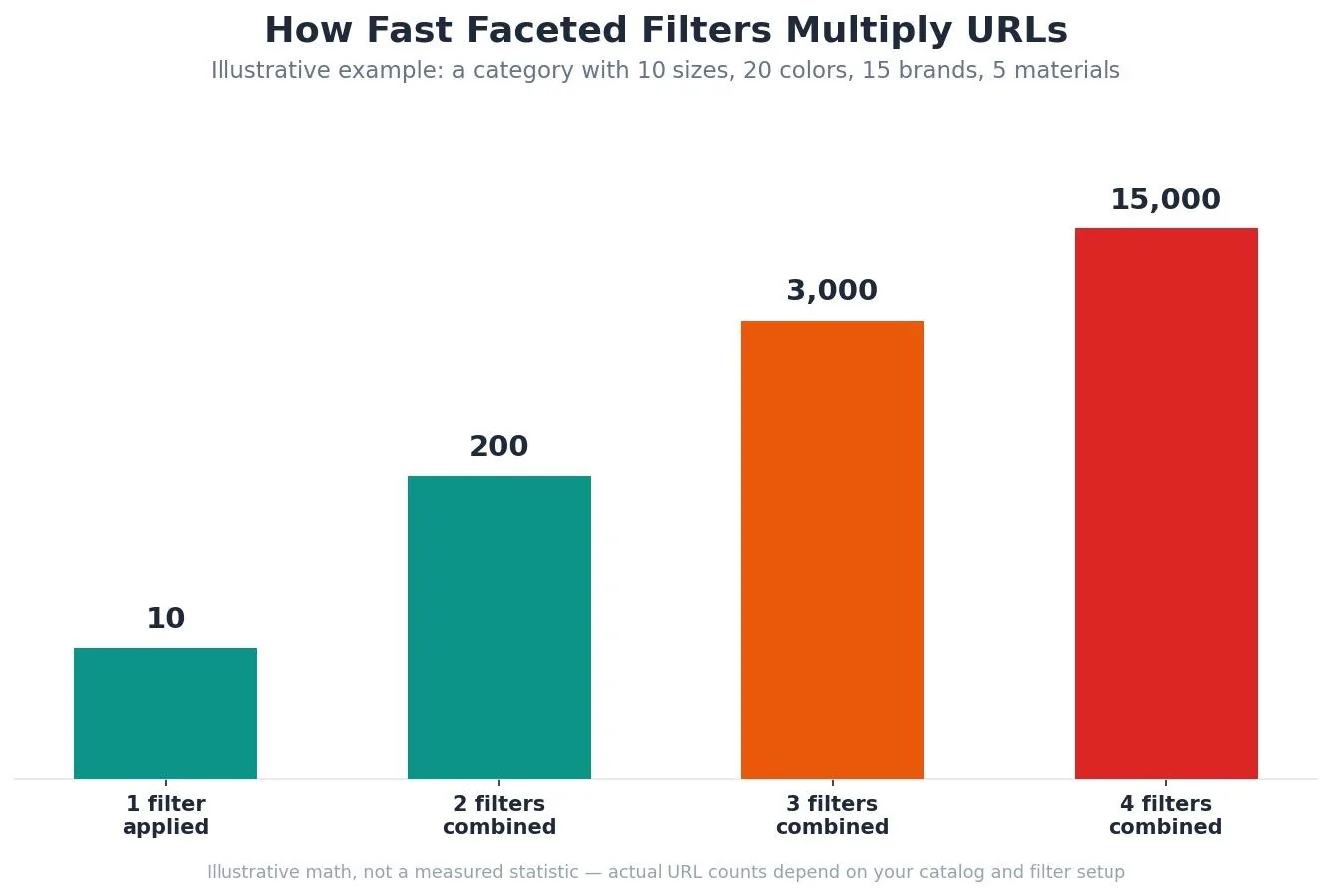
The fix isn't to block every filter combination. It's to decide, deliberately, which combinations deserve their own indexed URL and which don't. A filter combination with genuine search demand, enough unique products, and room for unique title tags and intro copy is a reasonable candidate for indexing. Everything else should canonicalize back to the parent category or carry a noindex tag, kept crawlable so link equity and product discovery aren't blocked outright.
Google's John Mueller has addressed this exact tension repeatedly. His consistent public position, reported by Search Engine Roundtable and corroborated by other SEO outlets covering the same statements, is that noindex and rel=canonical should not be applied to the same URL at the same time, since the two signals contradict each other: a noindex page may never be crawled enough for the canonical to be read, while a rel=canonical is only ever a hint Google can choose to ignore. For genuinely low-value filter combinations, blocking the pattern in robots.txt is often a cleaner solution than trying to layer noindex and canonical together.
Faceted URL handling comparison
| Method | What it does | Crawl budget impact | Best used for |
|---|---|---|---|
| Self-referencing canonical | Confirms the URL is its own indexable page | Neutral — page still crawled | Facets with real search demand |
| Canonical to parent | Consolidates ranking signals to the main category | Reduces index bloat | Near-duplicate facets with no unique value |
| Noindex, follow | Keeps the page out of the index, still crawlable | Google may reduce crawl frequency over time | Facets with some value but not indexable yet |
| Robots.txt disallow | Blocks crawling of the URL pattern entirely | Strongest crawl budget protection | Clearly low-value, high-volume patterns (e.g. sort/session parameters) |
Try it: faceted URL indexability checker
The tool below walks through three questions to give a starting recommendation for a specific filter combination.
Ecommerce SEO tool
Faceted URL indexability checker
Answer three questions about a specific filter combination to get a starting recommendation for canonical, noindex, or full indexing.
Pagination: what changed in 2019, and what to do now
For years, rel=prev/next markup was the standard way to tell Google that a series of paginated category pages belonged together. Google officially retired rel=prev/next as a pagination signal in March 2019, confirming it hadn't been using the markup for ranking purposes for some time before that announcement either.
The current recommended approach is simpler than the old one: give each paginated page — page 1, page 2, page 3 — its own self-referencing canonical tag, and let each page be indexed on its own terms. Don't canonicalize every paginated page back to page 1. That tells Google the products on pages 2 and beyond don't exist, and it can quietly remove them from the index. A view-all page, where practical, can serve as an alternative single indexable version, with component pages canonicalizing to it instead.
Structured data: what belongs on a category page
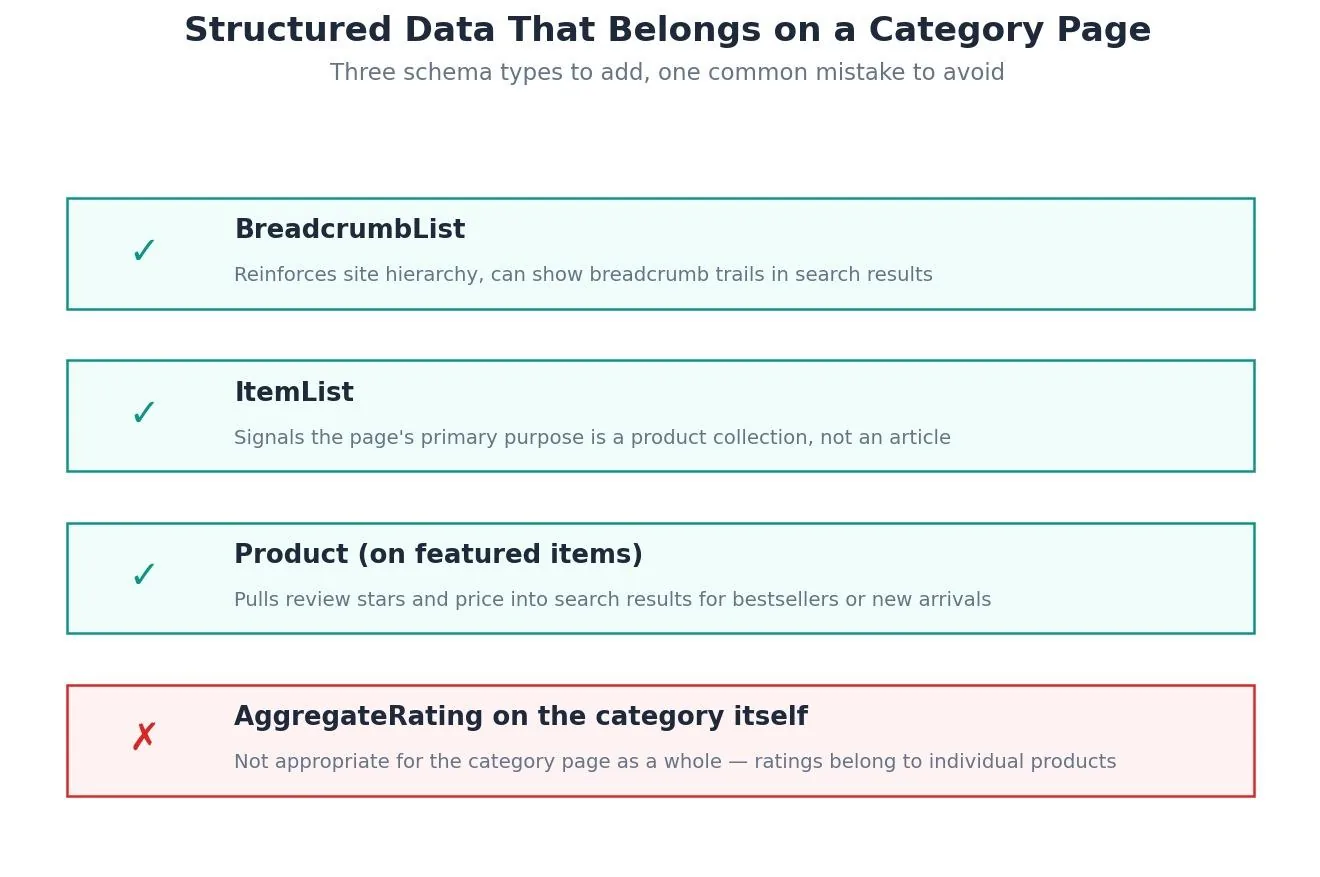
BreadcrumbList schema reinforces the site's hierarchy and can produce breadcrumb trails directly in search results. ItemList schema tells Google the page's primary purpose is a product collection rather than an article. That distinction matters for how the page gets classified and displayed. Product schema on individual featured items — bestsellers or new arrivals, for example — can pull review stars and pricing into search results for those specific products. AggregateRating schema, however, is a mismatch here: it's meant to represent ratings for one specific thing, not a shelf of unrelated products grouped under one heading, so save it for individual product pages instead.
Content placement: above the fold vs. below the fold
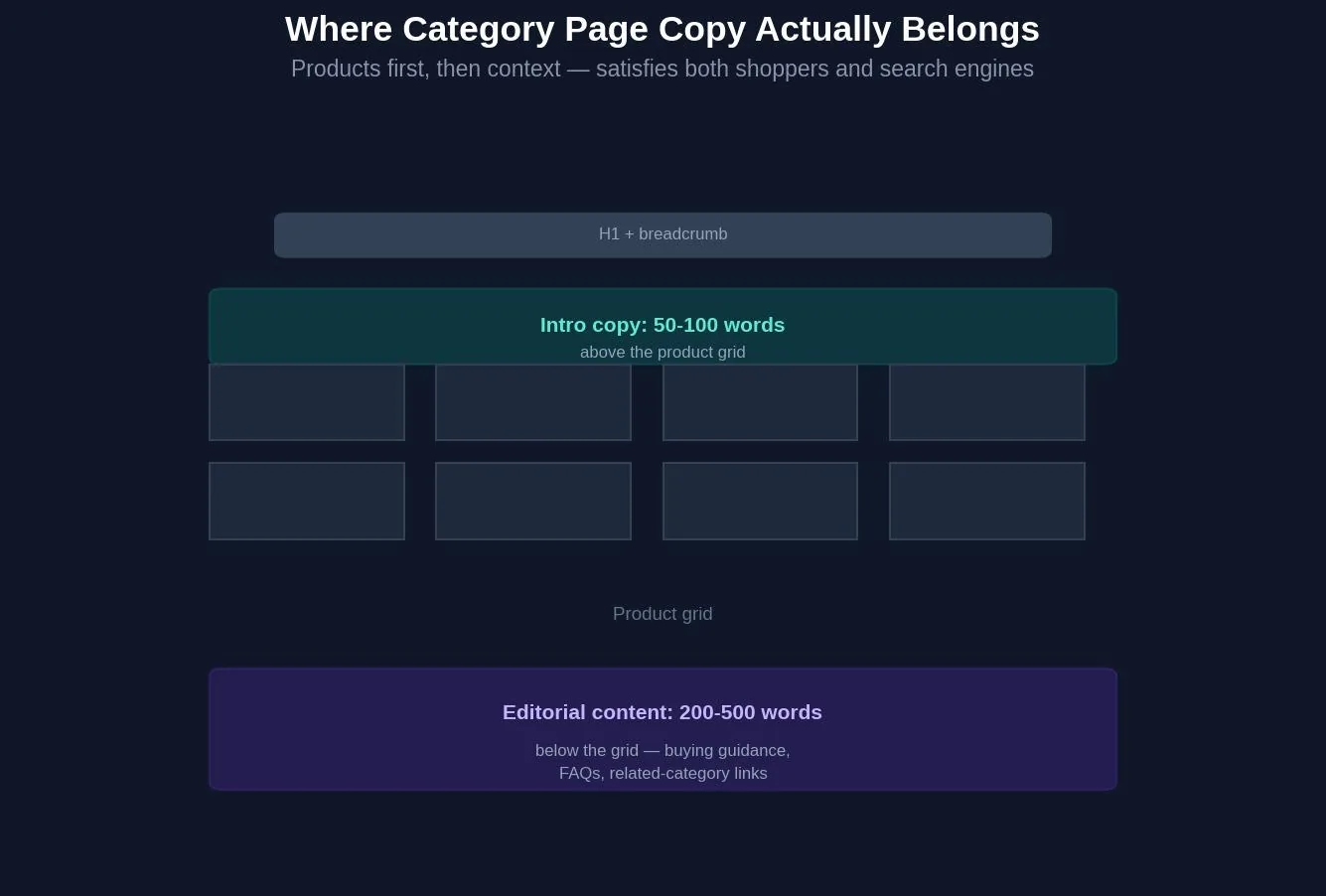
Where to put category page copy relative to the product grid is a genuinely contested question, and testing across ecommerce sites consistently points to the same answer: users want to see products first. A short 50 to 100 word introduction above the grid gives immediate context, keeps any filter or sort CTA visible without delay, and doesn't push shoppers past the thing they actually came for. A longer 200 to 500 word editorial section below the grid, covering buying guidance, related categories, and long tail keyword variations, gives search engines the substantial unique content that a bare product grid can't provide on its own.
Internal linking: distributing link equity through category pages
Category pages function as nodes in an internal linking network. They need authority flowing in from higher up the site (the homepage, top-level navigation) and they need to distribute link equity down to the product pages and long tail subcategory pages beneath them. Every product in the grid should be linked through both its image and its title. Cross-links between sibling categories matter just as much: a shopper browsing hiking boots is a plausible customer for hiking socks or trail backpacks too, and linking those adjacent categories to each other spreads internal linking signals across the catalog instead of leaving each one as an isolated island.
Category pages also need to load fast to hold onto the traffic all this SEO work earns. Fast load times and passing Core Web Vitals matter as much on a category page — often more, given how image-heavy product grids tend to be. Whether a site uses classic pagination or infinite scroll for long category pages, the underlying crawlability principle is the same: Google needs a way to reach every product, not just the ones visible on first load.
Common ecommerce category page SEO mistakes to avoid
Treating category pages as an afterthought behind product pages is the most common and most costly mistake, given how much broad commercial search demand these pages are positioned to capture.
Letting faceted navigation run unmanaged is a close second. Without canonical tags, noindex rules, or robots.txt handling, filter combinations compete with the main category URL for rankings and quietly consume crawl budget that should go to genuinely valuable pages.
Canonicalizing every paginated page back to page 1 is a subtler mistake that actively removes deeper products from the index rather than protecting it.
Category pages left with no internal links from navigation, blog content, or related categories become islands. Even a category page with excellent content and clean technical SEO struggles to rank without incoming authority.
Tools for auditing category page SEO
Google Search Console is the starting point for almost every category page audit: the Coverage report shows whether faceted URLs are being indexed when they shouldn't be, and the Performance report can be filtered to category URL patterns to track impressions and clicks over time. Beyond Search Console, a full-site crawler such as Screaming Frog is useful for spot-checking a large catalog: pulling every category and facet URL at once makes it much faster to spot a canonical tag pointing the wrong way or a noindex rule that didn't get applied where it should have.
Frequently asked questions
What is the difference between a PLP and a CLP?
The terms are often used interchangeably. PLP (product listing page) and CLP (category landing page) both refer to the same type of page: one that organizes and displays a group of related products rather than a single product.
Should filtered category URLs be indexed?
Only the ones with genuine search demand, enough unique products, and room for unique title tags and content. Everything else should canonicalize back to the parent category or use noindex, and genuinely low-value patterns can be blocked in robots.txt.
Is it okay to use noindex and rel=canonical on the same page?
Google's John Mueller has repeatedly advised against combining them on the same URL, since a noindex page may not be crawled enough for the canonical signal to be picked up reliably. Pick one approach per URL rather than layering both.
What schema markup should a category page include?
BreadcrumbList and ItemList schema are standard. Product schema on individually featured items works well too. AggregateRating schema does not belong on the category page as a whole.
How much content should a category page have?
A common pattern is 50 to 100 words above the product grid for immediate context, and 200 to 500 words below it for buying guidance, long tail keyword coverage, and the substantial unique content search engines need to index the page well.
Getting category page SEO right across a catalog
Category pages reward the same discipline product pages get, applied to a page type that usually has more organic upside per page. Clean URL structure, deliberate faceted navigation rules, correct pagination handling, the right schema, and real internal linking all compound. None of these fixes is exotic. The difficulty, as with most ecommerce SEO, is applying them consistently across hundreds or thousands of category and filter pages instead of perfecting one flagship category and leaving the rest of the catalog to its own devices.
Ready to fix your ecommerce category pages at scale?
Auditing faceted navigation, pagination, structured data, and internal linking across a large catalog is exactly the kind of technical work that quietly caps organic growth until someone addresses it. Web Tonic's growth marketing team folds this kind of technical and on-page SEO into a broader strategy that also covers content and paid acquisition, so category page performance becomes part of an ongoing system rather than a one-time cleanup.
More from Web Tonic: growth marketing services, data & analytics.
Sources: seroundtable.com · sandstormdigital.com · ayima.com · gofishdigital.com · digitalapplied.com