Table of contents
Every SEO tool seems to have its own version of the same idea: a single number meant to sum up how strong a website is. Ahrefs calls it Domain Rating. Moz calls it Domain Authority. SEMrush calls it Authority Score. They're related, but they're not the same metric, and confusing them is one of the fastest ways to make a bad decision about which sites to pursue for links or which competitors to worry about.
This guide explains what domain rating actually measures, how it differs from Domain Authority (DA) and Page Authority (PA), and what a CMO or SEO strategist should actually do with the number once they have it.
Key Takeaways
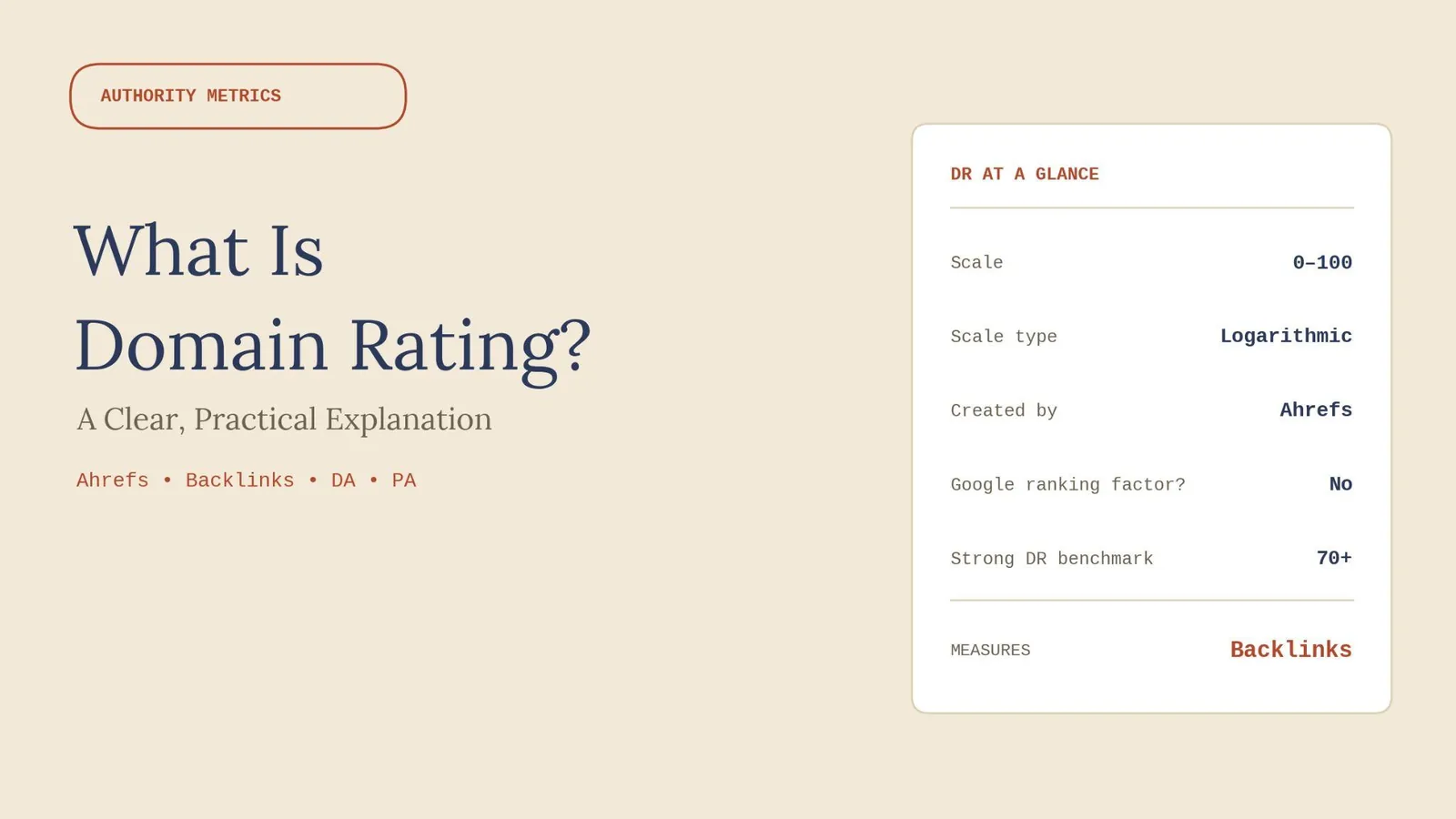
- Domain Rating (DR) is Ahrefs' own 0–100 metric measuring the strength of a website's backlink profile, based purely on referring domains and link quality.
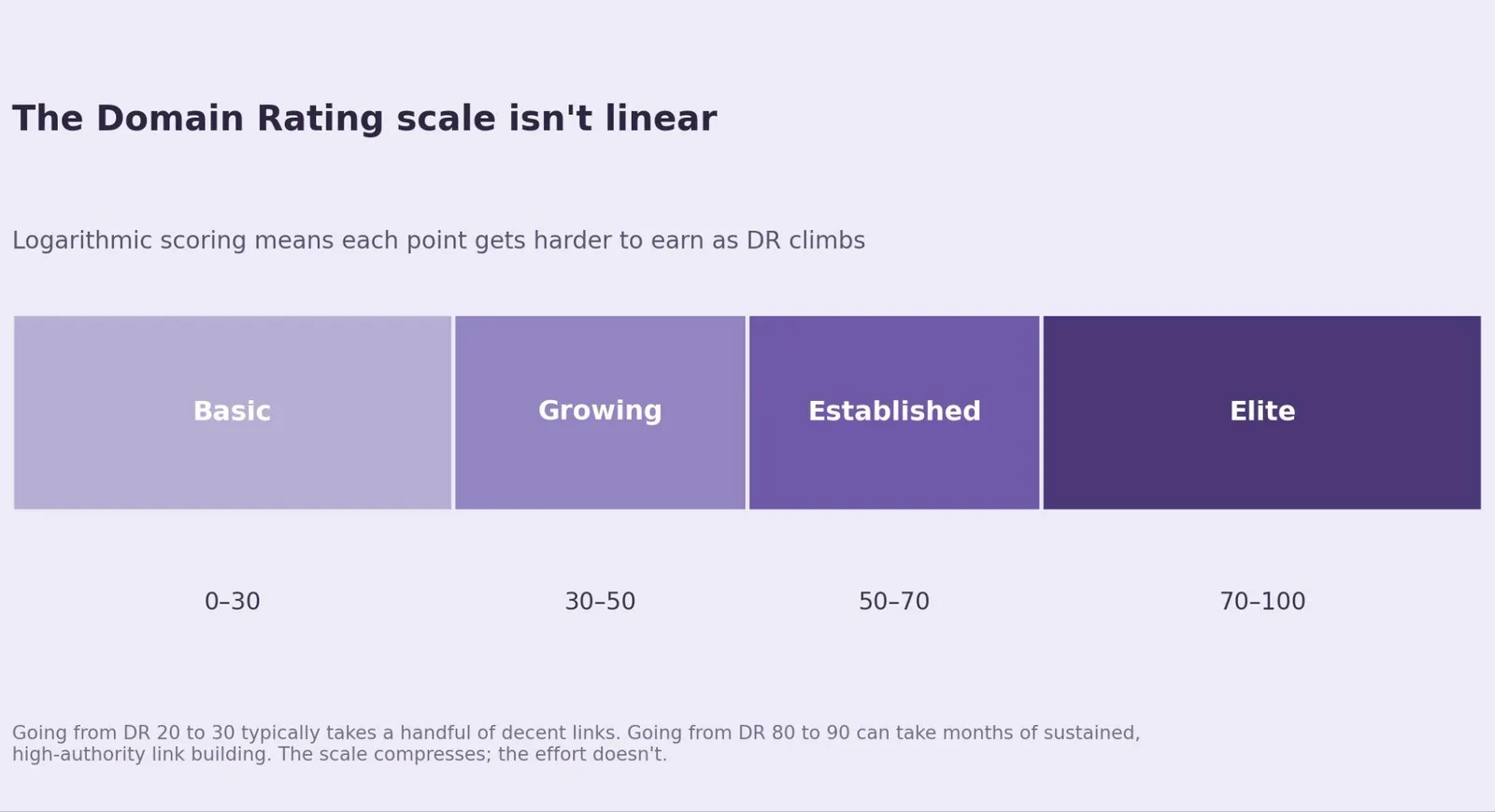
- The scale is logarithmic, not linear. Moving from DR 20 to 30 is far easier than moving from DR 80 to 90.
- DR is not a Google ranking factor. Google's John Mueller has said this repeatedly and directly across multiple years, on the record.
- A DR above 70 is generally considered strong; most small or newer sites sit well below 30.
- Nofollow links contribute zero DR, and multiple links from the same referring domain don't stack the way people assume.
- DR correlates with rankings without causing them. High DR and good rankings both tend to come from the same underlying thing: genuinely strong content that earns real backlinks.
What domain rating actually measures
DR deliberately leaves out traffic, spam signals, domain age, and other non-link variables, and Ahrefs is transparent about that narrowness. Ahrefs built it deliberately narrow: DR is a pure link-graph score, nothing more.
Because it's link-graph math, DR treats links unevenly on purpose. Ahrefs weighs high-quality, topically relevant backlinks heavily, so one strong link can outweigh dozens of weak ones, while nofollow links contribute zero value and multiple links from the same referring domain don't stack the way people assume.
Domain rating vs. domain authority vs. page authority
Ahrefs' Domain Rating and Moz's Domain Authority both run on a 0–100 scale and both try to describe website authority in some form, but they're built by separate companies using separate link indexes and separate formulas, so the numbers for the same site rarely match. Domain Rating, Domain Authority, and SEMrush's Authority Score are best understood as cousins, not twins.
| Metric | Created by | What it measures | Update frequency |
|---|---|---|---|
| Domain Rating (DR) | Ahrefs | Pure backlink-graph strength (referring domains + link quality) | Near-real-time |
| Domain Authority (DA) | Moz | Machine-learning prediction of ranking potential, 40+ signals | Periodic (roughly monthly) |
| Page Authority (PA) | Moz | The same underlying model as DA, applied to a single page rather than the whole domain | Periodic (roughly monthly) |
| Authority Score | Semrush | Backlink signals combined with organic traffic and spam-risk factors | Periodic |
Moz founder Rand Fishkin has described Domain Authority as essentially the same model as Page Authority, just run at the root-domain level instead of the individual-page level. That's a useful mental shortcut: PA asks how strong one URL is, and DA asks the same underlying question about the whole domain.
Is domain rating a Google ranking factor?
No, and this isn't speculation. Google's John Mueller stated in 2020 that Google does not use Domain Authority in any capacity when crawling, indexing, or ranking pages, and in a 2022 Reddit reply he added that he couldn't recall checking a single site's DA in his 14 years working at Google. Neither DR nor DA nor Authority Score are Google ranking factors. Ahrefs itself is transparent that there's no evidence any search engine uses Domain Rating as a direct signal either.
There's a genuinely interesting wrinkle worth knowing about, and it's more nuanced than a flat "Google says no." A 2024 leak of Google's internal Content Warehouse API surfaced a feature analysts labeled siteAuthority, suggesting Google's own systems compute some form of domain-level trust signal internally. That's a different thing entirely from Moz's trademarked Domain Authority metric; it confirms Google may weigh site-level trust in some form, not that Moz or Ahrefs have cracked what that internal signal actually is. This nuance doesn't mean DR secretly matters after all. High DR and good rankings tend to show up together because they share the same root cause: genuinely strong content earning genuinely strong backlinks. Google isn't reading your Ahrefs dashboard.
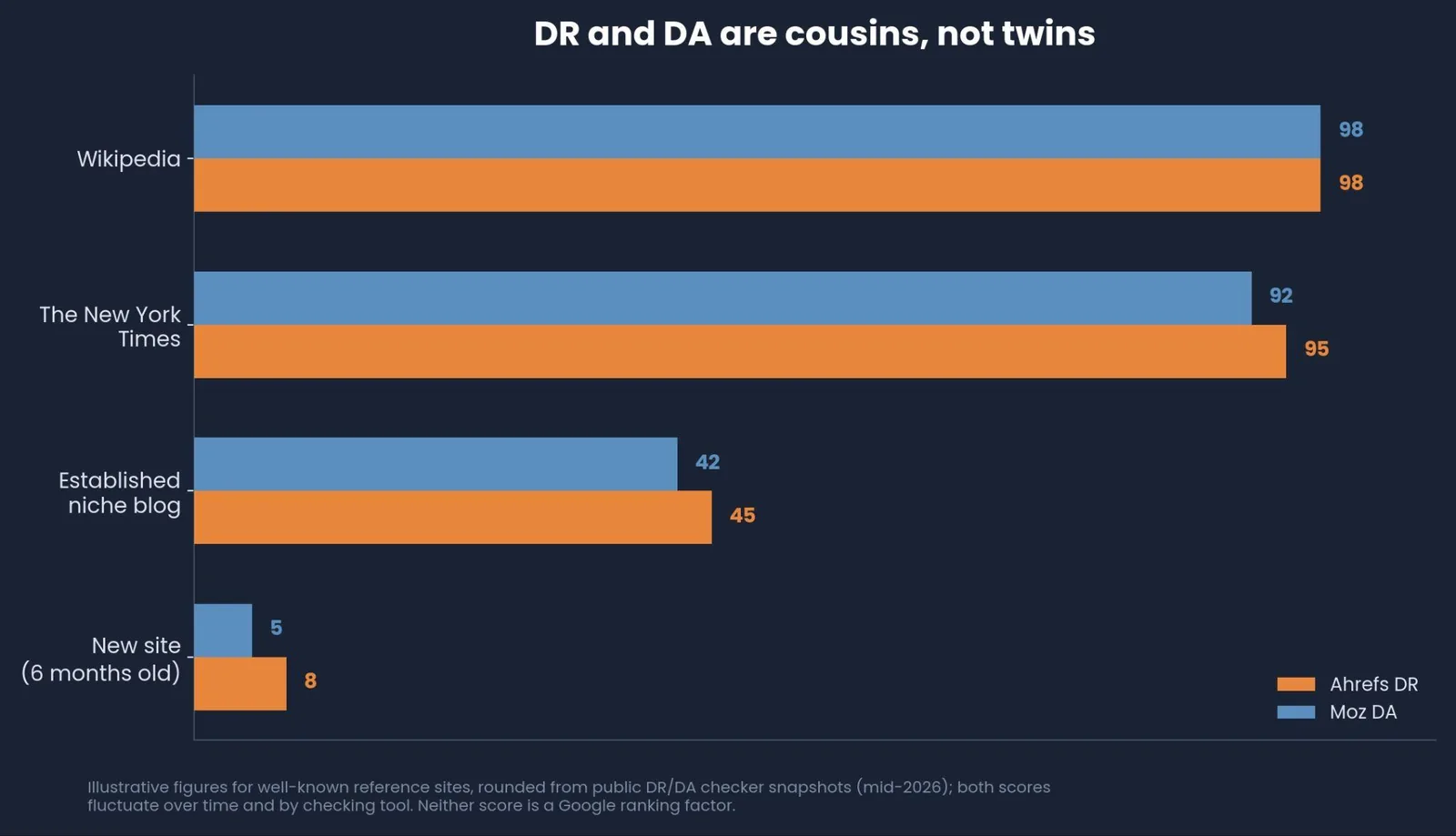
Almost no site ever gets close to a perfect score; Facebook, YouTube, and Wikipedia are among the rare handful that land in the high 90s. Further down that ceiling, sites like BBC.com and The New York Times still sit in the low-to-mid 90s, built on years of citations from universities, government sources, and other major outlets.
What a good domain rating actually looks like
What good domain rating looks like depends entirely on who you're competing against, not on a fixed number. A DR of 35 might be a strong, credible score for a local service business and a weak one for a national media brand. Instead of chasing an arbitrary target, run a quick competitor check on the search engine results for your target keywords and see where their DR actually sits.
As a rough, industry-agnostic reference point, a DR of 70 and above is generally considered strong, sites in the 30–70 range represent solid, functioning backlink profiles for most established businesses, and anything under 30 is typical for newer or smaller sites still building their first real links.
How domain rating connects to AI search visibility
DR's relevance hasn't shrunk in the age of AI search, it's just shifted. A February 2026 study from Fullintel and the University of Connecticut, presented at IPRRC, put the share of AI citations sourced from earned media above 89%, real journalism and third-party coverage, not content brands publish about themselves. Sites that build genuine DR through editorial coverage and digital PR tend to get cited by tools like ChatGPT, Perplexity, Gemini, and Google AI Overviews. Sites that inflate DR through junk link blasts generally don't. AI retrieval systems pull from the open web's actual credibility signals, not a DR database.
Building DR the durable way
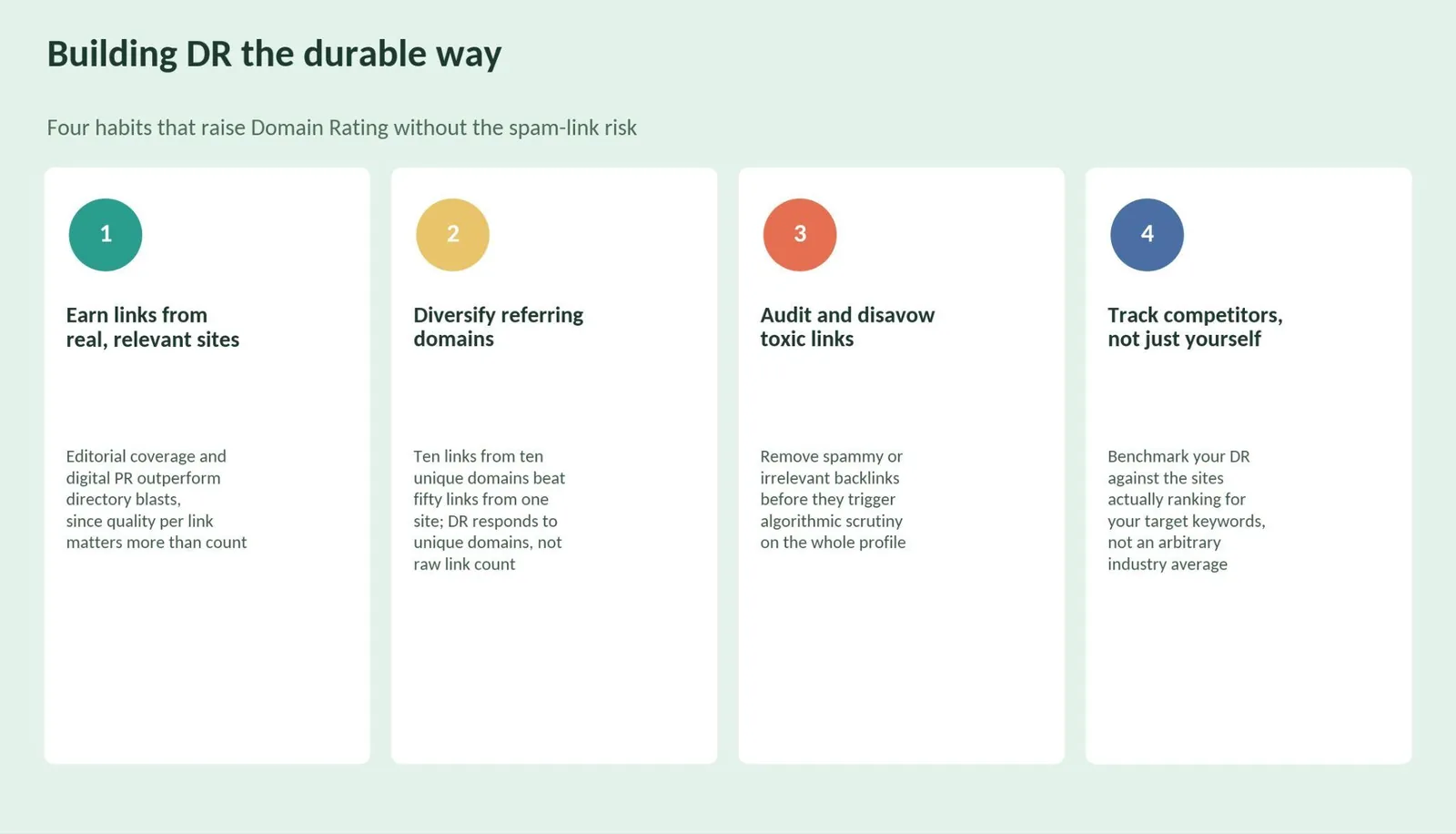
Campaigns built around genuine media coverage tend to show up in DR within a fiscal quarter or two, rather than overnight. Four habits separate durable DR growth, the kind that survives Ahrefs' next algorithm refinement, from the kind that doesn't:
- Prioritize referring domain diversity over raw link count. Ten links from ten unique, relevant domains move DR further than fifty links from a single site.
- Treat sudden spikes as a red flag, not a win. A site jumping 20 DR points in a single month from spammy directory placements is a pattern worth investigating, not a sign of real authority.
- Audit and disavow toxic links periodically, especially after a bulk outreach or guest-posting campaign, before a low-quality cluster drags down trust in the rest of the profile.
- Benchmark against competitors, not an industry average. The only DR number that matters is the one the sites actually ranking for your keywords are sitting at.
This kind of sustained link building and digital PR work is a full seo strategy in itself, not a one-time project. Moz, the digital marketing tool suite behind Domain Authority, and Ahrefs both publish their scores as tools for exactly that kind of ongoing work.
Common mistakes to avoid
- Treating DA 50 and DR 50 as equivalent scores. The scales aren't interchangeable; there's only a loose correlation between the two companies' numbers.
- Chasing a round-number DR target with no competitive context. A DR of 40 might already beat everyone ranking for your keywords, or it might not be close.
- Assuming a link-building campaign worked because DR went up fast. A rapid spike from low-quality link blasts is far more often a warning sign than a genuine win.
- Ignoring content and search intent because a site's DR looks strong. A high-DR page still loses to a more relevant, better-matched page constantly.
- Skipping a disavow review after aggressive outreach. Toxic backlinks accumulated from bulk guest posting or PPC-adjacent link networks can quietly drag down an otherwise healthy profile.
Try it yourself: domain rating tier lookup
Slide to any DR score to see what tier it falls into and what that typically means in practice.
Video Title CTR Score Checker
Type a working title below. This runs a quick heuristic check against common YouTube title patterns, not YouTube's actual algorithm.
FAQ
Can a low-DR site outrank a high-DR competitor? Yes, regularly. Backlinko's own blog has ranked on page one for competitive SEO terms with a DA in the 60s, well below many sites it outranks, because content quality, search intent match, and relevance carry real weight that DR alone can't capture.
Does disavowing links improve Domain Rating? Sometimes modestly, but it's rarely the main lever. Removing genuinely toxic links protects against future drops more than it produces gains on its own; new, high-quality backlinks do the heavy lifting.
Why do Ahrefs and Moz show different scores for the same site? Because they're separate companies running separate crawlers against separate link indexes with separate formulas. A DR of 62 and a DA of 48 for the same domain isn't an error; it's just two different measurement systems answering slightly different questions.
Use the number, don't chase it
Domain Rating is a genuinely useful proxy for one thing: how strong a site's backlink profile is right now, relative to its competitors. It's not a ranking factor, it's not the goal of an SEO program, and it's not interchangeable with Domain Authority or Authority Score, whatever a client's board deck might imply.
Use it to benchmark competitors, vet link opportunities, and track whether your link-building work is moving in the right direction. Build the content and backlinks that earn a higher score honestly, and the ranking benefits tend to follow. The underlying work was the same all along.
Building a durable backlink profile is exactly the kind of off-site SEO and digital PR work our team at Web Tonic handles for clients who'd rather see their domain authority grow through real coverage than risky link shortcuts.
More from Web Tonic: growth marketing services, data & analytics, performance creative.
Sources: outrank.so · rightblogger.com · userp.io · joinindexed.com · presswhizz.com · keyword.com · seroundtable.com · seojuice.com · searchatlas.com · reporteroutreach.com · loganix.com · skyseodigital.com