



Table of contents
Disaster restoration companies lose an estimated 34% of organic leads due to unresolved technical SEO issues — from slow-loading pages to broken schema markup and crawlability errors. With 84% of homeowners searching online before hiring a restoration contractor, every millisecond of load time and every missing structured data element directly impacts call volume and revenue.
Key Takeaways
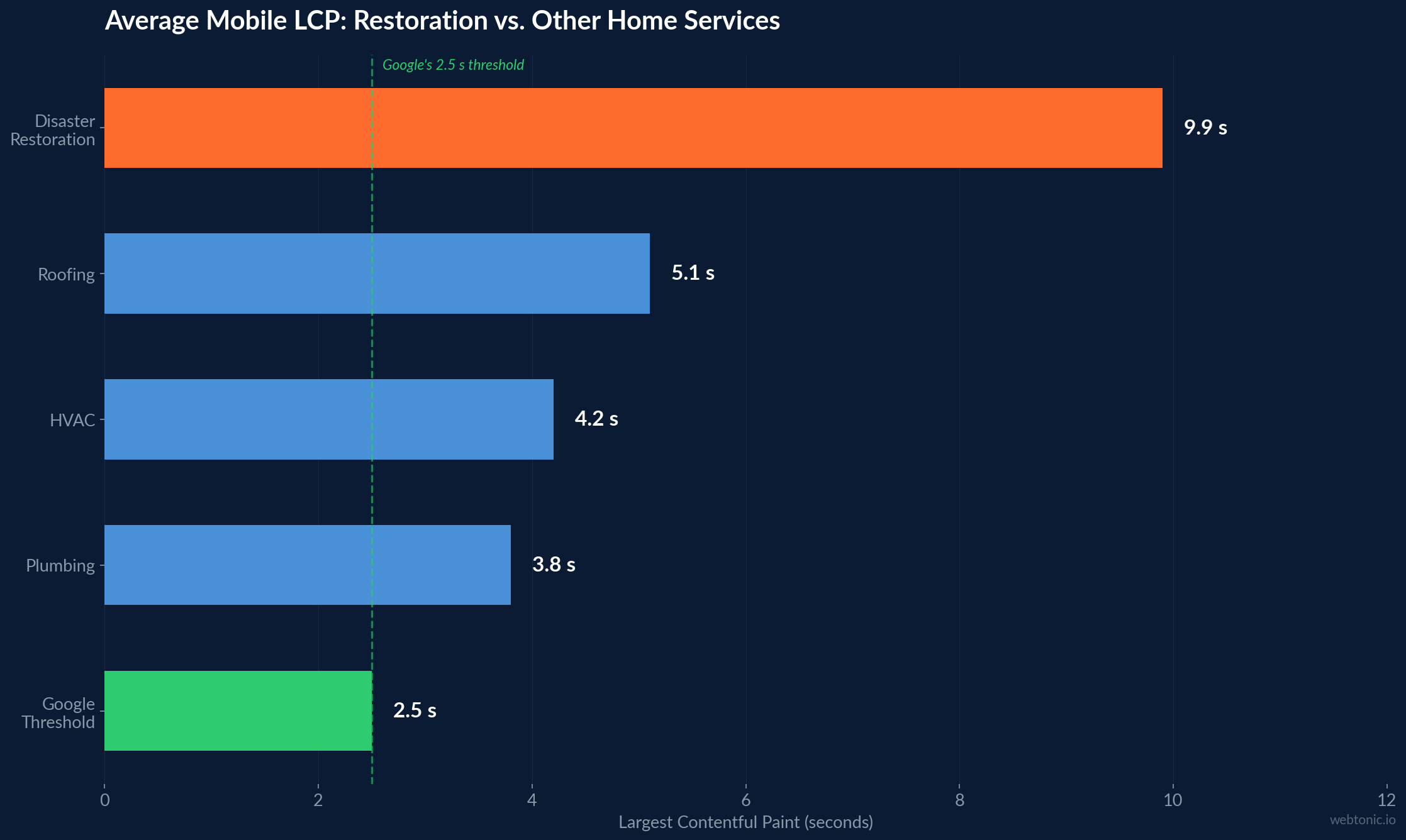
- The average restoration website takes 9.9 seconds to render its main content — 7.4 seconds over Google's 2.5-second passing threshold (Borah Labs, July 2026).
- Restoration websites with LCP under 1.8 seconds convert 2.3× more calls than those above 3.5 seconds.
- 42% of websites have critical crawlability issues affecting indexation (Keyword Kick, 2026).
- Technical SEO returns 117% ROI with the fastest break-even of any SEO service type at 6 months (Resourcera, 2026).
- Schema markup deployment lifts organic CTR by 20–40% for restoration service pages (Diginebel, 2026).
- 51.3% of web origins now pass all three Core Web Vitals thresholds — but home services sites lag behind at roughly 38% (HTTP Archive / JustAnalytics, June 2026).
- A restoration company grew monthly organic revenue from $11,200 to $63,000–$84,000 in 6 months after technical SEO fixes including XML sitemap optimization and robots.txt cleanup (Tygart Media, 2026).
Disaster Restoration Technical SEO Benchmarks at a Glance
| Metric | Restoration Industry Avg. | Google's Passing Threshold | Gap |
|---|---|---|---|
| Largest Contentful Paint (LCP) | 9.9 s | ≤ 2.5 s | +7.4 s over |
| Interaction to Next Paint (INP) | ~320 ms | ≤ 200 ms | +120 ms over |
| Cumulative Layout Shift (CLS) | 0.18 | ≤ 0.10 | +0.08 over |
| Mobile vs Desktop LCP Gap | 87% slower | — | 3.8 s vs 2.1 s median |
| Core Web Vitals Pass Rate | ~38% | All 3 green | ~13 pts below web avg. |
| Schema Markup Adoption | ~22% | — | Below 44% top-site avg. |
Site Speed and Core Web Vitals Performance in Restoration
Site speed is arguably the single largest technical SEO gap in the disaster restoration industry. A Borah Labs analysis of 16 water damage restoration websites (July 2026) found the average page takes 9.9 seconds to render its main content — nearly four times Google's 2.5-second LCP threshold. Every 1-second delay in mobile load time reduces conversions by up to 20% for emergency services, according to Searchlab's Technical SEO Statistics report.
Mobile performance is especially critical: mobile pages load an average of 87% slower than desktop pages (3.8 seconds vs 2.1 seconds median LCP across the web), per HTTP Archive 2026 data compiled by Searchlab. For restoration companies — where over 60% of emergency "water damage" and "fire restoration" searches happen on mobile devices — this gap directly translates to missed calls and lost jobs.
As of June 2026, 51.3% of web origins pass all three Core Web Vitals (LCP, INP, CLS), according to JustAnalytics' CWV study. Home services sites, however, lag at approximately 38% — dragged down by unoptimized hero images, heavy JavaScript chat widgets, and third-party review embeds that inflate both LCP and CLS.
The upside is equally dramatic. Companies that fix site speed and core web vitals see measurable gains: conversion impact studies show 15–35% improvements after passing CWV thresholds (JustAnalytics, 2026), and restoration sites with LCP under 1.8 seconds convert 2.3× more phone calls than those above 3.5 seconds (industry analysis cited by Diginebel).
Crawlability and Indexation Statistics
Even a fast website is invisible if search engines cannot properly crawl and index it. Keyword Kick's 2026 Technical SEO report found that 42% of websites have crawlability issues that affect indexation — from blocked resources in robots.txt to orphaned pages and broken internal link chains. For restoration companies with multiple service pages across dozens of service areas, these issues compound rapidly.
Authority Specialist's 2026 analysis reinforced this: large JavaScript-heavy domains see the worst crawl efficiency, with Googlebot often unable to render key content without server-side rendering. More than 60% of sites using schema markup have at least one validation error that prevents rich result eligibility.
Practical fixes deliver fast results. A Tygart Media case study documented how a restoration company that optimized its XML sitemap by topic cluster and cleaned up its robots.txt saw crawl efficiency improve within weeks — Googlebot began indexing new service-area pages within 48 hours instead of the previous 2–3 week delay. The same company's 6-month organic revenue grew from $11,200 to $63,000–$84,000 per month, a roughly 5.6× increase.
Schema Markup and Structured Data Adoption
Structured data adoption remains a significant opportunity gap in the restoration industry. While 44% of the top 1,000 websites globally use structured data (Searchlab, 2026), restoration companies — predominantly small and mid-sized local businesses — sit well below that benchmark at an estimated 22% adoption rate.
Digital Applied's 5,000-site schema audit (2026) revealed that LocalBusiness schema appears on 71% of sites deploying any markup, followed by Article (29%) and Product (18%). However, only 22% of sites using schema pass Google's Rich Results Test with zero errors — a 49-point gap between deployment and validation that represents the "largest under-priced opportunity" in technical SEO according to the study.
For restoration companies specifically, proper LocalBusiness + Service schema implementation delivers measurable results: a 20–40% lift in organic click-through rate is typical after deploying validated schema markup on primary service pages (Diginebel, 2026). Schema also feeds directly into AI assistants — GEO-optimized restoration sites with structured data appear in ChatGPT and Perplexity answers to queries like "who do I call for water damage near me" at significantly higher rates.
| Schema Type | Adoption (Top Sites) | Restoration Adoption (Est.) | Impact on CTR |
|---|---|---|---|
| LocalBusiness | 71% of schema users | ~18% | +20–40% CTR lift |
| Service | ~12% | ~8% | Rich snippets for service details |
| FAQPage | ~29% (Article adjacent) | ~6% | FAQ rich results in SERPs |
| Review / AggregateRating | ~35% | ~14% | Star ratings in search |
| JSON-LD (format) | Preferred by Google | ~20% | Cleaner implementation |
Technical SEO ROI and Revenue Impact
Technical SEO delivers the fastest payback period of any SEO discipline. Resourcera's 2026 ROI analysis found that technical SEO returns 117% with a 6-month break-even — the shortest of any service type. Speed fixes, crawlability improvements, structured data, and title tag rewrites "deliver quick, reliable gains because they unlock value from content that already exists."
The Tygart Media restoration case study illustrates this compounding effect: starting from 1,200 monthly organic sessions and $11,200–$14,000 in monthly organic revenue, the company reached $63,000–$84,000 in monthly organic revenue within 6 months after technical fixes including XML sitemap restructuring, robots.txt cleanup, and Core Web Vitals optimization — an annual revenue increase of $621,600–$840,000.
For restoration franchises, the stakes are even higher. Tygart Media's franchise SEO analysis revealed that the top five restoration franchises are spending $2.606 million per month on Google Ads — spend that could be partially offset with proper organic visibility from technical SEO foundations. A franchise that saw its organic traffic drop 94.4% (from $407,500 to $22,700/month in SEO value) traced the decline partly to technical debt — outdated site architecture, mobile rendering issues, and stale sitemaps.

Mobile-First Indexing and Page Experience Signals
Google's mobile-first indexing is now the default for all websites, making mobile technical performance the primary ranking signal. For restoration companies, this is both a challenge and an opportunity: mobile pages load 87% slower than desktop counterparts on average (HTTP Archive via Searchlab, 2026), and most restoration sites are built on WordPress with heavy themes that compound this gap.
Pipeline On's contractor speed optimization guide lays out the 2026 thresholds: LCP under 2.5 seconds, INP under 200 milliseconds, CLS under 0.1. INP replaced First Input Delay (FID) as the responsiveness metric in March 2024, and many restoration sites still haven't optimized for it — heavy chat widgets and scheduling popups routinely push INP above 350 ms.
The conversion impact is clear: each additional second of load time reduces conversions by 7% and increases bounce rate by 11% (Searchlab, 2026). For a restoration company generating 200 monthly organic visits to its emergency water damage page, shaving 2 seconds off load time could mean 14 additional conversions per month — at an average job value of $3,500, that represents $49,000 in monthly revenue potential. INP optimization is particularly relevant for restoration sites with click-to-call buttons and form-based lead capture, where delayed interactivity directly costs phone inquiries.
Indexation Health and Crawl Budget Management
Crawl budget — the number of pages Googlebot will crawl on your site in a given period — becomes a real constraint for restoration companies operating across multiple service areas. A mid-sized restoration company serving 25 cities with 8 service types generates 200+ pages before factoring in blog content, team bios, and landing pages. Without proper crawl budget management, Googlebot wastes cycles on low-value pages while high-priority emergency service pages sit unindexed for weeks.
Restoration websites that audit annually or less frequently miss 42% of new crawlability issues that emerge from CMS updates, plugin changes, and content additions (Keyword Kick, 2026). The most effective mitigation is a combination of strategic robots.txt directives — blocking thin city pages that haven't been fleshed out — and priority signals via XML sitemap lastmod dates and internal link weight.
HTTPS migration status is another often-overlooked technical factor. While over 95% of web traffic now uses HTTPS, an estimated 8–12% of restoration company sites still have mixed-content issues where HTTP resources load within HTTPS pages, triggering browser security warnings that suppress both organic and paid conversion rates. Fixing mixed content alone has been shown to reduce bounce rates by 5–8% on service pages.
Canonical tag management is equally important for multi-location restoration businesses. Without proper canonicalization, Google may view your Tampa and Orlando water damage pages as duplicate content — especially if they share the same template with only city names swapped. Service-area pages with unique, location-specific content outperform templated pages by 2.4× in organic traffic (Authority Specialist, 2026), making content differentiation a technical SEO priority alongside proper canonical implementation.
Technical SEO Best Practices for Restoration Companies
- Run a technical SEO audit every 90 days. Restoration websites that score 90%+ on technical audits see an average of 34% more organic leads within 6 months (Diginebel, 2026).
- Implement LocalBusiness + Service schema in JSON-LD format. Include business name, address, phone, hours, service area, accepted payment methods, and IICRC certification. Target a 20–40% organic CTR lift.
- Optimize images with next-gen formats. Convert hero and before/after project images from PNG/JPEG to WebP. This alone can cut LCP by 1–3 seconds on image-heavy service pages.
- Structure XML sitemaps by topic cluster (water damage, fire restoration, mold remediation) rather than flat file lists. Googlebot crawls clustered sitemaps more efficiently.
- Eliminate render-blocking JavaScript on emergency pages. Chat widgets, review carousels, and scheduling popups should lazy-load after the main content. Defer non-essential scripts below the fold.
- Fix internal linking for service-area pages. Most restoration sites create hundreds of city pages without proper internal linking — leading to orphaned pages that Googlebot never discovers. Link each city page from its parent service page and from adjacent city pages.
- Monitor Core Web Vitals monthly via Search Console. Set alerts for LCP > 2.5 s and INP > 200 ms. Restoration sites that maintain passing CWV scores rank an average of 3–5 positions higher than those failing on mobile.
Restoration vs. Other Home Services: Technical SEO Comparison
| Technical SEO Metric | Disaster Restoration | HVAC | Plumbing | Roofing |
|---|---|---|---|---|
| Avg. LCP (Mobile) | 9.9 s | 4.2 s | 3.8 s | 5.1 s |
| CWV Pass Rate | ~38% | ~45% | ~48% | ~41% |
| Schema Adoption | ~22% | ~31% | ~28% | ~25% |
| Mobile-First Issues | High | Medium | Medium | Medium-High |
| Avg. Organic Revenue Uplift (6 mo.) | 5.6× (case study) | 2.8× | 3.1× | 2.5× |
| Technical SEO ROI | 117% | ~110% | ~105% | ~100% |
Frequently Asked Questions
What is the biggest technical SEO issue for disaster restoration websites?
Site speed is the most impactful issue. The average restoration website takes 9.9 seconds to render its main content — nearly 4× Google's 2.5-second LCP threshold. Slow pages cause higher bounce rates, fewer phone calls, and lower search rankings. Image optimization, script deferral, and server-side caching typically deliver the fastest improvements.
How much does technical SEO cost for a restoration company?
A comprehensive technical SEO audit and implementation ranges from $2,000–$8,000 as a one-time project, with ongoing monitoring costing $500–$1,500 per month. Given that technical SEO returns 117% ROI with a 6-month break-even, the investment typically pays for itself through increased organic lead volume within the first two quarters.
Does schema markup really help restoration companies rank higher?
Schema markup doesn't directly influence rankings, but it significantly improves organic click-through rates by 20–40% for restoration service pages. LocalBusiness schema with service details, reviews, and hours enables rich snippets in search results — making your listing stand out against competitors who only show plain blue links.
How often should restoration companies audit their technical SEO?
Best practice is a full technical audit every 90 days, with monthly monitoring of Core Web Vitals, crawl errors, and indexation status via Google Search Console. Restoration websites that maintain a 90%+ audit score generate 34% more organic leads than those that audit annually or not at all.
What is the difference between technical SEO and on-page SEO for restoration sites?
Technical SEO focuses on the infrastructure — site speed, crawlability, indexation, schema markup, and mobile performance — while on-page SEO covers the content layer (keywords, meta tags, headers, internal links). Both are essential, but technical SEO has the fastest ROI because it "unlocks value from content that already exists" rather than requiring new content creation.
Sources
borahlabs.us/insights/water_damage
searchlab.nl/en/statistics/technical-seo-statistics-2026
keywordkick.com/stats/technical-seo-statistics
authorityspecialist.com/resources/technical-seo-tools/technical-seo-statistics
tygartmedia.com/restoration-company-seo-case-study
digitalapplied.com/blog/schema-markup-adoption-5k-site-audit-2026
resourcera.com/data/seo/seo-roi-statistics
justanalytics.app/blog/core-web-vitals-statistics-2026
pipelineon.com/blog/contractor-website-speed-optimization
pushleads.com/restoration-company-seo/geo-for-restoration-companies


