



Table of contents
The U.S. disaster restoration market generates $12–$15 billion in annual revenue, and organic search captures a growing share of customer acquisition. Below are the SEO statistics that restoration companies need to benchmark their digital performance in 2026.
Key Takeaways
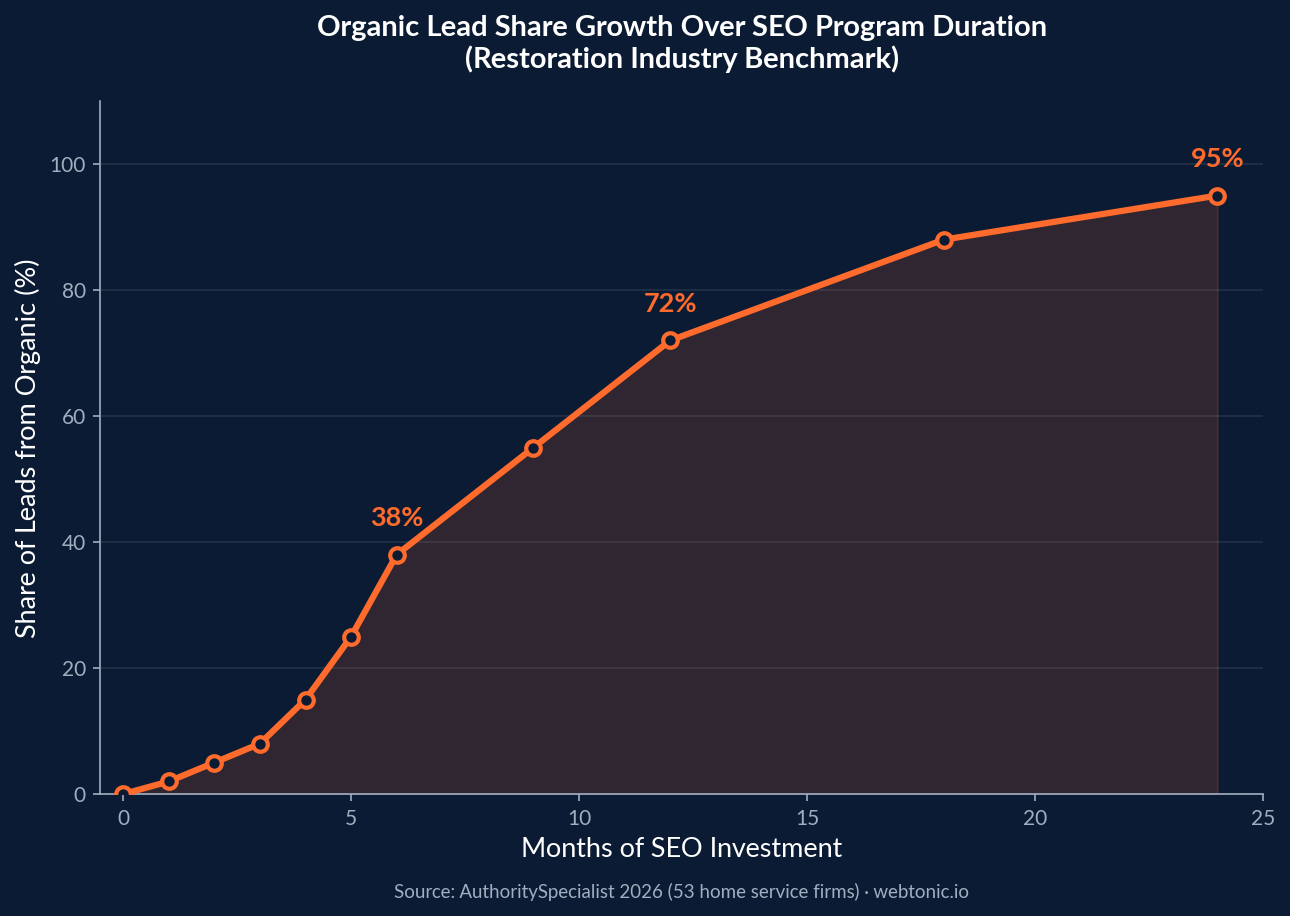
- 42–61% of inbound leads come from organic search for restoration firms with 12+ months of consistent SEO investment.
- Emergency-intent queries generate local pack click-through rates 2–3× higher than informational queries in the restoration vertical.
- Average residential water damage jobs range from $3,000 to $12,000, making organic search one of the highest-ROI acquisition channels.
- Google Ads PPC costs $100–$200 per click for water damage restoration in saturated U.S. markets.
- Restoration sites ranking in the top 3 Google Map Pack positions capture a disproportionate share of after-hours emergency calls.
- The average restoration website takes 9.9 seconds to render main content — 7.4 seconds over Google's 2.5-second LCP threshold.
- Firms with 20+ indexed pages outrank thinner competitors in 78% of head-to-head market comparisons.
- SEO returns compound over 6–12 months as domain authority builds, unlike PPC which stops producing leads when spend stops.
Disaster Restoration SEO Benchmarks at a Glance
| Metric | Benchmark | Source |
|---|---|---|
| Organic lead share (12+ mo. SEO) | 42–61% | AuthoritySpecialist 2026 |
| Emergency query local pack CTR lift | 2–3× vs. informational | AuthoritySpecialist 2026 |
| Top 3 local result click share | ~68% | Marketing LTB 2026 |
| Avg. residential water damage job value | $3,000–$12,000 | AuthoritySpecialist 2026 |
| PPC cost per click (saturated markets) | $100–$200 | AuthoritySpecialist 2026 |
| Avg. page LCP (restoration sites) | 9.9s (2.5s target) | Borah Labs 2026 |
| Content depth advantage (20+ pages) | 78% win rate | AuthoritySpecialist 2026 |
| Location page conversion lift | 1.8× vs. generic page | AuthoritySpecialist 2026 |
| Online search before contact | 84% of customers | Marketing LTB 2026 |
| Voice search YoY growth (emergency) | +20% | Marketing LTB 2026 |
The SEO Opportunity in Disaster Restoration
The economics of disaster restoration create a uniquely compelling case for SEO investment. With average residential water damage jobs ranging from $3,000 to $12,000 and commercial losses running multiples higher, even a single additional organic lead per month can justify an entire SEO program. A restoration company spending $1,500 per month on SEO that closes one incremental $4,000 job is immediately cash-flow positive — before accounting for repeat referrals and online reviews that compound visibility over time.
The United States water damage restoration market alone is valued at roughly $12–$15 billion in annual revenue, driven by aging housing stock, more frequent extreme weather events, and expanding commercial restoration work. According to AuthoritySpecialist's 2026 benchmark data from 34 restoration contractors, organic search represents the highest-ROI acquisition channel when cost-per-lead is compared against Google Ads and other paid alternatives.
The competitive landscape is intensifying. Google's 2024 local algorithm updates have widened the gap between page-one and page-two operators in dense metros, making sustained SEO investment more critical than ever for restoration businesses across the U.S. and beyond.
Google Business Profile and Google Map Pack Statistics
For disaster restoration companies, Google Business Profile (GBP) and the Google Map Pack dominate local search visibility. According to Marketing LTB's 2026 restoration marketing statistics:
- 57% of restoration companies say GBP is their top lead source.
- 84% of restoration customers search online before contacting a company.
- Optimized Google Business Profiles receive 5× more direction requests than unoptimized profiles.
- 81% of restoration searches include local intent terms like "near me" or a city name.
The three signals that determine Google Maps rankings — proximity, prominence, and relevance — require active management. Google Business Profile optimization starts with accurate primary and secondary categories, complete service descriptions, regular geo-tagged photo uploads, and active review management. Using Google Search Console alongside GBP Insights helps restoration companies track which queries trigger their local listing.
Tygart Media's A/B tests confirm that review response programs produce a 14% local visibility lift (p=0.04) and weekly GBP posting generates +89% more calls than monthly posting across 18 tested restoration companies. Schema markup implementation drives 3× more AI Overview appearances — a significant advantage as Google's AI-powered search features expand.
Keyword Data and Search Demand
Google Keyword Planner and SEO tools like Semrush reveal substantial search demand for restoration services at the local level. In most metro areas, combined monthly search volume for water damage restoration terms runs into thousands of impressions per month, with sharp spikes following flood or freeze events.
| Keyword Category | Search Intent | Competitive Level | Conversion Rate |
|---|---|---|---|
| Emergency ("water damage near me") | Immediate action | Very high | 15–25% |
| Service-specific ("mold remediation [city]") | Solution evaluation | High | 10–18% |
| Cost-related ("water damage repair cost") | Research / comparison | Moderate | 5–12% |
| Insurance ("water damage insurance claim") | Process information | Moderate | 3–8% |
| DIY / informational ("how to dry carpet") | Self-service | Low | 1–3% |
Emergency-intent queries generate local pack CTRs 2–3× higher than informational queries in the restoration vertical. According to Tygart Media's restoration SEO playbook, each core service — water damage, fire damage, mold remediation, smoke damage, biohazard, contents — needs its own dedicated page targeting a primary keyword in the title tag, H1, and first paragraph, expanded to 1,200–2,000 words of substantive content covering the process, insurance procedures, certifications, and a strong call to action.
Technical SEO and Website Performance
Technical SEO forms the foundation that determines whether content and backlink investments translate into rankings. According to Borah Labs' 2026 water damage website benchmark study, the average restoration page takes 9.9 seconds to render its main content — more than 7.4 seconds over Google's 2.5-second LCP threshold.
Key technical SEO benchmarks for restoration websites:
- Core Web Vitals passing rate is critically low across restoration sites, with most failing on LCP due to unoptimized images and heavy page builders.
- Mobile optimization is disproportionately important because emergency restoration queries overwhelmingly originate from smartphones.
- CMS selection matters — WordPress sites with proper caching and image optimization outperform bloated page-builder sites on speed metrics.
- Structured data (LocalBusiness + Service schema) helps restoration pages appear in rich results and AI Overviews.
- Google Analytics and Google Search Console integration enables tracking of organic performance by service type and location.
For restoration companies using a CMS like WordPress, addressing site speed before investing in content or link building ensures that technical issues do not negate SEO gains. Data-driven monitoring through Google Analytics helps identify which pages drive the most valuable leads.

SEO vs. PPC: The Unit Economics
The cost comparison between SEO and PPC for restoration companies is stark. According to AuthoritySpecialist, water damage restoration PPC costs $100–$200 per click in saturated markets like Houston, Miami, and Chicago. Google Ads spend can spike during storm events without a corresponding budget increase, creating unpredictable acquisition costs.
In contrast, SEO creates a compounding acquisition channel. Every month of PPC requires the same spend for the same clicks — there is no cumulative benefit. Stop spending and leads stop the same day. Restoration companies that invest in SEO typically see compounding returns as domain authority builds over 6–12 months. The cost of Google Ads makes a dual-channel strategy — PPC for immediate volume, SEO for long-term cost reduction — the most effective approach.
Content Strategy and On-Page SEO
Content depth is the most consistent performance predictor across home service SEO campaigns. According to AuthoritySpecialist's 2026 benchmark data from 53 home service firms:
- Firms with 20+ indexed service and FAQ pages outrank thinner sites in 78% of head-to-head comparisons.
- Multi-location operators with dedicated location pages convert organic visitors at 1.8× the rate of firms using a single generic service page.
- Service category pages tend to rank faster than highly competitive location pages in saturated markets.
- Firms with 2+ years of domain history see faster ranking movement within 3–5 months.
The most overlooked on-page lever is internal linking. Service pages should link to relevant blog content, location pages, and case studies. The link graph signals to Google which pages matter most. For city-specific pages, 800–1,500 words of locally relevant content — neighborhoods served, common local damage causes, response times — routinely outperforms generic pages. Voice search optimization is growing in importance: 30% of online searches are now voice-based, and "near me" voice queries have increased 146% since 2023.
SEO Measurement and ROI Tracking
Effective SEO measurement for restoration companies goes beyond keyword rankings. According to AjileMedia's SEO measurement playbook, restoration businesses should track metrics that connect SEO performance to revenue:
| Metric | What It Measures | Tool |
|---|---|---|
| Organic sessions by service page | Traffic quality by service type | Google Analytics |
| Google Map Pack impressions | Local visibility reach | GBP Insights |
| Click-to-call rate from organic | Lead quality from SEO traffic | Call tracking + Google Analytics |
| Cost per organic lead | SEO ROI vs. paid channels | CRM + Google Analytics |
| Keyword visibility by service category | SEO progress by service line | Google Search Console |
| Core Web Vitals scores | Technical SEO health | PageSpeed Insights |
The shift from vanity metrics (rankings, pageviews) to revenue-connected KPIs is essential. A restoration company tracking cost per organic lead through Google Analytics and a CRM can directly compare Google Ads CPL against organic CPL — revealing the true ROI of their SEO investment over time.
Best Practices for Restoration SEO in 2026
- Optimize your Google Business Profile first. With 57% of restoration companies citing GBP as their top lead source, it delivers the fastest ROI.
- Build dedicated service pages for every restoration category. Water damage, fire damage, mold remediation, storm damage, and biohazard each need 1,200–2,000 words of substantive, optimized content.
- Create city-specific landing pages. Location pages with local signals convert at 1.8× the rate of generic pages.
- Fix technical foundations before scaling content. Address site speed (target LCP under 2.5s), mobile optimization, and CMS configuration.
- Implement structured data. LocalBusiness and Service schema drives 3× more AI Overview appearances in Google search.
- Monitor performance through Google Search Console and Google Analytics. Track organic leads by service type and compare CPL against paid channels.
- Invest in link building alongside content. Domain authority compounds over time, delivering decreasing cost-per-lead as rankings improve.
- Plan for voice search. Structure FAQ content for conversational queries, especially emergency searches originating from mobile devices.
Related reading
- Technical SEO Adoption & ROI in Disaster Restoration: 54+ Key Stats (2026)
- Disaster Restoration Local SEO Statistics: 2026 Google Business Profile & Map Pack Data
- Disaster Restoration Link Building Statistics: 2026 Backlink Benchmarks & ROI Data
- GEO & AEO services at Web Tonic
Frequently Asked Questions
How much should a restoration company invest in SEO?
Most restoration companies invest $1,500–$5,000 per month in SEO depending on market competitiveness and service area size. Given that average residential water damage jobs range from $3,000–$12,000, even one additional organic lead per month can make the investment profitable. Companies in saturated metros like Houston or Miami may need the higher end of this range to compete effectively against franchise operations. Tracking ROI through Google Analytics and a CRM helps justify and optimize the budget.
How long does SEO take to work for restoration companies?
Most restoration SEO campaigns require 4–6 months before generating consistent organic call volume. The Google Map Pack is typically the first ranking win and primary conversion driver. Companies with existing domain authority and review history see faster results. New domains should budget 6–12 months of sustained effort. Returns compound over time — the 12–24 month period typically delivers the strongest ROI as domain authority accumulates.
What is the biggest SEO mistake restoration companies make?
Building a single generic services page instead of dedicated pages for each restoration category. According to benchmark data, firms with 20+ indexed pages outrank thinner sites in 78% of head-to-head comparisons. Each service — water damage, fire damage, mold remediation — needs its own optimized page. The second most common mistake is neglecting Google Business Profile optimization, which is the top lead source for the majority of restoration businesses.
Is SEO or PPC better for restoration companies?
They serve different roles. PPC via Google Ads provides immediate lead volume but costs $100–$200 per click in competitive markets and offers no compounding benefit. SEO requires 4–6 months before delivering consistent results but creates compounding authority where organic leads arrive without per-click costs. The most effective restoration marketing strategies use both: PPC for immediate coverage while building long-term organic authority through SEO.
How important is mobile optimization for restoration SEO?
Critical. The majority of emergency restoration searches originate from mobile devices — homeowners dealing with flooding or fire damage search from their phones. Google's mobile-first indexing means a slow or poorly optimized mobile experience directly impacts rankings. With the average restoration page taking 9.9 seconds to render on mobile, there is significant competitive advantage for companies that achieve Core Web Vitals compliance (LCP under 2.5 seconds, INP under 200ms, CLS under 0.1).
Sources
authorityspecialist.com/industry/home/water-damage-restoration/seo-statistics
authorityspecialist.com/industry/home/services/seo-statistics
authorityspecialist.com/industry/home/water-damage-restoration
marketingltb.com/blog/statistics/restoration-marketing-statistics
tygartmedia.com/seo-for-restoration-companies
tygartmedia.com/restoration-marketing-ab-tests
borahlabs.us/insights/water_damage
ajilemedia.com/the-modern-seo-measurement-playbook-for-water-damage-restoration-businesses
searchlab.nl/en/statistics/voice-search-statistics-2026


