



Table of contents
Restoration businesses that rank in Google's top 3 local results capture nearly 68% of all clicks — and in emergency searches like "water damage near me," the gap widens even further. Here are the local SEO statistics that define how disaster restoration companies win customers in 2026.
Key Takeaways
- 68% of clicks go to the top 3 local search results for restoration-related queries.
- 57% of restoration companies say Google Business Profile is their top lead source.
- 84% of restoration customers search online before contacting a company.
- 81% of restoration searches include local intent terms like "near me" or a city name.
- Optimized Google Business Profiles receive 5× more direction requests than unoptimized profiles.
- Weekly GBP posting generates +89% more calls than monthly posting across tested restoration companies.
- Emergency restoration calls spike by over 300% during major storm events.
- Voice searches for emergency restoration services have increased over 20% year over year.
Disaster Restoration Local SEO Benchmarks at a Glance
| Metric | Benchmark | Source |
|---|---|---|
| Top 3 local result click share | ~68% | Marketing LTB 2026 |
| GBP as top lead source | 57% of companies | Marketing LTB 2026 |
| Online search before contact | 84% of customers | Marketing LTB 2026 |
| Local intent search share | 81% | Marketing LTB 2026 |
| Optimized GBP direction request lift | 5× | Marketing LTB 2026 |
| Emergency-intent local pack CTR vs. informational | 2–3× higher | AuthoritySpecialist 2026 |
| Weekly GBP posting call lift vs. monthly | +89% | Tygart Media 12-week test |
| Review response visibility lift | +14% | Tygart Media A/B test |
| Local landing page conversion lift vs. generic | 2.3× | Tygart Media 60-day test |
| Voice search YoY growth (emergency restoration) | +20% | Marketing LTB 2026 |
Google Business Profile: The Cornerstone of Restoration Local SEO
For disaster restoration companies, Google Business Profile (GBP) optimization is the single highest-ROI local SEO activity. According to Marketing LTB's 2026 restoration marketing statistics, 57% of restoration companies identify GBP as their top lead source, and firms with optimized profiles receive 5× more direction requests than those with incomplete listings.
PushLeads' GBP optimization guide identifies the core Google Business Profile optimization elements that drive Map Pack visibility for restoration businesses: accurate primary and secondary categories, complete service lists with descriptions, Q&A management, regular geo-tagged photo uploads, and 24/7 availability signaling. In cities like Dallas, Austin, and Chicago, where multiple restoration franchises compete for the same emergency queries, GBP completeness often determines which three businesses appear in the Google Maps pack.
Using Google Search Console alongside GBP Insights, restoration companies can track exactly which queries trigger their local listing and monitor impression-to-click conversion rates across different service categories — from water damage to mold remediation and fire restoration.
Google Maps Pack Dominance in Emergency Searches
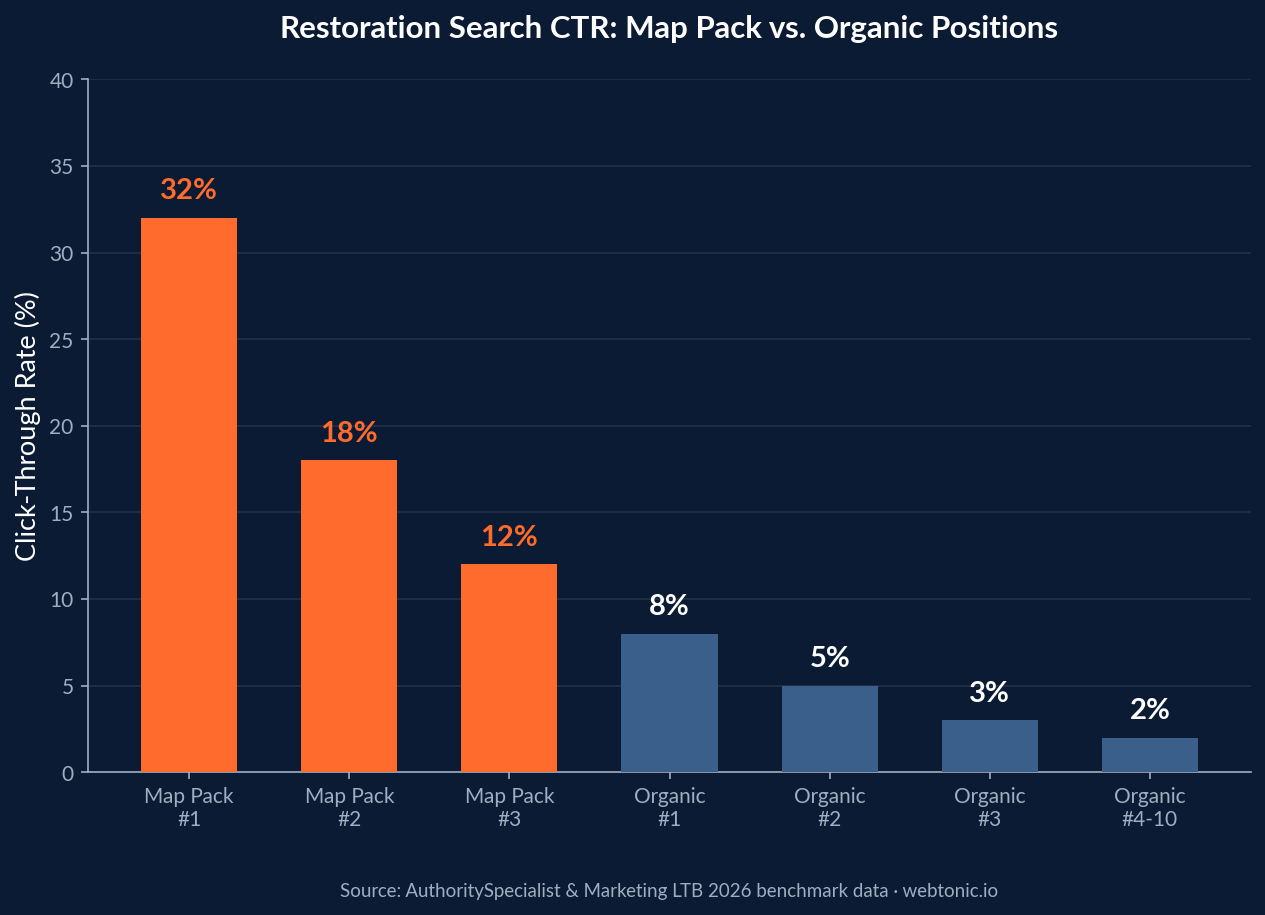
The Google Map Pack (the three local business listings displayed at the top of Google search results with a map) drives a disproportionate share of restoration leads. According to AuthoritySpecialist's 2026 benchmark data from 34 restoration contractors:
- Emergency-intent queries like "water damage repair near me" generate local pack CTRs 2–3× higher than equivalent informational queries.
- Top 3 local pack positions capture a disproportionate share of after-hours emergency calls — the highest-value segment in restoration.
- Organic rankings below position 3 see significantly lower click-through on mobile, where most emergency searches originate.
- The competitive gap between page-one and page-two operators has widened since Google's 2024 local algorithm updates.
Three signals determine Google Maps rankings: proximity (distance from the searcher to the business), prominence (review volume, link authority, brand mentions), and relevance (how clearly the GBP matches the query). For restoration companies in Texas metros like Dallas and Austin, or competitive markets like Chicago, mastering all three signals simultaneously is necessary to maintain Map Pack visibility. Apple Maps visibility is also growing as iOS users increasingly use Siri for emergency searches.
GBP Posting and Review Management Statistics
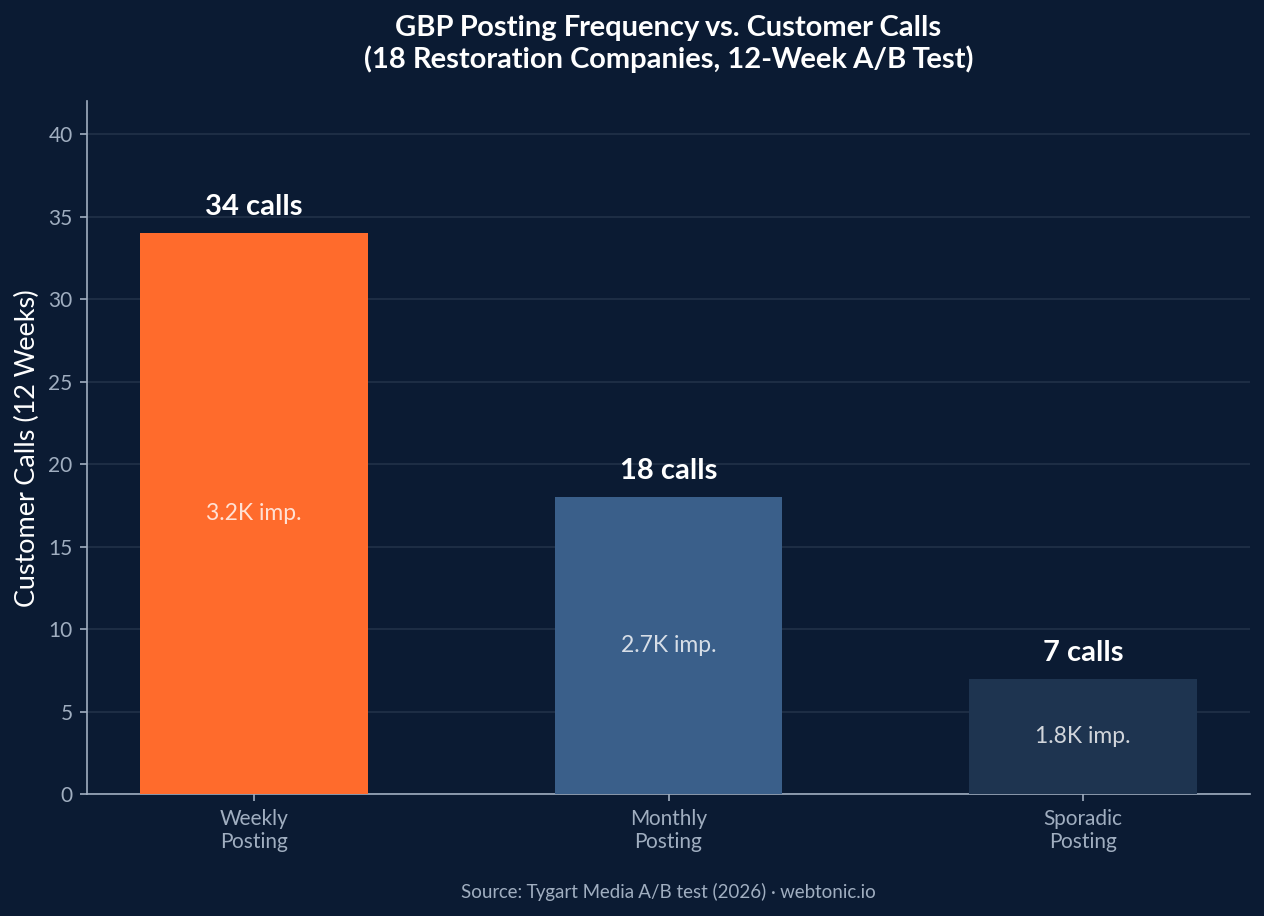
Tygart Media's controlled A/B tests across restoration companies produced quantifiable results for GBP management activities:
| Activity | Test Design | Result |
|---|---|---|
| Weekly GBP posting | 18 companies, 12 weeks, 3 cohorts | +21% impressions, +57% clicks, +89% calls vs. monthly |
| Review response program | 8 companies, 31 days, p=0.04 | 14% local visibility lift |
| Schema markup implementation | 90-day controlled test | 3× more AI Overview appearances |
| Local landing pages vs. service pages | 60-day test, $127K ad spend | 2.3× conversion rate for local pages |
The posting frequency data is particularly striking. Weekly posters versus sporadic posters saw +80% more impressions, +169% more clicks, and +386% more calls over the 12-week test period. Even generic posts outperformed sporadic high-effort posts — consistency matters more than content quality for GBP posting, with each post taking approximately 5 minutes. Agencies like Blue Corona and Ryno Strategic Solutions have incorporated these posting cadences into their standard restoration marketing packages.
Voice Search and Near-Me Query Trends
Voice search is reshaping how homeowners find restoration services during emergencies. According to SearchLab's 2026 voice search statistics:
- 30% of all online searches are now conducted via voice, rising to 42% on mobile devices.
- 22% of all voice searches have local intent, and 76% of local voice searchers visit a physical location within 24 hours.
- "Near me" voice queries have increased 146% compared to 2023.
- Service providers account for 18% of local voice queries — including emergency restoration searches.
For restoration companies, voice search optimization means structuring content to answer conversational queries. When a homeowner says "Hey Google, find water damage cleanup near me" at 2 a.m., the businesses that appear are those with complete GBP profiles, strong review signals, and content structured for featured snippets. Google's Gemini-powered AI features are further amplifying this trend, with schema-optimized restoration pages appearing 3× more often in AI Overviews. Marketing agencies like Vinnie Mac Restoration Marketing report that voice-optimized clients see measurably higher after-hours call volume.
According to Marketing LTB, 81% of restoration searches include local intent terms, and voice searches for emergency restoration services have increased over 20% year over year. Companies with localized service pages rank for more "near me" searches, and emergency restoration calls spike by over 300% during major storm events.
Local Landing Pages and City-Specific SEO
For restoration companies serving multiple cities, individual city pages are the single highest-leverage local SEO investment after core service pages. According to Tygart Media's restoration SEO playbook, a page titled "Water Damage Restoration in [City Name]" with 800–1,500 words of locally relevant content — neighborhoods served, common local damage causes, local building stock, response times — will routinely outrank both national franchise pages and generic service pages.
The data supports this approach across U.S. markets:
- Multi-location operators with location-specific landing pages convert organic visitors at 1.8× the rate of firms using a single generic service page.
- Local landing pages outperform generic service pages by 2.3× for PPC conversion rates as well, making them valuable for both organic and paid channels.
- Firms with 20+ indexed service and FAQ pages outrank thinner competitors in 78% of head-to-head comparisons.
Each location page should include a consistent NAP (Name, Address, Phone), embedded Google Maps widget, service-area-specific testimonials, and structured data markup. For Facebook and social media advertising, these same city pages serve as high-converting landing destinations for geo-targeted campaigns.
Local SEO Cost-Effectiveness vs. Paid Channels
| Channel | Cost per Click / Lead | Compounding | Emergency Intent Capture |
|---|---|---|---|
| Local SEO (organic + GBP) | $0 per click once ranked | Yes — authority compounds | Very high (Map Pack dominance) |
| Google Ads PPC | $100–$200/click (saturated markets) | None | High but costly during spikes |
| Local Services Ads | $65–$180/lead | None | High (Google-screened) |
| Facebook / social ads | $15–$45/click | None | Low (awareness-focused) |
According to AuthoritySpecialist, water damage restoration PPC costs $100–$200 per click in saturated markets like Houston, Miami, and Chicago. Local SEO eliminates that per-click exposure entirely. During storm events when PPC ad spend can spike without a corresponding budget increase, restoration companies with strong local SEO foundations capture emergency traffic at zero marginal cost. For businesses using Google Ads alongside SEO, the combination creates full-funnel coverage.
Best Practices for Restoration Local SEO
- Complete and optimize your Google Business Profile. Accurate categories, full service list with descriptions, Q&A management, and 24/7 signaling.
- Post to GBP weekly. Consistency beats quality — even simple updates generate measurably more impressions and calls.
- Respond to every review. The 14% visibility lift from review response programs is statistically significant and easy to implement.
- Build city-specific landing pages. Each service area needs dedicated content with local signals, not just a city name substitution.
- Implement LocalBusiness and Service schema. Schema markup drives 3× more AI Overview appearances and strengthens local relevance signals.
- Monitor with Google Search Console and Google Analytics. Track which queries trigger your local listing and measure impression-to-click rates.
- Build local citations consistently. NAP consistency across BBB, Yelp, Angi, HomeAdvisor, and industry-specific directories reinforces GBP signals.
- Optimize for voice search. Structure FAQ content to answer conversational emergency queries naturally. With 30% of online searches now voice-based and 22% having local intent, voice optimization is essential for capturing emergency restoration leads during after-hours calls.
Related reading
- Disaster Restoration SEO Statistics: 2026 Organic Traffic Benchmarks & Performance Data
- Technical SEO Adoption & ROI in Disaster Restoration: 54+ Key Stats (2026)
- WDR Local SEO Stats & Trends (2026)
- Local SEO Services services at Web Tonic
Frequently Asked Questions
How long does local SEO take to work for restoration companies?
Most restoration SEO campaigns require 4–6 months before organic rankings generate consistent call volume. The Google Map Pack is the primary conversion driver. Companies with existing domain authority and review history see faster results — often within 45–75 days for less competitive suburbs. Saturated metros with heavy franchise competition require longer sustained investment.
What is the most important local SEO factor for restoration companies?
Google Business Profile completeness and activity. Since 57% of restoration companies identify GBP as their top lead source, it should be the first optimization priority. Accurate categories, regular posting, active review management, and geo-tagged photos collectively determine Map Pack positioning more than any single technical factor.
Do restoration companies need separate GBP listings for each service area?
Google requires a physical location for a standard GBP listing. Service area businesses should specify their coverage area carefully rather than listing every city. Companies with legitimate physical offices in multiple cities can maintain separate verified profiles, but creating fake locations violates Google's guidelines and risks suspension.
How do near-me searches affect restoration company visibility?
With 81% of restoration searches including local intent terms and "near me" voice queries growing 146% since 2023, proximity-based optimization is critical. Google Maps and Apple Maps both prioritize businesses closest to the searcher for emergency queries. Having verified locations and consistent citations ensures your business appears when nearby homeowners search during water damage, fire, or storm emergencies.
Should restoration companies invest in local SEO or PPC first?
Both channels serve different timelines. PPC provides immediate lead volume from day one, while local SEO builds compounding authority over 6–12 months. For restoration companies in the U.S. facing $100–$200 per click PPC costs, investing in local SEO alongside paid channels creates a long-term cost reduction path. The ideal approach uses PPC for immediate coverage while local SEO authority builds.
Sources
marketingltb.com/blog/statistics/restoration-marketing-statistics
authorityspecialist.com/industry/home/water-damage-restoration/seo-statistics
authorityspecialist.com/industry/home/water-damage-restoration
tygartmedia.com/restoration-marketing-ab-tests
tygartmedia.com/seo-for-restoration-companies
pushleads.com/google-business-profile-optimization-for-restoration-companies
searchlab.nl/en/statistics/voice-search-statistics-2026
waterrestorationmarketing.com/services/google-maps-optimization
the-rmg.com/google-business-profile-optimization-for-restoration-companies


