Table of contents
Restoration companies with dedicated landing pages convert 47% better than those using generic homepages, yet 65% of contractor sites score below 70 on PageSpeed. Here is every landing page benchmark restoration marketers need for 2026.
Key Takeaways
- Dedicated landing pages convert 47% better than generic restoration websites (Marketing LTB).
- Removing navigation menus increases conversions by 40% on emergency restoration pages (Marketing LTB).
- Companies replying within 5 minutes convert 80% more leads than those taking over an hour (PipelineOn).
- The median contractor site converts just 2–4% of visitors, while top performers hit 8–15% (PipelineOn).
- 65% of water damage restoration sites score below 70 on PageSpeed, with average LCP at 9.9 seconds (Borah Labs).
- Before-and-after photos increase restoration conversion rates by 43% and video testimonials boost them by 32% (Marketing LTB).
Restoration Landing Page Conversion Benchmarks
The gap between average and top-performing recovery service landing pages is enormous. A study of 200 contractor websites across six trades — roofing, HVAC, plumbing, electrical, solar, and restoration — found consistent patterns separating high converters from low converters.
| Conversion Tier | Conversion Rate | % of Restoration Sites | Key Differentiator |
|---|---|---|---|
| Top Performers | 8–15% | 6% | Sticky CTA, sub-2s load, call tracking |
| Above Average | 4–8% | 24% | Mobile-friendly, reviews, clear phone number |
| Median | 2–4% | 40% | Basic website, limited optimization |
| Below Average | <2% | 30% | Slow load, no mobile optimization, no CTAs |
Source: PipelineOn / Contractor Website Study and OnwardCraft 200-Site Analysis
The top 6% of contractor sites convert 4× more visitors than the median on the same traffic and same ad spend. For emergency restoration pages specifically, some achieve 16% conversion rates by combining above-the-fold phone numbers, response time guarantees, and insurance billing messaging (OnwardCraft). Plumbing and pest control lead the trades at 12–15% site conversion, while construction lags at 3.65% — restoration sites that adopt emergency-optimized best practices can outperform most trade verticals.

Page Speed and Mobile Performance
Speed is the single biggest technical factor separating high-converting restoration sites from low performers. Borah Labs' 2026 audit of water damage contractor pages found alarming performance gaps across Core Web Vitals:
| Core Web Vital | Restoration Industry Avg | Google's Passing Threshold | Gap |
|---|---|---|---|
| Largest Contentful Paint (LCP) | 9.91 seconds | 2.50 seconds | +7.41s |
| First Contentful Paint (FCP) | 3.75 seconds | 1.80 seconds | +1.95s |
| Cumulative Layout Shift (CLS) | 0.02 | 0.10 | Passes |
| Time to First Byte (TTFB) | 0.07 seconds | 0.80 seconds | Passes |
The average restoration page takes 9.91 seconds to render its main content — nearly 4× slower than Google's 2.5-second threshold. Sites loading under 2.5 seconds averaged 6.8% conversion, while those over 4.5 seconds averaged just 2.1% — a 3.2× difference (OnwardCraft). Every 1-second delay reduces conversions by approximately 7%, so a 5-second site loses 35% of leads versus a 1-second site.
With 71–76% of contractor traffic coming from mobile (and up to 85–90% for emergency trades like restoration), mobile optimization is not optional. Yet only 31% of low-performing restoration sites pass Google's mobile-friendly test, compared to 94% of top performers. Speed is the differentiator most of this market has not invested in yet — 29.4% of restoration sites score in the critical PageSpeed range (0–49).
Emergency Landing Page Optimization Factors
Emergency restoration landing pages must prioritize speed and trust over traditional marketing aesthetics. Most recovery contractors lose 60% of potential emergency leads because their pages treat urgent situations like routine projects (Marketing LTB). Visitors decide within 3–8 seconds whether to engage or bounce.
Critical above-the-fold elements for emergency restoration pages:
- Phone number in header, hero section, and floating call button — over 75% of emergency restoration searches happen on mobile devices, so click-to-call functionality is essential.
- Response time commitment — stating "On-site in 60 minutes" or "24/7 emergency response" builds immediate trust with property owners in crisis.
- Insurance billing options — property owners facing water damage or fire damage need to know their restoration costs will be covered before they call.
- Certification badges (IICRC, RIA) — trust signals that differentiate from unlicensed competitors and demonstrate professional qualifications.
- Single-column mobile layout with forms limited to 3 fields maximum — longer forms kill conversion rates on mobile emergency searchers.
Trust Signals and Content That Converts
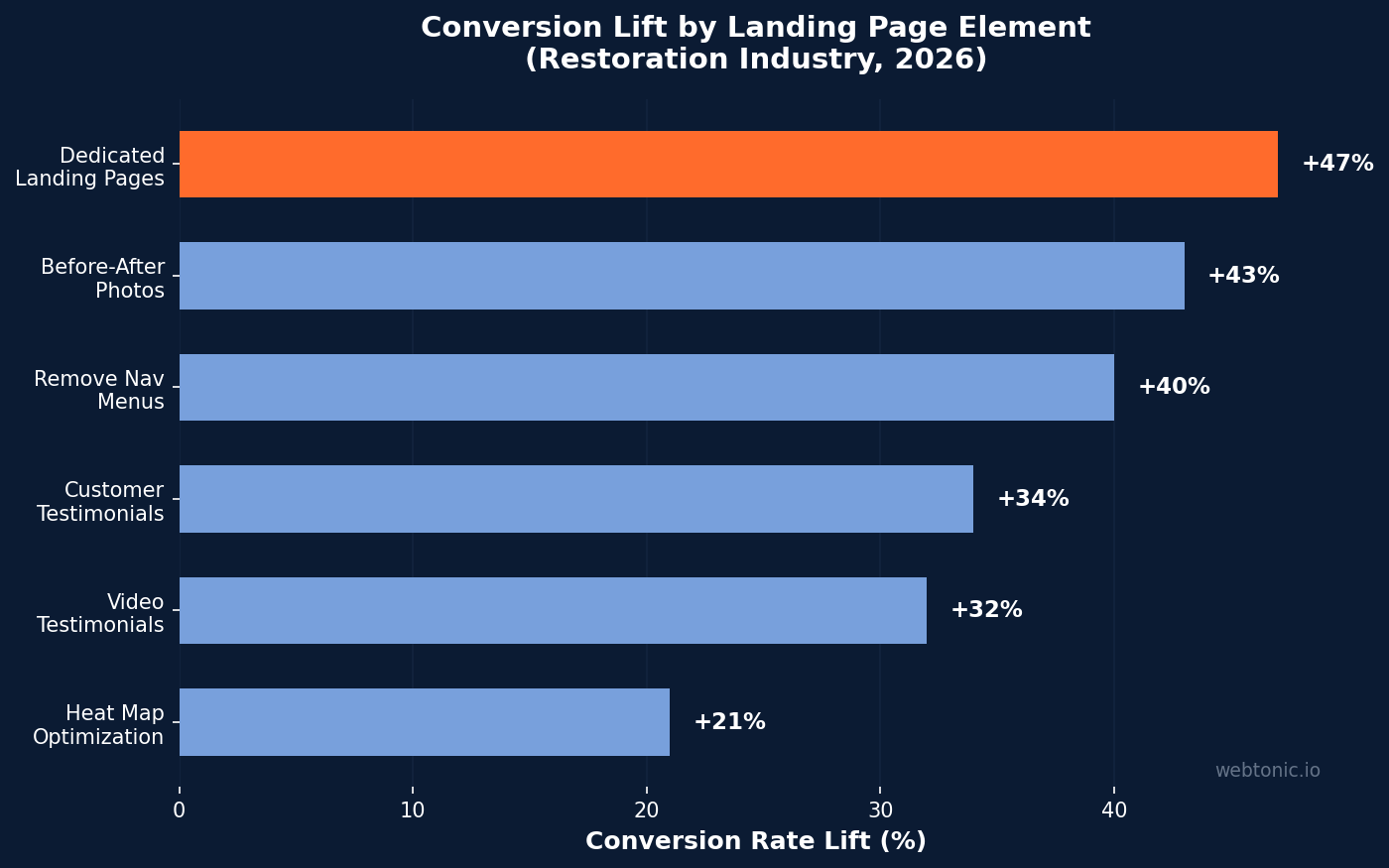
Recovery-specific content elements significantly impact conversion rates. The table below summarizes the lift each element provides based on Marketing LTB's 2026 analysis of 92+ restoration marketing statistics.
| Content Element | Conversion Lift | Implementation Priority |
|---|---|---|
| Dedicated landing pages (vs. generic site) | +47% | Critical |
| Before-and-after photos | +43% | High |
| Removing navigation menus | +40% | High |
| Customer testimonials | +34% | High |
| Video testimonials | +32% | Medium |
| Heat map-based optimization | +21% | Medium |
Source: Marketing LTB 2026 Restoration Marketing Statistics
The single biggest conversion lift (47%) comes from simply using dedicated landing pages instead of sending ad traffic to a generic homepage. Creating separate pages for water damage, fire damage, storm damage, and mold remediation allows messaging to match the searcher's specific emergency type, which dramatically improves both conversion rates and Google Ads Quality Scores.
SEO Health of Restoration Websites
Beyond conversion optimization, many contractor websites lack basic SEO signals that affect both organic rankings and paid landing page Quality Scores. Borah Labs' 2026 audit of water damage contractor sites found significant gaps:
- 68.8% of contractor sites have a mobile viewport declaration — meaning 31.2% render at desktop zoom on mobile phones, immediately losing mobile visitors.
- 81.3% have a populated meta description — the remaining 18.7% miss this free SEO signal that controls how search results appear to potential customers.
- 68.8% declare canonical URLs — sites without canonicals risk duplicate-content penalties across www, http, and tracking parameter variants.
- 68.8% have Open Graph tags — without these, links shared on social media display poorly, reducing referral traffic quality and social proof.
- WordPress powers 11.9% of restoration sites, with jQuery at 11.9%, Google Tag Manager at 10.4%, Google Analytics at 9.0%, and Cloudflare at 9.0% (Borah Labs).
Response Speed and Lead Conversion
Landing page optimization extends beyond design — response speed after form submission or call directly impacts close rates. Key response statistics from restoration industry benchmarks:
- Companies replying within 5 minutes convert 80% more leads than those taking over an hour (Marketing LTB).
- Responding within 60 seconds lifts conversion 391% — waiting 5 minutes kills 80% of qualifying odds (PipelineOn).
- Automated SMS and email confirmations maintain contact during after-hours emergencies when staff cannot answer immediately.
- Phone leads convert at 46% — the highest of any contact method — making click-to-call the most valuable landing page element for restoration companies.
A cleanup contractor generating 200 water damage leads monthly but converting only 30 loses about $180,000 annually to competitors. Improving conversion rate from 15% to 25% through landing page optimization can recover a significant portion of that lost revenue. The key metric to track is not just traffic volume, but the cost per acquired customer across each landing page variant.
Service-Specific Landing Page Strategy
Creating separate landing pages for each restoration service type produces significantly better results than sending all traffic to a generic homepage. Each emergency type has different concerns, search terms, and conversion drivers (Restoration Marketers):
- Water damage pages should emphasize extraction speed, drying timeline, and mold prevention — homeowners need reassurance that secondary damage will be minimized.
- Fire damage pages should highlight smoke odor removal, structural assessment, and insurance claim assistance — these are longer-term projects with higher emotional stress.
- Storm damage pages should feature emergency tarping, debris removal timelines, and FEMA/insurance coordination — these surge during weather events and require fast scaling.
- Mold remediation pages should address health concerns, testing procedures, and clearance protocols — these leads often come from home inspections and require educational content.
Mitigation businesses with dedicated landing pages for each service type also benefit from improved Quality Score in Google Ads. When the ad keyword, ad copy headline, and landing page content all align on the same service (e.g. "emergency water extraction"), Google rewards the advertiser with lower CPCs and better ad positions. A recovery contractor with a Quality Score of 9 can outrank a competitor bidding twice as much with a Quality Score of 5 — and that advantage compounds across hundreds of clicks per month. The combination of higher conversion rates and lower per-click costs makes service-specific landing pages the highest-ROI investment in recovery-industry digital marketing.
Each page should use keyword-matched headlines that mirror the ad copy driving traffic to it. This alignment improves Google Ads Quality Score, reduces cost per click, and increases conversion rates simultaneously.
Best Practices for Restoration Landing Pages
- Create separate landing pages per service — water damage, fire damage, storm damage, and mold remediation each deserve dedicated pages matching specific search intent and ad copy.
- Achieve sub-2.5-second LCP — compress images, eliminate render-blocking scripts, use a CDN. Sites loading under 2.5 seconds convert 3.2× better than those over 4.5 seconds.
- Place phone number above the fold in 3 locations — header, hero section, and floating mobile button. Phone leads convert at 46%, the highest of any contact method.
- Remove navigation menus on dedicated campaign pages — this single change increases conversions by 40% by eliminating exit paths.
- Add before-and-after photos — industry-specific social proof increases conversions by 43%. Include customer names, dates, and service details for credibility.
- Limit mobile forms to 3 fields — name, phone number, and service type. Every additional field reduces form completion rates on mobile emergency searchers.
- Implement sub-60-second response systems — automated SMS/email confirmations, after-hours routing, and CRM triggers ensure no lead goes cold.
Related reading
- Water Damage Restoration Landing Page Statistics (2026)
- Surrogacy Landing Page Statistics 2026: CRO Benchmarks & Data
- Veterinary Landing Page & CRO Statistics: 2026 Data & Benchmarks
- Landing Page Design services at Web Tonic
Frequently Asked Questions
What is a good conversion rate for a restoration landing page?
The median contractor page converts 2–4% of visitors. Top-performing restoration landing pages hit 8–15%, with some emergency pages reaching 16%. Aim for 8%+ conversion rate by implementing dedicated pages, sub-2.5-second load times, click-to-call buttons, and response time guarantees.
How fast should a restoration landing page load?
Under 2.5 seconds for Largest Contentful Paint (LCP). The average restoration site loads in 9.91 seconds, nearly 4× slower than Google's threshold. Sites loading under 2.5 seconds average 6.8% conversion rates versus 2.1% for sites over 4.5 seconds.
Should restoration companies remove navigation menus from landing pages?
Yes, for dedicated campaign landing pages. Removing navigation increases conversions by 40% by eliminating exit paths. Keep navigation on main website pages for organic visitors, but strip it from pages receiving paid traffic from Google Ads or Facebook campaigns.
What trust signals matter most on restoration landing pages?
In order of impact: before-and-after photos (+43% conversion), customer testimonials (+34%), video testimonials (+32%), IICRC/RIA certifications, and response time guarantees. These trust signals prove competence and reliability to property owners in crisis.
How important is mobile optimization for restoration landing pages?
71–76% of contractor traffic is mobile, climbing to 85–90% for emergency restoration searches. Only 31% of low-performing restoration sites pass Google's mobile-friendly test, compared to 94% of top performers. Mobile optimization is not a nice-to-have — it determines whether a restoration company captures or loses the majority of its leads.
Sources
marketingltb.com/blog/statistics/restoration-marketing-statistics
marketingltb.com/blog/statistics/restoration-marketing-statistics
pipelineon.com/blog/contractor-website-conversion-rate
pipelineon.com/blog/contractor-website-conversion-rate
onwardcraft.com/blog/contractor-website-study
borahlabs.us/insights/water_damage
almcorp.com/blog/water-damage-restoration-cpc-costs-digital-marketing
pushleads.com/restoration-company-seo/restoration-cost-per-lead