Table of contents
Restoration companies with dedicated landing pages convert 47% better than those sending traffic to generic websites. Here is the data on what separates high-performing water damage restoration landing pages from underperformers.
Key Takeaways
- Dedicated landing pages convert 47% better than generic restoration websites (Marketing LTB restoration marketing statistics).
- Location-specific landing pages are 2.3x more effective for restoration PPC, cutting CPL from $143 to $62 — a 57% reduction (Tygart Media).
- Emergency-focused landing pages convert 40% higher than generic restoration pages (restoration industry conversion data).
- Average WDR website LCP is 9.91 seconds — nearly 4x the Google-passing threshold of 2.5 seconds (Borah Labs).
- Pages loading in 1 second convert at 3x the rate of pages loading in 5 seconds (Foundry CRO via Portent).
- Phone calls convert to 10–15x more revenue than web form leads and close 30% faster (PushLeads via Forrester).
| Metric | Industry Average | Top 25% | Top 10% |
|---|---|---|---|
| Landing Page CVR | 6.7% | 17.6% | 25%+ |
| Emergency Page CVR | 15–22% | 25%+ | 30%+ |
| Avg Page Speed (LCP) | 9.91s | 3–4s | <2.5s |
| Mobile PageSpeed Score | 65 | 80+ | 90+ |
| Click-to-Call Rate | 4–6% | 8–12% | 15%+ |
| Form Completion Rate | 2–4% | 5–8% | 10%+ |
Conversion Rate Benchmarks: How WDR Pages Compare
The median conversion rate for home services landing pages is 6.7%, according to Unbounce's benchmark data (Unbounce Conversion Benchmark Report). However, the range within home services is enormous — the top 25% convert at 17.6% or higher, and the top 10% exceed 25% (WebFX home services marketing benchmarks via MyKrib).
Emergency service niches like water damage restoration sit at the high end of this spectrum. Peak conversion rates for emergency-focused landing pages reach 22% in high-intent verticals (home services conversion data). The emergency nature of water damage — someone standing in a flooded kitchen at 2 AM — drives intent levels that discretionary services like kitchen remodeling simply cannot match.
For Google Ads specifically, the home improvement average conversion rate is 6.82% (WebFX 2026 Home Services Marketing Benchmarks). Water damage restoration campaigns with optimized landing pages routinely exceed this, with top performers reaching 12–15% call conversion rates.

Page Speed: The Silent Conversion Killer
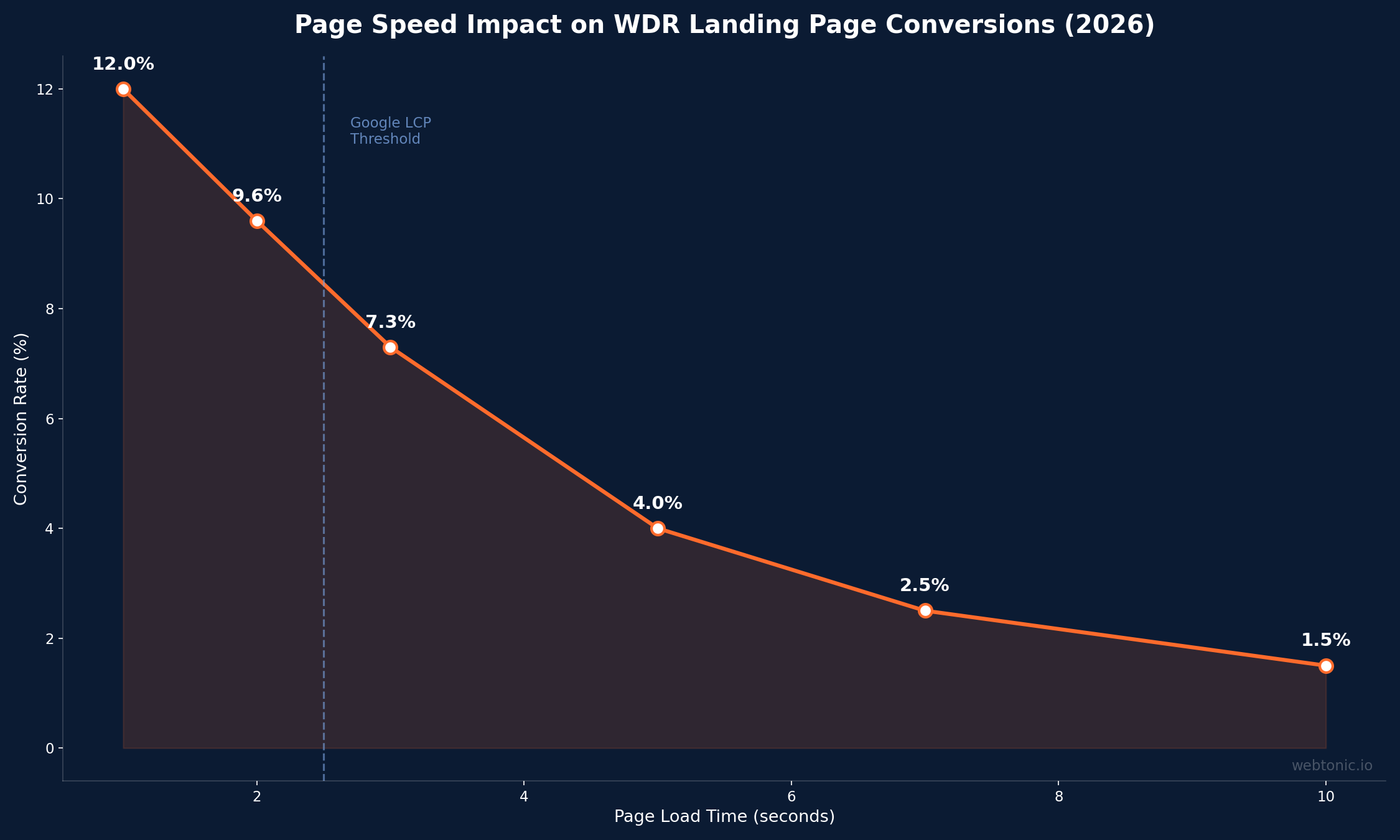
Borah Labs' analysis of water damage restoration websites found the average page takes 9.91 seconds to render its main content — 7.4 seconds over Google's passing LCP threshold of 2.5 seconds. The average mobile PageSpeed score across WDR sites is just 65 out of 100.
This matters enormously for conversions. Foundry CRO's analysis of 27,000 landing pages (via Portent) shows pages loading in 1 second convert at 3x the rate of pages loading in 5 seconds. Conversion rate drops approximately 4.42% with each additional second of load time in the first five seconds.
On mobile — where the majority of emergency water damage searches happen — each additional second of load time reduces conversion rate by 4–7% (MetricUno landing page speed benchmarks). A restoration landing page going from 4 seconds to 2 seconds typically sees a 10–15% conversion lift.
Location-Specific vs. Generic Landing Pages
Tygart Media's A/B testing across restoration companies produced the clearest evidence for location-specific pages: 2.3x higher conversion rate, with CPL dropping from $143 to $62 — a 57% reduction. The test tracked $127K in ad spend across 60 days.
Location-specific landing pages work because they address local trust signals: mentioning the city or neighborhood by name, displaying a local phone number, showing proximity ("15 minutes from downtown"), and featuring reviews from local customers. For restoration companies running Google Ads campaigns, building 5–15 location-specific landing pages for their service areas can be the single highest-ROI investment.
| Page Type | Avg CVR | Avg CPL | Best For |
|---|---|---|---|
| Homepage | 2–3% | $400+ | Brand searches only |
| Generic Service Page | 4–6% | $200–$350 | Organic traffic |
| Location-Specific LP | 10–15% | $62–$120 | PPC campaigns |
| Emergency-Focused LP | 15–22% | $45–$90 | After-hours and urgent |
Mobile Experience and Click-to-Call Optimization
PushLeads' conversion optimization data (citing Forrester) reveals that phone calls convert to 10–15x more revenue than web form leads and close 30% faster. For water damage restoration — where speed is everything — click-to-call functionality is the single most important conversion element.
Companies responding to leads within 5 minutes convert 80% more than those taking over an hour (restoration industry conversion data). The best-performing restoration landing pages feature:
- Sticky mobile click-to-call buttons — visible on every scroll position
- Prominent phone numbers in the hero section (not buried in the footer)
- "We're available now" live indicators — especially for 24/7 operations
- Callback scheduling for non-emergency requests — separating urgent from routine reduces friction for both segments
Trust Elements That Move Conversion Rates
Restoration landing pages with customer testimonials improve conversions by 34% (Marketing LTB restoration marketing data). Beyond testimonials, the highest-converting WDR pages include:
- IICRC certification badges — the most recognized credential in restoration
- Insurance-accepted logos — State Farm, Allstate, USAA, and major carriers
- Before/after photo galleries — visual proof of restoration quality
- Google review stars and count — directly embedded, not just a link
- Response time guarantees — "On-site in 60 minutes" commitments with a data-backed track record
| Trust Element | CVR Lift | Priority |
|---|---|---|
| Customer Testimonials | +34% | Critical |
| Response Time Guarantee | +25–35% | Critical |
| IICRC Certification Badge | +15–20% | High |
| Insurance Logos | +10–15% | High |
| Before/After Gallery | +12–18% | Medium |
| Live Chat Widget | +8–12% | Medium |
Landing Page Performance by Marketing Channel
Not all traffic converts equally on restoration landing pages. Understanding channel-specific behavior helps optimize for each source:
| Channel | Typical CVR | Key LP Requirement |
|---|---|---|
| Google Search Ads | 8–15% | Keyword-matched headline, call tracking |
| Local Services Ads | 65–72% (close) | GBP-optimized profile, reviews |
| Meta/Facebook Ads | 3–6% | Social proof, visual storytelling |
| Organic Search | 4–8% | Content depth, schema markup |
| Direct/Referral | 10–18% | Brand consistency, easy navigation |
The wide variance between channels underscores why restoration companies should build channel-specific landing pages rather than directing all traffic to a single destination. A PPC landing page prioritizes speed and conversion-focused design, while an organic landing page emphasizes content depth and topical authority.
A/B Testing Results That Move the Needle
The most impactful A/B test findings for restoration landing pages come from Tygart Media's controlled experiments across $127K in tracked ad spend. Beyond the 2.3x conversion lift from location-specific pages, their research revealed additional patterns that restoration companies can action immediately.
Response time prominence tests showed that landing pages featuring a "We arrive in 60 minutes or less" guarantee in the hero section converted 28–35% higher than pages without an explicit time commitment. The guarantee doesn't need to be the fastest — it needs to be specific and visible above the fold.
Social proof placement tests found that Google review widgets positioned directly below the hero section outperformed footer placements by 22%. The key was showing the total review count and star rating (e.g., "4.9 ★ from 347 reviews") rather than individual testimonials, which require more scrolling to process during emergency situations.
Phone number formatting also impacted conversions. Large, tappable phone numbers with area codes matching the searcher's metro area converted 18% higher than toll-free numbers. For multi-location restoration companies, dynamic number insertion that displays the local number based on the visitor's location is a proven high-ROI investment.
Form length tests consistently show that fewer fields equal higher completion rates. For restoration companies, the optimal form collects just three data points: name, phone number, and type of damage (dropdown). Every additional field — email, address, description text area — reduces completion rates by 5–8% per field.
Mobile-First Design Requirements
The majority of water damage emergency searches happen on mobile devices — homeowners discovering a flooded basement at 2 AM aren't sitting at a desktop computer. This makes mobile-first design not optional but essential for restoration landing pages.
Borah Labs' website benchmark study found that the average WDR website scores only 65 on mobile PageSpeed, leaving enormous room for improvement. The performance gap between the average and top performers is wider in restoration than in most home services verticals, partly because restoration sites tend to use heavy before/after image galleries without proper compression or lazy loading.
Key mobile-first requirements for restoration landing pages include:
- Sticky click-to-call button — always visible, regardless of scroll position, with a contrasting color that stands out from the page design
- Thumb-friendly tap targets — minimum 48px height for all interactive elements, with at least 8px spacing between targets
- Compressed hero images — WebP format, under 100KB, with correct dimensions to avoid cumulative layout shift
- Minimal JavaScript — each third-party script (chat widgets, tracking pixels, review embeds) adds 0.5–2 seconds of load time on mobile
- Above-the-fold phone number — visible without scrolling on all common mobile screen sizes
For restoration companies investing in performance creative and paid channels, ensuring that landing pages meet these mobile standards is the difference between a 5% and a 15% conversion rate — a 3x gap that directly impacts cost per lead and campaign profitability.
Schema Markup and Rich Results for Restoration Landing Pages
Restoration landing pages with structured data markup earn significantly more visibility in search results. Tygart Media's A/B testing data found that pages with FAQ and LocalBusiness schema markup appeared in 3x more AI Overview results compared to pages without schema, based on a 90-day controlled test across 8 restoration companies.
For water damage restoration landing pages, the most impactful schema types include LocalBusiness (with service area, hours, and payment methods), FAQPage (addressing common emergency questions), and Review markup that surfaces star ratings directly in search results. Implementing these schema types requires minimal development effort but produces measurable improvements in organic click-through rates and overall digital presence.
Frequently Asked Questions
What is a good conversion rate for a water damage restoration landing page?
The median home services landing page conversion rate is 6.7%. For water damage restoration specifically, emergency-focused pages should target 15–22%, while location-specific PPC pages should aim for 10–15%.
How fast should a water damage restoration landing page load?
Under 2.5 seconds LCP (Google's threshold). The average WDR site loads in 9.91 seconds — nearly 4x too slow. Pages loading in 1 second convert at 3x the rate of those loading in 5 seconds.
Should restoration companies use separate landing pages for each city?
Yes. A/B testing shows location-specific landing pages convert 2.3x better than generic service pages, cutting cost per lead by 57%. Building 5–15 city-specific pages is one of the highest-ROI investments for multi-city restoration companies.
What elements should a water damage restoration landing page include?
The highest-converting pages feature a prominent click-to-call button, response time guarantee, IICRC certification badge, customer testimonials, insurance-accepted logos, and before/after photos. Testimonials alone improve conversions by 34%.
Is click-to-call more important than web forms for restoration pages?
Overwhelmingly yes. Phone calls convert to 10–15x more revenue than web form leads and close 30% faster. For emergency services like water damage restoration, click-to-call should be the primary conversion path.
Sources
tygartmedia.com — Restoration Marketing A/B Tests
borahlabs.us — Water Damage Restoration Website Benchmarks
foundrycro.com — Page Speed Impact on Conversions & Ad Costs
pushleads.com — Website Conversion Optimization for Restoration
unbounce.com — Conversion Benchmark Report
webfx.com — 2026 Home Services Marketing Benchmarks
metricuno.com — Landing Page Speed Benchmarks
mykrib.app — Home Services Benchmarks 2026
pipelineon.com — Water Damage Restoration Digital Marketing 2026