Table of contents
Landing pages are where surrogacy marketing spend either converts or evaporates. With intended parent journey costs of $80,000–$200,000+ and a research phase lasting 6–18 months, a surrogacy landing page must do more than capture a form fill — it must earn trust at one of the most personal decision points in a visitor's life. These are the conversion benchmarks that separate high-performing surrogacy pages from the average.
Key Takeaways
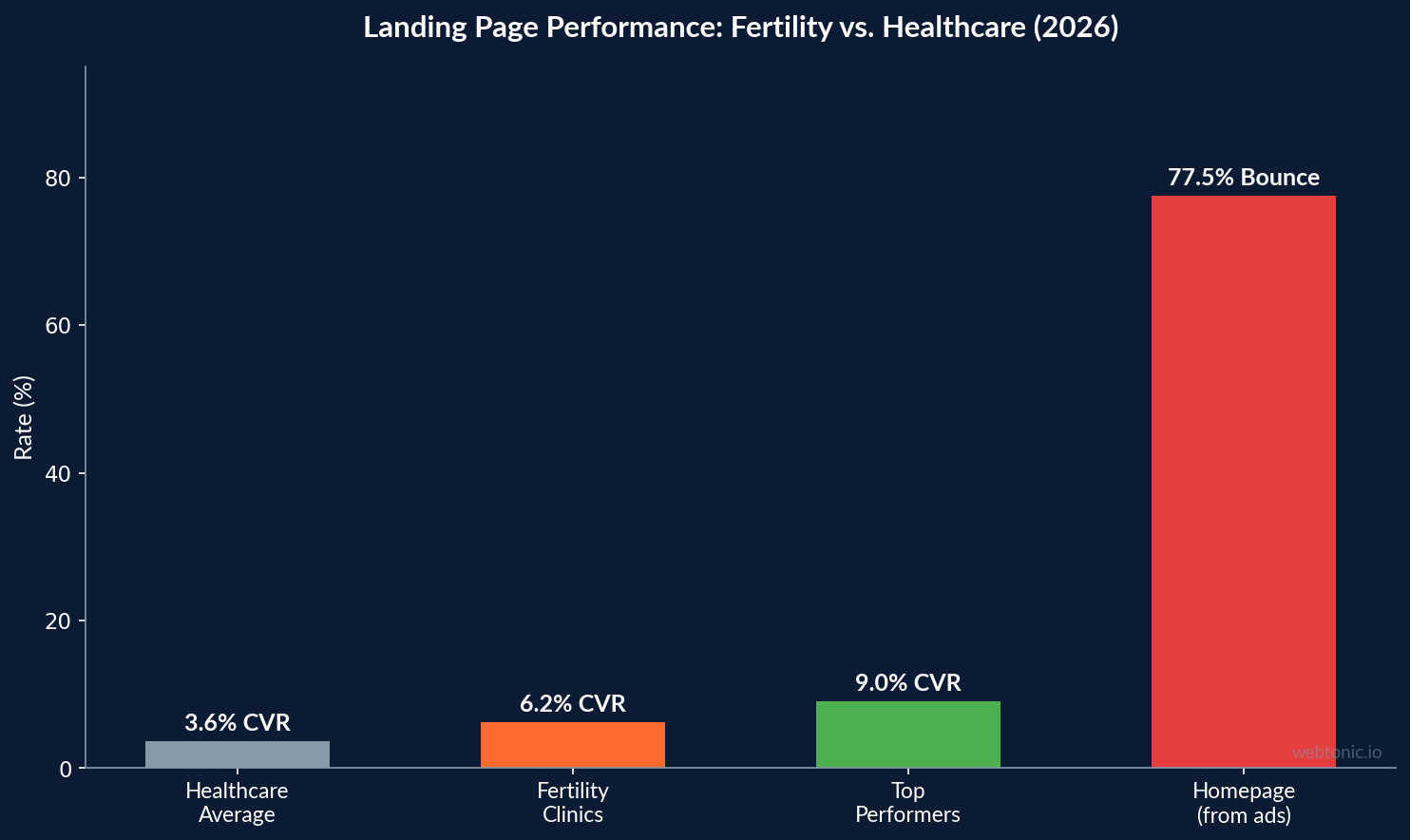
- Fertility clinic landing pages convert at 6.2% on average, with top-quartile pages reaching 2–3× the median through deliberate optimization.
- Healthcare landing pages average 3.0–4.2% conversion rates, while optimized pages reach 8–10% through structured testing programs.
- Homepage landing kills 70–85% of paid traffic — dedicated treatment-specific pages are non-negotiable for surrogacy campaigns.
- 81% of users abandon forms after starting; reducing fields to 5 or fewer can double completion rates in clinic contexts.
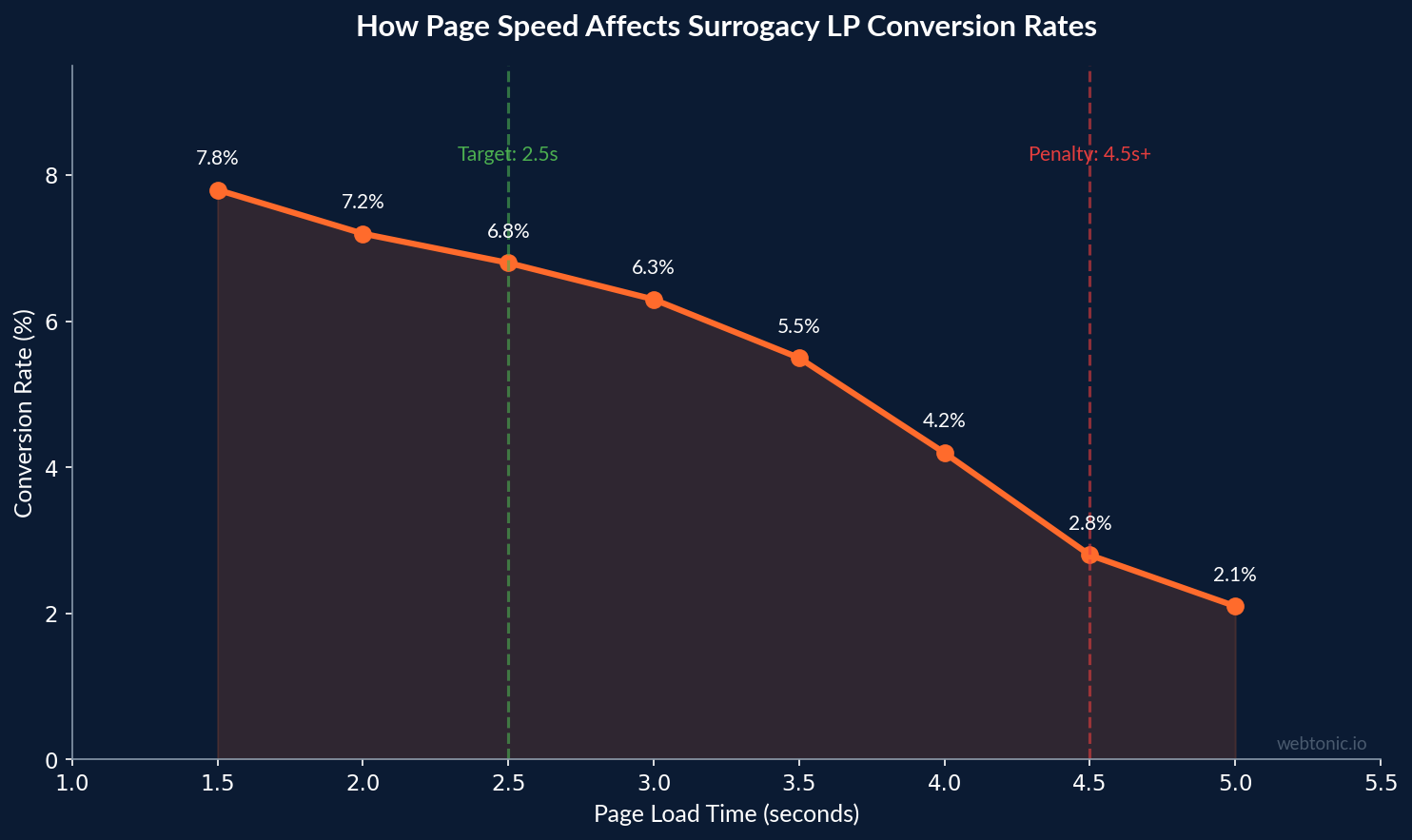
- Every additional second of page load time costs 7% in conversions, making speed a direct revenue lever for every campaign.
- Personalized CTAs convert 202% better than generic ones — "Book Your Free Surrogacy Consultation" outperforms "Contact Us" by a wide margin.
- Multi-step forms with 3 fields reduced abandonment by 52% in a documented fertility clinic CRO case study.
- Mobile search represents 65–80% of fertility queries, yet most clinic pages fail mobile Core Web Vitals assessments.
Surrogacy Landing Page Benchmarks at a Glance
These benchmarks combine general healthcare CRO data with fertility-specific conversion studies. Landing page performance is the single highest-leverage CPA reduction lever — improving conversion rate from the median to the top quartile has a larger impact than any budget increase or Google Ads spend optimization.
| Metric | Healthcare Average | Fertility Clinics | Top Performers |
|---|---|---|---|
| Landing Page CVR | 3.0–4.2% | 6.2% | 8–10%+ |
| Organic Search CVR | 2–4% | 3–7% | 8%+ (content-rich pages) |
| Form Abandonment Rate | 81% | 65–75% | Below 40% (optimized) |
| Mobile Traffic Share | 55–65% | 65–80% | — |
| Homepage Bounce (from ads) | 45–55% | 70–85% | N/A (avoid homepage landing) |
| CTA Personalization Lift | — | 202% vs generic | Up to 3× on specific pages |
| Speed Impact per Second | — | −7% CVR | Sub-2.5s LCP target |
| Map Pack Influence | — | 40–55% of local inquiries | Critical for local targeting |
The Surrogacy Conversion Funnel: From Click to Journey Start
Surrogacy landing pages feed one of the longest conversion funnels in all of healthcare. Understanding each stage is critical for proper attribution and optimization. A robust data intelligence framework must track conversions across this entire timeline, not just at the point of form submission.
| Funnel Stage | Typical Timeline | Conversion Action | Key Landing Page Element |
|---|---|---|---|
| Initial inquiry | Day 0 | Form fill or phone call | Clear CTA, trust signals, simple form |
| Inquiry to consultation | 14–45 days | Consultation booking | Retargeting LPs, follow-up content |
| Consultation to agreement | 1–6 months | Signed agency agreement | Resources hub, FAQ sections |
| Agreement to journey start | 3–6 months | Journey initiation | Portal onboarding, nurture emails |
| Total cycle | 6–12 months | First click to active journey | Full multi-touch nurture sequence |
Published IVF funnel data from the ICG IVF Marketing Insights Report shows that 41.89% of raw Google leads qualify through screening, 28.38% attend a consultation, and only 12.16% convert to treatment. This means a surrogacy landing page that captures 100 leads will ultimately produce roughly 12 active journeys — making every percentage point of CVR improvement worth thousands in downstream revenue. The landing page is not the end of the funnel; it is the entry point to a months-long relationship.
Form Optimization and Abandonment Statistics
Form design is the single highest-leverage CRO element on a surrogacy landing page. The data across healthcare verticals is unambiguous: simpler forms convert dramatically better, and the emotional sensitivity of surrogacy makes form friction even more costly.
- 81% of users abandon forms after starting them — the primary leak in most healthcare conversion funnels (Wolfable).
- Reducing form fields to 5 or fewer can double completion rates in clinic contexts — a name, phone number, and treatment interest is often all you need for initial qualification.
- A fertility clinic CRO case study showed that multi-step forms with only 3 fields reduced abandonment by 52% compared to traditional single-page forms (Redwud Creations).
- Click-to-call buttons should be persistent and visible on mobile — 87% of top-performing healthcare sites use sticky call elements that remain visible as users scroll.
- HIPAA compliance badges placed near the primary CTA increase form completion by building trust at the moment of highest friction — the point where visitors decide whether to share personal health information.
- Forms that mention "free consultation" or "no obligation" in the CTA button text perform significantly better than those with generic submit language.
Surrogacy vs. Other Healthcare Landing Pages
Surrogacy landing pages face unique challenges that distinguish them from other healthcare verticals. The emotional complexity of the decision, the length of the conversion cycle, and the financial magnitude of the commitment create a CRO landscape unlike standard medical marketing.
- Decision cycle length: Surrogacy research spans 6–18 months, compared to 2–4 weeks for most medical services. Landing pages must nurture long-term relationships, not just drive immediate conversions.
- Financial stakes: Journey costs of $80,000–$200,000+ make surrogacy one of the highest-ticket healthcare decisions. This demands more transparency and trust-building than a standard clinic appointment page.
- Dual audience problem: Surrogacy agencies serve two entirely different audiences (intended parents and surrogates) that require separate landing pages, messaging frameworks, and conversion paths.
- Emotional sensitivity: Visitors arrive during one of the most vulnerable periods of their lives. Pages that lead with empathy and story-based content — rather than clinical language — outperform transactional alternatives significantly.
- Compliance requirements: Surrogacy advertising faces restrictions on some platforms. Landing pages must convey trust and credibility without relying on aggressive promotional tactics.
Mobile Performance and Page Speed Impact
Mobile is the dominant channel for fertility search, and page speed directly determines conversion outcomes. Most surrogacy agencies underinvest in mobile performance despite 65–80% of their traffic coming from mobile devices.
| Performance Factor | Benchmark | Impact on Conversion |
|---|---|---|
| Mobile traffic share | 65–80% of fertility queries | Pages must be mobile-first designed |
| LCP target | Under 2.5 seconds | Sub-2.5s LCP correlates with 6.8% CVR |
| LCP penalty zone | Over 4.5 seconds | CVR drops to 2.1% (3.2× worse) |
| Speed-to-CVR ratio | −7% per additional second | Compounding loss across all traffic |
| Healthcare CWV pass rate | ~40% (WordPress sites) | Majority of clinics fail mobile vitals |
| Page abandonment threshold | 53% leave after 3 seconds | Speed is the first conversion gate |
| Average healthcare LCP | 10.2 seconds | Most sites in penalty zone |
The average healthcare site LCP is 10.2 seconds, with fertility clinic sites often exceeding this due to heavy imagery, embedded video testimonials, and unoptimized third-party scripts. A page that loads in under 2.5 seconds sees 3.2× the conversion rate of one loading over 4.5 seconds. For surrogacy agencies spending $5,000–$22,000/month on Google Ads, every second of load time improvement directly multiplies the return on that ad spend.
Trust Signals That Move the Needle
Surrogacy is a deeply personal and financially significant decision — journey costs of $80,000–$200,000+ mean the stakes are comparable to buying a home. Landing pages that acknowledge the emotional weight of the journey and provide transparent, specific trust signals consistently outperform transactional pages.
- Testimonials and journey stories from real intended parents and surrogates are the strongest trust signal. Agencies that redesigned their digital experience to lead with story-based content — rather than transactional language — saw measurable engagement and conversion lifts.
- Match success rates and journey completion percentages serve as the surrogacy equivalent of product reviews and social proof. Specific numbers are more persuasive than vague claims.
- HIPAA compliance badges near the CTA reduce friction at the conversion point — keeping a single high-level trust signal rather than cluttering the form area with multiple certification logos.
- Legal protections and fee transparency address the two primary objections in intended parent decision-making. A transparent fee breakdown is both a trust signal and the #1 search volume content for surrogacy keywords.
- Personalized CTAs convert 202% better than generic "Contact Us" buttons — "Book Your Free Surrogacy Consultation" or "Start Your Journey Today" signal specificity, value, and empathy.
- Dedicated landing pages for each audience segment ensure that intended parents and surrogates never see messaging designed for the other audience, which destroys trust and relevance.
Landing Page Best Practices for Surrogacy Agencies
- Build separate landing pages for intended parents and surrogates — these audiences have entirely different motivations, questions, and conversion triggers. A single page serving both is the most common conversion-killing mistake.
- Create treatment-specific pages for every ad group — "surrogacy cost" ads should land on a cost breakdown page, not the homepage. This alone can reduce bounce rates from 70–85% to under 30%.
- Limit forms to 3–5 fields maximum with a multi-step design that surfaces only name, phone, and treatment interest initially. Add qualification questions in a follow-up step.
- Achieve sub-2.5 second LCP on mobile by compressing images, deferring non-critical scripts, using modern image formats (WebP/AVIF), and minimizing third-party tracking scripts.
- Lead with emotional storytelling, not transactional language — the journey to parenthood through surrogacy is life-changing, and the page should mirror that emotional reality.
- Place a HIPAA badge next to your primary CTA and move additional certifications to a dedicated trust band lower on the page to maintain a clean, focused conversion area.
- Run A/B tests on CTA copy first — moving from generic to personalized CTAs is typically the fastest conversion win, delivering 2–3× improvements before touching layout or design.
- Implement performance creative principles across all landing page imagery — authentic, diverse representation of the families your agency serves builds both trust and relevance.
FAQ
What is a good conversion rate for a surrogacy landing page?
Fertility clinic landing pages average 6.2% conversion rates according to Benchmarketing's 2026 dataset. Healthcare landing pages broadly average 3.0–4.2%, while top performers reach 8–10%. For surrogacy, aiming for 6%+ on dedicated pages is a realistic and competitive target given the high-consideration nature of the decision.
How many form fields should a surrogacy landing page have?
Three to five fields maximum. Research shows 81% of users abandon forms after starting, and reducing fields to 5 or fewer can double completion rates. A documented fertility clinic case study showed that a multi-step form capturing name, phone, and treatment interest reduced abandonment by 52%.
Does page speed really affect surrogacy landing page conversions?
Yes, dramatically. Every additional second of load time costs approximately 7% in conversions. Pages loading under 2.5 seconds achieve 6.8% CVR versus 2.1% for pages over 4.5 seconds — a 3.2× difference. With 65–80% of fertility searches on mobile, speed optimization is not optional.
Should surrogacy agencies use separate pages for IPs and surrogates?
Absolutely. Intended parents and surrogates have entirely different motivations, objections, and conversion triggers. Running both audiences to the same page is the most common conversion-killing mistake in surrogacy marketing. Each audience needs its own messaging, forms, trust signals, and growth marketing strategy.
What trust signals work best on surrogacy landing pages?
Journey stories from real families, match success rates, transparent fee breakdowns, legal protection details, and a single HIPAA compliance badge near the CTA. Personalized CTAs like "Book Your Free Surrogacy Consultation" convert 202% better than generic "Contact Us" buttons.
Sources
benchmarketing.org — Fertility Clinics Marketing Benchmarks 2026
wolfable.com — Optimize Healthcare Clinic Landing Pages
tandemmedicalmarketing.com — Intended Parent Marketing Playbook
ichelonconsulting.com — OHMRC Model Healthcare Landing Page CRO
authorityspecialist.com — IVF Clinic SEO Benchmarks 2026
redwudcreations.com — Promise Fertility Center CRO Case Study
tandemmedicalmarketing.com — Surrogacy Agency Marketing
ichelonconsulting.com — IVF Google Ads vs Meta Ads Data