



Table of contents
Restoration companies that rank in Google's top 3 local results capture nearly 68% of clicks, yet the average cost per click for "water damage restoration" now exceeds $60–$85 in competitive markets. Here are the digital marketing benchmarks, lead generation costs, and channel performance statistics shaping restoration marketing strategy in 2026.
Key Takeaways
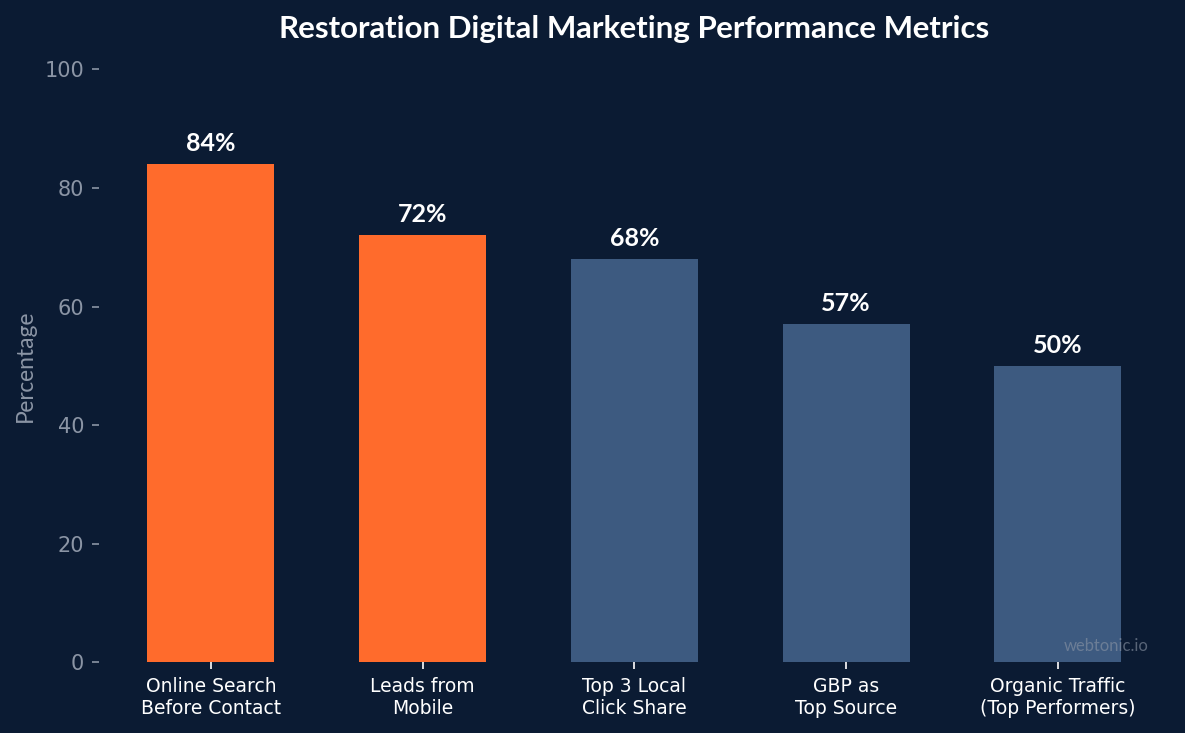
- 84% of restoration customers search online before contacting a company (Marketing LTB)
- 72% of restoration leads come from mobile devices during emergency situations (Marketing LTB)
- $60–$85 per click for "water damage restoration" keywords in competitive markets, with outlier bids exceeding $200 (Tygart Media)
- 57% of restoration companies say Google Business Profile is their top lead source (Marketing LTB)
- SEO produces 5.3× higher long-term ROI than paid channels for restoration businesses (Marketing LTB)
- 97% of consumers use the internet to find local services like water or fire damage repair (Blue Corona)
- Local SEO generates 3× more qualified leads than broad national campaigns for restoration companies
Restoration Digital Marketing Benchmarks at a Glance
| Channel / Metric | Benchmark | Source |
|---|---|---|
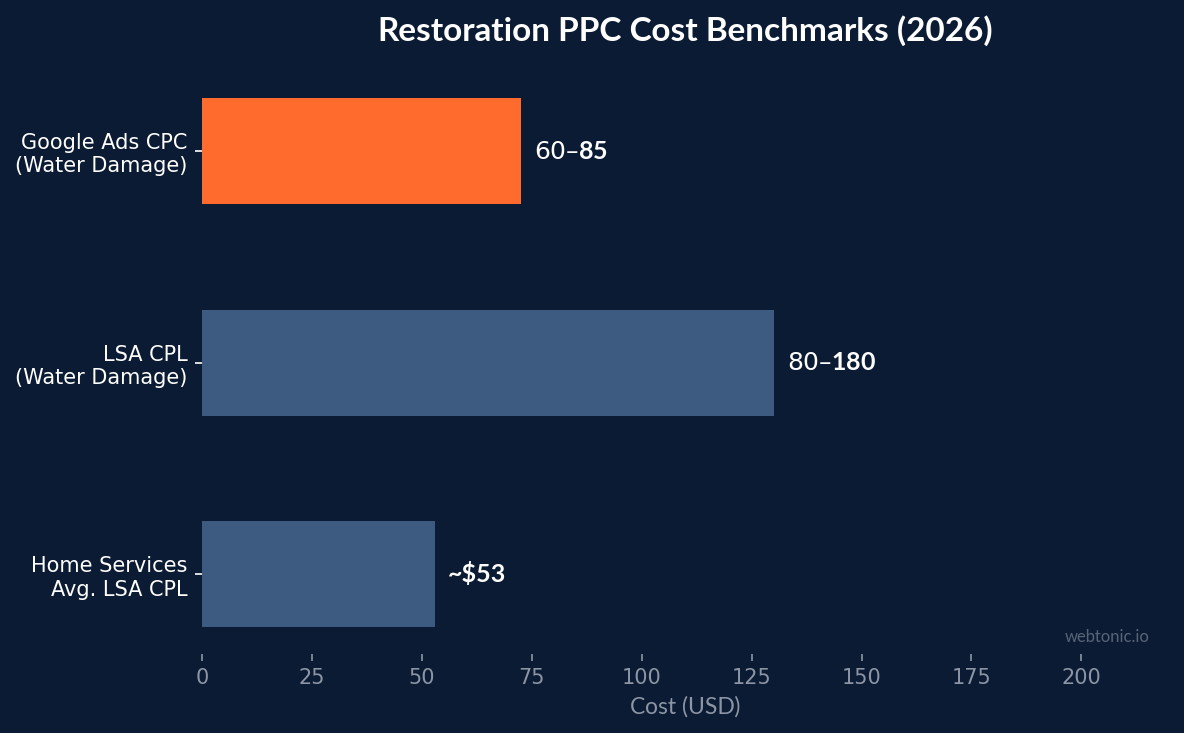
| Google Ads CPC (water damage) | $60–$85 per click (up to $200+ in metros) | Tygart Media |
| LSA cost per lead | $80–$180 (water damage) | Tygart Media |
| PPC conversion rate (emergency) | Above 18% for water damage keywords | Marketing LTB |
| GBP as top lead source | 57% of companies | Marketing LTB |
| SEO ROI vs. paid channels | 5.3× higher long-term ROI | Marketing LTB |
| Organic search traffic share | 50%+ for top-performing companies | Marketing LTB |
| SEO results timeline | 4–9 months on average | Marketing LTB |
| Mobile lead share | 72% during emergencies | Marketing LTB |
Search Advertising Costs and Performance
Restoration company marketing is one of the most expensive paid-search categories in the United States. According to Tygart Media's 2026 analysis, "water damage restoration" keywords routinely clear $60–$85 per click in competitive markets, with reported outlier bids running well over $200 in metros like New York, Houston, and South Florida. Some emergency-restoration terms have broken $500 per click in specific high-demand moments.
Google Ads CPC for restoration has increased over 35% since 2022 (Marketing LTB). PPC campaigns targeting "emergency water removal" keywords outperform general restoration keywords by 42% in conversion rates. For companies evaluating their Google Ads cost structure, the restoration vertical demands careful keyword segmentation to control acquisition costs.
Google Local Service Ads for Restoration
The "Google Guaranteed" boxes at the top of mobile search results represent the highest-value real estate for emergency-driven services. For water damage restoration, reported 2026 LSA cost-per-lead ranges from $80–$180 depending on market (Tygart Media). On a $6,000 average ticket, even a $150 LSA lead at a 25–35% close rate produces a customer acquisition cost (CAC) of roughly $450–$600 — workable on jobs that gross $1,800–$2,400.
However, Google has removed credits for "job type not serviced" and "geo not serviced" lead disputes, pushing the effective cost higher. Three channels do the heavy lifting for commercial water and fire restoration: LSA, Google Search Ads, and organic SEO. Everything else — Yelp, Angi, HomeAdvisor, Facebook, programmatic display, lead-broker buys — is either supplemental, declining, or actively cannibalizing margins.
| Paid Channel | Cost Range | Best For |
|---|---|---|
| Google LSA (water damage) | $80–$180 per lead | Emergency residential jobs, highest SERP placement |
| Google Search Ads | $60–$85 CPC (up to $500) | Fast lead generation, keyword-level targeting |
| Organic SEO | Monthly retainer investment | Long-term ROI (5.3×), reduced paid dependency |
| Lead-broker buys | Varies widely | Volume fill — but margin cannibalization risk |
SEO and Organic Search Performance
Organic search generates over 50% of website traffic for top-performing restoration companies (Marketing LTB). Restoration businesses that rank in Google's top 3 local results capture nearly 68% of clicks, while those investing in SEO see results within 4–9 months on average. SEO leads close at higher rates than cold outreach leads, making organic visibility a compounding asset.
Benchmark data from Authority Specialist (34 multi-territory water damage contractors) shows that emergency-intent queries like "water damage repair near me" generate local pack click-through rates 2–3× higher than informational queries. Map Pack placement captures a disproportionate share of after-hours emergency calls, which represent the highest-value segment. With average residential water damage jobs ranging from $3,000–$12,000, organic search is one of the highest-ROI acquisition channels.
Google Business Profile and Local Marketing
57% of restoration companies identify their Google Business Profile as the top lead source (Marketing LTB). Voice searches for emergency recovery operations have increased over 20% year over year, and local SEO generates 3× more qualified leads than broad national campaigns. For businesses building a growth marketing strategy around local visibility, GBP optimization is the highest-leverage starting point.
| Local Marketing Metric | Data Point |
|---|---|
| GBP as primary lead source | 57% of restoration companies |
| Voice search growth (YoY) | 20%+ increase for emergency services |
| Local SEO vs. national campaigns | 3× more qualified leads |
| Local pack CTR (emergency queries) | 2–3× higher than informational queries |
| 24/7 answering service impact | 2× more leads captured |
| Lead timing (post-damage) | 83% within 48 hours |
Case Study: SEO-Driven Market Dominance
Foxxr Digital Marketing documented a restoration company (GreenWorks Environmental) achieving 83.87% share of local voice across New Jersey through targeted Local SEO, Meta advertising, and strategic content. Key results included:
- 660 total qualified leads with $208K in tracked lead value
- 100,089 total website visitors from organic and paid channels combined
- Average rank position improved from 6.75 to 2.34, securing top-3 local pack positions
- Geographic coverage expanded from 24 to 52 points out of 62 across the state
- 50-point competitive advantage over the nearest competitor in local search share
This case demonstrates the compounding effect of digital marketing investment: restoration companies that build organic visibility reduce their dependency on paid ads over time (Marketing LTB), while maintaining a strong Google Ads strategy for immediate emergency-intent capture.
Content Marketing and Online Visibility
97% of consumers use the internet to find local services like water or fire damage repair (Blue Corona). This near-universal online search behavior means content marketing isn't optional for restoration companies — it's the foundation of discoverability. Restoration firms that invest in educational content (emergency preparedness guides, damage assessment checklists, insurance claim FAQs) build organic authority that compounds over time.
Blue Corona's restoration marketing teams documented a 10,000% return on ad spend (ROAS) for one restoration client, achieved through a combination of SEO, paid search, and website optimization. Their approach includes designing websites that convert visitors into calls and leads, optimizing for keywords like "restoration company near me" and "mold removal," and building brand authority through educational content and strong Meta advertising campaigns.
Voice searches for emergency restoration services have increased over 20% year over year, driven by smart speaker adoption and mobile voice assistant usage. Queries like "find water damage repair near me" and "emergency mold removal" represent high-intent searches where the user needs service immediately — making voice search optimization an emerging priority for restoration companies investing in performance creative strategies.
Marketing Channel Allocation for Restoration
For a $3M–$15M restoration company, channel allocation is the single most important budget decision. Tygart Media recommends concentrating spend across LSA, Google Search Ads, and owned SEO before considering supplemental channels. Key allocation principles:
- LSA first — highest real estate on mobile, especially for emergency categories like water damage and mold
- Google Search Ads second — fastest lead-generation channel, but CPC requires careful management
- SEO third (but invested continuously) — 5.3× ROI compounds over time, reducing paid dependency
- 80% of demand is reactive — emergency-driven, compressing the decision window to hours
- Companies using automation reduce marketing operational costs by 55% (Marketing LTB)
Market Context: Industry Scale
The global property recovery services market is valued at $45.2 billion in 2026, projected to reach $58.5 billion by 2031 at a 5.28% CAGR (Fortune Business Insights). In the U.S., the property-restoration niche is roughly $7.2 billion across 62,582 firms (Proof). With 5.6% of insured homes filing a claim in an average year and catastrophe losses hitting $115.6 billion in 2024, digital marketing investment is scaling alongside the market.
Digital Marketing Technology and Automation
Restoration companies using digital marketing automation reduce operational costs by 55% (Marketing LTB). AI adoption across the broader restoration industry has surged — the percentage of contractors with no AI usage dropped from 50% to approximately 30% between 2025 and 2026, with 37% now exploring AI solutions (Cleanfax). Primary applications include marketing content generation, estimate drafting, and report writing.
For companies running Meta advertising alongside Google Ads, the CRM–call tracking–attribution stack becomes essential. Tygart Media recommends exactly three systems working in coordination: a CRM, call tracking (70–80% of leads are phone calls), and attribution. The CallRail–ServiceTitan integration specifically allows restoration companies to connect marketing source data to actual job revenue — not just lead counts — transforming marketing ROI measurement from guesswork to precision.
Restoration businesses with 24/7 answering services capture 2× more leads than those with limited availability. With 80% of demand being reactive and emergency-driven, the companies that combine always-on phone coverage with automated email and SMS follow-up sequences convert at significantly higher rates than competitors still relying on manual callbacks during business hours.
Related reading
- Water Damage Restoration Marketing Stats
- Education & Coaching Digital Marketing Statistics: 2026 Trends, Benchmarks & Strategy Data
- Fintech Digital Marketing Statistics: 2026 Performance Report
- Marketing Strategy Consulting services at Web Tonic
Frequently Asked Questions
How much does Google Ads cost for restoration companies?
Google Ads CPC for "water damage restoration" ranges from $60–$85 per click in most competitive markets, with outlier bids exceeding $200–$500 in major metros. Google Local Service Ads cost $80–$180 per lead. Total customer acquisition cost on a $6,000 average ticket typically runs $450–$600 when accounting for close rates of 25–35%.
Is SEO worth it for restoration companies?
SEO produces 5.3× higher long-term ROI than paid channels for restoration businesses, and organic search generates over 50% of website traffic for top performers. Results typically appear within 4–9 months. SEO leads also close at higher rates than cold outreach, making it the highest-compounding channel available.
What percentage of restoration leads come from mobile?
72% of restoration leads come from mobile devices during emergency situations. Emergency-intent mobile queries generate local pack CTRs 2–3× higher than informational queries, and 83% of leads occur within 48 hours of property damage — making mobile-optimized landing pages and click-to-call functionality critical.
How important is Google Business Profile for restoration companies?
57% of restoration companies identify GBP as their top lead source. Businesses with strong local SEO rankings and complete GBP profiles capture 3× more qualified leads than broad campaigns. Companies with 24/7 answering services capture 2× more emergency leads than those with limited availability.
What digital marketing ROI can restoration companies expect?
A documented case study showed one restoration company generating 660 qualified leads and $208K in lead value through integrated SEO and Meta advertising. Blue Corona reports achieving 10,000% return on ad spend for a restoration client. The key is connecting marketing spend to actual job revenue — not just lead counts — through CRM and attribution infrastructure.
Sources
marketingltb.com – Restoration Marketing Statistics 2026
tygartmedia.com – Restoration Company Marketing 2026
authorityspecialist.com – Water Damage Restoration SEO Benchmarks
bluecorona.com – Restoration Digital Marketing
foxxr.com – GreenWorks Environmental Case Study
proofco.ai – State of Restoration 2026
fortunebusinessinsights.com – Disaster Recovery Market
pushleads.com – Restoration Cost Per Lead


