



Table of contents
Higher education institutions spent over $2.4 billion on advertising in the first half of 2025 alone, with digital channels now commanding 68–72% of total marketing budgets. Here is the data shaping education and coaching digital marketing strategy in 2026.
Key Takeaways
- The global education marketing services market is valued at $1.07 billion in 2026, projected to reach $1.68 billion by 2035 at a 6.7% CAGR (Business Research Insights via Click-Vision)
- Digital channels account for 68–72% of postsecondaryucation marketing spend, up from 42% in 2020, with social media ad budgets growing 31% year-over-year (SEO Works)
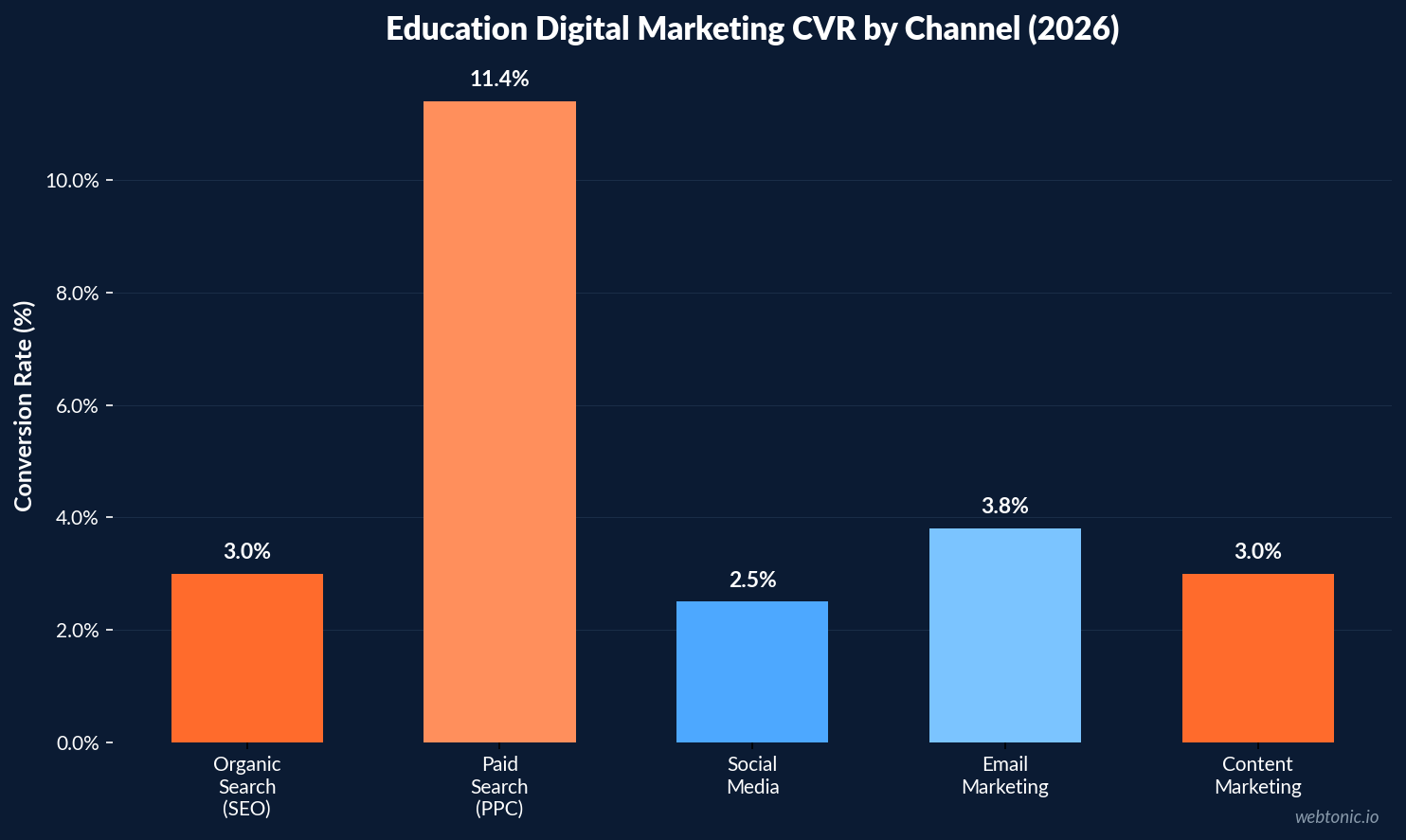
- Google Ads CPC for education rose 40% year-over-year to $6.23, while conversion rates improved 43.87% to 11.4% — the largest CVR gain of any vertical (FoundryCRO)
- Organic search delivers 28–32% of qualified enquiries for universities at a cost per acquisition of £580–850, making SEO the most cost-efficient recruitment channel (SEO Works)
- Higher education email open rates average 38.5%, significantly above the cross-industry mean, with engagement rates reaching 5.40% on social media (CuFinder)
- Coaching businesses achieve 7x ROI on digital marketing investments, with content marketing producing leads at 50–70% lower cost than paid channels (Careertrainer.ai)
- Short-form video (Reels, TikTok) drives the highest engagement in education marketing, with social ad spend in the sector growing 31% year-over-year (Searchlab)
Education Digital Marketing Market Overview
| Metric | Value | Trend | Source |
|---|---|---|---|
| Education Marketing Services Market | $1.07 billion (2026) | → $1.68B by 2035 (6.7% CAGR) | Click-Vision |
| US Higher Ed Ad Spend (H1 2025) | $2.4+ billion | Double-digit YoY growth | SEO Works |
| Digital Share of Marketing Budget | 68–72% | Up from 42% in 2020 | CuFinder |
| Average HE Marketing Budget | $4.15 million/year | 2–3% of operating budget | Click-Vision |
| Social Media Ad Spend Growth | +31% YoY | Reels & TikTok leading | Searchlab |
The education sector's digital transformation is accelerating. According to Click-Vision's 2026 education marketing statistics report, the global education marketing services industry reached $1.07 billion, with growth driven by increasing competition for student enrollment and the professionalization of coaching business marketing. Other's 2026 media shift analysis confirms that U.S. education ad spend continues growing at double-digit rates, with social media and video formats leading the charge.
SEO & Organic Search Performance in Education
Search engine optimization remains the most cost-efficient digital marketing channel for higher education institutions. SEO Works' 2026 education marketing report reveals:
- Organic search delivers 28–32% of qualified enquiries for UK universities, at a cost per acquisition of £580–850 — the lowest of any recruitment channel
- Only 6% of higher education websites currently achieve optimal technical SEO performance, leaving massive room for improvement
- SEO-driven content marketing produces 2–3x more leads per dollar than paid advertising for academic institutions with mature organic programs
For coaching businesses, SEO plays an increasingly critical role as a long-term strategy. Careertrainer.ai reports that organic content marketing converts at approximately 3% for coaching services — a consistent conversion rate that compounds over time as content libraries grow. The average cost per lead through content marketing is 50–70% lower than paid advertising channels, making SEO a strategic priority for coaching practices building sustainable client pipelines. Explore our growth marketing services for education brands.
Paid Search & PPC Benchmarks for Education
Google Ads performance in education experienced significant shifts in 2026. FoundryCRO's 2026 higher education benchmarks report the following paid search statistics:
| Metric | 2026 Value | YoY Change | Context |
|---|---|---|---|
| Google Ads CPC | $6.23 | +40% | Rising competition from online programs |
| Google Ads CTR | 7.56% | +32% | Improved ad relevance + AI bidding |
| Conversion Rate | 11.4% | +43.87% | Largest CVR gain of any vertical |
| Cost Per Lead | $77.48 | Stable | CPC increase offset by CVR improvement |
| Bounce Rate (Avg) | 55.4% | — | Education website average |
The 2026 data tells an important story: while education CPC rose 40%, conversion rates improved by nearly 44%, resulting in relatively stable cost per lead. This suggests that institutions investing in better landing page experiences and conversion optimization are successfully absorbing rising auction costs. SearchInfluence notes that paid search remains where most post-secondary continuing education units direct the largest share of their online advertising budget — and with good reason, given the high conversion rates from intent-driven queries. See our complete Google Ads pricing guide for more benchmarks.
For coaching businesses, PPC economics differ significantly. Executive coaching commands $14.84 CPC on Google with a 3.2% conversion rate and $284 CPA, according to Benchmarketing. The higher acquisition costs reflect the premium nature of coaching services and longer sales cycles typical of high-ticket professional development offers.
Social Media Marketing Statistics for Education
Social media has become the second-largest digital marketing channel for education after paid search. CuFinder's 2026 higher education benchmarks provide comprehensive social media data:
- Social media engagement rate: 5.40% average across higher education institutions — well above the cross-industry average of 1.5–3.0%
- Social media ad spend in education grew 31% year-over-year, with Instagram Reels and TikTok ads driving the most engagement, per Searchlab's education statistics
- Short-form video content generates 2–3x stronger engagement than static posts on university social accounts
- LinkedIn remains the top platform for executive education and coaching marketing, though at a 40–60% elevated CPL compared to Meta platforms
The shift toward video-first social media strategies is particularly pronounced in education. GHL's 2026 business coaching snapshot finds that coaching businesses using short-form video in their marketing mix grow their audience 3–4x faster than those relying solely on text and static image content. The most effective education social media strategies combine organic community building with targeted paid amplification — typically allocating 60–70% of social budget to paid and 30–40% to asset production.

Email Marketing Performance in Higher Education
Email remains one of the highest-ROI digital marketing channels for education institutions. CuFinder's benchmark data shows higher education email open rates average 38.5% — significantly above the cross-industry average of 20–25%. This elevated performance reflects the highly motivated nature of education email lists, which typically comprise prospective students actively researching programs.
| Email Metric | Higher Education | Coaching Industry | Cross-Industry Avg |
|---|---|---|---|
| Open Rate | 38.5% | 30.4% | 21.5% |
| Click-Through Rate | 4.2–6.8% | 3.1–4.5% | 2.3% |
| Conversion Rate | 2.5–5.0% | 1.8–3.2% | 1.5% |
| Unsubscribe Rate | 0.15–0.25% | 0.20–0.35% | 0.26% |
For coaching businesses, email marketing serves as the primary nurture channel between initial lead capture and enrollment decision. Coaches with structured email sequences convert leads at 2.5–3x the rate of those using ad-hoc follow-up. The most effective education email strategies segment by intent level (browser vs researcher vs applicant) and deliver personalized content based on program interest and engagement history.
Content Marketing & Conversion Rate Optimization
Content strategy in education digital marketing has evolved from basic blog publishing to sophisticated, data-driven conversion optimization. SearchInfluence's compilation of 90+ higher education marketing statistics highlights the growing role of content in the enrollment funnel.
Higher education website visitor-to-inquiry conversion rates range from 2–5%, with program-specific landing pages outperforming generic institutional pages by 40–60%. The data shows that institutions investing in conversion rate optimization see the largest efficiency gains in their digital marketing programs — often achieving 15–25% improvement in cost per enrollment without increasing ad spend.
For coaching marketers specifically, content marketing ROI statistics are compelling. Businesses that consistently publish educational content generate 3x more leads than those relying exclusively on paid channels. The average ROI on coaching investments reaches 7x the initial investment, providing a powerful narrative for inbound-driven lead generation strategies that emphasize outcomes, case studies, and thought leadership. Learn how our data intelligence services support enrollment professionals.
Global Digital Advertising Trends in Education
The global digital advertising market for education continues to expand, driven by increasing competition and the proliferation of online learning platforms. Worldwide education online ad spend surpassed $12 billion in 2025, with North America accounting for approximately 45% of global spending and Europe representing 28%. Asia-Pacific markets — led by India, China, and Southeast Asia — are growing fastest at 22–28% year-over-year, driven by massive demand for professional skills development and certification programs.
For digital marketers in the education space, the data points to a clear strategic shift. Video content now drives 38% of all education ad engagement, up from 22% just two years ago. Higher education marketers report that short-form video campaigns deliver 2.5x higher ROI compared to static display advertising. The convergence of social media algorithms favoring video, declining organic reach for text-based posts, and improved video production accessibility has made video the default format for education online advertising campaigns.
Market analysts project the education digital advertising market will reach $18–20 billion globally by 2030, with AI-powered targeting and personalization driving much of the growth. Institutions deploying machine learning for student prospect scoring report 25–35% improvements in conversion rates and 15–20% reductions in cost per enrollment. For coaching businesses entering digital marketing, the statistics overwhelmingly support a strategy that combines SEO-driven content marketing for long-term efficiency with targeted social media advertising for immediate reach.
Data-Driven Strategy & Marketing Technology Adoption
Marketing technology adoption in education has reached a tipping point. 78% of higher education marketers now use some form of marketing automation, up from 52% in 2022. CRM platforms, email automation tools, and analytics dashboards have become standard infrastructure for enrollment marketing teams. The data shows that institutions with mature marketing technology stacks achieve 30–40% lower cost per enrollment compared to those relying on manual processes.
Key technology adoption statistics for education and coaching marketers include:
- Marketing automation adoption: 78% of higher education institutions use at least one automation platform
- CRM usage: 85% of institutions with enrollment teams over 10 people use a dedicated CRM for prospect management
- Attribution modeling: 42% of education marketers report using multi-touch attribution, up from 28% in 2023
- AI-powered content: 35% of academic content teams use AI tools for content creation, optimization, or personalization
- Chatbot deployment: 48% of higher education websites now feature AI chatbots for initial prospect engagement
For coaching businesses, the technology landscape is more fragmented. Only 31% of individual coaches use a CRM system, though adoption rises to 72% among coaching firms with 5+ practitioners. The ROI data is clear: coaches using integrated marketing technology convert leads at 2–3x the rate of those managing prospects manually, reinforcing the business case for martech infrastructure investment.
Related reading
- The Definitive Guide to Disaster Restoration Digital Marketing Statistics (2026)
- Electrical Digital Marketing Statistics 2026
- Fertility & IVF Digital Marketing Statistics: 2026 Industry Benchmarks
- Marketing Strategy Consulting services at Web Tonic
FAQ
How much do higher education institutions spend on digital marketing?
The average higher education marketing division operates with a total annual budget of $4.15 million, with 68–72% now flowing to digital channels. U.S. institutions spent over $2.4 billion on advertising in the first half of 2025. Marketing budgets typically represent 2–3% of the institution's operating budget, with the digital share growing steadily from 42% in 2020.
What is the best digital marketing channel for education?
Organic search (SEO) delivers the lowest cost per acquisition at £580–850 and drives 28–32% of qualified enquiries. Paid search delivers the highest conversion rates at 11.4%, while social media generates the fastest audience growth through short-form video content. The optimal strategy combines all three channels — SEO for long-term efficiency, PPC for immediate volume, and social for awareness and engagement.
What ROI do coaching businesses see from digital marketing?
Coaching businesses achieve an average ROI of 7x on marketing investments. Content marketing produces leads at 50–70% lower cost than paid advertising, and organic content converts at approximately 3% for coaching services. The most successful coaches combine thought leadership building with targeted paid campaigns to maximize both volume and efficiency. See our Meta Ads services for enrollment campaigns.
How effective is email marketing for education?
Higher education email marketing significantly outperforms cross-industry averages, with open rates averaging 38.5% versus the 21.5% industry mean. Click-through rates range from 4.2–6.8%, and conversion rates reach 2.5–5.0%. Coaching industry email marketing also performs above average, with 30.4% open rates and 3.1–4.5% CTR.
What are the key digital marketing trends in education for 2026?
The four dominant trends are: short-form video marketing (Reels and TikTok driving 31% growth in social ad spend), AI-driven personalization (predictive analytics for student targeting), conversion rate optimization (landing page improvements driving 44% CVR gains), and content-led lead generation (coaching and education brands building authority through SEO and thought leadership content).
Sources
click-vision.com/education-marketing-statistics
seoworks.co.uk/downloads/education-marketing-statistics
foundrycro.com/blog/higher-education-marketing-benchmarks-2026
cufinder.io/blog/benchmarks/higher-education
searchinfluence.com/blog/2026-higher-education-marketing-benchmarks
searchlab.nl/en/statistics/education-edtech-statistics-2026
careertrainer.ai/en/reports/coaching-programs-statistics
benchmarketing.org/benchmarks/industries/executive-coaching
weareother.ca — 2026 education media shift
ghlbusinesscoachingsnapshot.com — state of business coaching 2026


