Table of contents
Only 20% of dental offices actively use email campaigns, leaving the other 80% to rely on phone calls and postcards to fill chairs. That gap represents a massive opportunity: email delivers $36–$44 in return for every $1 spent and outperforms every other retention channel in the industry. This page compiles 40+ verified data points covering open rates, click-through benchmarks, recall effectiveness, and reactivation results — a complete reference for any clinic or agency looking to benchmark performance in 2026.
Key Takeaways
- Email returns $36–$44 for every $1 invested, making it the highest-ROI channel for dental providers.
- Appointment reminders achieve a 68.4% open rate — more than 3× the cross-industry average.
- Hygiene recall emails book 26% of overdue appointments, directly filling empty chair time.
- Reactivation campaigns convert 10–12% of inactive patients who have not visited in 12+ months.
- Automated reminders reduce no-shows by 24%, recovering revenue that would otherwise be lost.
- Personalized subject lines increase opens by 50%, making segmentation a high-impact lever.
Core Email Benchmarks for Dental Providers
| Metric | Dental Benchmark | Cross-Industry Avg |
|---|---|---|
| Average Open Rate | 28–34% | 21.3% |
| Appointment Reminder Open Rate | 68.4% | N/A |
| Welcome Email Open Rate | 63–82% | ~50% |
| Click-Through Rate (CTR) | 1.75–7.31% | 2.5–3.5% |
| Unsubscribe Rate | 0.06–0.25% | 0.2–0.5% |
| ROI Per $1 Spent | $36–$44 | $36–$42 |
| Cost Per Send | $0.01–$0.05 | $0.01–$0.03 |
Email ROI: Why the Numbers Are Exceptional
The $36–$44 return per dollar spent makes dental email one of the highest-ROI channels in any industry. Understanding what drives this figure helps clinics optimize their own campaigns for maximum impact.
- The cost per send is just $0.01–$0.05, meaning a list of 2,000 subscribers costs $20–$100 to reach. Even a single reactivated appointment ($200–$350 in revenue) pays for months of campaigns.
- Hygiene recall campaigns alone book 26% of overdue appointments — for a clinic with 500 overdue patients, that translates to 130 booked cleanings from a single campaign cycle.
- Drip follow-up sequences retain 33% more patients annually compared to offices without automated email touchpoints (Zipdo).
- Post-appointment follow-up emails increase return likelihood by 30%, making them one of the simplest automations to implement with the highest payoff.
- By comparison, paid search costs $50–$200 per new lead and delivers a one-time acquisition. Email builds compounding value by keeping acquired patients active over their entire lifetime.
- A single reactivation campaign targeting 1,000 dormant patients can generate 100–120 booked appointments at virtually zero marginal cost — revenue that would otherwise require $5,000–$24,000 in paid advertising to produce.
Dental Email Performance by Campaign Timing
When you send matters almost as much as what you send. These timing benchmarks reflect the unique behavior patterns of dental audiences.
| Send Window | Open Rate Impact | Best Campaign Type |
|---|---|---|
| Tuesday–Thursday AM | Highest (30–40%) | Newsletters, educational content |
| Monday AM | Above average (28–32%) | Weekly appointment reminders |
| 48 Hours Before Appointment | 68.4% | Appointment confirmations |
| 2 Hours Before Appointment | 55–65% | Same-day reminders |
| 6 Months Post-Visit | 25–35% | Hygiene recall |
- Morning sends (8–10 AM local time) outperform afternoon sends by 15–20% in open rate for dental promotional emails.
- Tuesday through Thursday consistently delivers the highest engagement, while weekend sends underperform by 30–40% for non-urgent dental communications.
- Automated sequences timed to the patient lifecycle (new patient welcome → 6-month recall → annual reactivation) produce significantly better results than ad-hoc newsletter blasts.
Open Rates: Dental vs. Industry Averages
Dental emails significantly outperform the cross-industry average because the content is personally relevant — appointment reminders, treatment updates, and recall notices are messages patients actually want to receive.

- Dental newsletters average 28–34% open rates, beating the cross-industry figure by 30–50% (Stacc).
- Medical, dental, and healthcare emails average 34% combined open rate across Mailchimp and MailerLite data (MailerStack).
- Transactional emails (appointment confirmations) reach 68.4%, reflecting the urgency and personal relevance of the message (CuFinder).
- Welcome emails earn 63–82% open rates — the highest of any campaign type. A 3-part series over 7–14 days maximizes engagement.
- Personalized subject lines lift open rates by 50%, making name and treatment-type personalization a quick win.
Campaign Effectiveness by Type
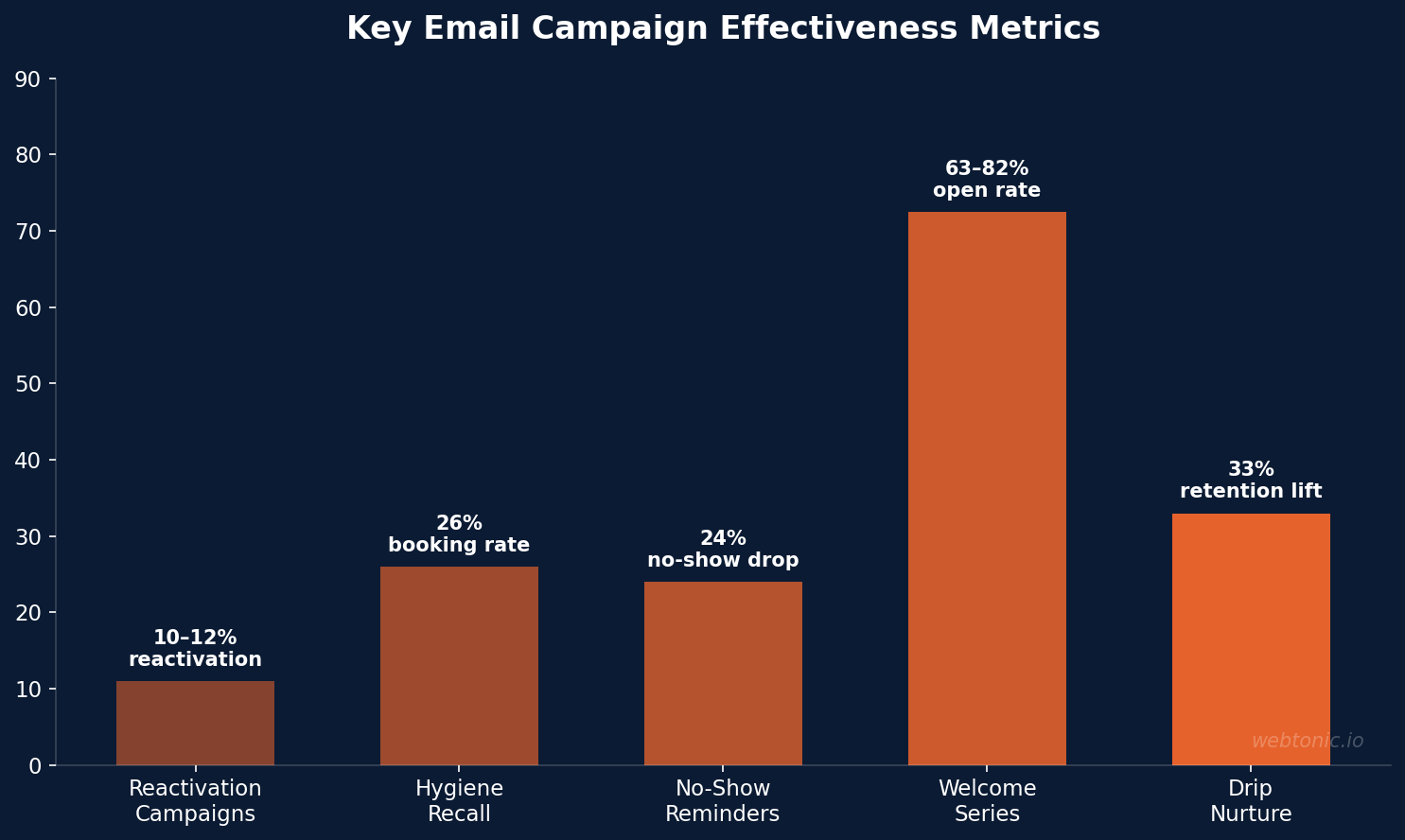
Different campaign types serve different objectives — from filling empty chairs to reactivating dormant patients. The data shows which formats drive the most revenue per send.
| Campaign Type | Key Metric | Benchmark |
|---|---|---|
| Appointment Reminders | No-show reduction | 24% |
| Hygiene Recall | Booking rate (overdue) | 26% |
| Reactivation (12–18 mo.) | Conversion rate | 10–12% |
| Welcome Series | Open rate | 63–82% |
| Drip Nurture Sequences | Annual retention lift | +33% |
| Post-Appointment Follow-Up | Return likelihood | +30% |
Patient Recall and Reactivation Data
Every dental office carries a backlog of dormant patients — individuals who have not returned for their regular cleaning or follow-up. Email-driven recall is the most scalable tool to recover this lost revenue.
- The average clinic carries 800–2,000 dormant patients (no visit in 12+ months) out of a base of 1,500–3,000 — roughly 30–50% of the entire roster (Ainora).
- Average recall rate is 60–70%, meaning 30–40% of patients fail to return on schedule. Well-managed offices reach 85–95%.
- Pre-scheduled patients return at 80–90% versus just 35–45% for those who leave without booking their next visit.
- Reactivation by dormancy window: 6–12 months: 25–35% | 12–18 months: 15–25% | 18–24 months: 10–15% | 24+ months: below 8%.
- A 3–5 touch multi-channel campaign reaches 15–25% of dormant patients, delivering 3–5× the single-touch rate.
- Clinics lose roughly 15–20% of their patient base each year to natural attrition. Email recall offsets this directly.
Email vs. Other Channels: Cost and Retention
Compared to other promotional channels, email stands out on both cost-per-contact and retention value. For dental providers focused on keeping chairs filled, the economics are compelling.
| Channel | Cost Per Patient Contact | Retention Value |
|---|---|---|
| Email Campaigns | $0.01–$0.05 | Very High |
| Direct Mail / Postcards | $0.50–$2.00 per piece | Low |
| Social Media Ads | $20–$80 per lead | Medium |
| Google Ads | $50–$200 per lead | Low (one-time) |
| Referral Programs | $0 (organic) | High |
- Retaining a patient costs 5–7× less than acquiring a new one (American Dental Association).
- A patient receiving monthly emails stays active 33% longer than one who does not (Stacc).
- Retention email open rates reach 30–50%, while acquisition emails average only 15–25% (Dentalbase).
- Cost per retained patient via email: $5–$15. Cost per acquired patient via paid search: $50–$200.
List Building and Segmentation Statistics
The size and quality of a dental office's subscriber list directly determines campaign performance. These data points show how top performers build and segment their audiences.
- The average dental clinic has 1,500–3,000 patients of record, but only 20–40% are opted into promotional emails (Ainora).
- Segmented campaigns generate 14.3% higher open rates than non-segmented sends across all industries — the impact is even larger for dental, where treatment history enables precise targeting.
- 98% of consumers research businesses online before choosing them. Email bridges the gap between that research and the booking decision (Dentalbase).
- Retention email open rates reach 30–50% because recipients already have a relationship with the clinic. Acquisition emails average only 15–25%.
- The cost to retain a patient via email is $5–$15, compared to $50–$150 to acquire a new one via paid search.
- Practices running separate retention and acquisition sequences see 2–3× higher open rates and 5–10× better cost per appointment than those using a single generic newsletter.
No-Show Impact and Automated Prevention
No-shows are one of the most expensive problems in dental operations. Automated email sequences address this directly, recovering revenue that would otherwise be lost to empty chairs.
| Metric | Industry Average | With Automation |
|---|---|---|
| No-Show Rate | 11–15% | 8–11% |
| Reminder Open Rate | N/A | 68.4% |
| Confirmation Response | 40–50% (phone) | 65–75% (email+text) |
| Revenue Recovery (monthly) | N/A | $2,000–$5,000+ |
- The average dental office loses 11–15% of appointments to no-shows (Brevo). For a clinic seeing 20 patients per day, that translates to 2–3 empty slots daily.
- More than 8 in 10 dentists report patient no-shows as a top operational challenge (ADA Health Policy Institute).
- The most effective reminder sequence combines a 48-hour advance email + a 2-hour same-day confirmation. This two-touch approach yields the 24% no-show reduction benchmark.
- Adding SMS to the reminder sequence lifts response rates by another 15–20%, as text messages are opened within 3 minutes on average.
- At an average appointment value of $200–$350, recovering even 2–3 slots per week translates to $1,600–$4,200 in monthly revenue recovered.
Platform Adoption and Technology Trends
The tools dental offices use for email campaigns are evolving rapidly, with practice management system (PMS) integrations and AI-driven personalization gaining traction.
- 65% of family dental offices say they rely on email for patient retention, indicating growing adoption despite the overall 20% active-use figure (Arch Dental Marketing).
- HIPAA-compliant platforms are non-negotiable. Dental offices must use tools that offer Business Associate Agreements (BAAs) — Mailchimp, Constant Contact, and dental-specific platforms like RevenueWell or Weave all provide this.
- AI-powered recall systems reach 60–75% of dormant patients versus 40–50% for manual calling, by optimizing send times and automating retries (Ainora).
- Offices switching from manual to AI-driven recall report a 20–30% improvement in recall rates within 3–6 months.
- The Mailchimp benchmark for "Medical, Dental, Healthcare" shows a 21.72% open rate, while MailerLite data for the same vertical shows 46.29% — the combined estimate is 34.01%, reflecting platform and list-quality differences (MailerStack).
- Dental offices using data-driven segmentation consistently outperform those sending batch-and-blast messages across every engagement metric.
Where Dental Email Marketing Fits in the Broader Strategy
Dental email marketing does not exist in isolation — it works best when integrated with other channels. For dental practices running Google Ads, local SEO, and social media campaigns, email serves as the retention backbone that maximizes the value of every patient acquired through those channels.
- Email marketing for dentists amplifies the ROI of every other channel. A patient acquired through Google Ads at $200 who stays active for 5 years via email nurture generates $3,000–$5,000 in lifetime revenue.
- Dental practices with strong Google Business Profile optimization and active email campaigns see compounding growth — the profile drives discovery, and email drives retention.
- Local SEO and dental email marketing are complementary. Patients who find a dental practice through local search and subsequently receive email follow-up are 40% more likely to book a second appointment.
- The most effective dental marketing strategies combine email marketing for dentists with search engine visibility. When a patient searches for a dentist, finds the practice via local SEO or Google Business Profile, books their first appointment, and then enters an automated email nurture sequence, the full funnel operates at peak efficiency.
- Dentist email marketing platform selection matters. Dental clinics need an email marketing platform that integrates with their practice management system (PMS) for automated recall, appointment reminders, and patient segmentation based on treatment history.
Dental Email Marketing Statistics: Industry Context
These dental marketing statistics highlight why email remains under-adopted despite its proven performance. The gap between what the data shows and what dental practices actually do represents the single largest opportunity in the vertical.
| Dental Marketing Channel | Adoption Rate | ROI Ranking |
|---|---|---|
| Google Business Profile | 95% | High (free) |
| Google Ads / PPC | 75% | Moderate (4:1–8:1) |
| Social Media Content | 82% | Low–Moderate |
| Dental Email Marketing | 20% | Highest ($36–$44 per $1) |
| Local SEO | ~50% | High (5:1–20:1) |
- Dental email marketing is the least adopted yet highest-ROI channel — creating a significant competitive advantage for the 20% of dental practices already using it.
- People searching for dental services online are increasingly expecting follow-up communication via email rather than phone calls, especially among patients under 45.
- Dental clinics that combine dentist email marketing with local SEO and Google Business Profile management report the fastest patient list growth and the lowest per-patient acquisition cost.
- As dental marketing evolves, email will play an even larger role as search algorithms and paid ad costs continue to shift. Building a strong subscriber list today creates an owned audience asset that does not depend on algorithm changes or rising ad costs.
Best Practices Backed by the Data
- Separate retention from acquisition lists. The two audiences require different messaging, tone, and CTAs. Combining them into a single newsletter depresses conversion for both.
- Automate appointment reminders. A 24% reduction in no-shows is achievable with a simple two-touch sequence (48 hours + 2 hours before).
- Run quarterly reactivation campaigns. Reaching dormant patients before the 18-month cliff (where reactivation drops below 10%) dramatically improves yield.
- Use welcome series for every new patient. The 63–82% open rate window is the best moment to set expectations, promote additional services, and request a review.
- Comply with regulations. HIPAA-compliant platforms (Mailchimp, Constant Contact with BAA, or dental-specific tools) protect patient data and avoid costly violations.
How Email Supports Local Search and Google Visibility
For dental clinics competing in local search results, email campaigns create a feedback loop that strengthens overall online presence. When dentists send email content that drives patients back to the website, those visits signal relevance to Google — reinforcing the practice's position in local SEO rankings and Google Business Profile visibility.
- Dental clinics that send monthly newsletters see 20–30% more Google reviews, because email is the easiest vehicle for requesting patient feedback. More reviews directly improve local SEO and Google Maps ranking.
- Email-driven website visits boost dwell time and reduce bounce rate — two signals that Google uses when ranking dental practice websites in organic search results.
- Dentists who include Google Ads landing page links in email campaigns see improved Quality Scores, as returning visitors already trust the practice and engage more deeply with the content.
- People who receive regular dental email content are 2× more likely to leave a positive review than those who only interact at the chair — making email the most scalable path to building the review volume that local SEO demands.
- For dental practices investing in both local SEO and email, the combined effect produces faster ranking improvements and higher conversion rates than either channel alone. The patient list becomes an asset that supports search visibility, Google Business Profile authority, and ongoing content distribution.
Related reading
- What Dental Outbound Reps Should Track from Cold Email Metrics
- Comparing Cold Outreach and Warm Campaigns in Trucking Email Marketing
- How Garage Doors and Windows Email Marketing Changed Between 2023 and 2026
- Email Marketing services at Web Tonic
FAQ
What is the average open rate for dental emails?
Promotional newsletters from dental providers average 28–34% open rates, significantly above the 21.3% cross-industry average. Transactional messages like appointment reminders reach 68.4%, and welcome emails achieve 63–82%. The higher figures reflect the personal relevance of health-related communications.
How much ROI does email produce for dental clinics?
Email delivers $36–$44 in return for every $1 spent, according to industry benchmarks. The cost per send is just $0.01–$0.05, making it the most cost-efficient channel available. Hygiene recall campaigns alone book 26% of overdue appointments, directly converting sends into chair time.
How effective are reactivation emails for dormant patients?
Single-touch reactivation emails convert 3–5% of dormant patients. A multi-touch campaign (3–5 messages across email, text, and phone) lifts that to 15–25%. Timing matters: patients dormant 6–12 months reactivate at 25–35%, but beyond 24 months the rate drops below 8%.
Do appointment reminder emails actually reduce no-shows?
Yes. Automated reminders reduce no-shows by 24% on average. The most effective sequence combines a 48-hour advance reminder with a same-day confirmation. Given that the typical clinic loses 11–15% of appointments to no-shows, this single automation can recover thousands of dollars monthly.
What percentage of dental offices use email today?
Only 20% of dental offices actively run email campaigns. The remaining 80% rely on phone calls and postcards. Meanwhile, 65% of family practices say they rely on email for patient retention, suggesting adoption is growing but still far from saturation. Early adopters have a significant competitive advantage.
Sources
thestacc.com/blog/email-marketing-dentists
cufinder.io/blog/benchmarks/dentists
mailerstack.com/average-email-open-rates
ainora.lt/blog/dental-recall-reactivation-statistics-benchmarks
dentalbase.ai/blogs/marketing/email-marketing-retain-acquire-dental-patients
brevo.com/blog/dental-email-marketing
repugen.com/patient-review-survey
zipdo.co/dental-marketing-statistics