Table of contents
No study prices garage door and window email marketing on its own, so the honest way to answer “what changed between 2023 and 2026” is to separate two things: the closest available ecommerce benchmark, which barely moved, and the actual news events - a tripling ROI story and a terminated tax credit - that reshaped what these emails could credibly say.
Key Takeaways
- No email benchmark isolates garage door or window contractors as their own category.
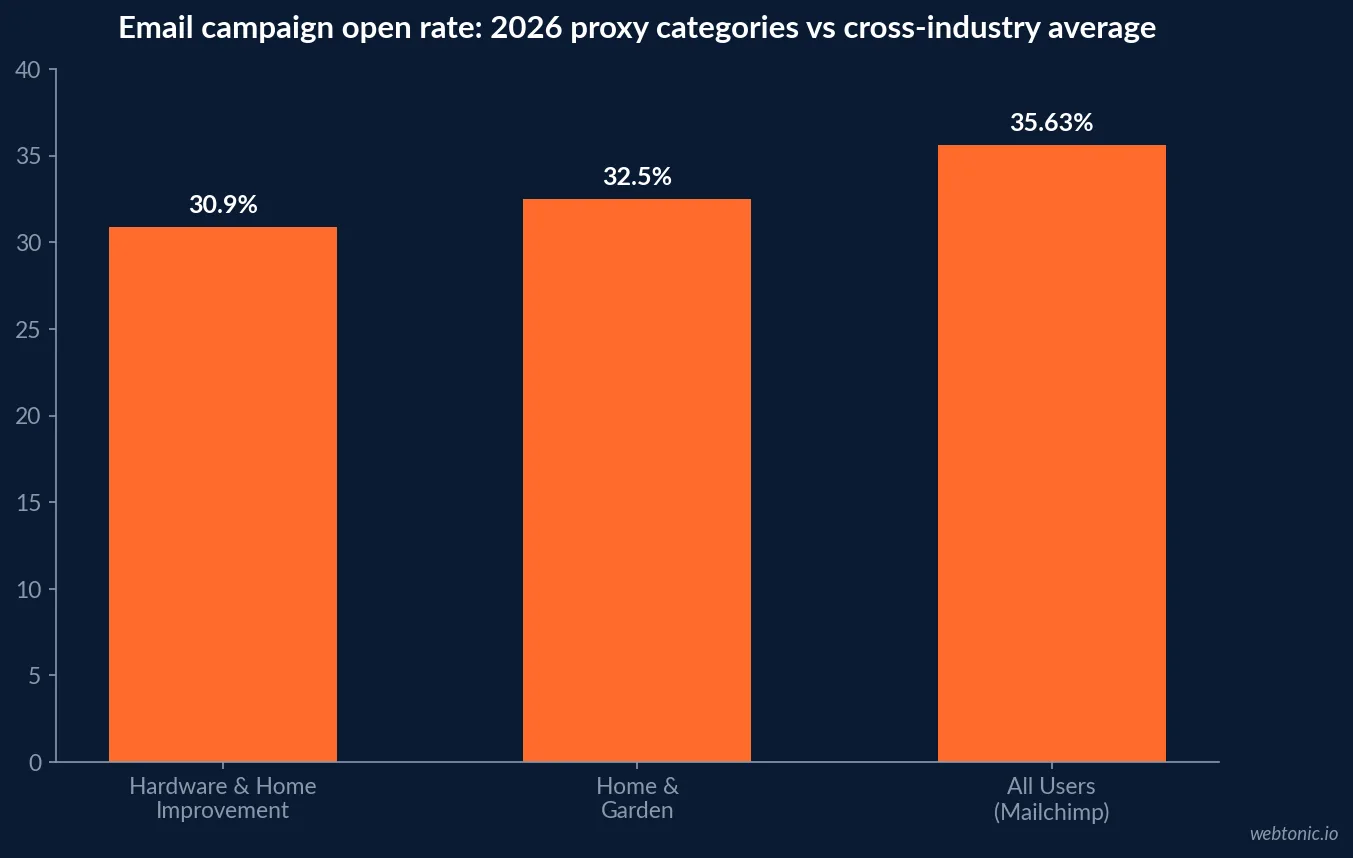
- Klaviyo's Hardware & Home Improvement proxy open rate is 30.9% for campaigns in 2026.
- The Home & Garden proxy open rate is 32.5%, slightly higher.
- Automated flow open rates run higher: 31.7% and 34.2% for the same two categories.
- Campaign click rate for Hardware & Home Improvement is 1.84%.
- Flow placed-order rate for the same category is 2.07%, against 2.11% across all industries.
- Mailchimp's cross-industry All Users open rate is 35.63%, a useful outside check.
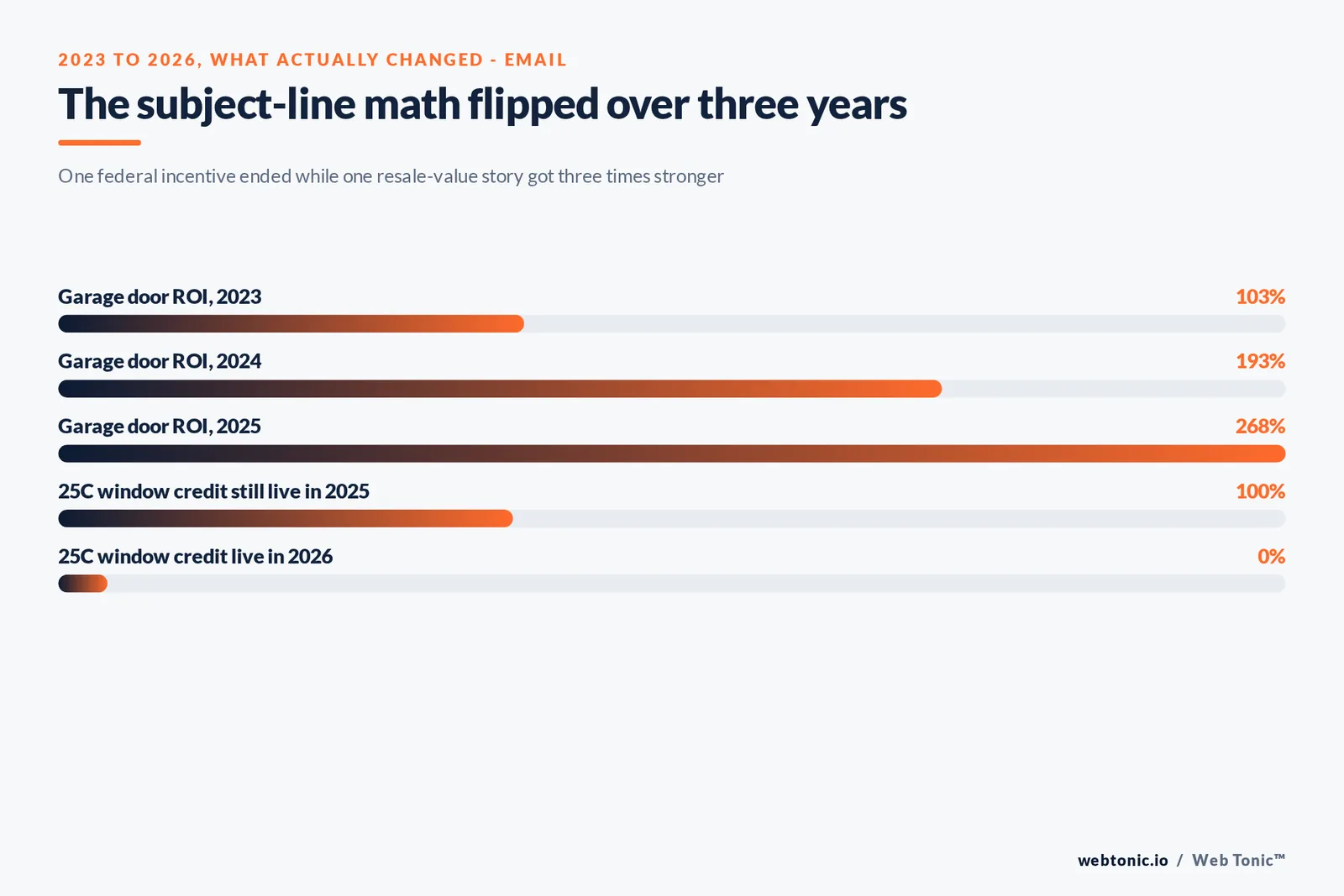
- The federal 25C window and door tax credit ended for property placed in service after Dec. 31, 2025.
- That termination came via the One Big Beautiful Bill Act, per IRS guidance.
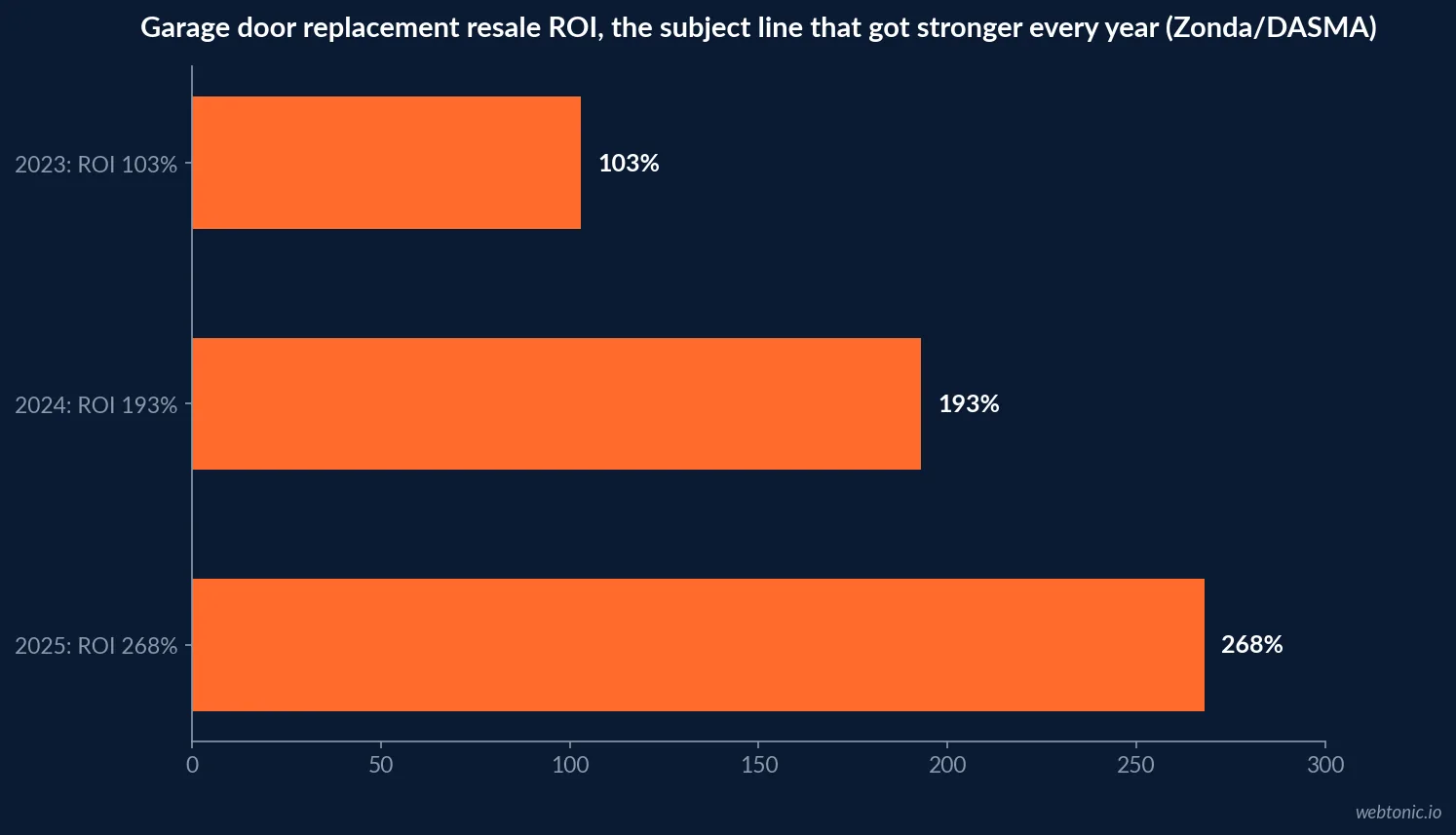
- Garage door replacement ROI rose from 103% in 2023 to 268% in 2025 (Zonda/DASMA).
- That is a 165% increase in ROI in three years, on job costs that rose only $370.
- Automated flows generate roughly 41% of total email revenue despite being a small share of sends (Klaviyo 2026).
- Flows deliver about 3x the click rate and 13x the placed-order rate of one-off campaigns (Klaviyo 2026).
- The overhead and garage door services market is projected past $16 billion in 2026 (FMI Consulting).
Why this page tracks events, not a single benchmark line
Email platforms report benchmarks by broad ecommerce category, and no platform - Klaviyo, Mailchimp, or any other vendor with a stated methodology - breaks out garage doors and windows as their own line. Klaviyo's closest proxies, Hardware & Home Improvement and Home & Garden, are built from over 183,000 brands, but those brands are overwhelmingly ecommerce retailers, not local installation contractors. So instead of forcing a single misleading number, this page separates the proxy benchmark (which changed little) from the real news events between 2023 and 2026 that should have changed what these emails actually said.
| Email metric (2026 proxy data) | Hardware & Home Improvement | Home & Garden | Source |
|---|---|---|---|
| Campaign open rate | 30.9% | 32.5% | Klaviyo 2026 |
| Flow (automated) open rate | 31.7% | 34.2% | Klaviyo 2026 |
| Campaign click rate | 1.84% | 1.78% | Klaviyo 2026 |
| Flow placed-order rate | 2.07% | 2.12% | Klaviyo 2026 |
The event that ended a live subject-line hook: the 25C credit
For years, window and exterior-door replacement emails could legitimately reference a federal tax incentive. That changed. Per 26 U.S.C. § 25C and the IRS's own FAQ page, the energy efficient home improvement credit “shall not apply with respect to any property placed in service after December 31, 2025,” a termination enacted under the One Big Beautiful Bill Act. Before that date, the credit covered a share of qualifying window, skylight and exterior door costs up to stated annual caps.
Any email template still built around “claim your window tax credit this year” for 2026 installations is not just outdated copy, it is describing a benefit that no longer exists for the buyer. That single regulatory change is a bigger swing in email messaging than anything in the open-rate data.
| Event timeline (2023-2026) | What changed | Source |
|---|---|---|
| 2023 | 25C credit fully in force; garage door ROI at 103% | IRS / DASMA-Zonda |
| 2024 | 25C credit still in force; garage door ROI climbs to 193% | IRS / DASMA-Zonda |
| 2025 | Dec. 31, 2025: last day 25C credit applies to placed-in-service property | IRS / OBBBA |
| 2026 | 25C credit terminated; garage door ROI at 268%, the strongest yet | IRS / DASMA-Zonda |
The event that strengthened a subject-line hook: the ROI climb
While the tax-credit angle closed, a stronger one opened. DASMA's coverage of Zonda Media's Cost vs. Value Report tracks garage door replacement ROI rising from 103% in 2023 to 193% in 2024 to 268% in 2025 - a 165% increase in three years - while the average job cost rose only from $4,302 to $4,672. That is a genuinely stronger, more current number than most email templates in this category are using, and it applies to garage doors specifically rather than a windows-and-doors blend.
Windows do not have an equivalent single-project ROI figure this clean; the closest comparable claim is the discontinued 25C credit, which is exactly why the messaging shift matters: the honest, current hook for garage doors is resale ROI, and for windows it is now energy savings and comfort rather than a federal rebate.
Why automated flows deserve more of the calendar than one-off campaigns
Klaviyo's 2026 benchmark data, drawn from over 183,000 brands, finds automated flows deliver roughly 3x the click rate and 13x the placed-order rate of one-off campaigns, while generating close to 41% of total email revenue despite representing a small share of total sends. For a garage door and window business, that argues for building a small number of durable, trigger-based flows - quote-follow-up, post-installation review request, seasonal maintenance reminder - rather than relying mainly on promotional blasts.
| Send type (Klaviyo 2026 data) | Relative click rate | Relative placed-order rate | Share of total email revenue |
|---|---|---|---|
| One-off campaigns | 1x (baseline) | 1x (baseline) | ~59% |
| Automated flows | ~3x | ~13x | ~41% |
Where the market context still applies
FMI Consulting's 2026 sector brief puts the US overhead and garage door services market above $16 billion, with more than 114 million doors already in service creating durable, non-discretionary maintenance demand. That installed base is exactly the audience a maintenance-reminder flow should be built around, since it needs no new-customer acquisition cost to reach.
Two published ROI figures, and why they don't match
The 268% garage door ROI figure above comes from Zonda's own market data as covered by DASMA. A different figure shows up on the National Association of Realtors' remodeling resource page, which cites the “Cost vs. Value Report (Journal of Light Construction, 2025)” putting garage door replacement at 194% cost recouped, still the top-ranked project on NAR's list but a meaningfully lower number than Zonda's 268%. Both figures trace back to the same underlying Cost vs. Value research program, drawn from different market-year cuts and, in NAR's case, a NARI-member professional estimate rather than Zonda's direct regional cost-versus-sale-price data. An email campaign should cite one source consistently and note the figure's year, rather than blending the two into a single number.
| Source | Garage door ROI figure cited | Basis | Use in email copy |
|---|---|---|---|
| Zonda Media / DASMA | 268% (2025) | 119 US markets, direct cost-vs-resale-value data | Primary figure for subject lines, cite the year |
| National Association of Realtors | 194% | NARI-member professional estimate, per NAR's remodeling page | Cite only if attributing to NAR specifically |
What a second vendor's data confirms about flows versus campaigns
The flows-outperform-campaigns pattern is not a Klaviyo-only finding. Omnisend's 2026 ecommerce marketing report, built from 27 billion emails sent through its own platform, found automated emails generating $2.87 in revenue per email sent against $0.18 for one-off campaigns - an even wider gap than Klaviyo's category data shows, and from a completely separate 2025 sending dataset. Two vendors with different customer bases landing on the same directional conclusion is a stronger basis for reallocating calendar time than either figure alone.
What the window side of this trade lost, in numbers
Before termination, the 25C credit was not trivial: per the IRS's own guidance, the credit covered 30% of qualifying costs up to an annual cap, with a stated $600 limit specifically for exterior windows and skylights and a combined annual limit of $1,200 for most other qualifying improvements under the post-2022 rules. An email that used to say “claim up to $600 back on new windows” was citing a real, specific number, which is exactly why leaving that language live into 2026 is a factual error, not a stale-but-harmless line. Marketers running multi-year drip sequences for window replacement should treat this as a mandatory audit item, not an optional copy refresh, since an inaccurate tax claim in marketing material carries its own regulatory exposure separate from ordinary advertising puffery. The safest immediate action is a full template audit against the December 31, 2025 cutoff date, treating any live reference to a 2026 window tax credit as an error to fix the same day it is found, not on the next scheduled content refresh.
| 25C credit detail (pre-termination) | Figure | Status for 2026 | Source |
|---|---|---|---|
| Windows and skylights annual cap | $600 | No longer applies - property must be placed in service by Dec. 31, 2025 | IRS |
| Combined annual limit, most other improvements | $1,200 | Same termination date applies | IRS |
| Credit rate | 30% of qualifying cost | Terminated for post-2025 installs | 26 U.S.C. § 25C |
What this proxy data cannot tell you
None of the benchmarks above come from a garage door or window installation company's own list; Klaviyo and Omnisend both draw from ecommerce sending data. Treat every open, click and placed-order figure as a rough calibration point for your own list, not a target, and weight the two genuinely contractor-relevant facts on this page - the ROI trend and the 25C termination - more heavily than the proxy percentages when deciding what to change first.
What to actually change in the next campaign
Audit every live template for the 25C credit language first; that is a compliance and accuracy issue, not a style choice. Then rebuild the garage door messaging around the 268% ROI figure while it is current, and stand up a maintenance-reminder flow against your installed customer base rather than adding another one-off promotional send. Our data and analytics team can help instrument which flow actually drives booked jobs, and our broader email marketing statistics page has the cross-industry context to benchmark the rest of the calendar. For the paid side of the funnel these emails support, see our cost-per-lead benchmarks by industry.
Frequently Asked Questions
Is there an email marketing benchmark specific to garage door and window companies?
No. The most relevant published data, Klaviyo's 2026 email benchmarks, covers Hardware & Home Improvement and Home & Garden as ecommerce product categories built from over 183,000 Klaviyo brands - retailers selling hardware and home goods, not contractors selling installation. Every open, click and placed-order figure on this page is that proxy, clearly labeled, not a contractor-specific number.
What is the single biggest email-relevant change between 2023 and 2026?
The federal 25C energy efficient home improvement credit, which covered a share of the cost of qualifying replacement windows and exterior doors, was terminated for any property placed in service after December 31, 2025, under the One Big Beautiful Bill Act. Per current IRS guidance, that credit simply no longer applies. Any email template still promoting a live federal window tax credit for 2026 work is out of date and should be corrected immediately, not just refreshed.
What changed in the ROI story a marketer can cite in a subject line?
DASMA's coverage of Zonda's Cost vs. Value Report shows garage door replacement resale ROI moving from 103% in 2023 to 193% in 2024 to 268% in 2025 - a number that got dramatically more compelling for email copy over exactly the 2023-2026 window this page covers, while the average job cost barely moved.
How do open rates for this proxy category compare to the platform average?
Klaviyo's 2026 data puts Hardware & Home Improvement campaign open rate at 30.9% and Home & Garden at 32.5%, both close to typical ecommerce ranges and roughly in line with Mailchimp's cross-industry All Users average of 35.63%. None of these figures are dramatically above or below the platform norm, which argues against assuming this category needs a fundamentally different open-rate strategy.
Should garage door companies even be judged against ecommerce email benchmarks?
Only as a rough proxy. Most garage door and window businesses are local service contractors selling a one-time installation, not ecommerce brands selling repeat hardware purchases, so metrics like placed-order rate from Klaviyo do not map cleanly onto a quote-request or booked-appointment funnel. Use the proxy for open and click benchmarking, and build your own baseline for anything tied to lead conversion.
Sources
Klaviyo - 2026 Email Marketing Benchmarks by Industry
Mailchimp - Email Marketing Benchmarks & Industry Statistics
US Code - 26 U.S.C. § 25C, Energy efficient home improvement credit
IRS - FAQs on energy efficient home improvement and residential clean energy credits
DASMA / Zonda Media - Cost vs. Value Report 2025 coverage
FMI Consulting - Private Equity Sector Brief: Overhead & Garage Door Services, March 2026
National Association of Realtors - Remodeling resource page
Omnisend - Email Marketing Statistics 2026