Table of contents
Dental practices do not cold-email patients, but the vendors selling to dental practices run ordinary B2B cold email, and 2026 vendor datasets put the average reply rate between 0.45% and 3.43% depending on how it is measured. This page is a metrics guide for that B2B side of the industry, not a patient-acquisition playbook.
Key Takeaways
- Instantly's 2026 benchmark puts average B2B reply rate at 3.43%.
- Top quartile campaigns reach 5.5%, and elite campaigns exceed 10.7%.
- Belkins' narrower 2025 dataset of 7.5 million emails reports a 0.45% average.
- Woodpecker's median reply rate across 56,614 campaigns is 1.5%.
- Woodpecker's median open rate across 37,000 campaigns is 26%.
- Reply rate falls from 1.2% to 0.4% as daily volume per mailbox rises from 21-50 to 201-500.
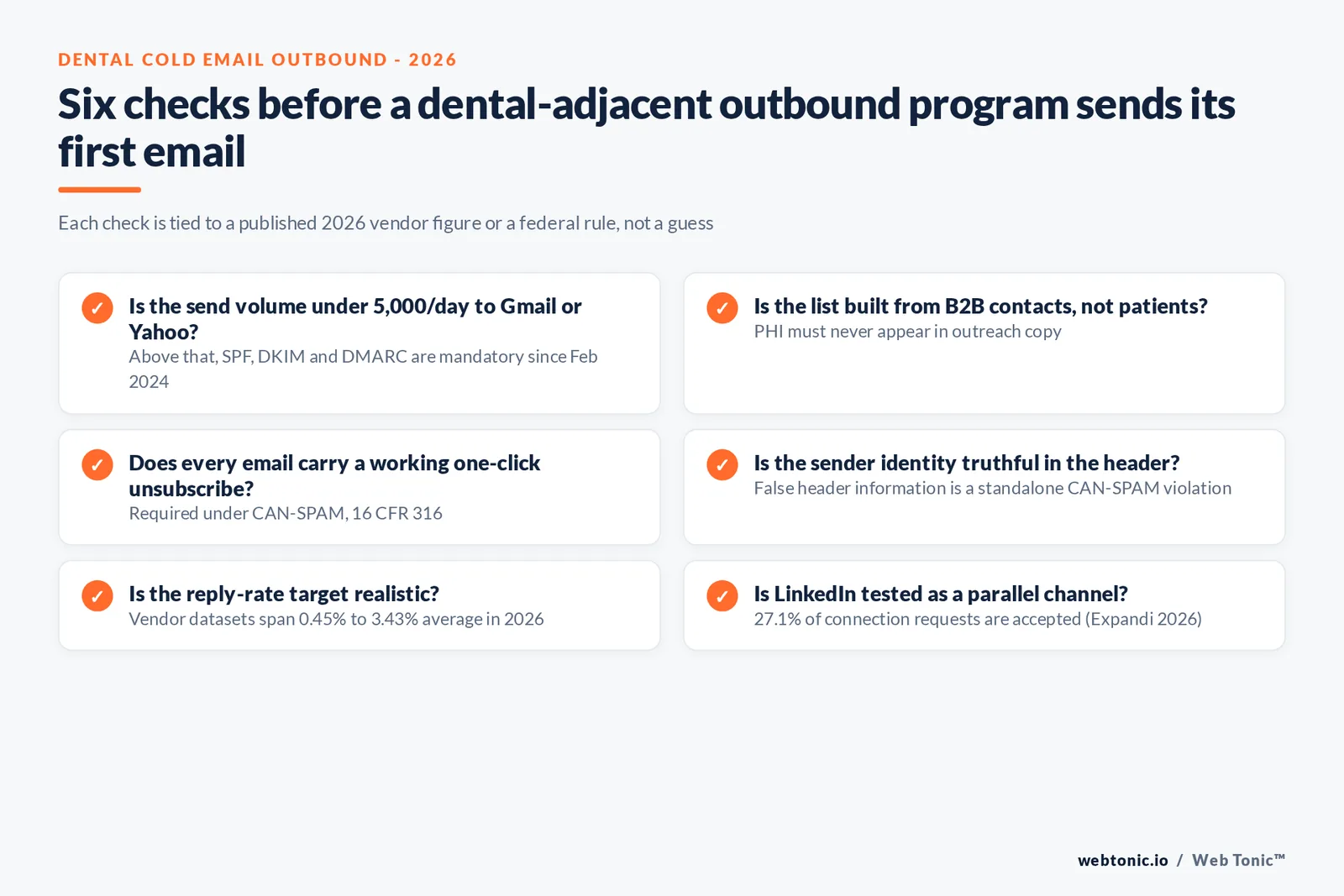
- Google and Yahoo have required SPF, DKIM and DMARC for 5,000+/day senders since Feb 2024.
- Spam complaint rates must stay under roughly 0.3% under those same rules.
- CAN-SPAM requires a working one-click unsubscribe on every commercial email.
- False header or "from" information is a standalone CAN-SPAM violation.
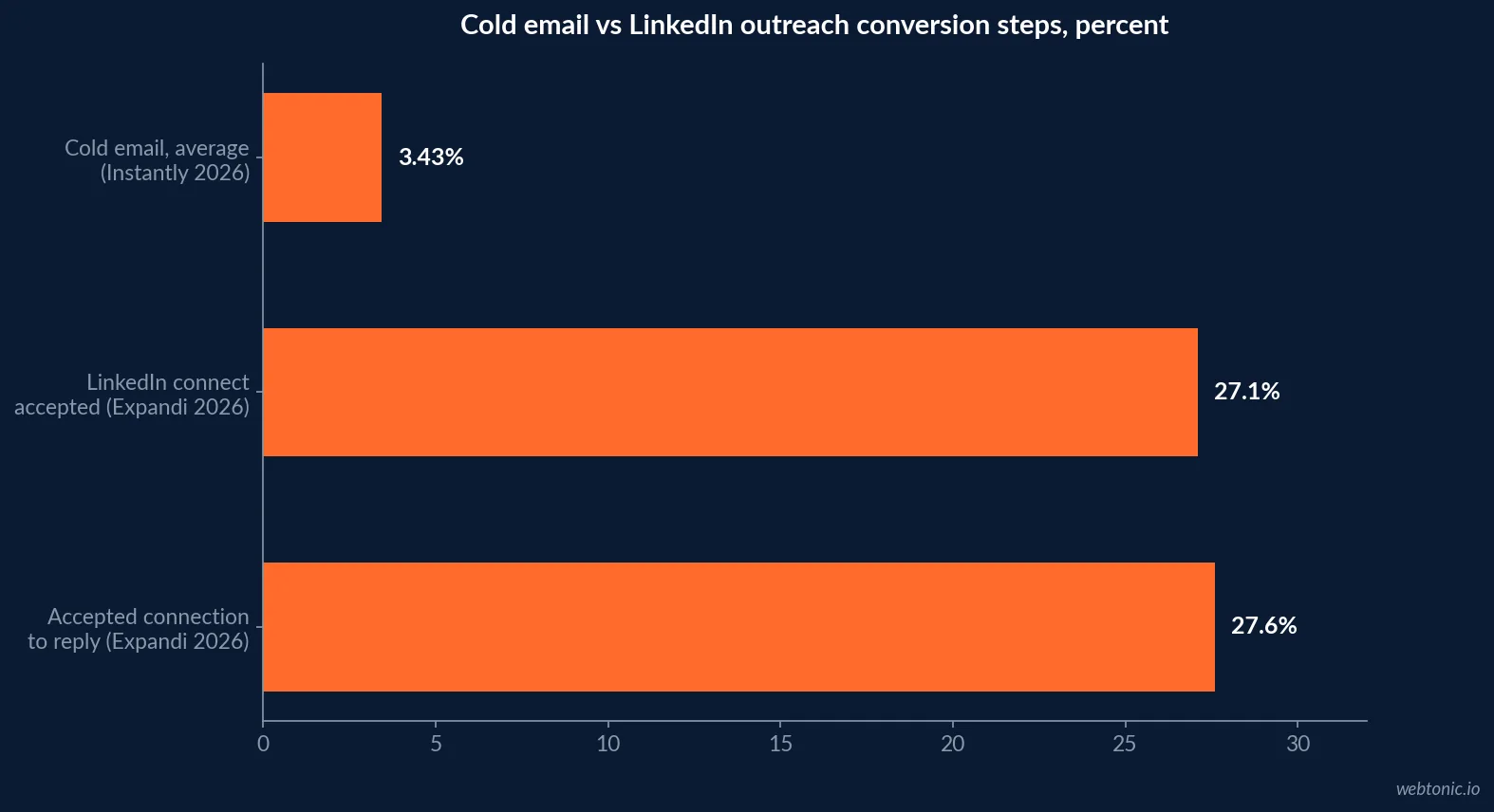
- 27.1% of tracked LinkedIn connection requests were accepted in Expandi's 2026 data.
- 27.6% of accepted LinkedIn connections produced a reply.
- The US has close to 200,000 practicing dentists across roughly 178,000-202,000 locations.
- PHI must never appear in B2B outreach copy, even though HIPAA does not ban the outreach itself.
- No dental-specific cold email benchmark exists, so this page uses vendor-wide 2026 datasets.
Who is actually sending cold email in dentistry
Reframe the question before tracking anything: a dental practice itself has no reason to send cold email, because its buyers are patients who found it through search, referral, or insurance directories, not a purchased list. The senders in this niche are on the supply side - practice management software vendors, equipment and supply distributors, dental billing and RCM companies, staffing agencies, and marketing firms - reaching practice owners, office managers, and DSO operations and procurement teams.
That B2B-to-B2B framing matters because it changes both the applicable law (ordinary CAN-SPAM commercial email rules, not patient-privacy marketing restrictions) and the benchmark set that applies (general B2B cold email data, not a healthcare-consumer channel).
The metric to track first: reply rate, not open rate
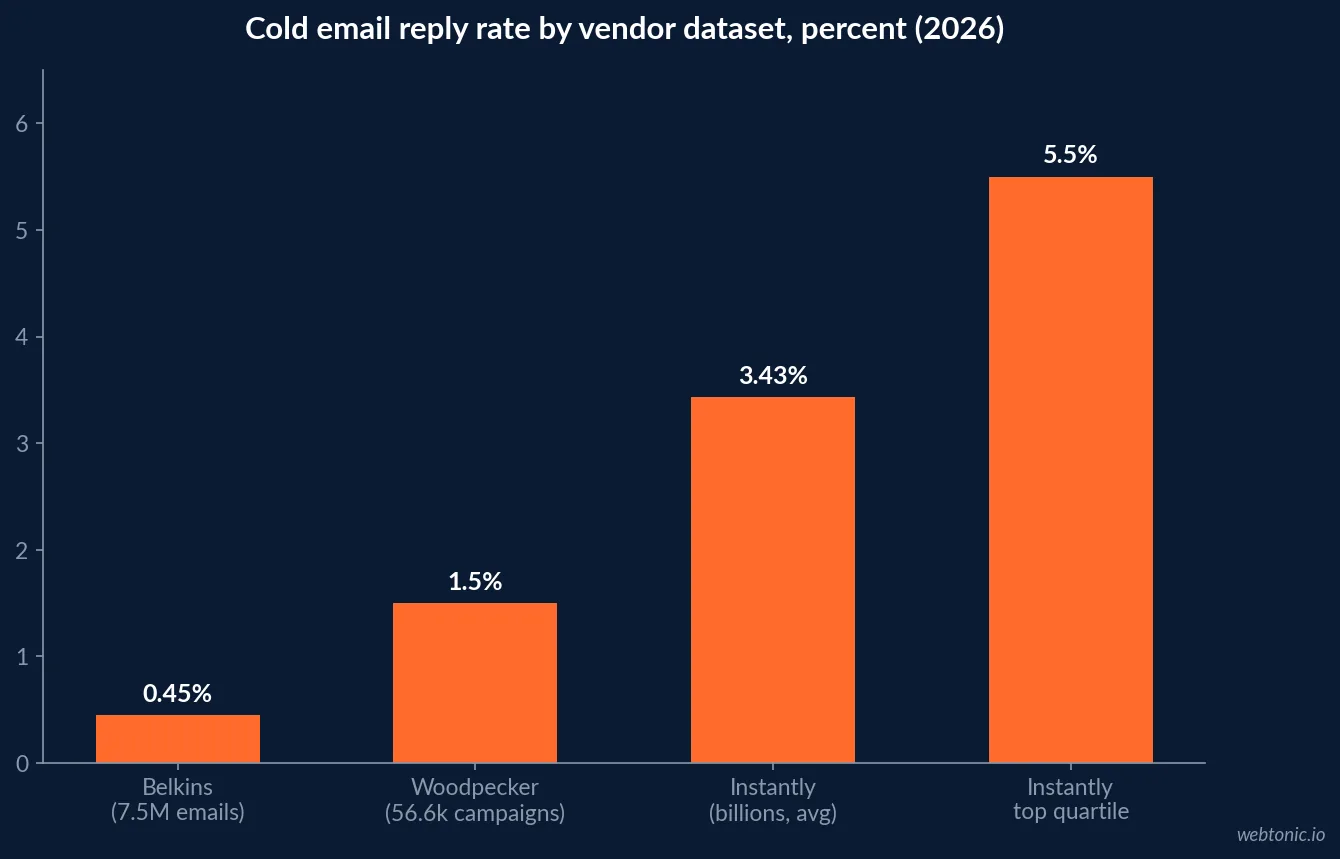
Lemlist's lemcoach benchmark guide tells users directly to track reply rate as the primary metric: a rate above 5% is good, above 8% is excellent, and below 3% means something in the sequence is broken. Woodpecker's own live benchmark tool, drawn from 56,614 tracked campaigns, puts the median reply rate at 1.5% against a median open rate of 26% across 37,000 campaigns - a wide enough gap that open rate alone would badly overstate how many prospects a dental-adjacent rep is actually reaching.
| Vendor dataset (2026) | Sample size | Reported metric | Value |
|---|---|---|---|
| Instantly Cold Email Benchmark Report | Billions of emails, 700,000+ businesses | Average reply rate | 3.43% |
| Instantly Cold Email Benchmark Report | Same dataset | Top quartile reply rate | 5.5% |
| Instantly Cold Email Benchmark Report | Same dataset | Elite (top 10%) reply rate | 10.7%+ |
| Belkins 2026 study | 7,530,489 emails, 2025 client campaigns | Average reply rate (unique replies/sends) | 0.45% |
| Woodpecker live benchmark tool | 56,614 campaigns | Median reply rate | 1.5% |
| Woodpecker live benchmark tool | 37,000 campaigns | Median open rate | 26% |
Why the numbers spread so wide
The gap between Belkins' 0.45% and Instantly's 3.43% average is mostly a measurement and mix difference, not a contradiction. Belkins measures unique replies over total sends across its own client base of cold, unwarmed prospecting lists; Instantly's figure spans users who follow its own deliverability playbook - authenticated domains, warmed mailboxes, personalization, and capped daily volume. Both are legitimate, both are labelled with sample size, and a dental-adjacent outbound rep should benchmark against the dataset that matches their own list quality and sending discipline, not the more flattering number. Our broader demand generation statistics page covers how B2B teams outside dentistry set the same kind of realistic channel targets.
Volume discipline changes the number more than copywriting does
Woodpecker's own volume-segmented data is the clearest operational lesson in any of these reports: mailboxes sending 21 to 50 emails a day average a 1.2% reply rate; push that to 201 to 500 a day and the average reply rate drops to 0.4%, even before deliverability penalties from spam-filter throttling are counted. For a dental-vertical vendor with a finite list of realistic buyers - a few hundred DSOs, a few thousand independent practices in a target region - sending fewer, better-targeted emails per mailbox outperforms scaling volume against a limited addressable market.
| Daily sends per mailbox | Average reply rate | Implication for a niche B2B list | Source |
|---|---|---|---|
| 21-50/day | 1.2% | Matches a realistic dental-vendor list size | Woodpecker 2026 |
| 201-500/day | 0.4% | Outpaces most niche lists; volume beats itself | Woodpecker 2026 |
| First email in sequence | 58% of all eventual replies (Instantly) | The opener still carries most of the weight | Instantly 2026 |
| Follow-up touches | Remaining 42% of replies | Follow-ups matter but are not the majority driver | Instantly 2026 |
The compliance floor: CAN-SPAM and the 2024 bulk-sender rules
Every commercial email into a US inbox, dental-vertical or not, is governed by the CAN-SPAM Act and its implementing rule at 16 CFR Part 316: truthful header and "from" information, a non-deceptive subject line, clear identification as an ad where required, a valid physical postal address, and a working opt-out honored within 10 business days. Since February 2024, Google and Yahoo layered stricter technical requirements on top for anyone sending 5,000 or more messages a day to their users: mandatory SPF, DKIM and DMARC authentication, spam complaint rates kept under roughly 0.3%, and one-click unsubscribe support.
| Requirement | Applies to | Threshold or rule | Governing source |
|---|---|---|---|
| Truthful header/from info | All commercial email | No falsified sender identity | CAN-SPAM, 16 CFR 316 |
| Working opt-out | All commercial email | Honored within 10 business days | CAN-SPAM, 16 CFR 316 |
| SPF + DKIM authentication | All senders | Basic requirement | Google sender guidelines |
| SPF + DKIM + DMARC | 5,000+ messages/day to Gmail/Yahoo | Mandatory since Feb 2024 | Google + Yahoo bulk-sender rules |
| Spam complaint rate | 5,000+ messages/day senders | Keep under ~0.3% | Google Postmaster Tools guidance |
Where LinkedIn fits alongside cold email
Expandi's State of LinkedIn Outreach H2 2026 report, built from 180,155 tracked connection requests given at least 30 days to mature, found 27.1% of requests accepted and 27.6% of accepted connections going on to produce a reply, with 2.0% of accepted connections converting to a booked meeting. That accepted-to-reply figure looks stronger than any cold email reply-rate benchmark on this page, but it is measured on a smaller, pre-filtered base - people who already said yes to a connection - so the two channels are complements, not substitutes, for a dental-vertical vendor building outbound pipeline.
The HIPAA and TCPA caution that still applies
HIPAA does not prohibit a software vendor or supplier from emailing a dental office manager about a product. What it prohibits is any protected health information appearing in that outreach - no patient names, no case details, nothing tied to an identifiable individual's care. Any parallel outreach by text message additionally falls under the Telephone Consumer Protection Act, which requires prior consent before an automated or bulk text campaign, a stricter bar than email's opt-out model under CAN-SPAM.
What good sequence structure looks like in the data
Instantly's 2026 benchmark also breaks down where replies actually come from inside a sequence: 58% of all eventual replies land on the first email, and the remaining 42% come from follow-ups. That split argues against two common mistakes: sending a single email and giving up, and over-building a six- or seven-touch sequence assuming later touches carry equal weight. Lemlist's benchmark guide recommends short, direct emails with one clear call to action per message rather than a long pitch, which matches what actually drives the reply-rate difference between average and top-quartile campaigns.
For a dental-vertical vendor with a short list of realistic target accounts, this means investing the personalization budget in the first email and one strong follow-up, rather than a long, generic sequence padded with touches that historically do less than half the work.
| Sequence position | Share of eventual replies | What it implies | Source |
|---|---|---|---|
| First email | 58% | The opener has to do most of the work | Instantly 2026 |
| Follow-up touches (combined) | 42% | Diminishing but real value in 1-3 follow-ups | Instantly 2026 |
| Recommended email length | 50-125 words | Short outperforms a long pitch | Instantly 2026 |
| Recommended follow-up cadence | 7-14 days between touches | Spacing beats rapid-fire sends | Instantly 2026 |
Deliverability floor before any of this matters
None of the reply-rate benchmarks above are reachable if the email never lands in an inbox. Instantly's own reply-rate guide sets the deliverability floor at spam complaints under 0.3% and bounce rate under 2%, alongside full SPF, DKIM and DMARC authentication. A dental-vertical vendor sending from a fresh domain without a warm-up period will see deliverability problems mask what would otherwise be a normal reply rate, which is a common misdiagnosis: teams blame copy or targeting for a problem that is actually authentication or warm-up.
What Gong's much larger dataset adds to the picture
Gong Labs has analyzed tens of millions of cold emails across its customer base and reports that pitching a product in the opening message, rather than asking a question or offering something of value first, reduces reply rates by as much as 57%. That finding matters more for dental-vertical vendors than most, because the instinct with a niche, credential-heavy buyer (a DSO procurement lead, a licensed dentist) is to lead with product specifications - exactly the pattern Gong's data flags as the weakest opener.
| Opener style | Effect on reply rate (Gong Labs) | Better alternative |
|---|---|---|
| Leads with a pitch/product specs | Up to 57% lower reply rate | Lead with a specific, relevant question |
| Asks a question first | Baseline, higher reply rate | Follow the question with the offer, not before it |
Setting a realistic target
Given the roughly 178,000 to 202,000 active dental practice locations and near 200,000 practicing dentists that make up the addressable market, a dental-vertical vendor should benchmark against the tighter, list-quality-matched figures - Belkins' 0.45% for a cold, unwarmed list, or Woodpecker's 1.5% median for a moderately targeted one - rather than anchoring expectations on Instantly's 3.43% average, which already assumes an authenticated, warmed sending setup. Our growth marketing team sets outbound targets the same way: from the dataset that matches the list in hand, not the best number in the market. If your list or authentication setup needs a review before the first send, talk to us.
Frequently Asked Questions
Do dental practices cold-email patients?
No, and they should not try to. This page is about the B2B side of the dental industry: software vendors, equipment suppliers, staffing agencies, billing companies and marketing firms that sell to practice owners, office managers and DSO operations teams by email. HIPAA does not ban B2B outreach email, but protected health information must never appear in a sales message, and TCPA governs any text-message outreach separately.
What reply rate should a dental-adjacent outbound rep expect?
Instantly's 2026 Cold Email Benchmark Report, built from billions of emails across more than 700,000 businesses, puts the average B2B reply rate at 3.43%, the top quartile at 5.5%, and elite campaigns above 10.7%. Belkins' narrower 2026 study of 7.5 million of its own client emails reports a lower 0.45% average, calculated strictly as unique replies over total sends, which shows how much the measurement method itself moves the headline number.
What is the single metric to track first, and why not open rate?
Reply rate. Lemlist's own lemcoach benchmark page tells its users to track reply rate as the primary metric, not opens or clicks, because Apple Mail Privacy Protection and other proxy-fetching pre-load tools inflate open-rate data past the point of being directionally useful. A reply is unambiguous; an open often is not.
What changed after the Google and Yahoo 2024 bulk-sender rules?
Since February 2024, any sender delivering 5,000 or more messages a day to Gmail or Yahoo Mail accounts must authenticate with SPF, DKIM and DMARC, keep spam complaint rates under roughly 0.3%, and provide one-click unsubscribe. Woodpecker's own volume data shows why this matters operationally: reply rate falls from 1.2% at 21-50 sends per mailbox per day to 0.4% at 201-500 sends per day, so the rules and the data point the same direction, toward smaller, better-authenticated sending.
Should a dental-adjacent B2B seller use LinkedIn instead of cold email?
As a parallel channel, yes. Expandi's 2026 State of LinkedIn Outreach report, drawn from 180,155 tracked connection requests, found 27.1% of requests accepted and 27.6% of accepted connections producing a reply. That reply-on-accepted-connection rate beats typical cold email reply rates, but it requires the prospect to accept a connection first, which is its own funnel step cold email does not have.
Sources
Instantly - Cold Email Benchmark Report 2026
Instantly - Cold Email Reply Rate Benchmarks
Belkins - B2B cold email response rates, 2026 study
Belkins - State of B2B Outreach Report
Woodpecker - Free cold email benchmarks tool
Lemlist - lemcoach cold email benchmarks and metrics
Google - Email sender guidelines
Yahoo Sender Hub - FAQs
Federal Trade Commission - CAN-SPAM Act Compliance Guide for Business
eCFR - 16 CFR Part 316, CAN-SPAM Rule
Expandi - State of LinkedIn Outreach H2 2026
Gong Labs - Does cold email even work any more