Table of contents

Transportation has the lowest measured email open rate of any tracked industry, and cold outbound to shippers runs on a set of benchmarks two large platforms measure very differently. This page keeps the two channels separate, because collapsing warm relationship email and cold shipper prospecting into one "email marketing" number hides both problems.
Key Takeaways
- Travel and transportation has a 30.10% email open rate, the worst of every industry MailerLite tracks (2026).
- That is built from over 3.6 million campaigns and 181,000 accounts, December 2024 to November 2025 (MailerLite).
- The all-industry cross-platform open rate is 35.63% (Mailchimp).
- Transportation's click rate is 1.68%, against varied comparators across other tracked industries (MailerLite).
- Transportation's click-to-open rate is 6.34% (MailerLite).
- Transportation's unsubscribe rate is 0.13%, among the lowest tracked (MailerLite).
- Woodpecker's own platform data (20M+ emails) puts average cold email reply rate at 3.43% in 2026, down from 5.1% in 2024.
- Smartlead's own platform data (850M+ emails, H1 2026) puts median cold email reply rate at 0.74%, with the top 10% clearing 2.6%.
- Personalized cold email averages an 18% reply rate against roughly 9% for non-personalized sends (Woodpecker).
- Small lists under 50 contacts average a 5.8% reply rate against 2.1% for lists of 1,000 or more (Woodpecker).
- Sequences of four to seven touchpoints hit an 8.3% reply rate (Woodpecker).
- Belkins' 2026 study is built from over 7.5 million cold emails, 175,000+ logged calls and 15 million-plus LinkedIn touchpoints, a scale reminder of how much data underlies these disagreeing numbers.
- Trucking is a USD 906 billion industry in which over 99% of carriers run 100 trucks or fewer (ATA), which is exactly why most of this industry cannot run enterprise-scale email programs and needs benchmarks sized to a small sender.
Two channels, two very different jobs
"Trucking email marketing" is really two disciplines wearing one name. Warm email, sent to existing shippers, drivers and subscribers, is a retention and dispatch-communication channel judged on open and click rates. Cold email, sent to net-new shipper or broker prospects who have never heard from the sender, is a pipeline-generation channel judged almost entirely on reply rate. Neither metric transfers to the other channel, and this page never mixes them.
| Channel | Primary metric | What it measures | Realistic 2026 range |
|---|---|---|---|
| Warm email (transportation vertical) | Open rate | Existing-relationship engagement | 30.10% (MailerLite) |
| Warm email, cross-industry baseline | Open rate | General comparator | 35.63% (Mailchimp) |
| Cold outreach (Woodpecker measurement) | Reply rate | New-shipper pipeline generation | 3.43% average |
| Cold outreach (Smartlead measurement) | Reply rate | New-shipper pipeline generation | 0.74% median |
Warm email: transportation is the industry's own worst performer
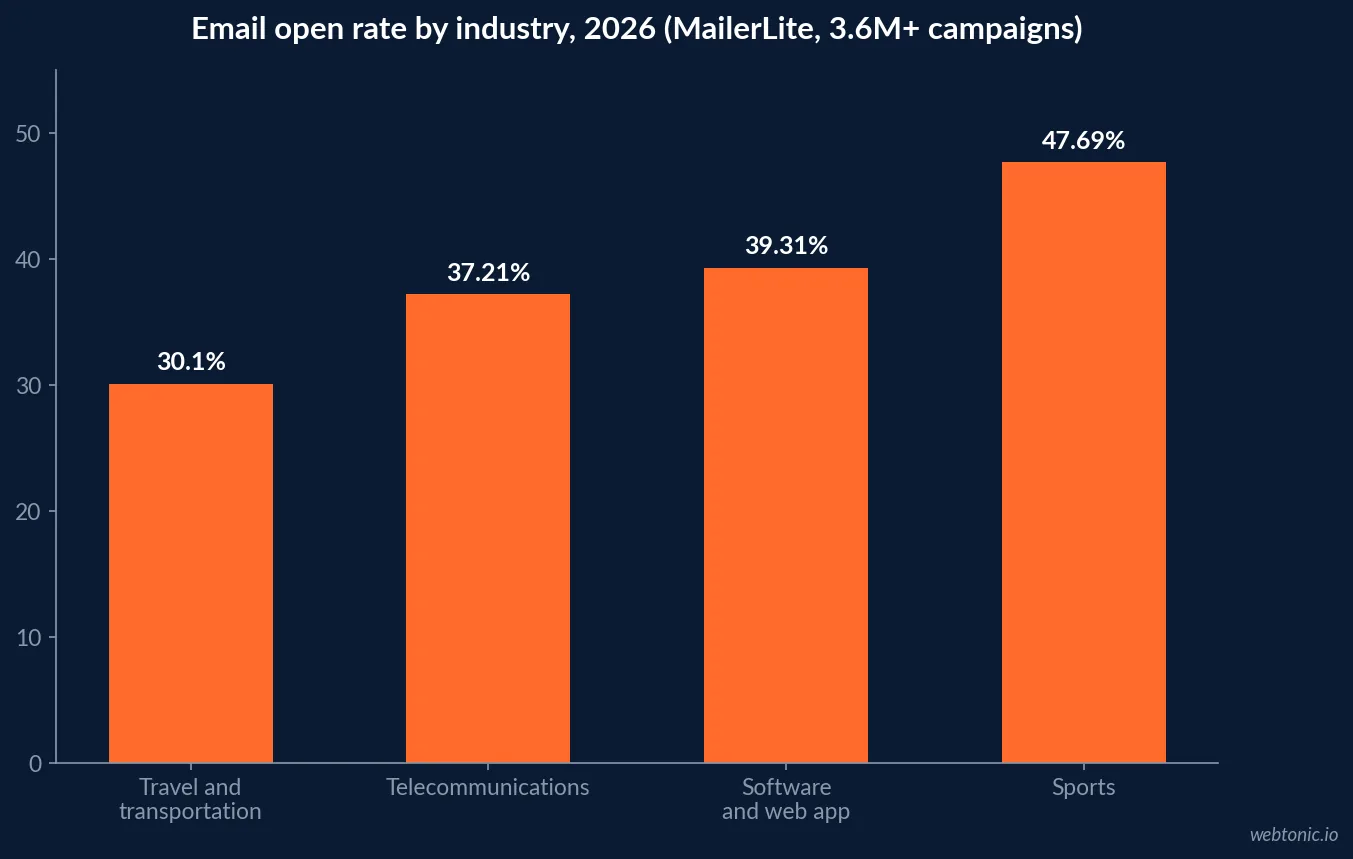
MailerLite's 2026 benchmark set, built from its own platform data across over 3.6 million campaigns and 181,000 accounts between December 2024 and November 2025, puts travel and transportation at a 30.10% open rate, the single worst of every industry it measured, trailing even e-commerce (32.67%) and publishing (34.24%).
The same MailerLite data puts the vertical's click rate at 1.68% and its click-to-open rate at 6.34%, alongside a comparatively low 0.13% unsubscribe rate. Read together, that is a list that opens less than almost anyone else's but does not unsubscribe more, which reads less like fatigue and more like an inbox that is simply not prioritizing dispatch-and-freight-industry email over other traffic.
| MailerLite 2026 metric, travel and transportation | Value | How it compares |
|---|---|---|
| Open rate | 30.10% | Lowest of every tracked industry |
| Click rate | 1.68% | Mid-pack against other verticals |
| Click-to-open rate | 6.34% | Mid-pack |
| Unsubscribe rate | 0.13% | Among the lowest tracked |
| All-users cross-industry open rate (Mailchimp, for reference) | 35.63% | About 5.5 points above transportation |
Cold outreach: two large studies, two very different numbers
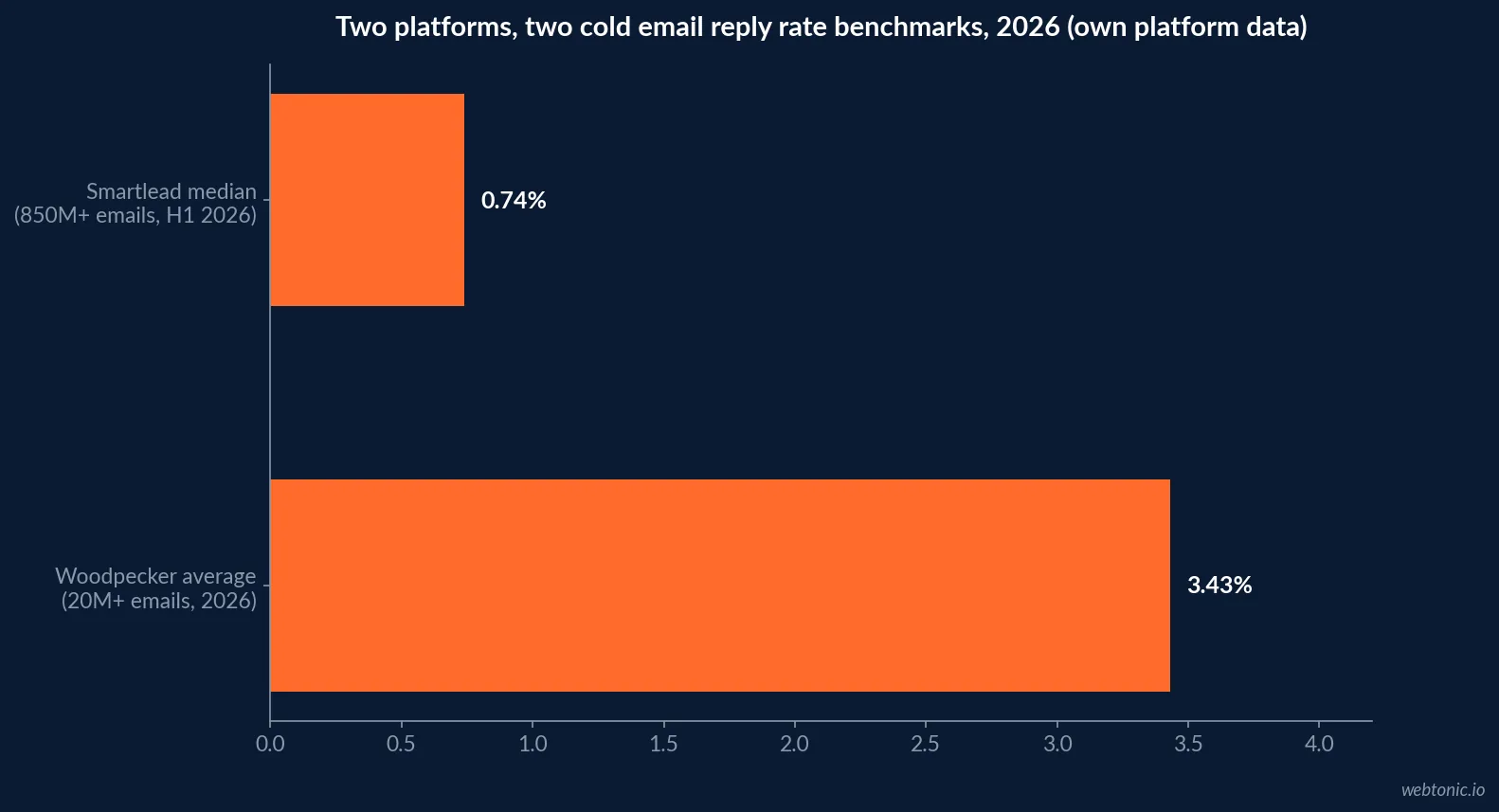
Cold email to net-new shipper or broker prospects is measured on reply rate, not open rate, and the two largest transparent platform studies do not agree on what "normal" looks like. Woodpecker, drawing on more than 20 million emails sent through its own platform, puts the average cold email reply rate at 3.43% in 2026, down from 5.1% in 2024. Smartlead, drawing on more than 850 million emails sent in the first half of 2026 through its own platform, puts the median reply rate at just 0.74%, with the top 10% of senders clearing 2.6%.
Both numbers are real, sourced, and stated with methodology; they are simply measuring different populations of senders and, almost certainly, very different list quality. The honest takeaway is that a single "expected reply rate" for cold outreach in this or any B2B vertical does not exist, and any plan should treat 0.74% as a conservative floor and 3.43% as a reasonable average target rather than picking whichever number looks better.
What actually moves the reply rate, by the same data
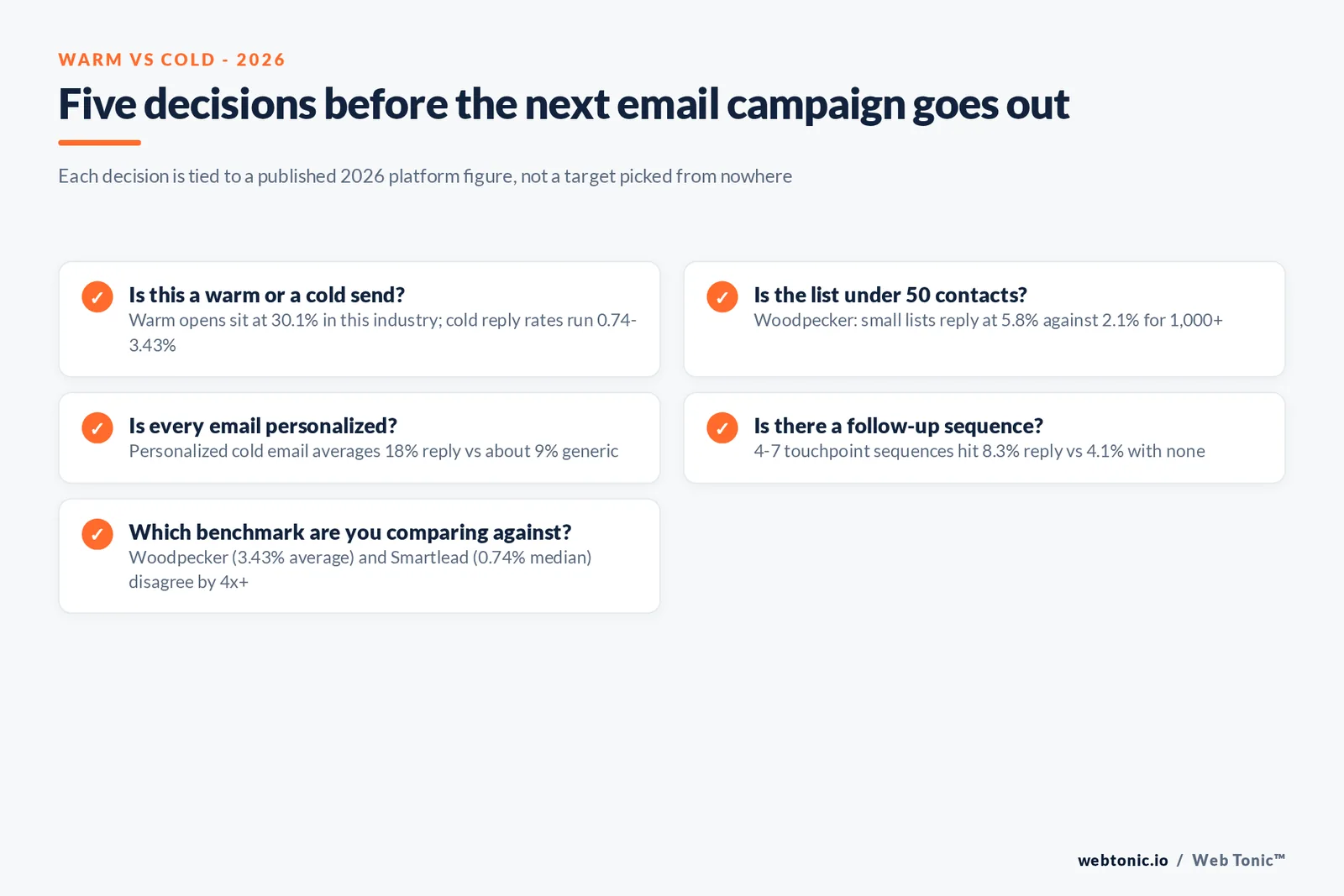
Where Woodpecker's data is unambiguous is on what changes a cold reply rate within its own platform: personalized emails average an 18% reply rate against roughly 9% for generic sends, and lists under 50 contacts average 5.8% against 2.1% for lists of 1,000 or more. Sequences of four to seven touchpoints hit 8.3%, well above a single, unfollowed-up send.
For a freight brokerage prospecting a specific lane or a specific vertical of shipper, that maps to a clear operating rule: a tight, well-researched list of fifty shippers with a real follow-up sequence will outperform a bought list of a thousand generic contacts, on the platform's own numbers, by roughly three times.
| Woodpecker lever (own platform data, 2026) | Lower performance | Higher performance |
|---|---|---|
| Personalization | ~9% reply (generic) | 18% reply (personalized) |
| List size | 2.1% reply (1,000+ contacts) | 5.8% reply (under 50 contacts) |
| Follow-up sequencing | 4.1% reply (no follow-up) | 8.3% reply (4-7 touchpoints) |
| Platform-wide trend | 5.1% average (2024) | 3.43% average (2026, declining) |
The scale behind these disagreeing numbers
It is worth naming how much data underlies benchmarks that still disagree this much. Belkins' 2026 State of B2B Outreach study is built from over 7.5 million cold emails, more than 175,000 logged calls, and more than 15 million LinkedIn touchpoints across 100 anonymized client campaigns. That is a genuinely large, transparent dataset, and it still arrives from a different sender population than Woodpecker's or Smartlead's, which is exactly why "the" cold email benchmark does not exist as a single number.
Against that backdrop, the fragmentation of the trucking industry itself matters: the American Trucking Associations puts trucking at a USD 906 billion industry in which over 99% of carriers run 100 trucks or fewer. Most senders in this space are closer to Woodpecker's small-list, high-reply profile than to a high-volume enterprise sender, which argues for benchmarking against the higher end of the published range, not the lower one.
A second platform confirms the same pattern
MailerLite is not the only sender-side platform to flag transportation as a weak vertical. Brevo's 2026 Marketing Orchestration Benchmark, built on first-party data from more than 175,000 active senders, puts Travel, Transportation and Tourism at a 19.96% open rate against an all-industry average of 20.73%, with a click-through rate of 2.15% and an unsubscribe rate of 0.55%, its highest of any industry Brevo reports in that cut.
Two platforms measuring different sender populations, on different methodologies, both land transportation-related email at or near the bottom of their industry tables. That consistency is stronger evidence than either study alone that this vertical's warm email genuinely underperforms, rather than one platform's sample being unrepresentative.
| Metric (Brevo 2026, first-party data) | Travel/Transportation/Tourism | All-industry average |
|---|---|---|
| Open rate | 19.96% | 20.73% |
| Open rate, including Apple MPP | 32.14% | 33.87% |
| Click-through rate | 2.15% | 2.27% |
| Unsubscribe rate | 0.55% | 0.46% (transportation's is the higher of the two) |
Why list size matters more in this industry than most
Woodpecker's small-list advantage, a 5.8% reply rate under 50 contacts against 2.1% for lists of 1,000 or more, lines up unusually well with this industry's structure. The American Trucking Associations puts trucking at a USD 906 billion industry in which over 99% of carriers run 100 trucks or fewer, which means most senders in this space are structurally closer to a boutique brokerage prospecting fifty named shippers in a specific lane than to an enterprise SaaS company blasting a purchased list of thousands.
That is good news for the smaller operators this data describes: the highest-reply-rate segment of Woodpecker's own findings is the one most trucking and logistics senders are already forced into by the size of their business, not a tactic they have to adopt against their nature.
| Sender profile | List size implied | Woodpecker reply-rate band |
|---|---|---|
| Single-truck or small local carrier | Under 50 named shippers | 5.8% average |
| Regional carrier or 3PL | 50-1,000 targeted contacts | Between the two bands, list-quality dependent |
| National fleet or large 3PL running purchased lists | 1,000+ contacts | 2.1% average |
Cold email is already a working channel in this industry, not a new one
The case for taking cold-outreach benchmarks seriously in trucking is not theoretical. Industry commentary on how brokers actually find loads names cold outreach to shipper lists as one of a handful of channels that genuinely works, alongside referrals, warm inbound leads, re-engaging former accounts and load-board technology. Cold email is not a speculative add-on to this industry's marketing mix; it is already one of the small number of channels practitioners report actually using.
That matters for how the numbers above should be read: a 0.74% to 3.43% reply-rate range is not a reason to avoid the channel, it is the range an already-proven channel operates in, and the personalization and list-size levers above are how a sender moves toward the higher end of it.
Deliverability is the metric that makes the other numbers real
None of the open, click or reply figures above matter if the email never reaches an inbox. Both Woodpecker's and Smartlead's benchmark pages emphasize deliverability as a precondition, not an afterthought, for the reply-rate numbers they publish: a clean sending domain, warmed IP or domain reputation, and a verified, low-bounce list are what makes a 3%-plus reply rate achievable rather than theoretical. A sender ignoring deliverability basics should expect results closer to the published floor than the published average, regardless of how good the copy is.
| Precondition for the published reply rates | Why it matters |
|---|---|
| Domain warmed before sending at volume | New or cold domains get filtered before copy is ever read |
| Verified, low-bounce list | High bounce rates suppress future deliverability platform-wide |
| Personalization at the message level | The single largest lever in Woodpecker's own data, 18% vs ~9% |
| A genuine follow-up sequence, not one send | 8.3% reply rate at 4-7 touchpoints vs 4.1% with none |
How to budget and measure both channels honestly
Warm email in this industry should be judged against its own 30.10% open-rate ceiling, not a general 35%-plus benchmark that this vertical has never hit. Cold outreach should be judged against a stated range, roughly 0.74% to 3.43% reply rate depending on list quality and personalization, with the explicit goal of moving toward the higher end through smaller lists and real follow-up sequencing rather than higher volume.
For the paid-channel counterpart to this outreach mix, our breakdown of whether Facebook ads are worth it and our data and analytics practice both start from the same rule this page follows: state the metric, state the source, and never average two different channels into one number. For help building the sequencing this data recommends, reach out to our team.
Frequently Asked Questions
Is transportation really the worst industry for email open rates?
By MailerLite's own measurement, yes. Its 2026 benchmark set, built from over 3.6 million campaigns sent by 181,000 accounts between December 2024 and November 2025, puts travel and transportation at a 30.10% open rate, the single worst of every industry it tracks, behind e-commerce at 32.67% and publishing at 34.24%.
How does that compare to a general email benchmark?
Mailchimp's own cross-industry figure, drawn from its full account base, puts the all-users average open rate at 35.63%, a click rate of 2.62% and an unsubscribe rate of 0.22%. Transportation's 30.10% sits roughly five points under that general baseline, which is the gap a warm newsletter or dispatch update campaign in this industry is actually working against.
What is a realistic cold email reply rate for outbound to shippers?
The honest answer is that two large, transparent studies disagree by more than 4x. Woodpecker, measuring more than 20 million emails sent through its own platform, puts the average cold email reply rate at 3.43% in 2026, down from 5.1% in 2024. Smartlead, measuring more than 850 million emails sent in the first half of 2026, puts the median reply rate at 0.74%, with the top 10% of senders clearing 2.6%. Both are primary, stated-methodology numbers; they are simply measuring different sender populations and list quality.
What actually moves a cold reply rate, according to this data?
Personalization and list size, by a wide margin. Woodpecker's data shows personalized cold emails averaging an 18% reply rate against roughly 9% for non-personalized sends, and small lists under 50 contacts averaging a 5.8% reply rate against 2.1% for lists of 1,000 or more. For a freight brokerage prospecting shippers, a short, targeted list beats a large, generic blast on this evidence.
Should a carrier or broker run cold outreach at the same volume as warm email?
No, and the two channels should be budgeted and measured separately. Warm campaigns to existing shipper and driver relationships are working against a documented 30.10% open-rate ceiling for this industry; cold outreach to net-new shipper prospects is working against a reply rate that two major platforms measure between roughly 0.74% and 3.43%. Neither number should be applied to the other channel's targets.
Sources
MailerLite - Email marketing benchmarks by industry, 2026
Brevo - 2026 Marketing Orchestration Benchmark, email marketing benchmarks
Mailchimp - Email Marketing Benchmarks and Metrics
Woodpecker - Cold email statistics, 2026 update
Smartlead - State of Cold Email benchmarks, 2026
Belkins - 2026 State of B2B Outreach
American Trucking Associations - Navigate the Challenges of 2026