Table of contents
Three separate 2026 studies, covering more than 47,000 respondents combined, agree on one uncomfortable point: customer expectations for experience are rising faster than most organizations can deliver against them, even where quality is technically improving. The regional recovery Forrester measured in North America has not closed the gap Zendesk and Qualtrics both found between what AI promises and what it currently delivers.
Key Takeaways
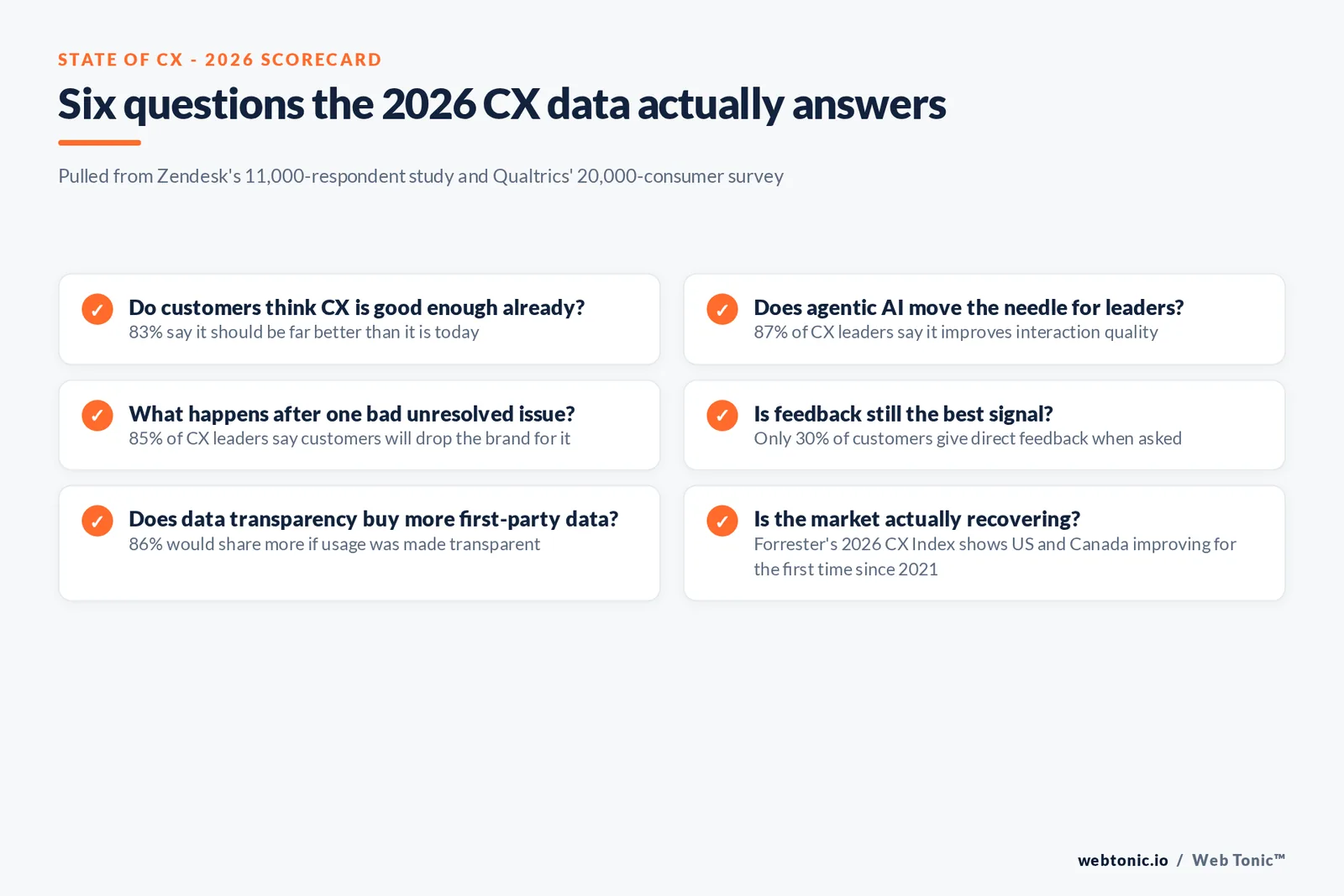
- 83% of consumers believe CX should be far better than it is today (Zendesk).
- 87% of CX leaders say agentic AI can dramatically improve interaction quality.
- 85% of CX leaders say customers will drop a brand over one unresolved issue.
- 85% say their organization is evolving CX strategy under cost pressure.
- 81% say prompt-driven analytics will transform decision-making for CX teams.
- 76% would choose a brand that lets them switch formats mid-conversation without restarting.
- Demands for AI decision transparency rose 63% year over year.
- Zendesk's study is built on over 11,000 respondents across 22 countries.
- Good customer service drives satisfaction at 92%, ahead of value for money (Qualtrics).
- Only 30% of customers give direct feedback when asked.
- 73% of customers already use AI in their own shopping or research.
- Only 20% are comfortable with AI handling a support interaction specifically.
- 86% would share more personal data if usage were more transparent.
- Qualtrics surveyed 20,000 consumers across 14 countries and 18 industries.
- US and Canada CX improved for the first time since 2021, per Forrester's 2026 Index.
- 20% of brands improved globally, 8% declined, 72% held steady (Forrester).
The expectation gap that three studies agree on
Zendesk's 8th annual CX Trends report, built from more than 11,000 consumers and CX professionals surveyed across 22 countries, opens with the starkest number in the category this year: 83% of consumers believe customer experience should be far better than it currently is. That is not a niche complaint - it is the majority view, in a year when 85% of CX leaders themselves report evolving their strategy specifically because of economic and cost pressure.
The tension is structural: leaders are cutting costs and consumers are raising the bar simultaneously, and 2026's AI investment is the mechanism most organizations are betting will resolve both at once.
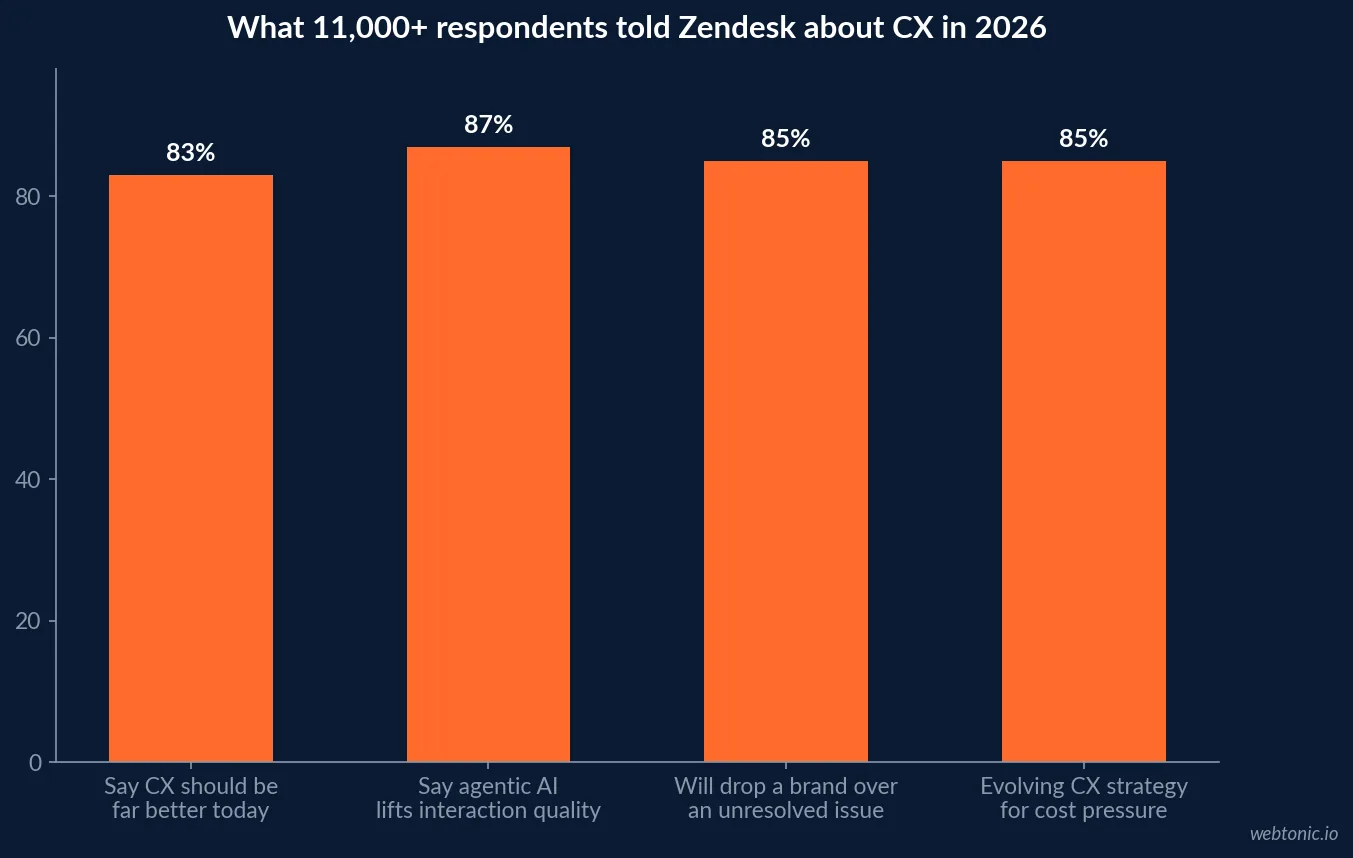
| Zendesk 2026 finding | Figure | What it measures |
|---|---|---|
| Consumers wanting better CX | 83% | Gap between current and expected experience |
| CX leaders on agentic AI's potential | 87% | Confidence AI can lift interaction quality |
| Leaders citing cost pressure on strategy | 85% | Economic constraint shaping 2026 CX decisions |
| Consumers dropping a brand over one issue | 85% (leader-reported) | The cost of a single unresolved contact |
| Leaders on prompt-driven analytics | 81% | Expected shift in how CX decisions get made |
| Rise in AI transparency demands | 63% year over year | Growing scrutiny of automated decisions |
What actually drives satisfaction, per the largest 2026 consumer study
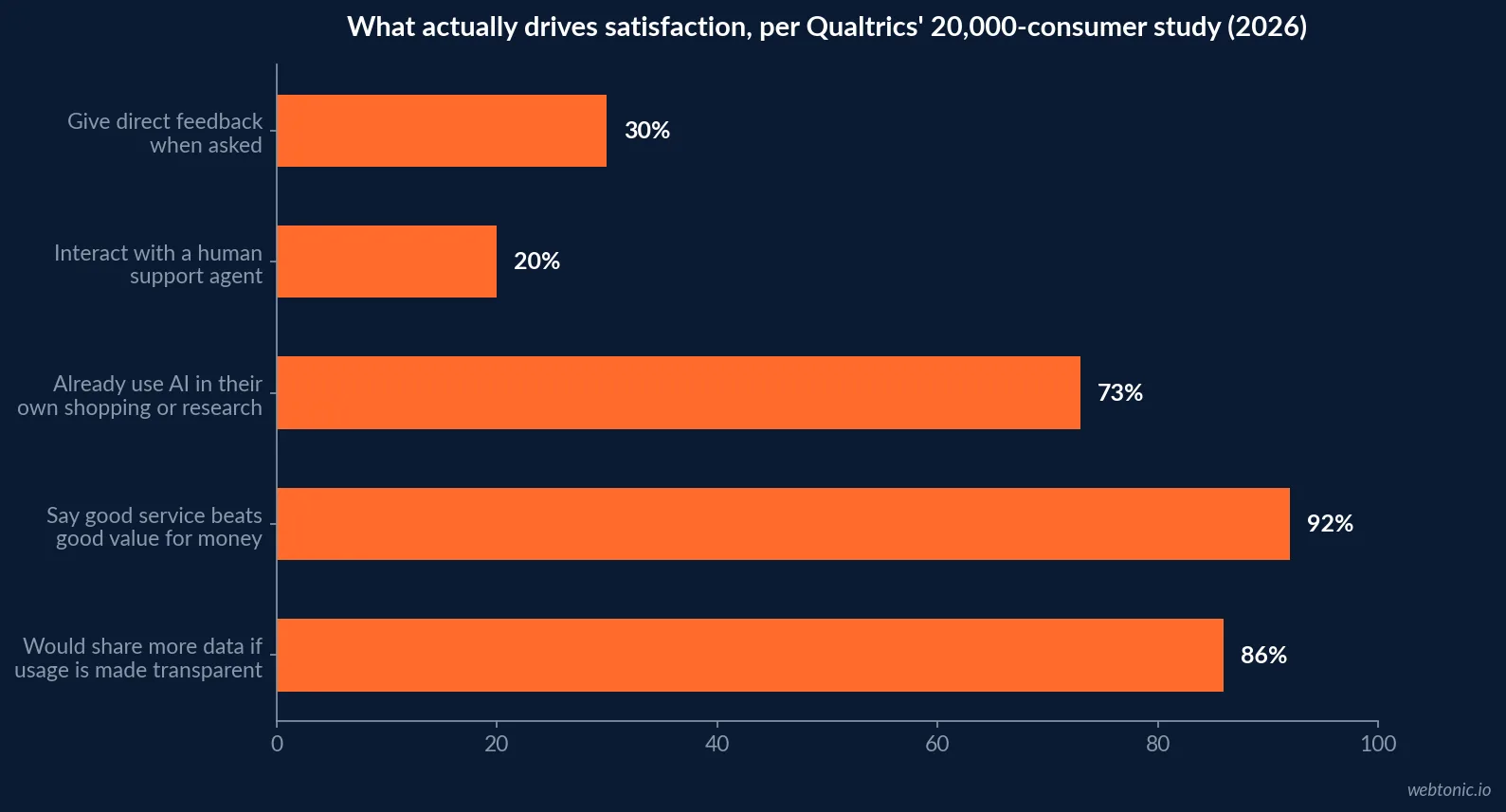
Qualtrics' 2026 Consumer Experience Trends report, surveying 20,000 consumers across 14 countries and 18 industries, found good customer service drives satisfaction at 92%, outranking good value for money. That ordering matters for budget allocation: a CX program funded primarily through price competitiveness is optimizing the weaker lever.
The same study found only 30% of customers give direct feedback when asked, which means most satisfaction and dissatisfaction signal has to come from behavioral and support data rather than surveys - a data-infrastructure problem as much as a CX one.
| Qualtrics 2026 finding | Figure | CX implication |
|---|---|---|
| Good service drives satisfaction | 92% | Service quality outranks price as a lever |
| Customers already using AI | 73% | AI adoption on the customer side has outpaced service design |
| Comfortable with AI-handled support specifically | 20% | Trust in AI narrows sharply inside service contexts |
| Give direct feedback when asked | 30% | Most signal must come from behavior, not surveys |
| Would share more data if usage is transparent | 86% | Personalization gains require disclosure, not just collection |
The AI trust gap inside the service interaction
The numbers above reveal a narrower gap worth isolating: 73% of consumers already use AI generally, but only 20% are comfortable with AI specifically handling an interaction with a support agent. That 53-point drop is the practical design constraint for 2026 CX investment - broad AI adoption does not transfer automatically into trust for AI-mediated service.
Zendesk's leader-side data adds texture to why: 76% of consumers say they would choose a brand that lets them move between text, images and video in the same thread without restarting, meaning the trust gap is not about AI generally, it is about losing context and control mid-conversation. Continuity, not automation itself, is what's under-delivered.
What "remembering the customer" is actually worth
Zendesk's report isolates memory specifically as the highest-leverage AI capability CX teams have in 2026. 74% of consumers find having to repeat themselves to a brand very frustrating, reading it as a sign the brand does not value their time or loyalty. 67% now believe brands should offer more personalized service specifically because AI can analyze their prior interactions - meaning the capability itself has raised the bar for what counts as adequate service.
The internal case is just as strong: 73% of frontline agents say seeing a customer's full historical interaction in one place helps them do their job better, and CX leaders report 83% agreement that remembering context across channels sharply reduces customer effort and frustration, with 85% saying persistent memory lets a brand build deeper, longer-lasting relationships. Memory infrastructure, not a new chatbot, is the 2026 investment with the clearest evidence behind it.
| Memory-related CX finding (Zendesk 2026) | Figure | What it argues for funding first |
|---|---|---|
| Consumers frustrated by repeating themselves | 74% | Cross-channel context, not a new channel |
| Consumers wanting more AI-informed personalization | 67% | Personalization built on interaction history |
| Agents saying full history improves their work | 73% | Agent-facing context tools, not just customer-facing AI |
| Leaders saying context reduces customer effort | 83% | Effort reduction as the KPI, not ticket volume alone |
| Leaders saying memory builds longer relationships | 85% | Retention framing for the investment case |
The loyalty perception gap leadership doesn't see
PwC's Customer Experience Survey adds a leadership-blind-spot dimension to the same picture: 52% of consumers say they stopped buying from a brand after a bad experience with its products or services, and 89% of executives believe customer loyalty has grown in recent years while only 39% of consumers agree. That wide gap between executive perception and consumer reality is arguably the root cause behind Zendesk's 83% figure above - leaders cannot fix an expectation gap they do not believe exists.
The same PwC research found only 30% of consumers say AI has made getting customer service assistance better, while 38% say it made it worse - though frequent AI users rated the experience meaningfully better than infrequent ones, suggesting the AI trust gap narrows with exposure and better design, not with AI investment alone.
Where the market is actually recovering
Forrester's 2026 Customer Experience Index, the analyst firm's long-running annual benchmark, found the US and Canada improved significantly across most industries in 2026 - the first broad improvement after several years of decline. Globally, Forrester reports 20% of tracked brands improved, 8% declined, and 72% held steady, with Europe remaining mostly stable and Asia Pacific showing a mixed picture.
That regional unevenness is the reason a single global CX statistic misleads: a North American brand citing this year's rebound and a European or Asia-Pacific brand citing flat performance are both accurately describing 2026, just in different markets.
| Region (Forrester CX Index 2026) | 2026 trend | Consecutive years of prior decline |
|---|---|---|
| United States & Canada | Improved significantly for most industries | Several years, ending in 2026 |
| Europe | Mostly stable, limited movement | Held largely flat |
| Asia Pacific | Mixed results across markets | Varied by market |
| Global aggregate | 20% improved, 8% declined, 72% unchanged | N/A - first-year snapshot metric |
What this means for a 2026 CX budget
Fund the continuity and context problem before the automation problem: Zendesk's 76% multimodal-continuity figure and the 53-point trust drop between general AI use and AI-in-service use both point to the same fix, which is preserving context across channels and handoffs rather than simply adding more AI touchpoints. Fund behavioral signal capture over survey expansion, since Qualtrics' 30% direct-feedback rate means most of the real signal already exists in support and product data, not in a feedback form nobody fills out. And benchmark regionally against Forrester's Index rather than a single global CX statistic, since North America, Europe and Asia Pacific are simply not telling the same story in 2026.
Our data and analytics practice builds the behavioral signal layer this data argues for, and our growth marketing team can connect a CX fix directly to a retention or conversion number worth reporting.
| 2026 CX study | Sample size | Scope | Headline figure used here |
|---|---|---|---|
| Zendesk CX Trends 2026 | 11,000+ respondents | 22 countries, consumers + CX professionals | 83% want far better CX |
| Qualtrics Consumer Experience Trends 2026 | 20,000 consumers | 14 countries, 18 industries | 92% rank service above value |
| Forrester Customer Experience Index 2026 | Not disclosed per-brand | North America, Europe, Asia Pacific | US/Canada CX improved for first time since 2021 |
| PwC Customer Experience Survey | Not disclosed in this citation | US consumers and executives | 52% stopped buying after a bad experience |
What to measure going into 2027
Track the gap between general AI adoption and AI-in-service comfort inside your own customer base, not just the industry average, since Qualtrics' 53-point gap is unlikely to close evenly across demographics or use cases. Track first-contact resolution specifically, since Zendesk's data ties unresolved issues directly to churn regardless of how satisfied the customer was before that one contact. And track your own region against Forrester's published trend rather than assuming a global "CX is improving" headline applies to your specific market.
If you want a second read on where your CX program sits against these 2026 benchmarks, talk to us, or see how we think about the funnel impact of experience quality in our breakdown of where paid acquisition and retained experience actually meet.
Frequently Asked Questions
Is customer experience actually improving in 2026?
Unevenly. Forrester's 2026 Customer Experience Index found CX in the US and Canada improved significantly for far more brands than in 2025 - the first broad improvement since a multi-year decline - while Europe stayed mostly stable and Asia Pacific was mixed. At the same time, Zendesk's 11,000-plus respondent study found 83% of consumers still believe customer experience should be far better than it is today, so a regional rebound has not closed the underlying expectation gap.
What is the biggest driver of customer satisfaction in 2026?
Service quality, not price. Qualtrics' 2026 Consumer Experience Trends report, surveying 20,000 consumers across 14 countries and 18 industries, found good customer service drives satisfaction at 92%, ahead of good value for money. Brands optimizing purely on price competitiveness are solving for the wrong variable relative to what actually moves the satisfaction number.
Do customers actually want more AI in their service experience?
Conditionally. 87% of CX leaders in Zendesk's study say agentic AI can dramatically improve interaction quality, and 73% of consumers in Qualtrics' study already use AI themselves, but only 20% of those consumers are comfortable with AI handling interactions with a support agent specifically. The gap between using AI generally and trusting it inside a service interaction is the practical design constraint for 2026 CX programs.
How much does one bad support experience cost a brand?
Zendesk's research frames it starkly: 85% of CX leaders say customers will drop a brand over an unresolved issue, even on the first contact. Combined with Qualtrics' finding that only 30% of customers give direct feedback when asked, most of that churn happens silently - the brand often never hears the complaint before the customer leaves.
What do customers want in exchange for sharing more personal data?
Transparency, specifically. Qualtrics found 86% of customers are willing to share more personal data if organizations are clearer and more transparent about how it is used. That is a direct data-strategy implication for CX teams: better personalization requires better data-usage disclosure, not just better data collection.
Sources
Zendesk - CX Trends 2026 Report, 8th annual edition
Qualtrics XM Institute - 2026 Consumer Experience Trends Report
Forrester - Have We Turned The Corner On CX Quality? (2026 CX Index)
Salesforce Research - State of the AI Connected Customer, 7th edition
PwC - Customer Experience Survey, AI teammates not tools