Table of contents

Chat has stopped being a support channel and started being a checkout lane. Buyers now expect to ask a question inside a conversation and finish the purchase there, and the 2026 data shows both sides of that shift: how far buyer expectation has moved, and how far most brands still have to go to meet it.
Key Takeaways
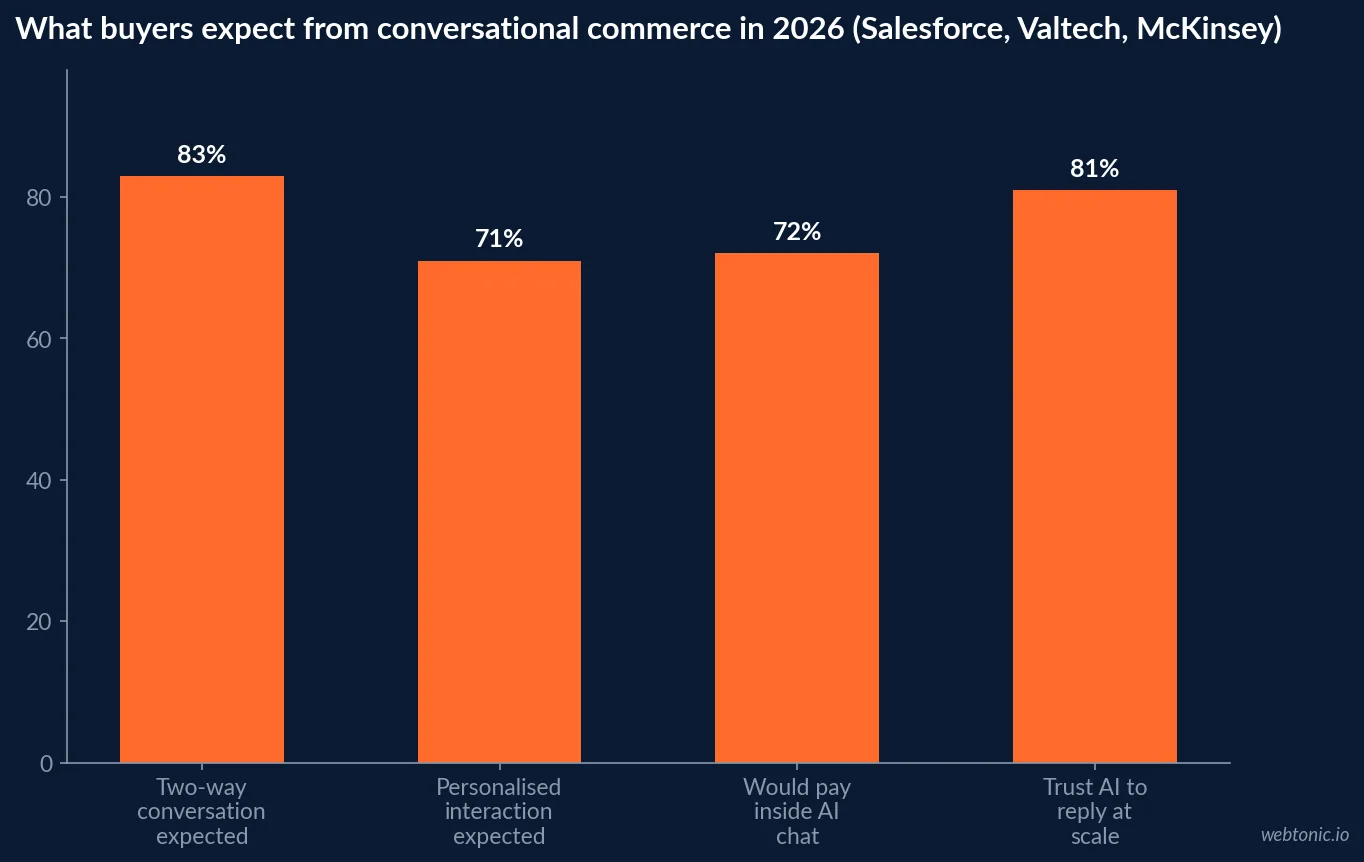
- 72% of consumers would complete a full purchase inside an AI chat app, payment included.
- 84% of ecommerce brands now treat conversational commerce as a strategic pillar.
- 79% of brands say AI-driven conversations increased sales and purchase rates.
- AI-only influenced orders grew 63% year over year, from 2.7M to 4.4M orders a quarter.
- 93% of AI-influenced purchases happen within 48 hours of the conversation starting.
- 83% of marketers say customers now expect two-way conversations.
- 69% of marketers still struggle to reply to customers promptly.
- 84% of marketers admit they are still sending generic, one-way campaigns.
- 81% of marketers would trust AI to respond to customers to help scale the work.
- Only 58% have complete access to service data needed to personalise a reply.
- AI currently handles 31% of ecommerce customer interactions, expected near 50% in two years.
- Agentic commerce transactions are forecast to grow over 19,000%, 620M in 2026 to 120bn by 2031.
- 96% of consumers think more companies should use chatbots, per Statista.
- 70% of CX leaders say chatbots are becoming skilled at personalising the journey.
- ChatGPT passed 800 million weekly active users in late 2025, up from 300 million a year earlier.
- 77% of consumers are comfortable with AI resolving a question or issue.
- 71% of consumers expect a personalised interaction; 76% get frustrated without one.
- Only 7% of brands use voice assistants for commerce today, versus 89% expecting it standard by 2030.
The expectation gap, in one comparison
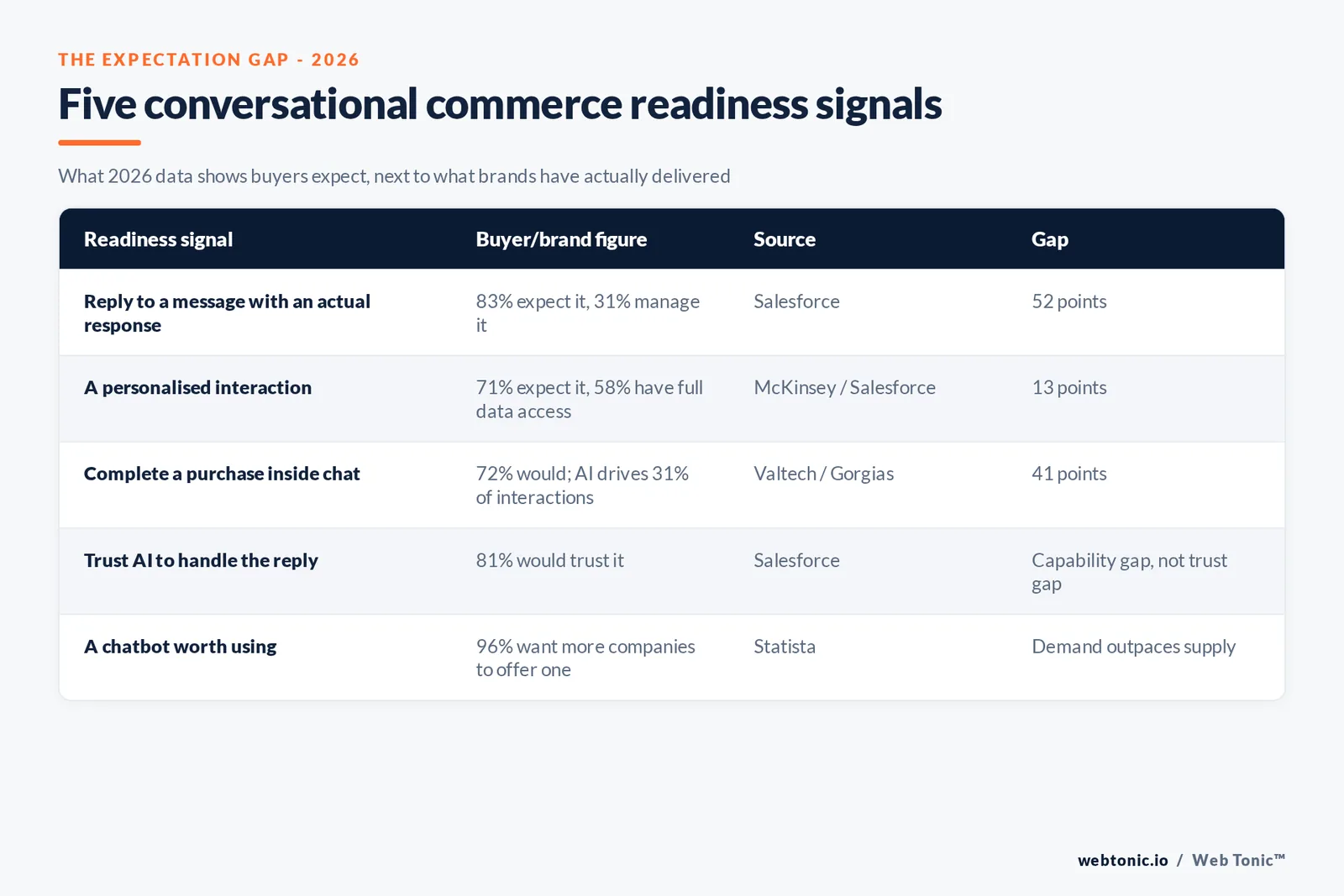
Put the buyer-side and brand-side numbers next to each other and the gap explains most of what the rest of this page covers. Buyers have already decided chat is a sales channel; Salesforce's Tenth Edition State of Marketing Report, surveying nearly 4,500 marketers, shows most marketing organisations have not caught up.
| What buyers expect (2026) | Figure | What brands actually deliver | Figure |
|---|---|---|---|
| Reply to a message with an actual response | 83% expect it | Reply to messages promptly | 31% manage it (69% struggle) |
| A personalised interaction | 71% expect it | Run generic, one-way campaigns | 84% still do |
| Complete a purchase inside chat, payment included | 72% would do it | Trust AI to handle that reply | 81% say yes, in principle |
| A chatbot recommendation worth using | 96% want more companies to offer it | Full access to the service data needed to personalise | 58% have it |
Buyers will already pay inside the conversation
The clearest signal is intent to transact, not just intent to chat. Valtech's Era of Conversational Commerce Report 2026, a global survey of more than 1,000 consumers, found 72% would consider completing a full purchase inside an AI chat app, including payment. That is not a hypothetical preference; it is a description of where intent is already forming.
Gorgias' own platform data shows this converting into real order volume: AI-only influenced orders grew 63% in a single year, from 2.7 million orders in Q1 to 4.4 million in Q4, across the 16,000-plus ecommerce brands on its platform.
| Metric (2026) | Figure | Source | What it measures |
|---|---|---|---|
| Consumers who would pay inside AI chat | 72% | Valtech, 1,000+ consumers | Willingness to transact in-conversation |
| AI-only influenced orders, YoY growth | 63% | Gorgias platform data | Real order volume, not survey intent |
| AI-influenced purchases completed within 48 hours | 93% | Gorgias 2026 Trends Report | Speed of the AI-shortened buying cycle |
| Brands reporting AI increased sales/purchase rate | 79% | Gorgias, 400 decision-makers | Revenue impact, brand-reported |
| Brands treating conversational commerce as a strategic pillar | 84% | Gorgias 2026 Trends Report | Strategic priority, up from an experiment |
Where the return actually shows up
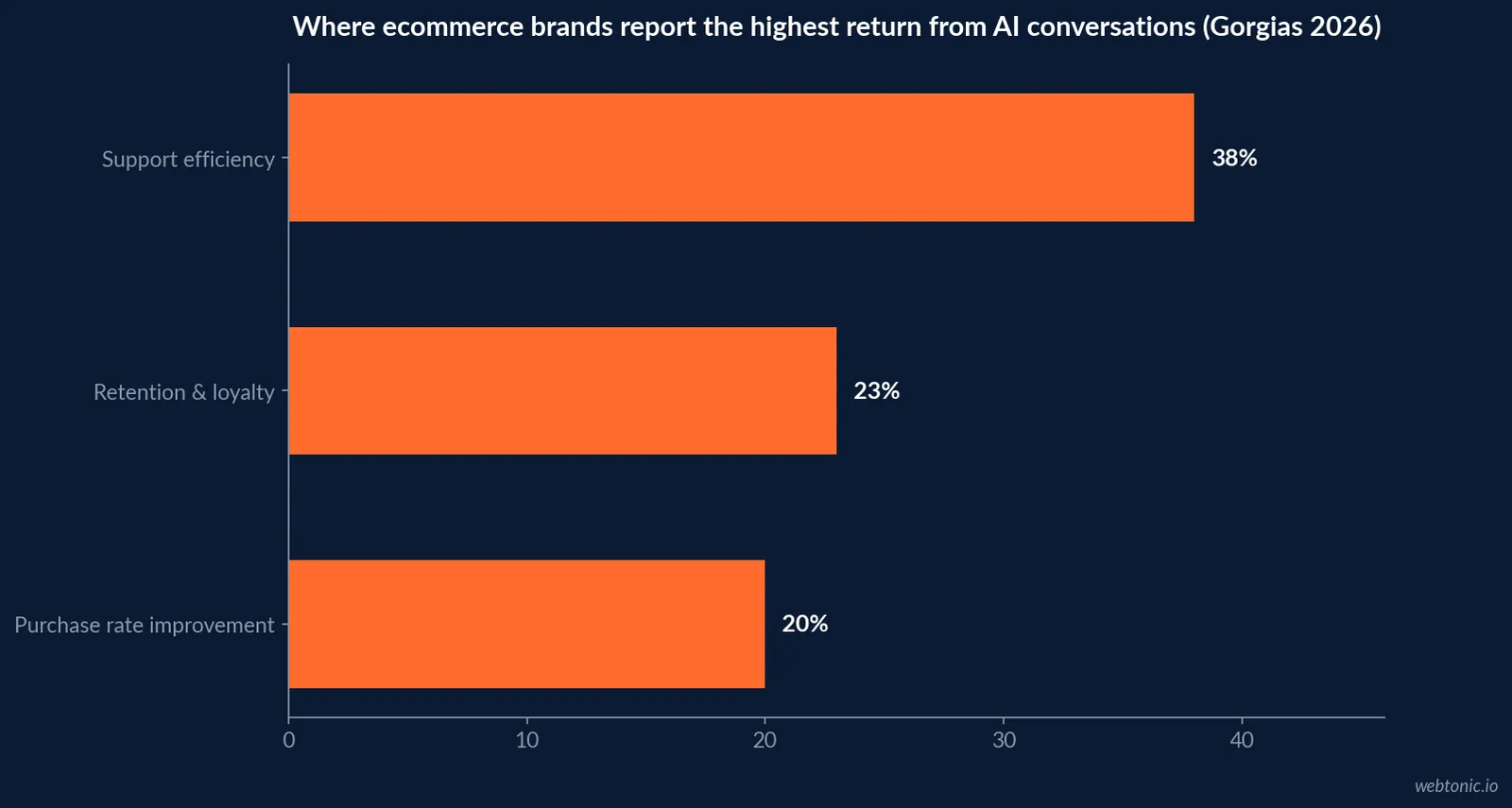
Brands seeing a return from conversational commerce do not all point to the same line item. Asked to rank the highest-return areas, Gorgias found 38% cited improved support efficiency, 23% pointed to retention and loyalty, and 20% saw improved purchase rates directly. Read together, the value compounds rather than concentrates: faster support reduces friction, better retention raises lifetime value, and more confident shoppers buy more often.
The expectation baseline predates the chatbot boom
None of this is a new appetite invented by generative AI. McKinsey's research, first published in 2021 and still the reference figure cited across the industry, found 71% of consumers expect a company to deliver personalised interactions, and 76% get frustrated when it does not happen. Conversational commerce is the delivery mechanism catching up to a bar that was already set.
What has changed is capacity. EMARKETER reports ChatGPT alone passed 800 million weekly active users in late 2025, up from 300 million a year earlier, and cites CSG data that 77% of consumers are comfortable with AI resolving a question or issue. The audience that would answer a personalisation survey in 2021 is now the same audience running that conversation through an AI agent.
| Consumer readiness signal | Figure | Source | Year |
|---|---|---|---|
| Expect a personalised interaction | 71% | McKinsey | 2021, still cited as baseline |
| Get frustrated without one | 76% | McKinsey | 2021, still cited as baseline |
| Comfortable with AI resolving an issue | 77% | EMARKETER, citing CSG | 2026 |
| Think more companies should use chatbots | 96% | Statista | 2024 |
| ChatGPT weekly active users | 800M+ | EMARKETER, citing TechCrunch/CNBC | Late 2025 |
Where brands are still behind on the data that makes this work
Personalising a reply requires the data to personalise it with, and that is the piece Salesforce's survey shows lagging hardest. Only 58% of marketers have complete access to service data, 56% to sales data, and 51% to commerce data. Siloed systems, not lack of intent, are the barrier: teams with unified customer data are 42% more likely to reply to customers regularly and 60% more likely to use AI agents to help do it.
That is the practical reason a chat-first storefront underperforms even when the AI itself is capable: the model can only be as personal as the data feeding it, and most marketing stacks still keep that data in three separate systems that do not talk to each other.
AI is changing the shape of the support team, not shrinking it
The narrative that AI replaces CX headcount does not match the 2026 data. Gorgias found 62% of ecommerce brands are planning to grow their support teams, not cut them; the scope of the role is shifting toward AI configuration, quality assurance and the escalations that need human judgement. Zendesk's 2026 research shows the trust side of that shift: 70% of CX leaders say chatbots are becoming skilled architects of a genuinely personalised journey, and 83% of employees say AI's capacity for decision support is a major benefit of adopting it.
| CX team signal (2026) | Figure | Source |
|---|---|---|
| Ecommerce brands planning to grow support headcount | 62% | Gorgias |
| CX leaders saying chatbots build personalised journeys | 70% | Zendesk |
| Employees saying AI improved the quality of their work | 80% | Zendesk |
| Employees citing AI's decision support as a major benefit | 83% | Zendesk |
Voice and agentic commerce are the next expectation, not this year's
Two forward indicators are worth tracking rather than acting on immediately. Gorgias finds only 7% of brands currently use voice assistants for commerce, yet 89% expect it to be standard by 2030. Separately, Juniper Research forecasts agentic commerce - AI agents making purchase decisions on a shopper's behalf - growing from around 620 million transactions in 2026 to 120 billion by 2031, a rise of more than 19,000%.
Both numbers describe the same pattern: a small current base with an expectation curve moving faster than most roadmaps. Building the data foundation and the conversation layer now is what makes either shift something you can adopt rather than something you have to catch up to.
How buyer expectation differs from generic AI adoption
It is worth separating "consumers use AI" from "consumers expect a brand's chat to sell to them" - the two numbers are not interchangeable, and the gap between them is where most conversational commerce investments go wrong. Statista's topic page on conversational commerce notes 32% of interactions with e-commerce AI chatbots are enquiries about product specifications, not generic small talk - shoppers are already using the channel transactionally, they are simply not always given a transactional answer back.
That distinction argues for building the chat layer around product and order data first, and general conversational polish second, since the expectation data shows buyers are asking specific questions with a specific purchase decision behind them.
| Chatbot interaction type (2026) | Share of interactions | Source | Implication |
|---|---|---|---|
| Product specification enquiries | 32% | Statista | Needs live product data, not scripted answers |
| Order tracking / status | High volume (top use case) | Gorgias | Automatable with existing order data |
| Returns, exchanges, refunds | High volume (top use case) | Gorgias | Automatable with existing policy data |
| Complex, judgement-based questions | Routed to humans | Gorgias | Where the hybrid model still needs people |
What to check before you invest in a chat-first storefront
Start with the gap, not the tool. Measure how many of your service, sales and commerce systems actually share data today - Salesforce's 58/56/51% figures are a reasonable industry floor to beat. Then decide whether the return you are chasing is support efficiency, retention or direct purchase rate, because Gorgias' 38/23/20% split shows those are three different projects with three different success metrics, not one initiative.
If the paid side of your funnel is what is actually feeding those conversations, our breakdown of what paid search costs in 2026 and whether paid social is worth it are useful companions before you commit budget to the conversational layer on top of it. Our growth marketing practice builds that data foundation before recommending an AI layer on top of it, and you can talk to us about where your stack currently stands.
Frequently Asked Questions
What is conversational commerce, in plain terms?
It is buying through a real-time, two-way conversation instead of a page-based funnel - chat, an AI agent, a messaging app or voice, where a shopper asks a question and can complete the purchase inside that same exchange. Gorgias frames it as the practice of using conversation as the primary sales channel, not just a support add-on, and its 2026 data shows 84% of ecommerce brands now treat it as a strategic pillar rather than an experiment.
Will shoppers actually pay through a chat window?
The 2026 data says yes, more than most brands assume. Valtech's global survey of over 1,000 consumers found 72% would consider completing a full purchase inside an AI chat app, payment included. Gorgias' platform data adds texture: AI-only influenced orders grew 63% year over year, from 2.7 million in Q1 to 4.4 million in Q4, so this is already showing up in real order volume, not just survey intent.
What do buyers expect that most brands are not delivering?
Two-way conversation. Salesforce's Tenth Edition State of Marketing Report, surveying nearly 4,500 marketers, found 83% say customers now expect to reply to a marketing message and get an actual response, yet 69% of marketers struggle to reply promptly and 84% admit they are still sending generic, one-way campaigns. That gap between expectation and delivery is the opening a chat-first storefront is meant to close.
Does AI in the chat window actually change buying behaviour, or is it just support?
Both, and the split matters. Gorgias found 79% of brands report AI-driven conversations increased sales and purchase rates, and when asked to rank where the return shows up, 38% pointed to support efficiency, 23% to retention and loyalty, and 20% to purchase rates directly. Zendesk's 2026 research backs the trust side: 70% of CX leaders say chatbots are becoming skilled at building a genuinely personalised journey, not just deflecting tickets.
Is this only relevant to ecommerce, or does it apply to service and B2B businesses too?
The buyer-expectation data is not ecommerce-specific. McKinsey's research puts the baseline at 71% of consumers expecting a personalised interaction from any company they deal with, with 76% getting frustrated when they do not get one - and Salesforce's 83% two-way-conversation figure was measured across the whole marketer base, not a retail sample. Any business with a chat, DM or messaging touchpoint is being held to the same bar.
Sources
Gorgias - 2026 Conversational Commerce Trends Report
Gorgias - Conversational Commerce as a Revenue Channel in 2026
Valtech - The Era of Conversational Commerce Report 2026
Salesforce - Tenth Edition State of Marketing Report, 2026
Statista - Conversational commerce, statistics and facts
Juniper Research - Agentic Commerce: 120 Billion Transactions by 2031
Zendesk - 59 AI customer service statistics for 2026
EMARKETER - FAQ on AI chatbots: how they work and their impact on marketing
McKinsey - What is personalization?