Table of contents

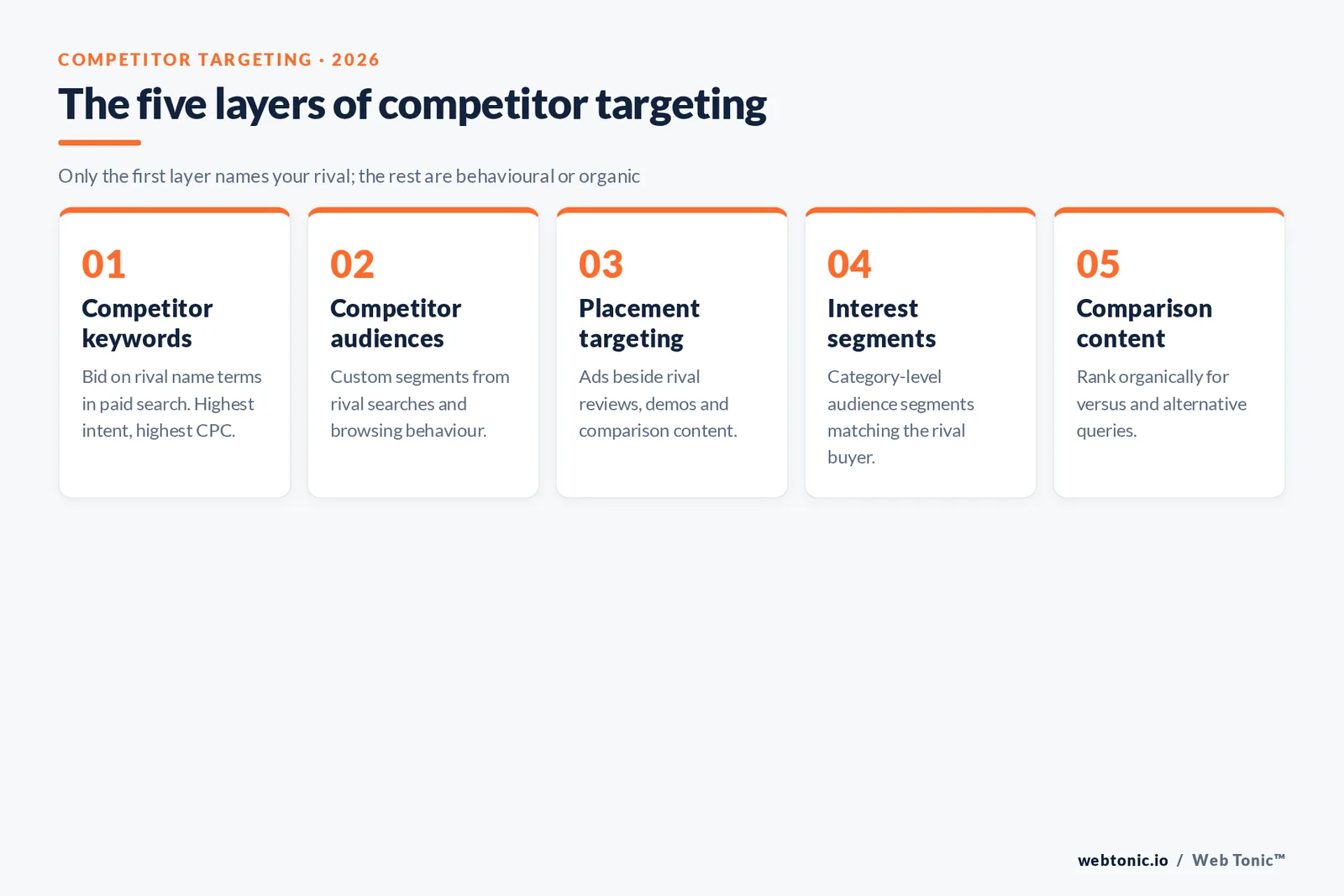
Competitor targeting is reaching people who are already evaluating a rival. Three layers do the work: competitor keywords in paid search, competitor audiences built from search and browsing behaviour, and placement targeting on social media.
Key Takeaways
- Only the keyword layer names your rival. Competitor audience targeting on Google Ads is built from custom segments describing what people search and browse, not from a list of rival customers.
- No advertising platform sells you another company's customer list. Custom audiences on social media are built from your own data, so competitor reach there is behavioural or interest-based.
- A data segment must have at least 100 active users in the last 30 days to serve, and lists uploaded before 1 February 2024 still need 1,000 matched users.
- Customer Match requires 90 days of Google Ads history and more than USD $50,000 lifetime spend for full access.
- Competitor keyword targeting is legal but expensive: all-industry paid search sits at $5.42 average CPC and 8.18% conversion rate, and competitor terms routinely convert at a fraction of that.
- Rivals can bid on your name too. Google's trademark policy issues a warning at least 7 days before any account suspension, so defence is a monitoring job, not a legal one.
The three layers of competitor targeting
Most confusion about competitor targeting comes from treating one tactic as the whole discipline. Separate the layers and the budget decisions get obvious. We cover the keyword layer in depth in our guide to paid search conquesting.
| Layer | How you target | What it costs and returns |
|---|---|---|
| Competitor keyword targeting | Bid on rival name terms in paid search | Highest intent, highest CPC, lowest conversion rate |
| Competitor audience targeting | Custom segments from competitor keywords and URLs | Mid intent, moderate CPC, best for retargeting-style scale |
| Placement and content targeting | Ads beside rival content or review pages | Low intent, cheap reach, strong for awareness |
| Interest and category targeting | Broad audience segments matching the rival's buyer | Lowest precision, best for cold prospecting on social media |
| Comparison content | Rank organically for versus and alternative queries | Slow to build, cheapest long-term way to reach competitor audiences |
Identify the right competitors before you target anybody
Targeting competitors you do not actually lose deals to is the fastest way to waste a test budget. Build the shortlist from data, not from memory. Our breakdown of how to research competitors' ads covers the tooling; the sources below decide who belongs on the list.
| Source | What it tells you | How to use it |
|---|---|---|
| Sales call notes and CRM lost-reason fields | Who you genuinely lose to | Rank rivals by lost revenue, not by name recognition |
| Google Ads auction insights | Who shares your search impressions | Target competitors with high overlap and high position above rate |
| Google Keyword Planner | Search volume on each rival name term | Drop rivals with negligible brand search volume |
| Organic keyword gap analysis | Where rivals rank and you do not | Feeds comparison content, not just paid campaigns |
| Paid keyword overlap reports | Which competitor keywords they buy | Shows where the auction is genuinely contested |
| Review sites and community threads | The objection that decides switching | Becomes your ad copy angle for high intent users |
Shortlist rule: 3 rivals is the right starting number, and more than 5 splits your data before it can teach you anything.
Google Ads: build competitor audiences with custom segments
The mechanism most marketers are looking for when they search competitor audience targeting is the custom segment. You describe intent using search terms people enter and websites people browse, and Google assembles the audience. Google's documentation on custom segments spells out the inputs.
| Custom segment input | Example | Best campaign fit |
|---|---|---|
| Search terms people enter | Rival name plus pricing, reviews, alternatives | Demand Gen, Display, YouTube, Discovery surfaces |
| Websites people browse | Rival domain, review directories, comparison sites | Display and YouTube prospecting |
| Apps people use | The rival's mobile app category | App and Display campaigns |
| Interests and behaviours | Category-level intent phrases | Broad top-of-funnel audience segments |
| Combination | Rival searches plus category browsing | Tightest competitor audience you can build in Google Ads |
Rule 1 — a custom segment built on 3 to 8 competitor keywords outperforms one built on 40. Every extra loose phrase dilutes the audience toward the category average.
Where competitor audiences are actually eligible
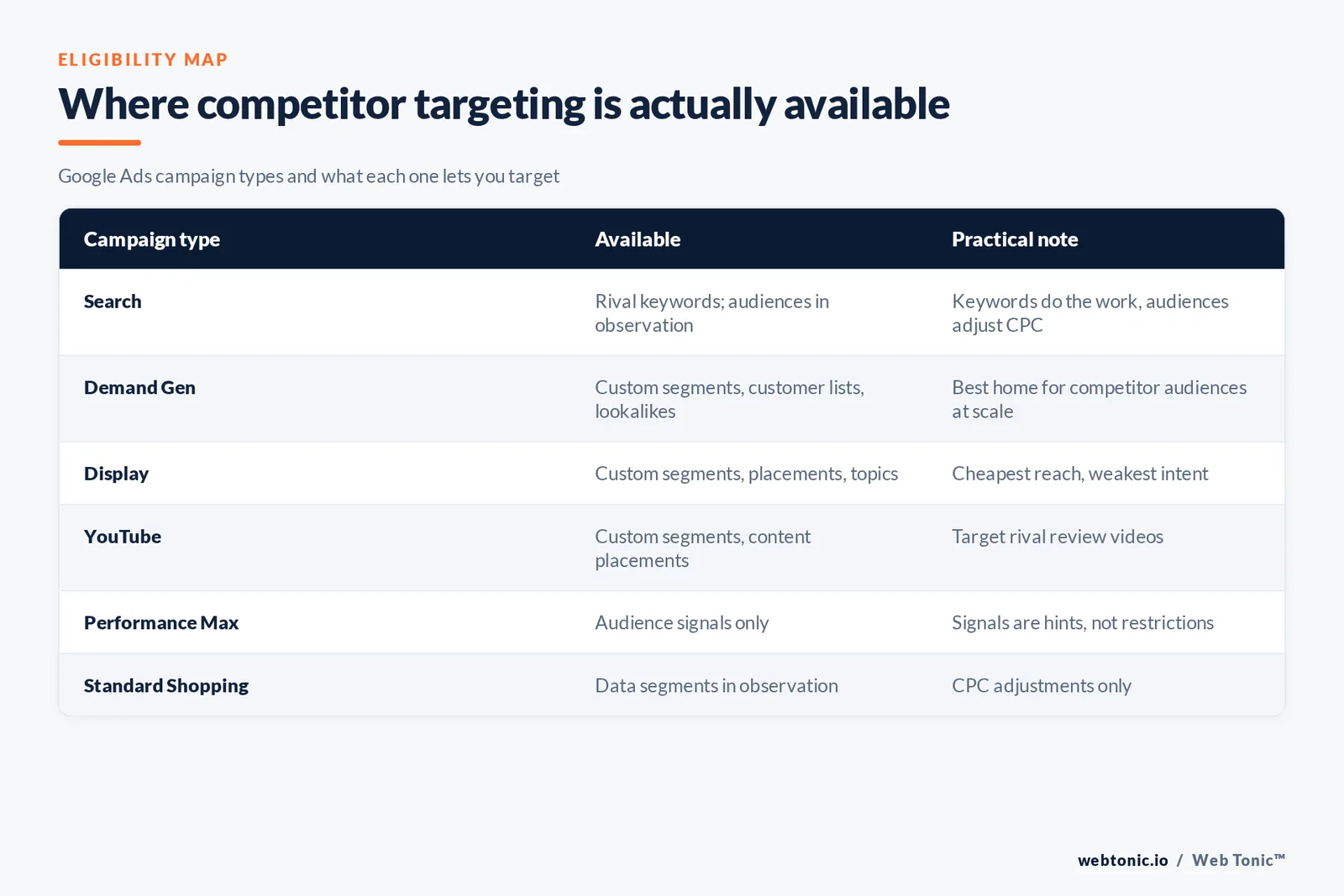
Availability varies by campaign type, and this is where plans quietly break. Cross-check the segment families in our guide to Google Ads audience targeting before you build campaigns around one.
| Campaign type | Competitor targeting available | Practical note |
|---|---|---|
| Search | Competitor keywords; audiences in observation | Keyword targeting does the work, audiences only adjust bids |
| Demand Gen | Custom segments, customer lists, lookalikes | The best home for competitor audience targeting at scale |
| Display | Custom segments, placements, topics | Cheapest competitor audience reach, weakest intent |
| YouTube | Custom segments and content placements | Target rival review videos, not the rival channel name |
| Performance Max | Audience signals only | Signals are hints; you cannot restrict delivery to them |
| Standard Shopping | Data segments in observation | Bid adjustments only, no competitor keyword control |
Targeting versus observation: the setting that changes everything
The same competitor audience behaves completely differently depending on this one radio button. Google's explainer on Targeting and Observation settings is the authority; the practical read is below.
| Setting | Effect on delivery | When to use it for competitor targeting |
|---|---|---|
| Targeting | Restricts eligibility to the audience segments selected | Small, high-confidence competitor audiences with a dedicated offer |
| Observation | Reports and allows CPC adjustments, no restriction | Search campaigns where the keyword already carries intent |
| Targeting plus tight geo | Very narrow delivery | Local head-to-head fights against one named rival |
| Observation with a positive CPC modifier | Same reach, more aggressive on the segment | Layering competitor intent onto existing paid search coverage |
Layer your own data on top of competitor keyword targeting
RLSA turns a generic competitor keyword campaign into a segmented one: people who already visited you and are now searching a rival's name are a different buyer from a cold searcher. Eligibility rules from how your data segments work apply here, and Customer Match adds its own policy requirements.
| Segment | Bid stance on competitor keywords | Message |
|---|---|---|
| Visited a pricing page in 30 days | Bid up 40% to 60% | Direct comparison and a switching incentive |
| Visited any page in 90 days | Bid up 15% to 25% | Reinforce the differentiator they already saw |
| Existing customers | Exclude entirely | Never pay to show a rival comparison to your own base |
| Customer list of churned accounts | Bid up, capped frequency | Win-back offer, requires 100 active matched users |
| Cold traffic only | Baseline CPC | Lead with the single strongest objection you resolve |
Limit 2: a segment needs 100 active users in the last 30 days to serve, and a newly created list can take 48 to 72 hours to populate. Judging a competitor audience on day one is judging an empty list.
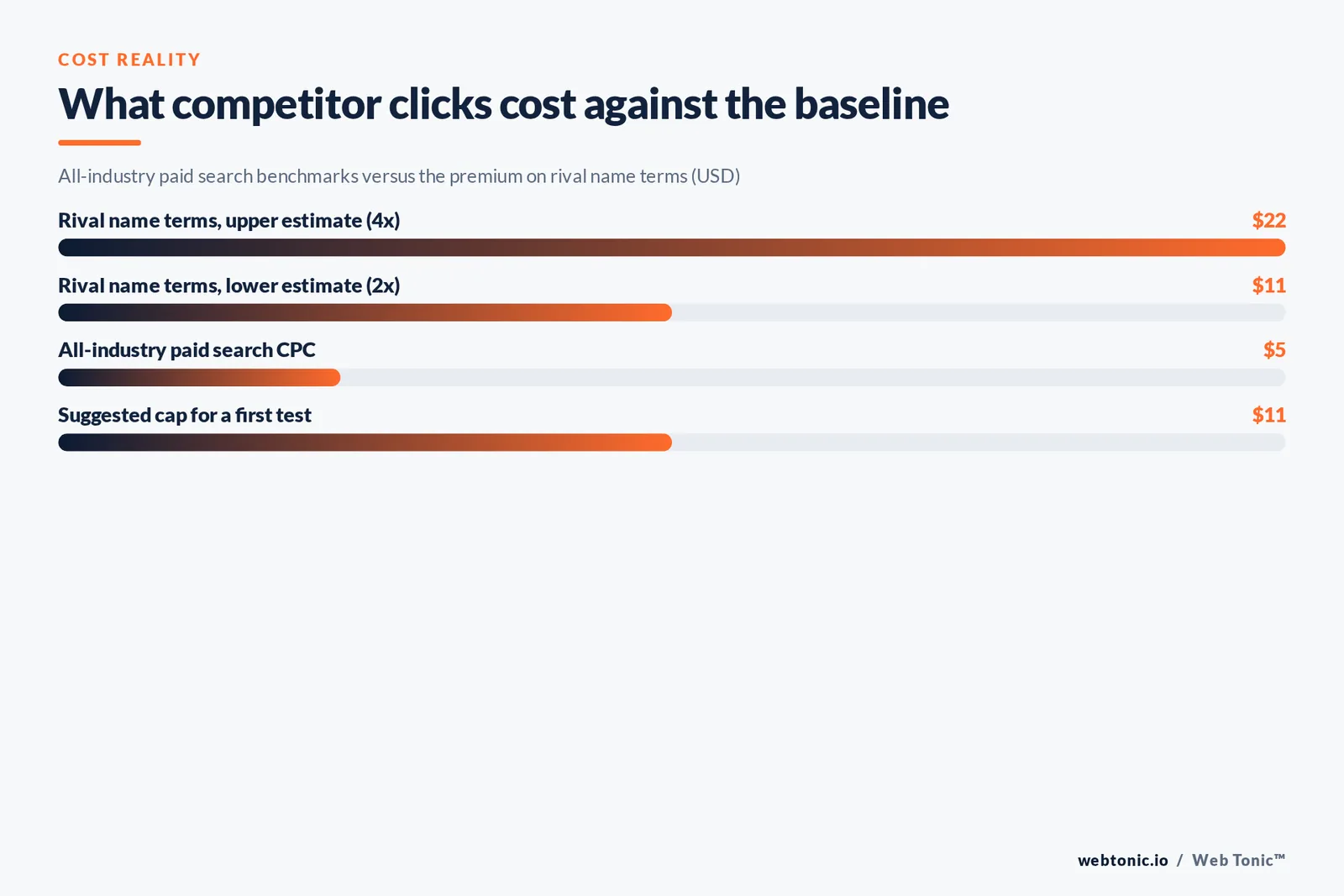
Bid rule 5 — cap competitor keyword bids at 2x your generic average CPC, roughly $11 at the all-industry $5.42 baseline. Past that the auction is telling you to use the audience layer instead.
Competitor targeting on Meta and other social media platforms
Here is the blunt truth: on social media you cannot upload a rival's customer list, and interest targeting no longer includes most company names. Competitor targeting becomes behavioural and creative. Platform targeting documentation from LinkedIn, TikTok and Reddit shows what each one genuinely offers.
| Platform | Closest thing to competitor targeting | Realistic expectation |
|---|---|---|
| Meta (Facebook and Instagram) | Custom audiences from your own data plus lookalikes | Rival interest targeting is largely gone; creative does the targeting |
| Company list targeting, job function, skills | The only platform where naming employers is a first-class filter | |
| Subreddit and community targeting | Target the rival's user community, not the rival brand | |
| TikTok | Interest, hashtag and video interaction targeting | Comparison-style creative beats any targeting setting |
| YouTube | Custom segments and content placements | Rival review and unboxing videos are the real inventory |
| X | Keyword and follower-lookalike targeting | Cheap reach, high noise, treat as awareness only |
Indirect competitor targeting
Indirect competitor targeting reaches the same buyer without bidding on the rival's name. It is usually cheaper per acquired customer, because you are not paying the brand premium on every click.
| Tactic | Where the audience comes from | Why it beats direct competitor keywords |
|---|---|---|
| Category and problem keywords | People describing the problem, not the vendor | Higher volume, lower CPC, less brand loyalty to overcome |
| Alternatives and versus queries | Buyers explicitly comparing options | Highest converting non-brand paid search inventory |
| Integration and compatibility terms | Users of the rival's ecosystem | Signals the rival relationship without naming it in the ad |
| Review site placements | Traffic already on comparison pages | Reaches high intent users at display prices |
| Competitor content placements on YouTube | Viewers of rival demos and reviews | Buys attention at video CPMs, not brand-term CPCs |
| Community and newsletter sponsorships | The rival's own audience, rented legitimately | No auction, flat cost, strong trust transfer |
Placement rule 6: 1 rival review video with 50,000 views is better inventory than 20 loosely related channels. Buy attention where the comparison is already happening.
Low-cost ways to reach competitor audiences without paid search
If your budget cannot absorb competitor keyword CPCs, these earn the same audience over a longer horizon. The practical implication is simple: organic comparison assets compound while auction prices do not.
| Asset | Query it captures | Effort to first result |
|---|---|---|
| Versus page per rival | Rival name plus vs your product | 4 to 6 weeks to rank on low-volume brand comparisons |
| Alternatives listicle | Best alternatives to the rival | 6 to 10 weeks, high conversion rate when it lands |
| Migration or switching guide | How to move off the rival | Slow, but the highest intent organic traffic you can own |
| Comparison table in your docs | Feature-level evaluation queries | Days, and it also arms your sales team |
| Answers in communities where rivals are discussed | Discussion-driven discovery | Ongoing, no media cost, needs a real person |
Measure competitor targeting on its own terms
Judged against your brand campaigns, every competitor campaign looks like a failure. Judge it against generic prospecting instead, using the all-industry paid search figures published by WordStream as the reference line.
| Metric | Reference point | Decision it drives |
|---|---|---|
| Cost per click | All-industry paid search $5.42; competitor terms 2-4x higher | Cap bids or move budget to the audience layer |
| Conversion rate | All-industry 8.18%; expect a third of that | Below a third, the offer is wrong, not the targeting |
| Cost per lead | All-industry $66.69 as the floor | Compare against your non-brand campaigns, never brand |
| Impression share lost to rank | Above 40% means the auction is out of reach | Improve landing page relevance or exit that rival |
| New customer rate | Should exceed your account average | If it does not, you are paying to reach your own base |
| Assisted conversions | Track a 30-day window | Competitor audiences often assist rather than close |
Measurement rule 7 — give a competitor targeting test 90 days and at least 30 conversions before you judge it. Anything shorter reads as noise.
Can competitors target you, and how to defend
Yes, and it is normal. Rivals can bid on your name in paid search; what they cannot always do is use your trademark in the ad text. Google's trademark policy handles complaints per advertiser and per URL, and USPTO registration is what gives you standing. Advertising claims themselves fall under FTC advertising guidance.
| Threat | What to check monthly | Defence |
|---|---|---|
| Rival bidding on your name | Auction insights on brand campaigns | Own position 1 on your own name with a high Quality Score |
| Your trademark inside their ad text | Ad copy on your own name searches | File a trademark complaint per advertiser and URL |
| Rival custom segment built on your name | Not visible; assume it exists | Retarget your own visitors and shorten the sales cycle |
| Comparison page outranking you | Organic results for your name plus alternatives | Publish your own comparison and keep it current |
| Review site bidding on your name | Your own name results page | Partner with the site or outbid on brand terms |
| Ad copy that misstates your product | Screenshots kept with dates | Escalate as a policy issue with evidence, not a legal threat |
Rule 3 — audit competitor activity on your own name terms once every 30 days. Trademark violations trigger a warning at least 7 days before suspension, so consistent monitoring is worth more than a single complaint.

Six mistakes that make competitor targeting look worse than it is
Almost every disappointing competitor targeting test fails for one of these reasons rather than because the tactic does not work.
| Mistake | Symptom | Fix |
|---|---|---|
| Broad match on rival name terms | Spend on unrelated queries | Exact and phrase only, with an aggressive negative list |
| Rival name in your ad headline | Disapprovals and policy warnings | Lead with the switching reason instead |
| Sending traffic to your homepage | Clicks with no conversions | Build one comparison page per rival |
| Mixing competitor and own-name campaigns | Blended metrics that hide the truth | Isolate competitor campaigns and budgets |
| Judging on a 14-day window | Premature shutdown | Run 90 days with a written kill threshold |
| Targeting 20 competitors at once | Thin data on every rival | Start with the 3 you lose most revenue to |
Limit 4: cap a first competitor targeting test at 10% to 15% of paid search budget for 90 days. That is enough for a read and small enough that a loss does not damage the account.
Where to start this quarter
Rank your rivals by lost revenue, pick three, and run two layers at once: exact-match competitor keywords in an isolated campaign, and a custom segment of the same competitor keywords in Demand Gen. Add one comparison page per rival so the organic layer starts compounding. Expect the audience layer to deliver 3 to 5 times the impression volume of the keyword layer at a materially lower CPC. If you would rather have this designed, measured and defended for you, our growth marketing team builds competitive programmes like this, and you can get in touch for a competitive audit.
FAQ
How can I find and target my competitors' customers effectively?
You cannot buy their customer list. What works is a custom segment built from the competitor keywords their buyers search and the sites those buyers browse, layered with your own data segments. Start with the 3 rivals you lose the most revenue to and build one segment each.
What is indirect competitor targeting?
Indirect competitor targeting reaches the same buyers without naming the rival: category and problem keywords, alternatives and versus queries, review site placements, and ads against rival review videos. It usually costs less per acquired customer because you avoid the brand-term premium.
Is competitor keyword targeting against Google's rules?
Bidding on a rival's brand name is allowed. Using their trademark in your ad text usually is not, and complaints are handled per advertiser and per URL. Google issues a warning at least 7 days before any account suspension, so most disputes end in an ad copy edit.
Which platforms work best for competitor audience targeting?
Demand Gen and YouTube in Google Ads, because custom segments are first-class there. LinkedIn is the strongest option in B2B since company targeting is native. On Meta and TikTok the creative does the targeting, since rival interest options are largely gone.
Are there low-cost alternatives to paid ads for reaching competitor audiences?
Yes. A versus page per rival, an alternatives listicle, a migration guide and honest participation in the communities where rivals are discussed reach the same buyers with no media cost. They take 4 to 10 weeks to produce results but keep working afterwards.
Sources
Google Ads Help — About custom segments, How your data segments work, Customer Match policy, Targeting and Observation settings, Trademark policy. LinkedIn Marketing Solutions ad targeting. TikTok for Business. Reddit Ads. WordStream 2026 Google Ads benchmarks. Ahrefs competitive analysis guide. USPTO trademarks. FTC advertising and marketing guidance. Figures verified August 2026.