Table of contents

Seventy-one percent of US business owners run their business with no written plan at all, according to Gallup's 2026 Pathways to Wealth survey - yet the same survey and a decade of academic research both point the same direction: businesses that plan report growth, funding and survival at meaningfully higher rates than those that don't.
Key Takeaways
- 71% of business owners have no business plan (Gallup, 2026).
- Only 11% of all owners have a detailed, written plan.
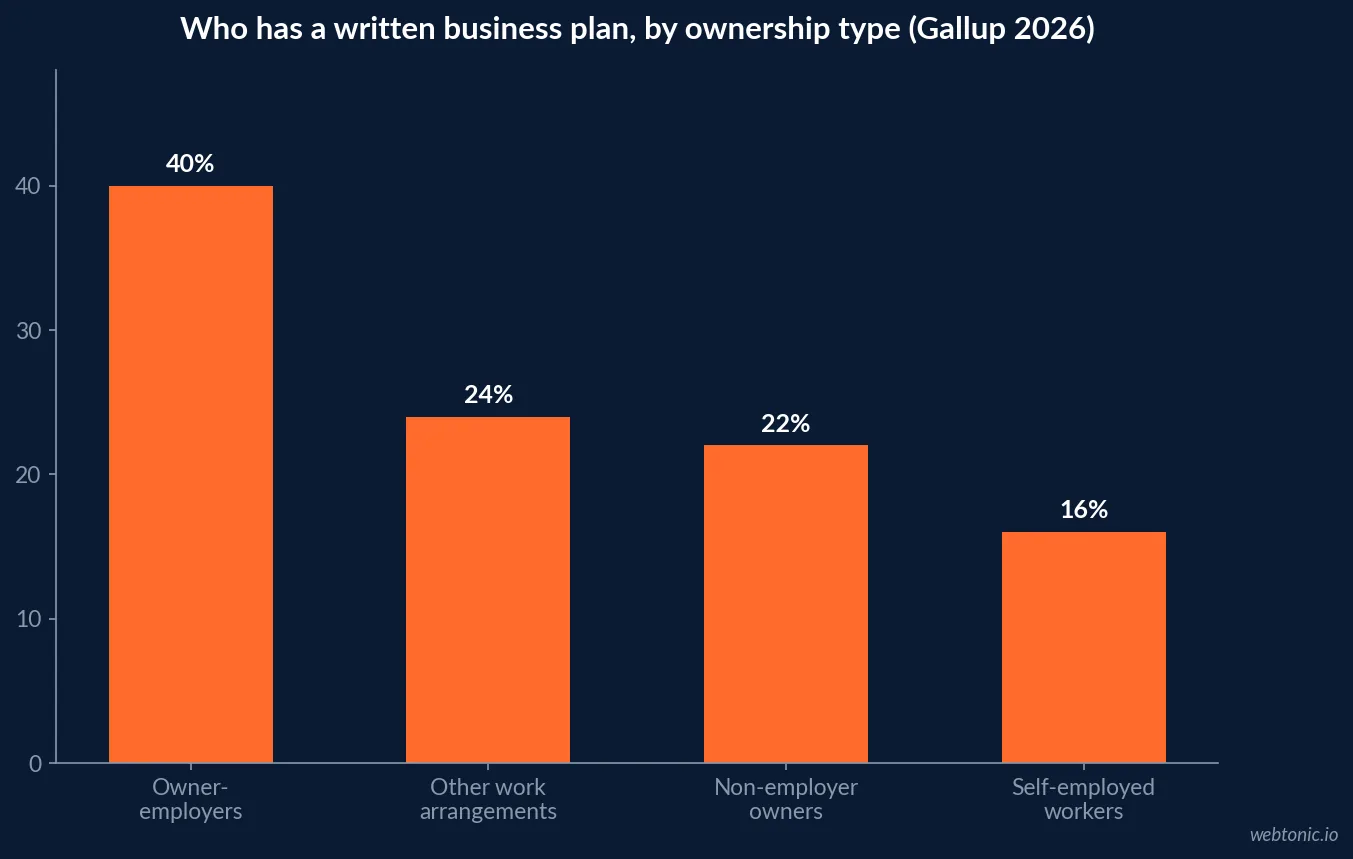
- 40% of owner-employers have a plan, against 22% of non-employer owners.
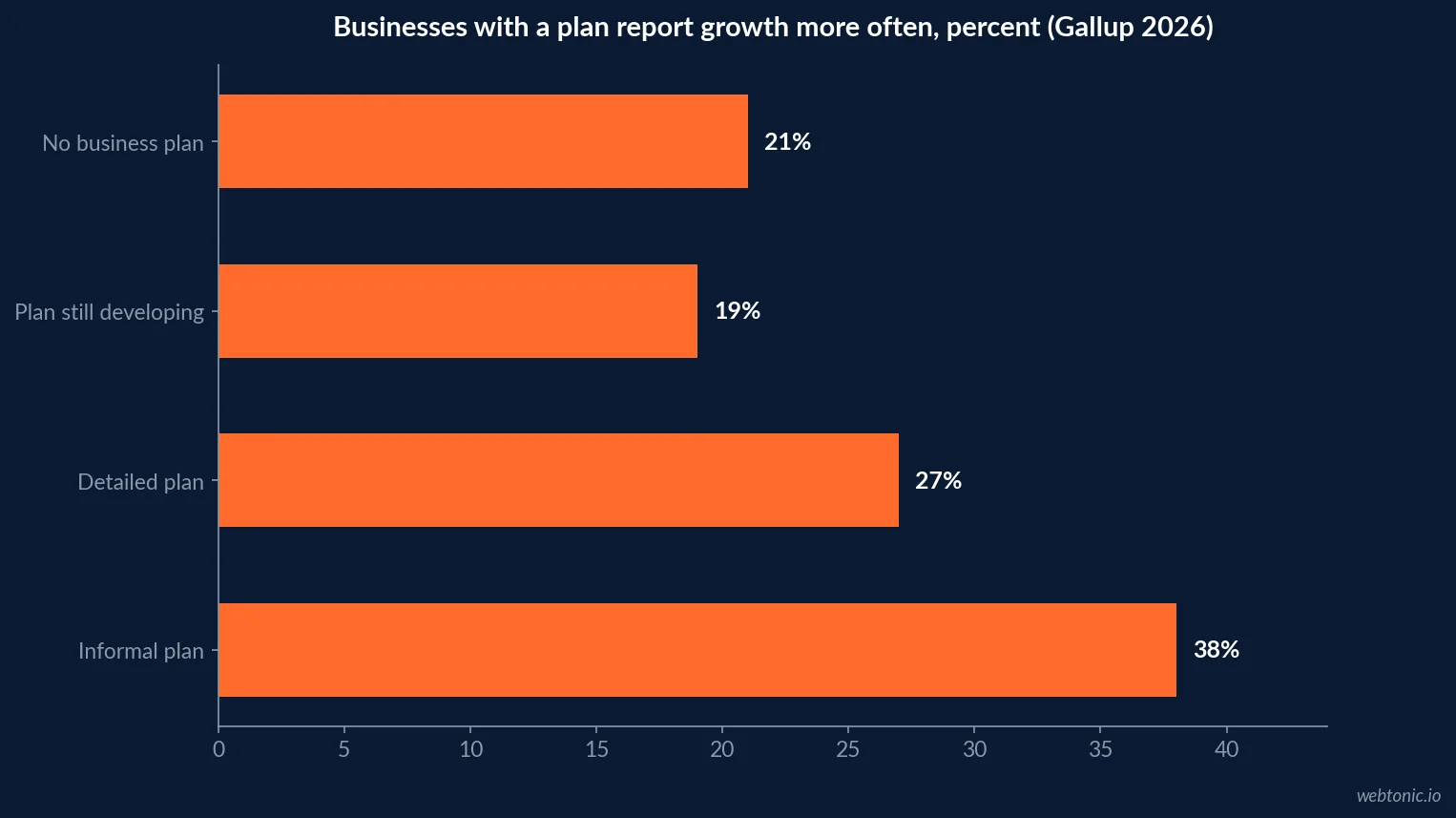
- 38% of owners with an informal plan report revenue growth, year over year.
- 27% of owners with a detailed plan report growth, still ahead of no plan.
- Only 21% of no-plan owners report growth, the lowest of any group.
- Just 10% of owners have ever submitted an RFP response.
- 33% of businesses with RFP experience report revenue growth.
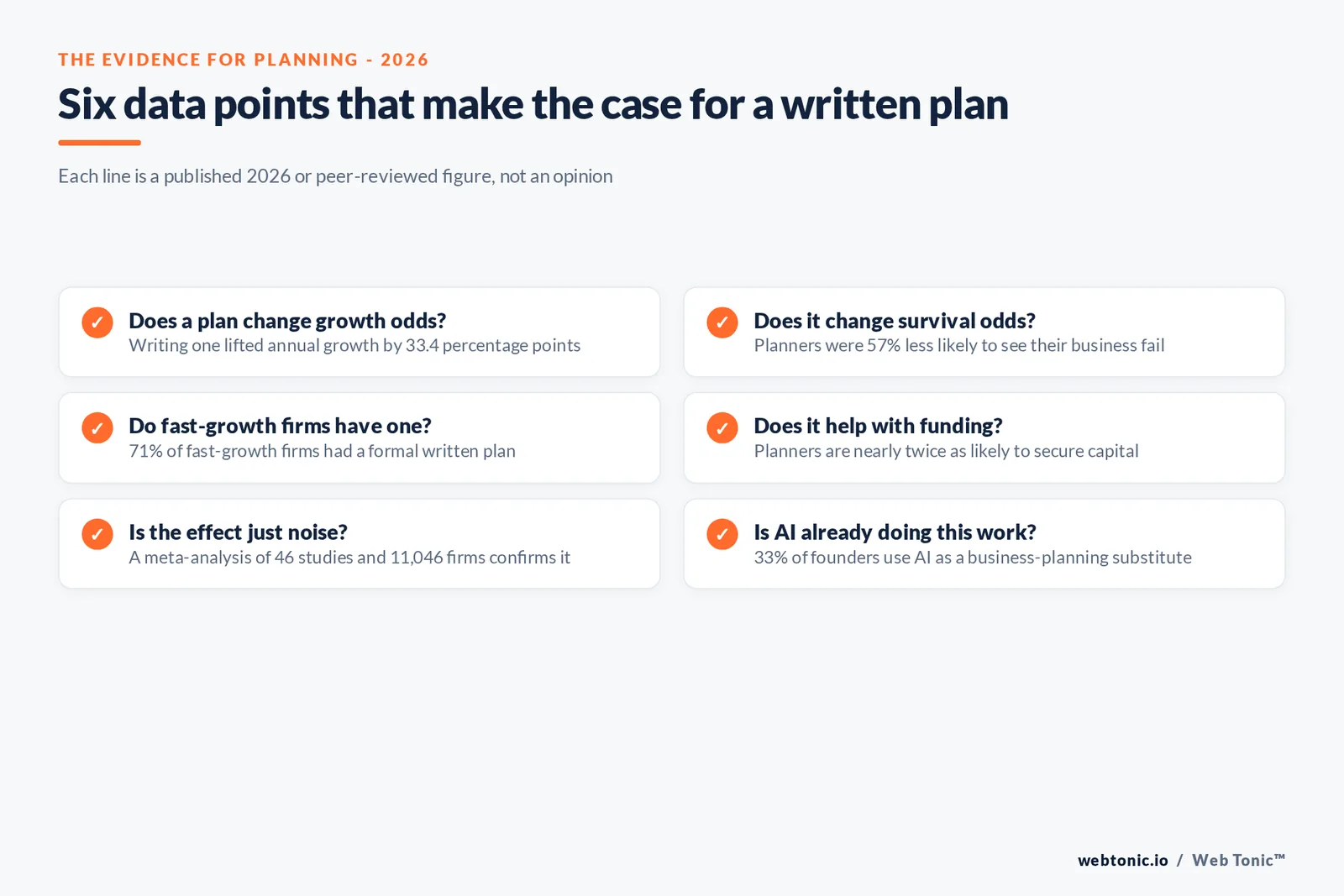
- Writing a plan lifted annual growth by 33.4 percentage points in a 622-venture study.
- Planners were 57% less likely to see their business fail in that same study.
- 71% of fast-growth firms had a formal written plan.
- Planners are nearly twice as likely to secure capital as non-planners.
- A 2010 meta-analysis covering 11,046 companies found planning improves performance.
- Only 18% of un-planned owners feel highly confident they could write a satisfactory plan.
- 35% of owners are not at all confident in their planning ability.
- 33% of entrepreneurs already use AI as a substitute for business planning or consulting.
- 67% say AI has increased their confidence in business decisions.
- 1.2 million business establishments closed in the US in 2022 alone.
Who actually writes a business plan
Gallup's 2026 Pathways to Wealth study, run with JPMorganChase and the Ewing Marion Kauffman Foundation, surveyed 5,926 working US adults including more than 3,500 business owners. The headline finding: 71% say they do not have a business plan, and just 10% have ever submitted a response to a request for proposal.
Planning is not evenly distributed by ownership type. Owner-employers - people running a business with at least one employee - are nearly twice as likely as non-employer owners to have submitted an RFP, and are the group most likely to have a plan in the first place.
| Ownership type | Has informal plan | Has detailed plan | No plan |
|---|---|---|---|
| Owner-employers (1+ staff) | 29% | 11% | 60% |
| Employee with other work | N/A | N/A | 76% (24% combined plan) |
| Self-employed workers | N/A | N/A | 84% (16% combined plan) |
| Non-employer owners | N/A | N/A | 78% (22% combined plan) |
The growth gap between planners and non-planners
Gallup's survey ties planning directly to reported momentum. Among all business owners, 38% of those with an informal plan report year-over-year revenue growth, as do 27% of those with a detailed plan. That share drops to 21% of owners with no business plan and 19% of those still developing one. Submitting an RFP shows a similar pattern: 33% of businesses that have done so report revenue growth, compared with 23% of those that have not.
The gap is not proof that a document alone causes growth - businesses with the resources to plan may also have the resources to grow - but it is consistent every time this question gets asked.
| Planning status | Report revenue growth | Source |
|---|---|---|
| Informal plan in place | 38% | Gallup 2026 |
| Detailed plan in place | 27% | Gallup 2026 |
| No plan at all | 21% | Gallup 2026 |
| Plan still in development | 19% | Gallup 2026 |
| Has submitted an RFP | 33% | Gallup 2026 |
| Has not submitted an RFP | 23% | Gallup 2026 |
What the academic research adds
Gallup's cross-sectional survey shows a correlation; the peer-reviewed planning literature tries to isolate the effect. LivePlan's 2026 review, built with a University of Oregon researcher, cites a 2010 meta-analysis pooling 46 separate studies covering 11,046 companies that found planning improved business performance on balance - with a stronger effect for established small firms than for brand-new ones.
A separate analysis of 622 new ventures in England tried to separate the plan's real effect from simple selection bias (the idea that people who plan were always going to succeed anyway). It found that writing a plan raised average annual growth by 33.4 percentage points, and that founders who completed a plan were 57% less likely to see their business fail. Among fast-growth firms in the same sample, 71% had a formal written plan.
The link to funding
The clearest commercial argument for a plan is capital access. LivePlan's review reports that planners were nearly twice as likely to grow their business or secure outside capital than founders who never wrote one, and that well-prepared founders won funding over merely passionate ones in side-by-side pitch comparisons. That tracks with what lenders and investors say they actually screen for: a document that shows the founder understands their own unit economics, not a polished narrative.
It also tracks with confidence data. Gallup found that among owners without a detailed plan, only 18% feel highly confident they could write one that would satisfy a potential investor or partner; 46% feel somewhat confident, and 35% are not at all confident. A third of that group say the main reason is that they do not yet know their own numbers well enough to write them down.
| Confidence level (owners with no detailed plan) | Share reporting it |
|---|---|
| Highly confident they could write a satisfactory plan | 18% |
| Somewhat confident | 46% |
| Not at all confident | 35% |
| Cite not knowing own numbers as the primary reason | 33% |
Where AI now fits into the process
LegalZoom's 2026 AI and Entrepreneurship survey of 1,000 US founders and business owners found 33% have already used AI as a substitute for business planning or consulting services - behind only customer support (37%) and marketing or advertising services (35%) as the professional function AI most often replaces. A further 42% use or are considering AI for financial planning, budgeting or forecasting.
Trust is rising alongside adoption: 67% say AI has increased their confidence in making business decisions, with 24% saying "significantly," and 62% say AI now provides more value than traditional tools or professional services. The boundary owners still hold: 38% would not let AI near a high legal or financial risk decision without human review.
| AI use case in 2026 | Share of entrepreneurs | Source |
|---|---|---|
| Used AI as a substitute for business planning/consulting | 33% | LegalZoom 2026 |
| Use or consider AI for financial planning & forecasting | 42% | LegalZoom 2026 |
| Say AI increased their decision-making confidence | 67% | LegalZoom 2026 |
| Say AI provides more value than traditional tools | 62% | LegalZoom 2026 |
| Would not use AI for high legal/financial risk calls | 38% | LegalZoom 2026 |
The backdrop: how often businesses actually close
Planning debates happen against a churn rate that is easy to underestimate. The SBA Office of Advocacy reports that in 2022, 1.4 million business establishments opened for the first time in the US while about 1.2 million closed permanently - and startups made up 15.7% of all business establishments that year, up from 12.5% in 2019. A written plan does not stop a business from closing, but the data above suggests it changes the odds.
None of this is an argument for a 40-page document nobody reads again. The research consistently shows that what matters is revisiting the plan as assumptions get tested, not the length of the first draft.
What a plan should actually contain in 2026
Across the sources above, the plans that correlate with growth share three traits: a stated unit-economics model rather than a narrative, a funding or RFP ask that names a number, and a revision cadence tied to a real event (a board meeting, a renewal, a funding round) rather than a calendar date. If you are building that model with paid channel data behind it, our growth marketing team can help attach real CAC and payback numbers to the plan before it goes in front of an investor.
A planning cadence that matches the evidence
None of the studies above reward a plan that gets written once and filed away. The meta-analysis of 46 studies found the performance benefit was strongest for established small firms - the ones revisiting a plan against real trading data, not a first-year guess. That argues for a cadence tied to events rather than a calendar, matched to how much is actually known at each stage.
| Business stage | What to plan first | Revisit trigger | Owner confidence gap it closes |
|---|---|---|---|
| Pre-launch | Unit economics, not narrative | Before the first funding ask | 18% feel ready for investor scrutiny |
| Year 1 trading | Actual CAC and margin vs. assumption | Each quarter's board or lender check-in | Assumptions replace guesses |
| Established, growing | Channel-level growth model | Each renewal or expansion decision | Plan reflects real customer data |
| Raising or selling | Diligence-grade documentation | The raise or sale window itself | Preparedness beats passion in a pitch |
What this means for marketing spend specifically
A business plan and a marketing plan are not the same document, but the data above applies to both: the businesses reporting growth are the ones that named a number before spending against it. If the plan you are building needs real paid-channel benchmarks rather than assumptions, see our breakdown of what Google Ads actually costs or whether Facebook Ads are worth the spend before you put a channel budget line in the plan itself. Our team can also review a draft plan's marketing assumptions directly.
How to use these numbers
Use the Gallup figures to benchmark your own planning habit against peers in your ownership category, not against a mythical "average founder." Use the academic figures - the 33.4 percentage point growth lift, the 57% lower failure odds - as the argument for spending a focused week on a plan rather than an open-ended quarter. And if AI is doing a third of that first draft already, budget the time you save for the confidence-building step Gallup shows most owners actually lack: knowing your own numbers well enough to defend them out loud.
Frequently Asked Questions
What percentage of business owners have a business plan?
Gallup's 2026 Pathways to Wealth survey of more than 3,500 US business owners found that 71% have no business plan at all. Owner-employers - those running a business with at least one employee - are the exception: 40% of them have either an informal (29%) or a detailed (11%) plan, against 22% of non-employer owners and 16% of the self-employed.
Does having a business plan actually help a business grow?
The correlation is consistent across every data set we checked. In Gallup's survey, 38% of owners with an informal plan and 27% with a detailed plan reported year-over-year revenue growth, against 21% of owners with no plan at all. Academic research goes further: a study of 622 new UK ventures found that writing a plan lifted average annual growth by 33.4 percentage points and cut the odds of failure by 57%, and a 2010 meta-analysis of 46 studies covering 11,046 companies found planning improved performance on balance.
Does a business plan help with raising money?
Founders who complete a plan are reported to be nearly twice as likely to grow their business or secure outside capital than those who never write one, per the University of Oregon-backed review LivePlan published in 2026. Preparedness reads as a proxy for seriousness to a lender or investor - it is not the document itself that closes the deal.
Are entrepreneurs using AI to write business plans in 2026?
Yes, and increasingly as a partial substitute for paid advisory work. LegalZoom's 2026 survey of 1,000 US founders and business owners found 33% have already used AI as a substitute for business planning or consulting services, and 42% use or are considering AI for financial planning, budgeting or forecasting. Two-thirds say AI has increased their confidence in business decisions.
Why do most owners still skip writing one?
Confidence, not time, is the biggest reported blocker. Among owners without a detailed plan, Gallup found just 18% feel highly confident they could write one that would satisfy a lender or investor, while 35% are not at all confident. A third of that group cite not yet knowing their own numbers as the primary reason they have not put a plan on paper.
Sources
Gallup - Business Planning and RFP Pursuit Vary by Ownership Type, 2026
LivePlan - Do You Need a Business Plan? Here's What the Research Says
Effectuation.org - The Multiple Effects of Business Planning on New Venture Performance
U.S. SBA Office of Advocacy - Frequently Asked Questions About Small Business, 2024
LegalZoom - AI and Entrepreneurship in 2026
SCORE - Startup Small Businesses Rely on Non-Government Financial Assistance