Table of contents
Census counts 29.8 million US businesses with no paid employees against 6.4 million that have staff, and the 2026 survey data shows what separates them isn't just headcount - it's revenue, workload, and how much of the admin load AI has already absorbed. Here is what the official counts and the newest vendor surveys say about staying solo versus building a team.
Key Takeaways
- 29,811,495 US businesses operate with no paid employees, per Census/SBA.
- Only 6,374,594 US businesses carry any paid employees at all.
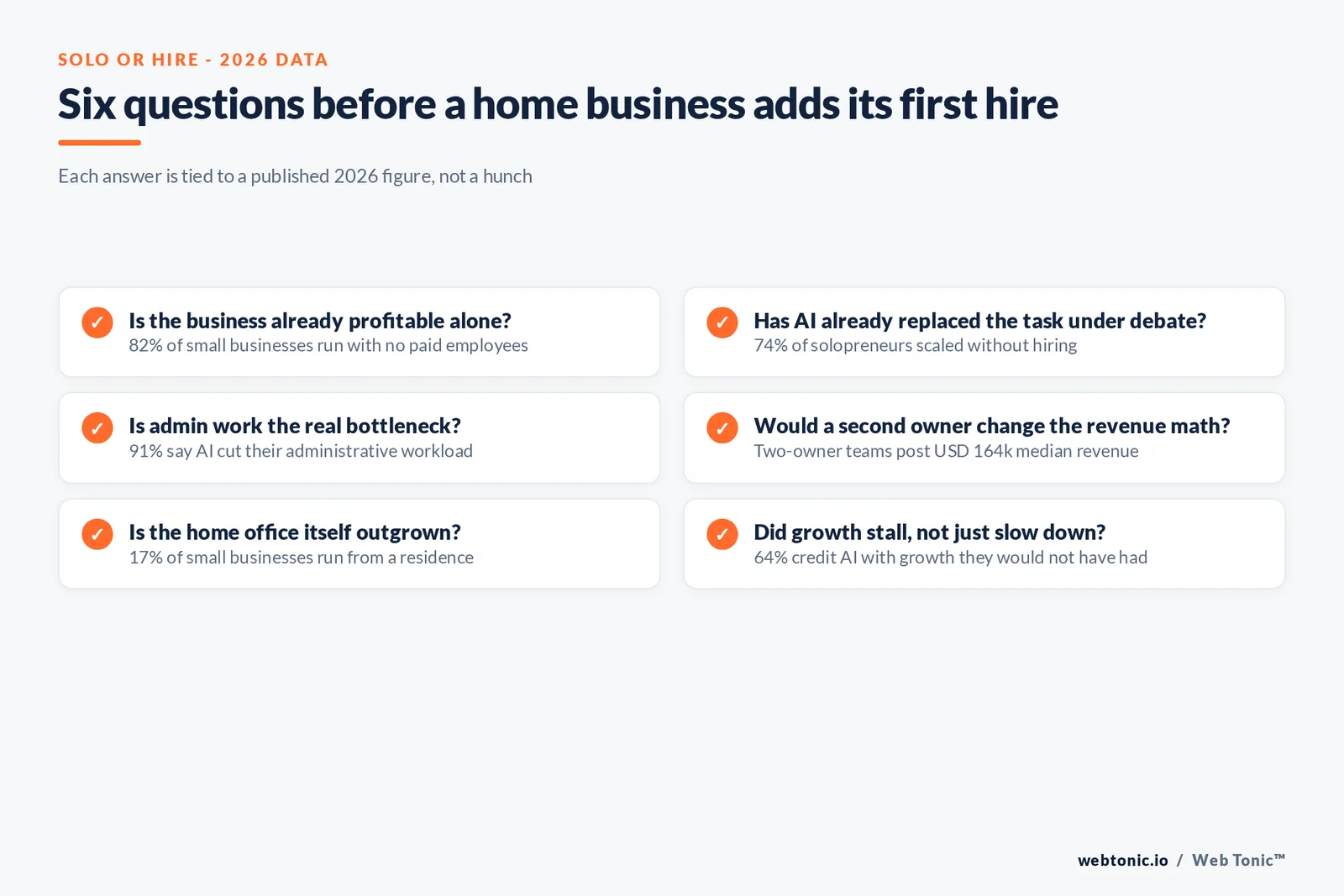
- 82% of small businesses are solopreneurs, per Zoom's 2026 report.
- Solopreneurs contribute roughly USD 1.7 trillion to the US economy.
- That is nearly 7% of total US economic activity from businesses of one.
- Solopreneur median annual revenue runs about USD 87,000.
- Two-person teams post median revenue near USD 164,000.
- Three-person teams post median revenue near USD 211,000.
- 17% of small employer firms run from a residence, per the Federal Reserve.
- 59% of small employer firms rent their headquarters space instead.
- 86% of solopreneurs try AI before hiring a person for a task.
- 74% of solopreneurs have scaled without hiring anyone.
- 91% say AI has reduced their administrative workload.
- 64% credit AI with growth they would not otherwise have had.
- Small businesses added a net 228,240 jobs in one recent 12-month period.
- That is 35.9% of all net US job growth in that period.
The official count: solo is the default, not the exception
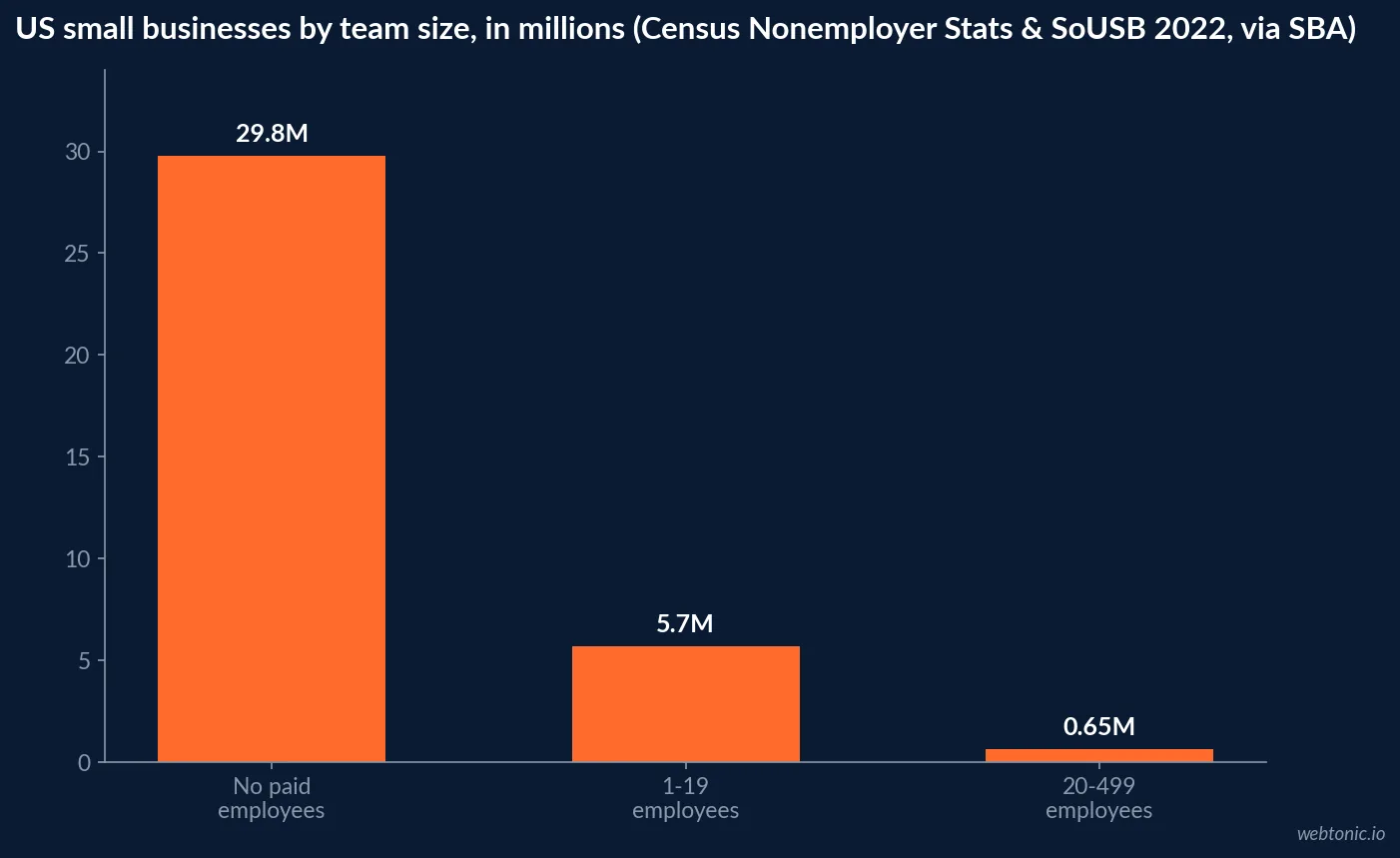
The SBA Office of Advocacy's 2026 Small Business Profile, built from Census Bureau Nonemployer Statistics and Statistics of U.S. Businesses, counts 29,811,495 US businesses with no paid employees against 6,374,594 with at least one employee and 654,501 mid-sized firms of 20 to 499 staff. All told, small businesses - firms under 500 employees - number 36,186,089 and make up 99.9% of US businesses.
Zoom's 2026 Small Business AI Report rounds the nonemployer figure to 29.8 million solopreneurs, or 82% of all small businesses, contributing an estimated USD 1.7 trillion to the economy - close to 7% of total US economic activity coming from businesses that never added a single employee.
What team size actually buys in revenue
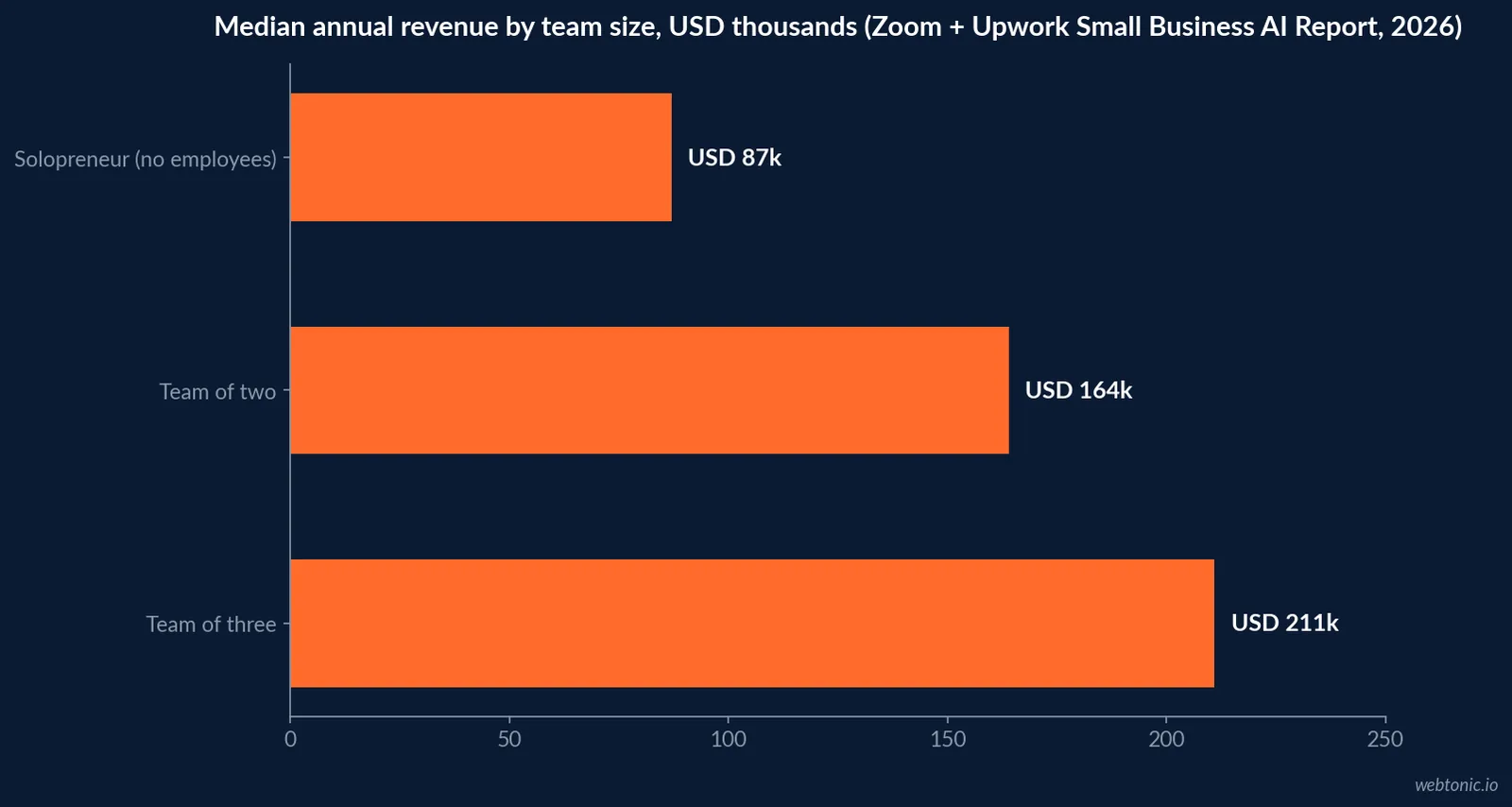
Revenue scales with team size, but not proportionally per owner. Reporting on Zoom's 2026 solopreneur survey data put median annual revenue at USD 87,000 for a single-owner business with no employees or contractors, USD 164,000 for a two-person team, and USD 211,000 for a three-person team. The jump from one owner to two nearly doubles total revenue; the jump from two to three adds a smaller increment, suggesting diminishing returns to headcount past the first hire for many home-based operations.
That pattern matters for anyone weighing a first hire purely on a revenue-growth basis: the data suggests the biggest revenue jump comes from adding the second person, not from adding more people after that.
| Team size | Median annual revenue | Revenue vs. solo | Source |
|---|---|---|---|
| Solopreneur (no employees, no contractors) | USD 87,000 | Baseline | Zoom 2026 solopreneur data |
| Team of two | USD 164,000 | +88% | Zoom 2026 solopreneur data |
| Team of three | USD 211,000 | +143% | Zoom 2026 solopreneur data |
| All US small businesses, net job growth | 228,240 net jobs added | 35.9% of total | SBA / BLS Business Employment Dynamics |
| Nonemployer share of all small businesses | 82% | n/a | Zoom 2026 / Census Nonemployer Stats |
Where the work actually happens
The Federal Reserve's 2024 Small Business Credit Survey, a collaboration of all 12 Federal Reserve Banks reaching more than 7,600 firms, asked employer firms what kind of physical space they use as a headquarters. 59% rent their space, 17% own it, and 17% run the business from a residence. The Fed's companion 2025 Report on Nonemployer Firms asks the same question of solo operators and finds residence-based headquarters more common still among nonemployer firms, particularly earlier-stage ones - later-stage firms that plan to hire are more likely to already operate outside a residence.
In other words, the home office is not a stopgap most solo operators are eager to leave; it is the default working arrangement for a business that has not yet outgrown it.
| Type of headquarters space (employer firms) | Share | Source |
|---|---|---|
| Rented space | 59% | Federal Reserve 2024 Small Business Credit Survey |
| Owned space | 17% | Federal Reserve 2024 Small Business Credit Survey |
| A residence | 17% | Federal Reserve 2024 Small Business Credit Survey |
| Businesses that moved headquarters, past 5 years | 25% | Federal Reserve 2024 Small Business Credit Survey |
| Same figure, 2019 survey wave | 31% | Federal Reserve 2019 Small Business Credit Survey |
AI is changing when the first hire actually happens
The clearest 2026 shift is not in the headcount data but in what fills the gap before a hire. FreshBooks' "The Era of the Solopreneur" report, based on a Wakefield Research survey of 500 solopreneurs and microbusiness owners, found 86% now try an AI tool before paying a person for a task that exceeds what they can do alone. Zoom's own 2026 data, drawn from its Solopreneur 50 program and the Zoom + Upwork Small Business AI Report, found 74% of solopreneurs have scaled their business without hiring anyone, 91% say AI has reduced their administrative workload, and 64% credit AI with growth they would not otherwise have achieved.
That does not eliminate hiring - it changes the trigger. The task that once justified a first hire on volume alone increasingly has to require judgment, a relationship, or a decision AI cannot make before headcount enters the conversation.
| What 2026 survey data shows about AI and hiring | Figure | Source |
|---|---|---|
| Solopreneurs who try AI before hiring for a task | 86% | FreshBooks / Wakefield Research |
| Solopreneurs who scaled without hiring | 74% | Zoom 2026 Small Business AI Report |
| Solopreneurs saying AI cut admin workload | 91% | Zoom 2026 Small Business AI Report |
| Solopreneurs crediting AI with otherwise-unreached growth | 64% | Zoom 2026 Small Business AI Report |
| Small businesses overall with no paid employees | 82% | Zoom 2026 / Census Nonemployer Stats |
What the demographic breakdown adds
The SBA/Census profile also breaks small-business ownership down by owner group, and the nonemployer share is not evenly distributed. Female-owned businesses number 14,236,990 in total, of which 12,880,000 - about 90% - carry no paid employees. Male-owned businesses number 19,658,693 in total, with 16,020,000, or about 81%, running with no employees. Both groups skew heavily solo, but female-owned businesses skew slightly more so, which is worth noting for anyone building products or content aimed specifically at the solopreneur segment.
Rural businesses show a similar pattern to urban ones on this measure: of 5,473,836 rural small businesses, 4,640,000 - about 85% - have no paid employees, close to the 83% rate among the much larger urban small-business population.
| Owner group | Total small businesses | Without paid employees | Solo share |
|---|---|---|---|
| Female-owned | 14,236,990 | 12,880,000 | ~90% |
| Male-owned | 19,658,693 | 16,020,000 | ~81% |
| Rural | 5,473,836 | 4,640,000 | ~85% |
| Urban | 27,734,633 | 22,980,000 | ~83% |
| Veteran-owned | 1,619,330 | 1,358,000 | ~84% |
The job-growth case for staying small
Small businesses are not a rounding error in the national jobs picture, even though most carry no employees at all. The SBA's data, drawn from the Bureau of Labor Statistics' Business Employment Dynamics program, found that between March 2024 and March 2025, small businesses accounted for 1,068,489 of the 1,249,999 total US establishment openings and contributed a net increase of 228,240 jobs - 35.9% of the total net job growth across the entire US economy in that period, from a segment that is overwhelmingly solo-operated at the base.
That context matters for the solo-vs-team question: the segment as a whole is a major jobs engine even though the typical individual firm within it never adds a second employee. Growth at the macro level is coming from volume of new solo starts and selective scaling, not from every solo firm converting into a team.
What the small-business lending picture adds
Financing access is one more variable that separates a hobby-scale solo business from one built to add a team. The SBA profile's Community Reinvestment Act data shows reporting banks issued USD 89.1 billion in 2024 loans to businesses with revenues of USD 1 million or less, and USD 114.7 billion in total new lending through loans of USD 100,000 or less - the size band most relevant to a first hire's payroll runway rather than a full relocation. The IRS's Nonfarm Sole Proprietorship Statistics track the tax side of that same population, reporting Schedule C business receipts, deductions and net income for the sole proprietorships that make up most of the 29.8 million nonemployer count above.
Put together, the lending and tax data suggest most solo operators are financing growth from revenue and small credit lines rather than large loans - consistent with a business that stays lean by design rather than one constrained by a lack of access to capital.
How to read your own numbers against this data
If your home business is clearing something near the USD 87,000 solopreneur median and the task list is dominated by admin rather than client-facing judgment calls, the 2026 data suggests testing an AI tool before a hire, in line with the 86% of solopreneurs who already do. If revenue is closer to the two-owner USD 164,000 median and the bottleneck is a decision only a second person can make, the jump in typical revenue at that team size suggests the hire has historically paid for itself for businesses in a similar position.
If the home business is also running paid marketing to grow past that ceiling, our growth marketing practice plans channel budgets around a real revenue base rather than a guess, our team can walk through the numbers above against your own, and our breakdown of what paid social actually costs is a reasonable next step before committing spend a solo budget cannot easily absorb.
Frequently Asked Questions
How many US home businesses operate with no employees at all?
The Census Bureau's Nonemployer Statistics, compiled with Statistics of U.S. Businesses in the SBA Office of Advocacy's 2026 Small Business Profile, count 29,811,495 US businesses with no paid employees against 6,374,594 businesses that do have employees. Zoom's 2026 Small Business AI Report rounds that to roughly 29.8 million solopreneurs, or 82% of all small businesses, contributing about USD 1.7 trillion to the economy.
Do solo operators earn less than small teams?
Team size correlates strongly with revenue. Reporting on Zoom's 2026 solopreneur data, coverage of the underlying survey put median annual revenue at USD 87,000 for single-owner solopreneurs, rising to USD 164,000 for two-person teams and USD 211,000 for three-person teams - meaning each added owner nearly doubles the typical revenue base, though not the per-owner take.
What share of small businesses are actually run from a residence?
The Federal Reserve's 2024 Small Business Credit Survey, a 12-Reserve-Bank collaboration reaching more than 7,600 firms, found 17% of small employer firms are managed from a residence, while 59% rent their headquarters space and another 17% own it. Nonemployer (solo) firms skew even more home-based, per the Fed's companion 2025 Report on Nonemployer Firms.
Is AI changing whether a solo operator needs to hire?
It appears to be delaying that decision for many. FreshBooks' 'The Era of the Solopreneur' report, based on a Wakefield Research survey of 500 solopreneurs and microbusiness owners, found 86% try an AI tool first before paying a person when a task exceeds what they can do alone. Zoom's own 2026 data reports 74% of solopreneurs have scaled their business without hiring and 91% say AI has reduced their administrative workload.
At what point does a solo home business typically add its first hire?
There is no single published trigger, but the data points to a workload ceiling rather than a revenue one: Zoom's research frames AI as replacing functions historically handled by a first hire - admin, scheduling, follow-up - so operators increasingly add headcount only once a task requires judgment or relationships that automation cannot cover, not once revenue crosses a threshold.
Sources
SBA Office of Advocacy - 2026 Small Business Profile: United States
Zoom - The State of Solopreneurship in 2026
Federal Reserve Banks - 2025 Report on Employer Firms (2024 Small Business Credit Survey)
Federal Reserve Banks - 2025 Report on Nonemployer Firms (2024 Small Business Credit Survey)
FreshBooks - Before They Hire, 86% of Solopreneurs Try AI First
US Bureau of Labor Statistics - Business Employment Dynamics
IRS - SOI Tax Stats: Nonfarm Sole Proprietorship Statistics