Table of contents

Short answer: Use the 2026 evidence to frame a test, not to copy a universal benchmark. The statistics below separate measured outcomes from survey opinions and put investment decisions in context.
Key Takeaways
- 88% of respondents trusted known-person recommendations in Nielsen’s 2021 global study.
- Referred customers made 31–57% more referrals in the 2024 field study.
- Qualtrics XM Institute’s 2025 study found consumers most frequently shared experiences with friends and family.
- Trust, referral behaviour and measured conversion are separate outcomes.
Benchmarks at a glance
| A trust-to-action snapshot | Signal | Finding / year | What it measures |
|---|---|---|---|
| Recommendation trust | 88% · 2021 | Nielsen global survey | Trust in recommendations from known people |
| Online opinions trust | 66% · 2015 | Nielsen global survey | Trust in consumer opinions posted online |
| Recommend influence | 30% · 2022 | Nielsen US journey study | Recalled recommendation usefulness |
| Advertising influence | 45% · 2022 | Nielsen US journey study | Recalled advertising usefulness |
The unit of analysis: conversations that create customers
Word of mouth is an influence mechanism, not a media placement with a stable impression count. A person may see a post, ask a colleague, read reviews and then speak with a salesperson before converting. Marketers should therefore distinguish exposure, recommendation, action and subsequent advocacy. Nielsen’s 2022 account of its US buyer-journey research found 30% of new brand triers recalled recommendations as useful or influential, compared with 18% recalling reviews and 45% advertising. These are different roles in a decision, not proof that one channel caused a purchase. The useful implication is portfolio design: paid media can make a brand visible; customer experience and credible recommendations can help it feel safe to choose. In reporting, label what is observed and what is inferred. A referral code records a trackable referral, while a survey records remembered influence. Neither is the whole of word of mouth.
Research source: Nielsen, Trustworthy channels and buyer journeys
Trust is the starting condition, not the outcome
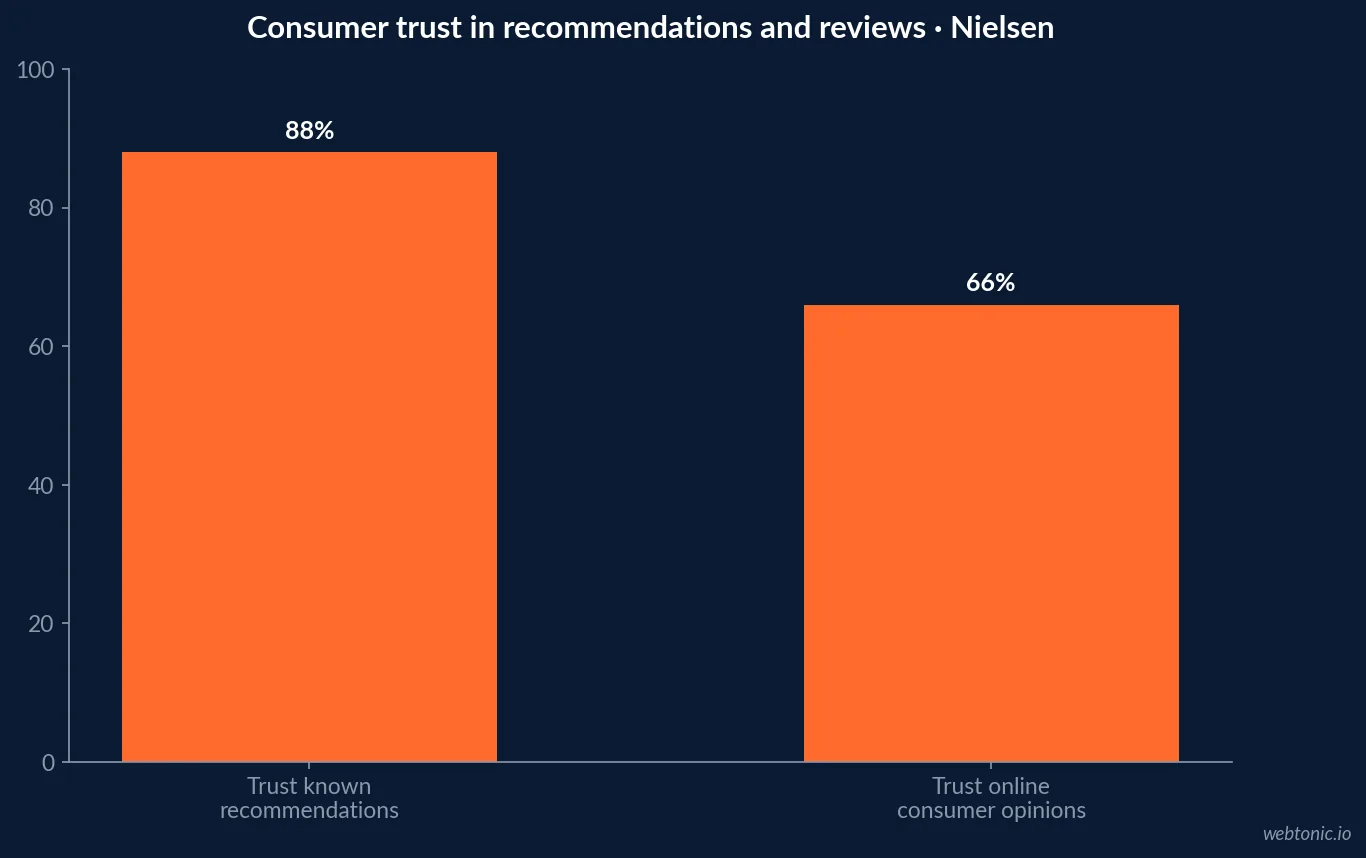
Nielsen’s 2021 global Trust in Advertising research reported 88% of respondents trusted recommendations from people they knew. That figure is a trust measure, not a conversion rate and not a guarantee that every recommendation is persuasive. The same research draws on more than 40,000 consumers across multiple regions. Its scale makes the finding useful for framing channel credibility, while its age means teams should not label it a 2026 consumer survey. Put it beside current customer evidence rather than treating it as a timeless forecast. Nielsen’s 2015 global survey likewise found 83% trusted friends-and-family recommendations and 66% trusted consumer opinions posted online. These historical readings suggest that the source and context of advocacy matter: a known person, an anonymous reviewer and a paid creator are not interchangeable. Qualtrics XM Institute’s 2025 Global Study, using 23,730 consumers across 23 countries surveyed in Q3 2024, found people most frequently shared good and bad experiences with friends and family. The study also found direct company feedback declined versus 2021 after both very good and very poor experiences. That newer evidence supports an operational point: customers often tell peers even when the company itself receives no feedback.
Research source: Nielsen, 2021 Trust in Advertising study
Read the relevant comparison below alongside the section above; definitions and populations matter.
| Referral mechanism | Observed effect | Evidence base | Interpretation |
|---|---|---|---|
| Referred customers refer more | 31–57% more | 41.2m customer field data | Conditional on purchase activity |
| Reminder treatment | 20–27% lift | Field experiment | Referral reminder, specific context |
| Recommendations trusted | 88% | Nielsen 2021 global study | Self-reported trust, not conversion |
| Conversation influence | 71% | Nielsen Indonesia 2020 | Real-life conversation impact |
The economic case: referrals can reproduce themselves
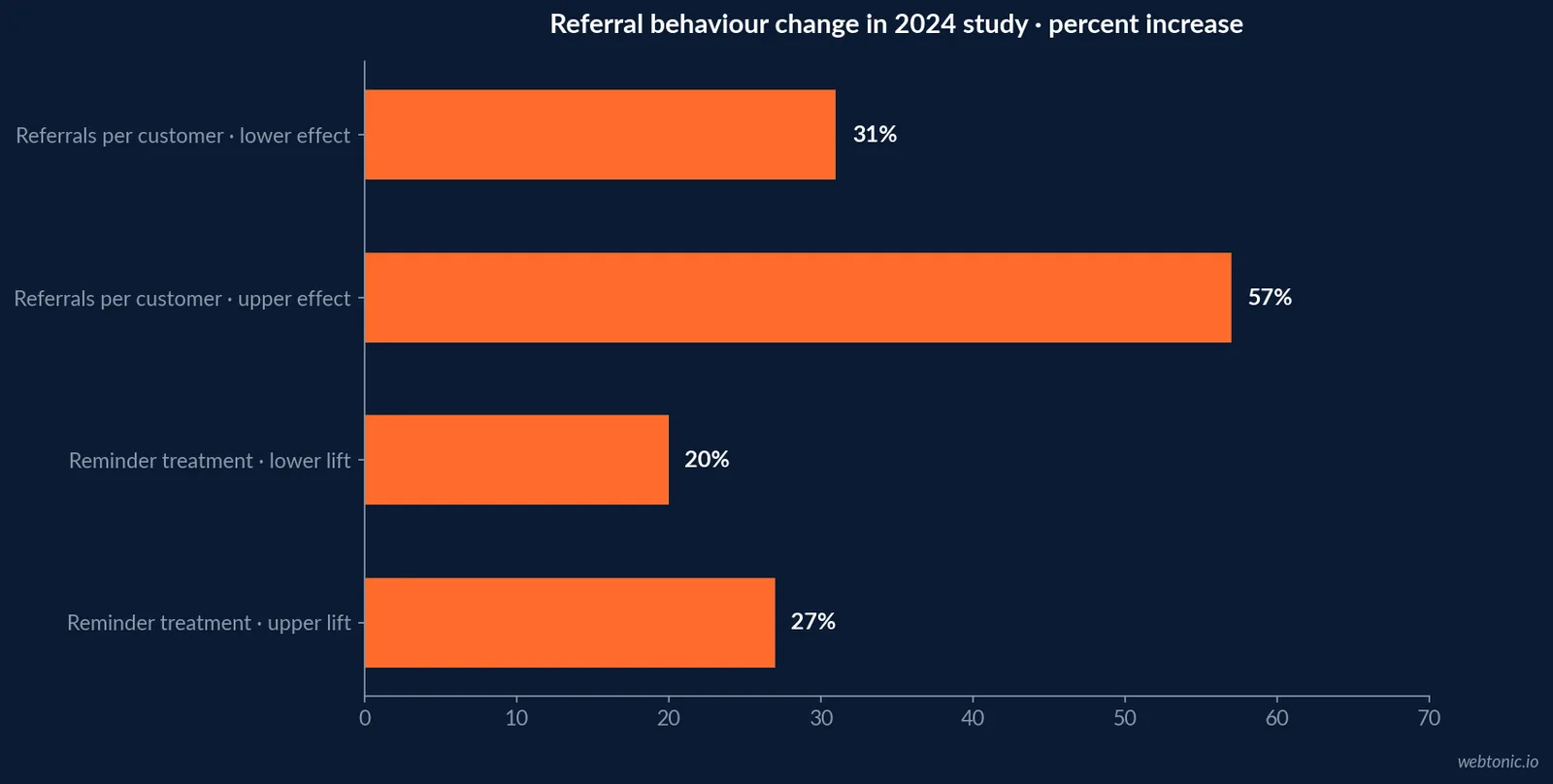
A 2024 Journal of Marketing Research study examined 41.2 million customers, preregistered lab experiments and a field experiment. It found referred customers made 31–57% more referrals than non-referred customers, conditional on purchase activity. In the field experiment, reminding customers they had joined through a referral lifted referral behavior by 20–27%. Harvard Business Review’s summary describes the downstream implication as referral contagion: an acquired customer can become an additional acquisition source. This is evidence about customer behavior in a particular setting, not a universal multiplier for every company. The actionable question is whether your own referred cohort produces more qualified introductions after controlling for tenure and opportunity to refer. Establish a comparable baseline and follow cohorts over time. Do not divide all new customers by referral-program cost and call the result lifetime value unless you have measured repeat purchase, margin, incentive expense and service costs.
Research source: University of Texas at Dallas authors, Referral Contagion paper
Online recommendations are not just social posts
The recommendation journey spans review platforms, community forums, group chats, creator discussions and face-to-face advice. Reddit’s 2024 product recommendation research analysed millions of community conversations and supplemented that analysis with two surveys totalling 11,000 respondents. It argues that community recommendations can appear throughout a purchase journey rather than only at consideration. The source is platform-commissioned research, so read its methodology and scope before generalizing to all social media. Nielsen’s 2020 survey in Indonesia found 58% said word of mouth influenced them highly, compared with 46% for social media; 71% said real-life conversations affected purchase decisions. Those country-specific results illustrate why “social reach” and “recommendation” should not be collapsed into one KPI. A private conversation may be invisible to analytics, while a public thread can persist and be searched. Listening programs, review responses and customer interviews can add context that click reports miss.
Research source: Reddit, Recommendation Journeys for Products, 2024
Read the relevant comparison below alongside the section above; definitions and populations matter.
| Research | Population / method | Year | Careful reading |
|---|---|---|---|
| Nielsen Trust in Advertising | 40,000+ global consumers | 2021 | Trust attitudes |
| Nielsen Real Life vs Digital Life | Indonesian consumers | 2020 | Country-specific influence |
| Referral Contagion | 41.2m field customers + experiments | 2024 | Referral behaviour |
| Reddit recommendation study | Millions of conversations + 11,000 survey responses | 2024 | Platform-sponsored product recommendations |
| 5WPR Consumer Culture | Consumer survey | 2024 | Report-specific response measures |
Why earned advocacy belongs beside paid acquisition
The strongest argument for word of mouth is not that it replaces advertising. Nielsen’s 2022 analysis found advertising was recalled as useful or influential by 45% of new brand triers, ahead of recommendations at 30% and reviews at 18%. That comparison cautions against an either-or budget debate. Paid distribution can seed awareness and help people recognize the product when a peer mentions it. Reliable service, clear positioning and a shareable result can make the recommendation worth passing on. Measure how channels interact: ask new customers what first introduced the brand, what helped them decide, and what finally triggered action. Do not force respondents to choose one if several touchpoints mattered. For channel planning, coordinate creative claims with the experience customers will actually receive; a referral that leads to a mismatched landing page risks converting advocacy into disappointment. Marketing teams can connect this work to broader growth marketing and performance creative planning.
Research source: Nielsen, Trustworthy channels and buyer journeys
Reviews and referrals: related signals, different jobs
Online reviews are visible proof; referrals are directed recommendations; word-of-mouth conversation includes both and much more. Nielsen’s 2022 buyer-journey research reported that 18% of new brand triers recalled using reviews and 30% recommendations, while 45% found advertising useful or influential. These percentages describe remembered sources in the journey, not mutually exclusive market shares. A 2024 5WPR consumer-culture report also asked about discovery and purchase influences; its results are survey-specific and should be cited with the report year and audience. Marketers should keep review operations focused on authentic, policy-compliant feedback, and design referral asks around customers who have experienced meaningful value. One cannot manufacture trust simply by offering a reward or asking everyone for a five-star review. Track review recency, response time and recurring themes alongside referral quantity. A rising referral count with recurring service complaints is a warning, not a victory.
Research source: 5WPR, Consumer Culture Report 2024
Read the relevant comparison below alongside the section above; definitions and populations matter.
| Source type | Useful for | Do not confuse with |
|---|---|---|
| Referral code | Trackable introduced lead | All private recommendations |
| CRM self-report | Offline and remembered influence | Causal attribution |
| Review analytics | Public feedback themes and recency | Friend-to-friend referrals |
| Community listening | Public conversation and questions | Whole-population sentiment |
| Cohort analysis | Quality and downstream referrals | Guaranteed program lift |
Where programs go wrong: incentives, pressure and disclosure
A reward can make an introduction easier to remember, but it can also alter how audiences interpret a recommendation. The FTC’s endorsement guidance says material connections that might affect the weight or credibility of an endorsement should be disclosed clearly. That principle applies to gifts, commissions and other benefits; it is not enough to bury the disclosure where readers will miss it. Avoid scripts that pressure a customer to make claims they cannot personally support. Do not condition ordinary service on positive public feedback. Make it easy to decline, and use incentives for participation or a qualified introduction rather than a particular sentiment. Review the specific laws, platform policies and jurisdictions relevant to your program; the FTC FAQ is an explainer, not legal advice. Strong programs make the customer’s experience and the truthful nature of the recommendation more important than short-term referral volume.
Research source: Federal Trade Commission, Endorsement Guides FAQ
Build measurement around the decision you can improve
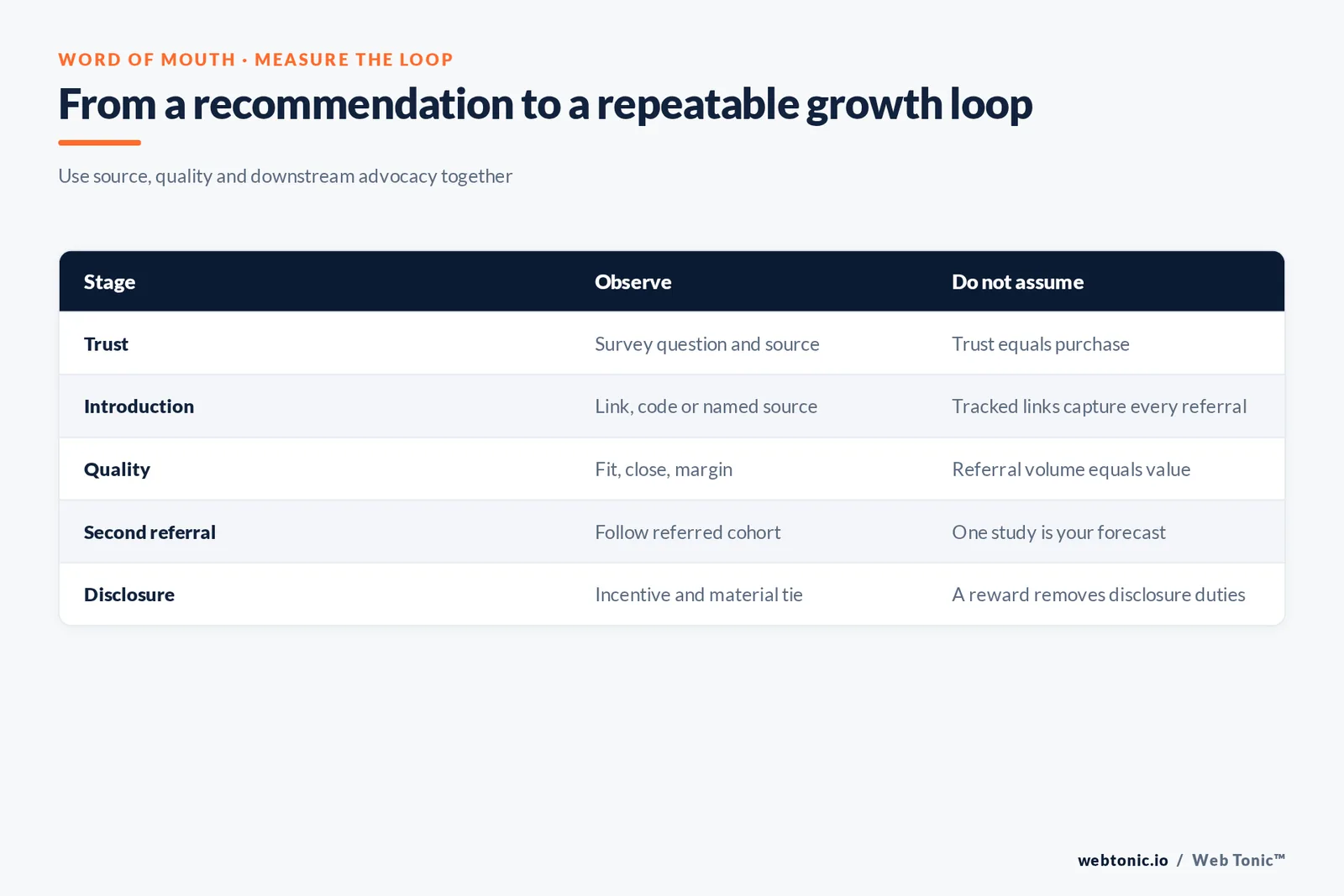
A minimum measurement plan has four layers. First, identify the source: referral link, offer code, self-reported introduction, review discovery or community mention. Second, describe lead quality: fit, sales acceptance, conversion and time to close. Third, measure economics using contribution margin and incentive cost, not gross revenue alone. Fourth, observe whether referred customers later refer others. Keep “unknown” as an allowed attribution category rather than forcing a source. Ask a short, neutral question at more than one touchpoint if the answer changes over time. Use consistent cohorts and windows; compare like with like by product, market and customer tenure. For hard-to-tag offline conversations, combine survey responses, CRM fields and qualitative research. This does not make the dataset perfect; it makes limitations explicit. A data intelligence approach can join operational records without claiming that correlation proves causal lift.
Research source: Qualtrics XM Institute, Global Consumer Study 2025
Read the relevant comparison below alongside the section above; definitions and populations matter.
| Risk | Practical safeguard |
|---|---|
| Reward distorts trust | Disclose material connections clearly |
| Selection bias | Compare cohorts with exposure and tenure in view |
| Pressure damages experience | Ask after customer value is realized; allow refusal |
| Vanity metrics | Pair volume with qualification, margin and retention |
| Source ambiguity | Keep “unknown” and record more than one influence |
A practical operating model for 2026
Start with the customer journey, not an incentive catalog. Identify the moments customers naturally share: a successful implementation, a resolved problem, a milestone or a result that is easy to explain. Confirm that customers are satisfied before asking. Offer a low-friction way to introduce someone and give the recipient a clear next step. Equip employees to recognize referrals without turning every service interaction into a pitch. For public sharing, provide accurate product facts, approved visual material and plain-language disclosure guidance; let people use their own words. Then review the program monthly: introduction rate, qualified lead rate, conversion, gross margin, customer complaints and advocacy by referred customers. Run a small test against a holdout or a matched cohort if the business can do so fairly. The right success criterion is incremental profitable growth, not an impressive percentage in a slide. Tie the program to a broader marketing strategy and review its fit as products and customer segments change.
Research source: YouGov, Most Recommended Brands 2025
Benchmark responsibly: no universal referral rate
Published findings vary because studies ask different questions, include different geographies and observe different behaviour. Nielsen’s global trust metric, Nielsen’s country-specific influence survey, Reddit’s community analysis and academic referral records are not directly comparable. A 2024 academic effect size should not be projected into a 2026 budget as if it were your company’s result. Use these sources to set hypotheses and build a local baseline. Segment by referred versus non-referred customers, but account for selection effects: loyal, engaged customers may be more likely both to refer and to buy again. Report the sample size and observation window. If the cohort is small, show counts and ranges rather than a false-precision percentage. A benchmark is useful when it points to a question your team can test; it is misleading when it substitutes for one.
Research source: Nielsen, Real Life vs. Digital Life
Related planning: growth marketing, data intelligence, performance creative, campaign strategy, and talk with Web Tonic.
Useful next steps: growth marketing, data intelligence, performance creative, and contact Web Tonic.
Frequently Asked Questions
Is word-of-mouth marketing still effective in 2026?
Yes, but its value is not captured by reach alone. 2024 field research found referred customers made 31–57% more referrals than comparable non-referred customers, while Nielsen’s global study found 88% trust recommendations from people they know. Track qualified referrals, conversion and downstream advocacy, not just mentions.
What is the difference between word of mouth and referral marketing?
Word of mouth includes unpaid conversations and sharing, both offline and online. Referral marketing is the measurable, deliberately facilitated subset: a customer recommends a business through a trackable link, code or named introduction.
How should a business measure word-of-mouth marketing?
Use several signals: referral source at intake, tagged referral links, review volume and quality, branded-search movement, and referred-customer retention or value. Keep attribution windows and definitions consistent; no single signal represents all conversation.
Should brands pay people to recommend them?
Incentives can prompt participation but do not guarantee a credible recommendation. Disclose material relationships, follow the FTC endorsement guidance, and reward actions without scripting a customer’s opinion.
What is a practical first step for a referral program?
Identify moments after a successful customer outcome, ask for an introduction without pressure, and make sharing easy. Test whether referred customers themselves become advocates, as the 2024 referral-contagion research suggests can happen.
Sources
Nielsen, 2021 Trust in Advertising study
Nielsen, Trustworthy channels and buyer journeys
Nielsen, Real Life vs. Digital Life
Harvard Business Review, referral contagion research
University of Texas at Dallas authors, Referral Contagion paper
Reddit, Recommendation Journeys for Products, 2024
5WPR, Consumer Culture Report 2024
Federal Trade Commission, Endorsement Guides FAQ
Qualtrics XM Institute, Global Consumer Study 2025
YouGov, Most Recommended Brands 2025