



Table of contents

Guest posting remains one of the most effective ways to earn high-quality backlinks, but only if you choose the right content format. 65% of marketers rank guest blogging as the most effective link building strategy, yet most pitches fail because the content format does not match the publisher's audience or editorial standards.
Key Takeaways
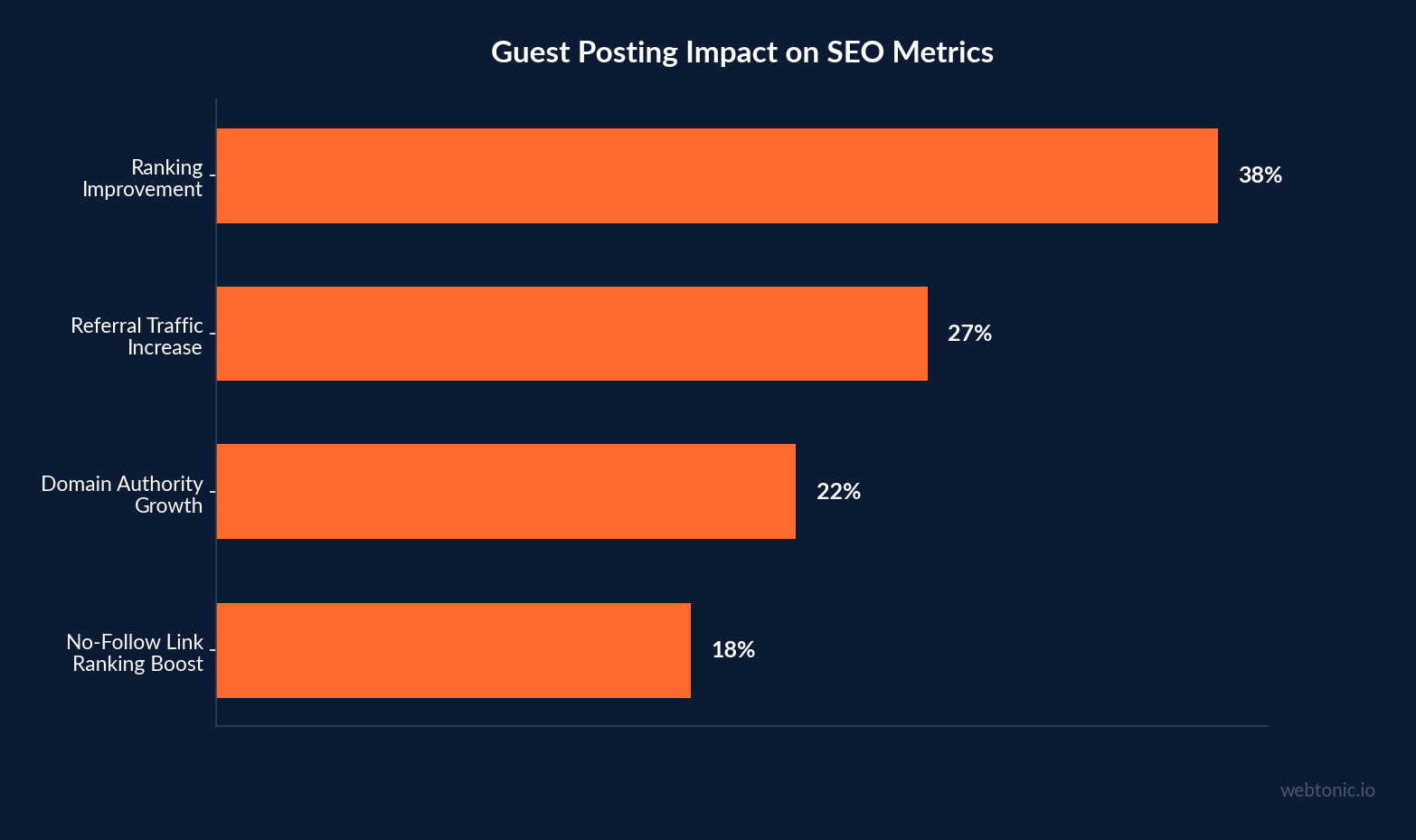
- Guest posts generate 27% more referral traffic than other types of backlinks, according to Ahrefs data.
- Websites that publish guest posts see a 22% increase in domain authority within six months (Moz).
- Only 4.6% of guest post marketplace opportunities qualify as high-quality (DR 71+ with 50K+ monthly traffic), per BuzzStream's analysis of 26,000+ sites.
- Data-driven guest posts earn 2–3× more backlinks than opinion-based articles because publishers and readers cite original statistics.
- Backlinks from guest posts improve search rankings by 38% on average (Moz), making content quality the decisive variable in link building ROI.
- No-follow guest post links still boost organic rankings by 18% on average, showing that even restricted links carry SEO value through brand signals and referral traffic.
Why the Content Format of Your Guest Post Matters
Not all guest posts are created equal. A 500-word generic opinion piece on a low-traffic blog does almost nothing for your link building efforts. The format you choose determines whether the host site's audience engages with your content, whether editors accept your pitch, and whether other sites link back to your guest post — creating a backlink multiplier effect.
The modern guest posting landscape has shifted dramatically. Google's spam policies explicitly target links created primarily to manipulate rankings, including links with optimized anchor text in guest posts. This means volume-based guest blogging — pitching dozens of low-quality articles with keyword-rich anchor links — is not just ineffective, it is risky. The guest posts that still work are genuine expert contributions to niche-relevant publications with real audiences.
The five content types below represent the formats that consistently earn editorial links, drive referral traffic, and build lasting authority for your brand and your website.
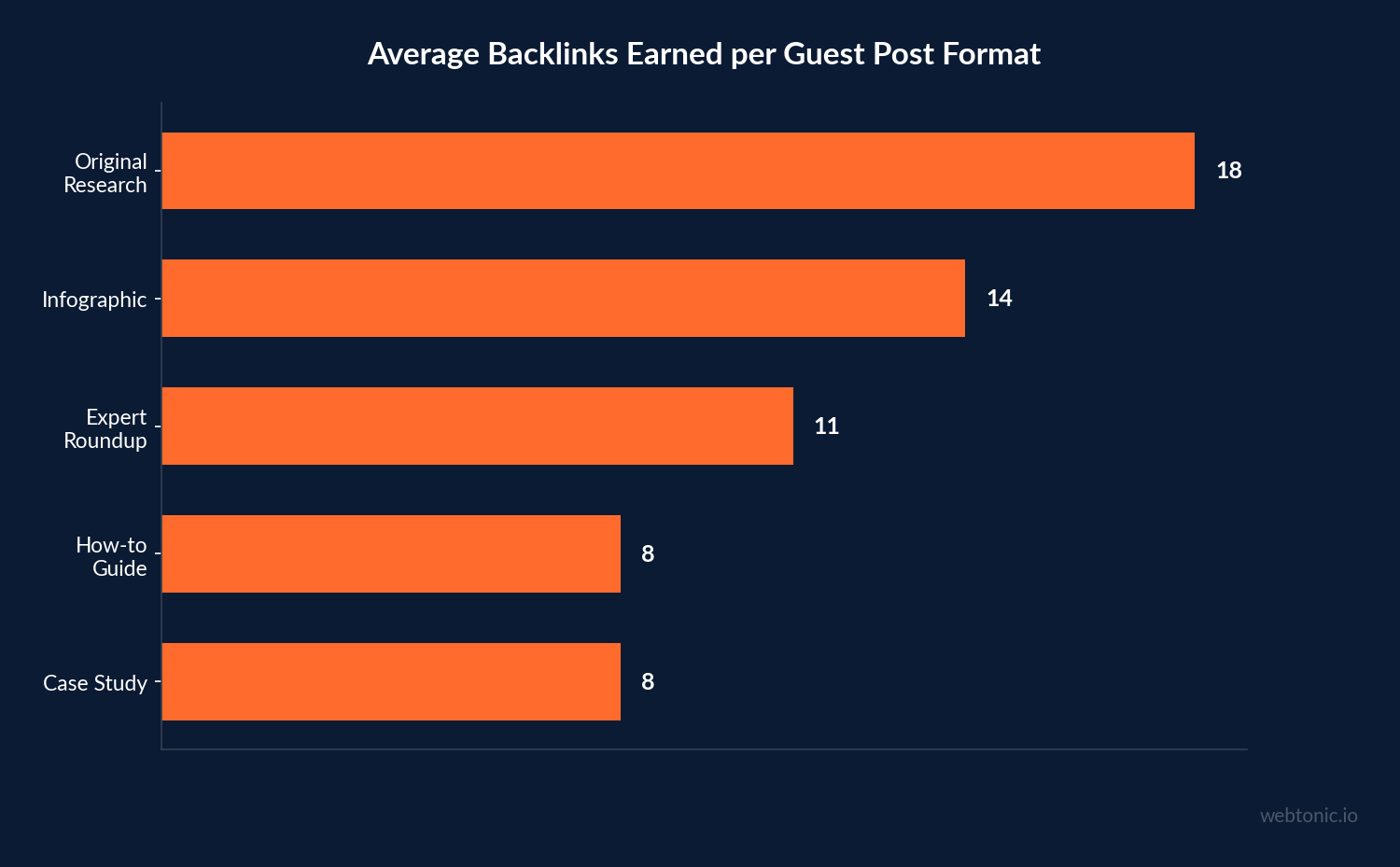
1. Data-Driven Original Research Posts

Original research is the single most powerful guest post format for link building. When you publish proprietary data — survey results, industry benchmarks, analysis of your own customer base — other sites cite your findings as a primary source, creating organic backlinks long after the guest post goes live.
Data-driven guest posts earn 2–3× more backlinks than opinion-based articles because they provide something no one else can replicate. A SaaS company that surveys 1,000 marketers on content budgets creates a citable asset. A marketing agency that analyzes 10,000 ad campaigns to reveal average CTR by industry produces data journalists and bloggers will reference for years.
How to Execute
- Identify a question your industry debates but lacks hard data on.
- Run a survey (Typeform, SurveyMonkey) targeting 200+ respondents for statistical credibility.
- Package the findings with branded charts and tables — these become embeddable assets the host site is happy to feature.
- Pitch the piece to publications in your niche with a subject line that leads with the headline stat: "New data: 73% of B2B buyers now prefer self-service demos."
2. Expert Roundup and Interview Posts
Expert roundups aggregate insights from multiple professionals on a single topic. They work exceptionally well for guest posting because they provide built-in promotion: every expert you feature will share the post with their own audience, amplifying reach and earning secondary links.
Roundup-style guest posts receive 3–5× more social shares than single-author articles because each contributor promotes the piece to their own followers. The link building benefit is twofold: you earn the editorial link from the host publication, and you build relationships with the experts you feature — opening the door for future guest posting opportunities on their platforms.
| Guest Post Format | Avg. Backlinks Earned | Referral Traffic Potential | Best For |
|---|---|---|---|
| Original Research | 12–25 per post | High (long-tail citations) | SaaS, agencies, data-rich brands |
| Expert Roundup | 8–15 per post | High (social amplification) | Thought leadership, B2B networking |
| Case Study | 5–12 per post | Medium (niche but engaged readers) | Service businesses, consultants |
| How-to Guide | 6–10 per post | High (SEO-driven organic traffic) | Any niche with actionable processes |
| Infographic Post | 8–20 per post | Medium-High (embed links) | Visual data, statistics, comparisons |
3. In-Depth Case Study Posts

Case studies work as guest posts because they prove real-world results. Instead of theorizing about what should work, you show what actually happened — with specific numbers, timelines, and outcomes. Publishers love case studies because they provide readers with actionable proof rather than abstract advice.
80% of B2B buyers say case studies are the most influential content type in their purchase decision (Demand Gen Report). When you publish a case study as a guest post on a relevant industry site, you earn a quality backlink and simultaneously build trust with the host site's audience.
Case Study Structure That Earns Links
- The challenge: Define the client's problem with specific metrics (e.g., "Cost per lead had risen 47% over six months").
- The approach: Explain your methodology in enough detail that experts find it credible but not so much that it reads as a sales pitch.
- The results: Lead with the strongest metric. "We reduced CPA by 62% in 90 days" is more compelling than "We improved campaign performance."
- The takeaway: End with a principle the reader can apply to their own work — this is what makes a case study shareable.
4. Comprehensive How-to Guides
How-to guides are the workhorse of guest posting. They rank well in search engines, provide lasting value, and demonstrate your expertise in a practical way. The key to earning strong backlinks with a how-to guide is depth: generic tutorials get ignored, but a 2,000+ word guide with original frameworks, screenshots, and step-by-step instructions becomes a resource other sites link to.
How-to guest posts work particularly well for SEO-driven link building because they target informational keywords that the host site may not have covered. When you pitch a comprehensive how-to on a topic the publication's audience searches for, you are offering free content that earns them organic traffic — making editors far more likely to accept your pitch and include your backlink.
What Makes a How-to Guest Post Link-Worthy
- Original frameworks: Create a named process or acronym that readers associate with your brand.
- Visual aids: Include screenshots, diagrams, or flowcharts that illustrate each step. Posts with images receive 94% more views than text-only articles.
- Templates or tools: Offer a downloadable template, spreadsheet, or checklist that supplements the guide — this gives you a natural reason to link back to your site.
5. Infographic and Visual Data Posts
Infographic guest posts combine visual storytelling with data to create highly shareable, highly linkable content. When you embed a custom infographic within a guest post, other bloggers and journalists embed or reference the visual — each instance generating a backlink to the original source.
Infographics are shared 3× more frequently than any other content type on social media (HubSpot). For link building purposes, the embed-and-credit model is especially powerful: you provide an embed code alongside the guest post, making it frictionless for other sites to feature your infographic with a backlink.
| Infographic Type | Link Building Strength | Production Effort | Best Publisher Fit |
|---|---|---|---|
| Statistical Overview | Very High | Medium (data collection + design) | Industry blogs, news sites |
| Process/Timeline | High | Low-Medium | How-to publications, SaaS blogs |
| Comparison Chart | High | Low | Review sites, buyer's guides |
| Interactive/Animated | Very High | High (development + design) | Major publications, digital magazines |
How to Pitch Guest Posts That Get Accepted
Even the best content format fails without a strong pitch. Here is a framework that consistently earns acceptances from high-authority publishers.
- Research the publication first: Read their last 10 guest posts. Note the tone, length, formatting, and topics they cover. Personalized pitches get 32% higher response rates than templates.
- Lead with value, not your link: Frame your pitch around what the post will do for the publisher's audience — traffic, engagement, a fresh angle — not the backlink you want.
- Include a headline and outline: Give editors a clear preview. A 3-sentence email with a working headline and 5-bullet outline outperforms a wall of text.
- Show credentials: Link to 2–3 published pieces on comparable sites. Editors need proof you can deliver quality content on deadline.
- Follow up once: Send one follow-up after 5–7 days. 44% of link building outreach gets no reply until the follow-up, but more than one follow-up crosses into spam territory.
Measuring Guest Post Link Building ROI
Not all guest post links carry equal weight. Track these metrics to ensure your guest posting strategy is moving the needle on your SEO performance.
- Domain Rating (DR) / Domain Authority (DA) of the host site: Links from DR 50+ sites carry significantly more SEO value than links from low-authority blogs.
- Referral traffic volume: A quality guest post should drive 50–500 referral visits per month from the host site, depending on its traffic.
- Number of secondary backlinks: The best guest posts earn citations from other sites — track these with Ahrefs or Moz to measure the multiplier effect.
- Organic keyword movement: Monitor your target pages' keyword rankings for 30–90 days after each guest post goes live. Meaningful rank improvements validate the link's impact.
- Cost per link: Factor in writing time, outreach effort, and any publication fees. High-quality guest post links typically cost $200–$800 per placement when you account for all inputs.
Guest Posting Best Practices for Sustainable Link Building
Effective guest posting goes beyond writing content for other websites. A sustainable guest blogging strategy requires careful site vetting, quality content creation, and natural link placement. Guest posting should support your broader link building strategy by earning backlinks from sites that have real organic traffic and genuine editorial standards.
When selecting guest posting sites, prioritize publications in your niche with a Domain Rating of 40 or higher and demonstrable organic traffic. Quality guest posting on high-authority sites builds more link equity than dozens of placements on low-traffic blogs. Your guest post content should provide genuine value to the host site's audience — not just serve as a vehicle for your backlink.
The anchor text in your guest post links matters significantly for SEO. Use natural, varied anchor text rather than keyword-stuffed exact-match anchors. Search engines evaluate anchor text diversity across your backlink profile, and over-optimized anchors from guest posts can trigger spam signals. Mix branded anchors, URL anchors, and naturally descriptive phrases for the healthiest link building results.
Finding High-Quality Guest Posting Opportunities
The quality of your guest posting sites directly determines the SEO value of your link building efforts. Free guest posting sites that accept any content from any contributor rarely provide meaningful backlink value — and they may even harm your website in search engines.
Instead, focus on blogger outreach to publications in your niche that maintain editorial standards. Use search operators to find guest posting opportunities: "write for us" + [your niche] and "guest post" + [your industry]. Cross-reference these sites against backlink analysis tools to verify their organic traffic and authority before investing time in a pitch.
Referral traffic from quality guest posts often outperforms the raw SEO value of the backlinks themselves. A single guest post on a high-traffic industry publication can drive hundreds of qualified visitors to your website per month — visitors who arrive pre-qualified by the host site's editorial credibility. Monitor your referral traffic from each guest posting placement to identify which publications deliver the best results for your link building strategy.
Related reading
- Guest Post Link Building Service for Online Education: How to Earn Authority Backlinks in the EdTech Niche
- Health & Wellness Link Building Statistics & Benchmarks (2026)
- HVAC Link Building Statistics: ROI, Domain Authority & Case Studies (2026)
- Link Building Services services at Web Tonic
FAQ
Are guest post backlinks still effective for SEO?
Yes, but quality matters far more than quantity. Backlinks from guest posts on high-authority, niche-relevant sites improve rankings by 38% on average. Low-quality guest posts on spammy sites can trigger Google penalties. Focus on publishing genuine expert content on sites with real editorial standards and organic traffic.
How many guest posts should I publish per month for link building?
Quality outweighs volume. 2–4 high-quality guest posts per month on sites with DR 40+ and real audiences will build more sustainable link equity than 20 low-quality placements. Consistency matters more than bursts — search engines look for natural link velocity.
What should I include in my guest post author bio?
Keep it concise — 2–3 sentences. Include your name, title, company, and one relevant credential. Add a link to your site's most relevant page (not just the homepage). Author bios with specific CTAs generate 22% more click-throughs than generic "visit my website" lines.
Should I pay for guest post placements?
Google's guidelines classify paid guest posts as link schemes if the links are not marked with rel="sponsored". If you pay for placement, ensure the link is properly disclosed. Organic (unpaid) guest posts on editorially rigorous sites carry stronger SEO weight because they signal genuine authority rather than purchased visibility.
How do I find high-quality sites that accept guest posts?
Use search operators like "write for us" + [your niche], analyze competitor backlink profiles in Ahrefs to find their guest post placements, join industry Slack channels and Facebook groups where editors seek contributors, and monitor your network for collaboration opportunities. The best guest post opportunities often come from relationship-based outreach, not cold pitches.
Sources
T-Ranks — Types of Guest Posting and Effectiveness
Backlynk — Guest Posting in 2026: Safe Strategy + Google Link Rules
T-Ranks — Different Types of Guest Posting
Ruler Analytics — Conversion Rate Benchmarks 2026
Usermaven — Conversion Funnel Optimization
Search Engine Land — 5 PPC Areas to Prioritize


