Table of contents
A keyword in SEO is the word or phrase a person enters into a search engine, and the phrase a page is deliberately built to answer. Keywords are how search engines connect a query to relevant content, and how you decide what to publish next.
Key Takeaways
- 94.74% of keywords get 10 or fewer searches per month and only 0.0008% exceed 100,000 — the addressable demand sits in thousands of small long tail keywords, not a handful of head terms.
- A page ranking in the top 10 typically also ranks for roughly 1,000 other keywords, so one URL should target one primary keyword and everything that shares its search intent.
- Google Keyword Planner overestimates search volume 54.28% of the time, which makes cross-checking volume with a second source part of the basic workflow.
- 46.08% of the clicks reported in Google Search Console come from queries Google hides, so your own data holds keyword ideas no tool will show you.
- 15% of daily Google searches are phrases never seen before — keyword strategy has to expect terms that no tool can report yet.
The definition, precisely
In SEO, a keyword (also called a search term, query or key phrase) is the string of words a user types or speaks into a search engine such as Google to find something. On the site owner's side, a keyword is the specific phrase and intent a page is optimized to satisfy. It is rarely a single word: most commercially useful keywords are three to six words long.
Two related terms cause most of the confusion. A query is what the user actually typed — the raw phrasing, typos included. A keyword is the normalised phrase marketers target and measure. Google's documentation on how Search works describes the matching process as interpreting meaning rather than string matching, which is why modern keyword work is about topics and intent, not repetition. Its SEO starter guide puts it plainly: write about what people are looking for, using the words they use.
Why keywords still matter
Keywords do four jobs, and only the first one is about ranking.
Job 1 — relevance. They tell search engines which query a page is the best answer to. Job 2 — demand sizing. Search volume is the cheapest available estimate of how many people want what you sell, before you spend anything building it. Job 3 — prioritisation. Difficulty and cost-per-click data reveal which topics are worth a page now versus next year. Job 4 — measurement. A keyword mapped to a URL is what makes organic traffic reportable instead of anecdotal.
The payoff concentrates sharply at the top. The first organic result captures about 39.8% of clicks, the top three take roughly 68.7%, and 96.6% of clicks land on page one. Meanwhile 96.55% of all pages get zero traffic from Google — usually because they were written without a keyword anyone searches, or because they target one they cannot win.
Types of keywords
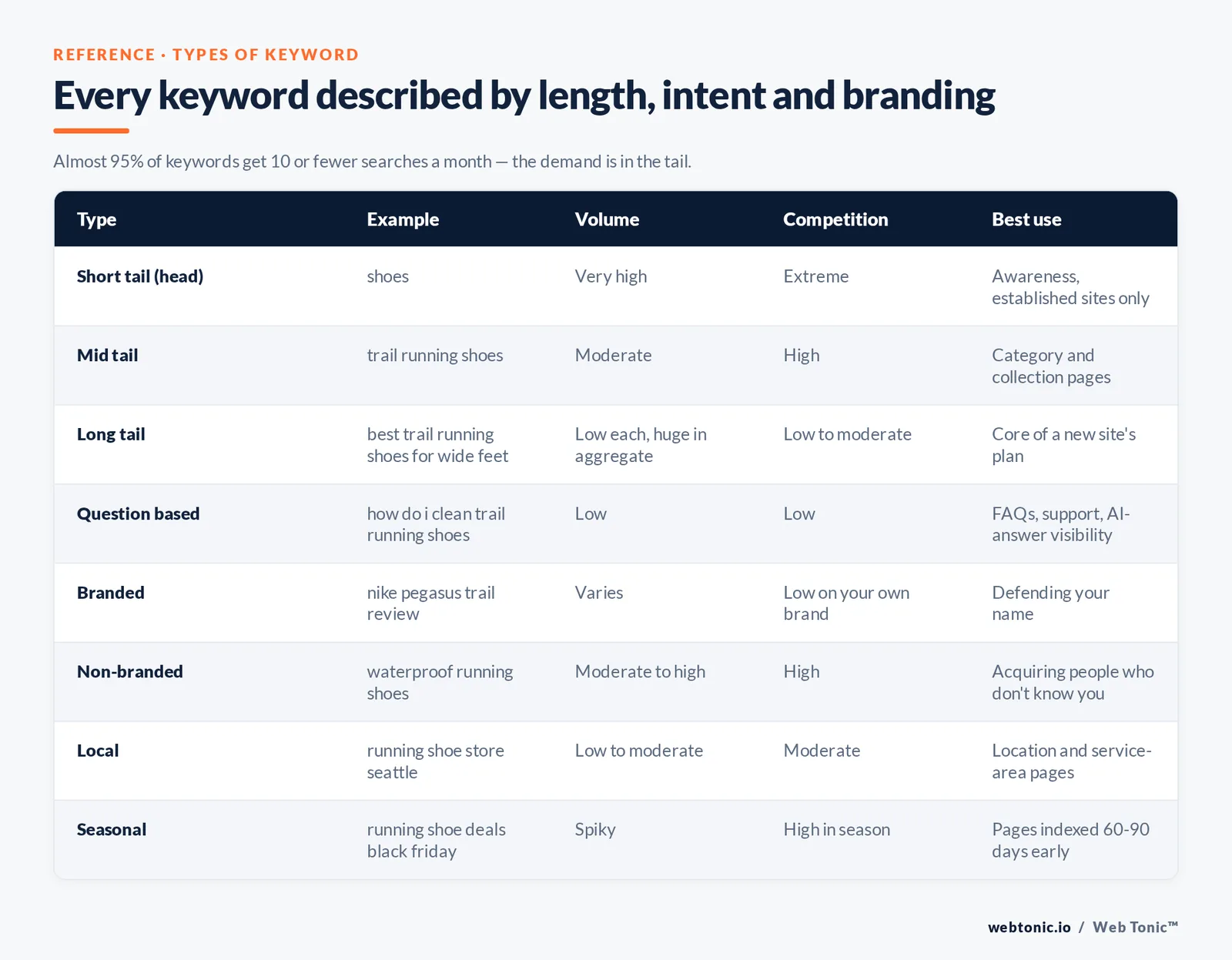
Classification is what turns a raw list into a plan. Every keyword can be described by length, by intent and by branding.
| Type | Example | Search volume | Competition | Best use |
|---|---|---|---|---|
| Short tail (head) | shoes | Very high | Extreme | Brand awareness for established sites only |
| Mid tail | trail running shoes | Moderate | High | Category and collection pages |
| Long tail | best trail running shoes for wide feet | Low each, huge in aggregate | Low to moderate | The core of a new site's content plan |
| Question based | how do i clean trail running shoes | Low | Low | FAQ blocks, support content, AI-answer visibility |
| Branded | nike pegasus trail review | Varies | Low on your own brand | Defending your name and comparison pages |
| Non-branded | waterproof running shoes | Moderate to high | High | Acquiring people who don't know you yet |
| Local | running shoe store seattle | Low to moderate | Moderate | Location and service-area pages |
| Seasonal | running shoe deals black friday | Spiky | High in season | Pages built and indexed 60–90 days early |
The strategic point behind the table: because almost 95% of keywords are tiny, a plan built only on high search volume terms leaves most of the market untouched. Ahrefs' explainer on long tail keywords shows how the aggregate works, and we go deeper on the trade-offs in our guide to long tail keyword strategy.
Search intent decides the page you build
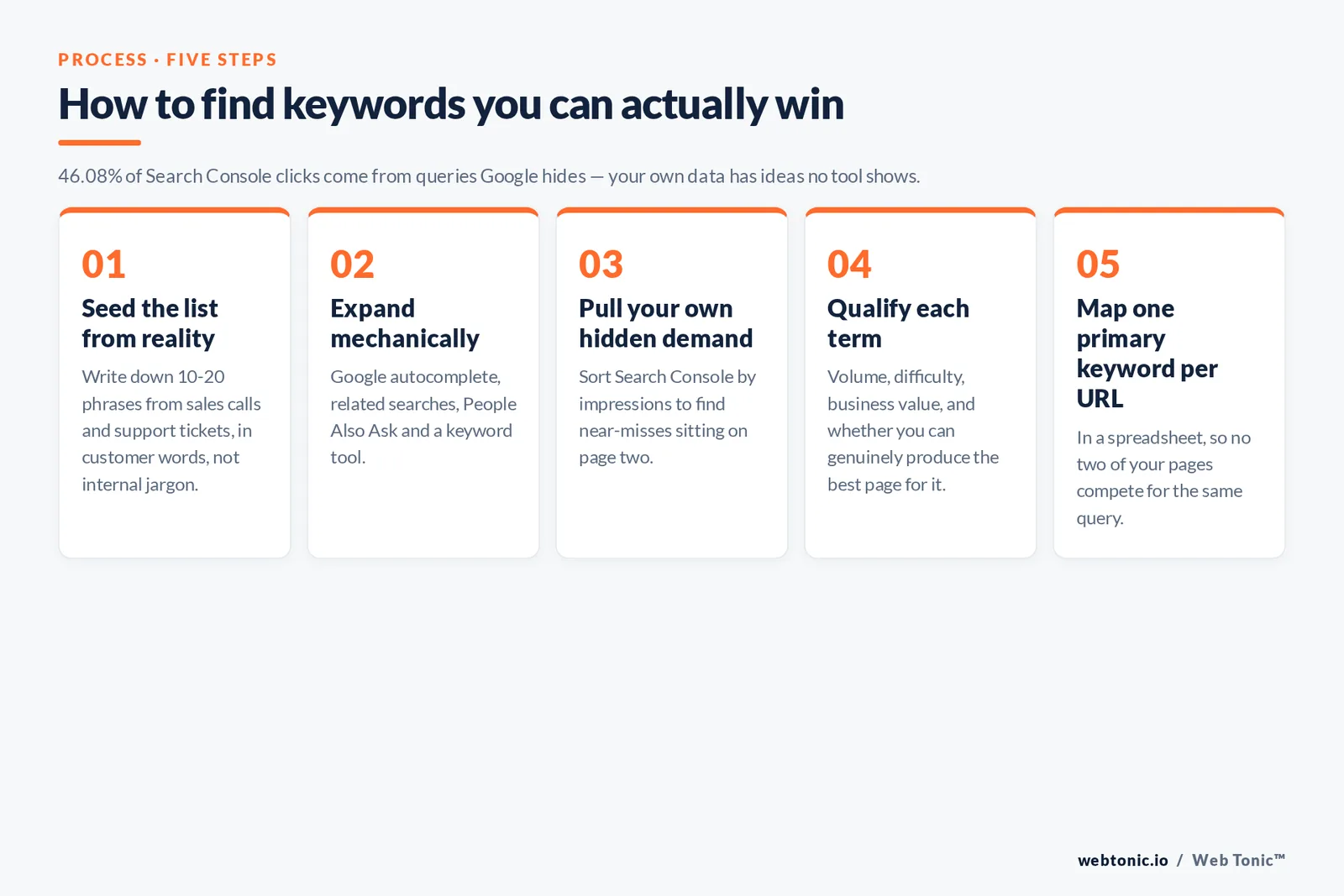
Two keywords with identical volume can require completely different pages. Search intent is the reason behind the query, and mismatching it is the most common cause of a well-optimized page that never ranks.
| Intent | Signal words | What the searcher wants | Page format that wins |
|---|---|---|---|
| Informational | what, how, why, guide, ideas | An explanation they can act on | Structured article with tables and examples |
| Navigational | brand names, login, pricing page | A specific destination | The canonical brand or product page |
| Commercial | best, top, review, vs, alternatives | Help choosing between options | Comparison or evaluation page with criteria |
| Transactional | buy, price, quote, near me, book | To act now | Product, service or booking page |
The reliable way to verify intent is to search the keyword and read the first page of results: Google has already tested which format satisfies that query. If eight of the top ten are listicles, a product page will not break in. Semrush's guide to search intent covers the classification rules, and Google's guidance on creating helpful content explains the satisfaction standard the winning format has to meet.
How to find keywords in five steps
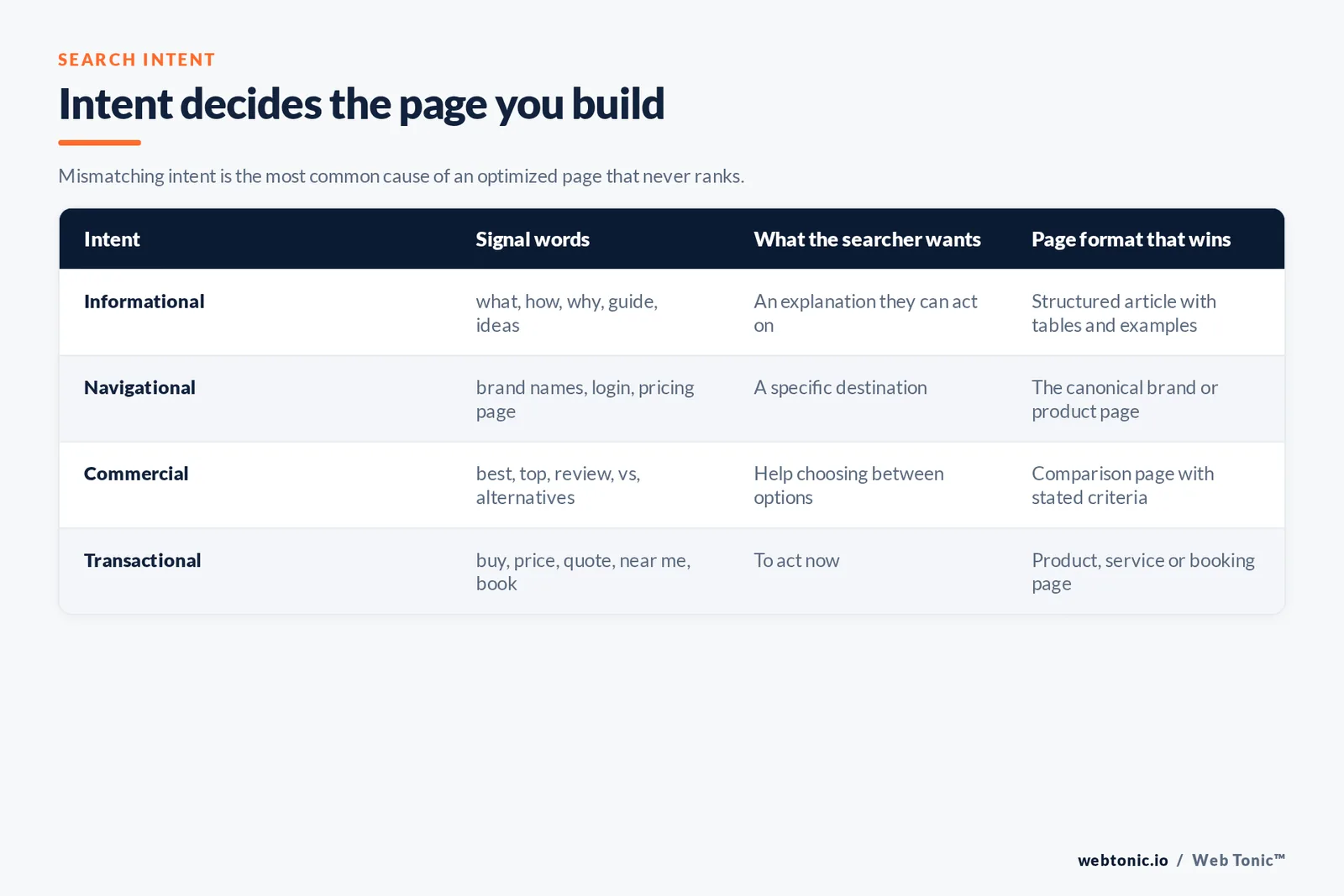
Step 1 — seed the list from reality. Write down 10 to 20 phrases from sales calls, support tickets and the words customers use, not internal jargon. Step 2 — expand mechanically using Google autocomplete, related searches, People Also Ask and a keyword tool. Step 3 — pull your own hidden demand: Search Console's query report shows terms you already appear for, and since 46.08% of its clicks come from withheld queries, sort by impressions to find near-misses on page two. Step 4 — qualify each term against volume, difficulty, business value and whether you can genuinely produce the best page for it. Step 5 — map one primary keyword per URL in a spreadsheet, so no two pages of yours compete for the same query.
A practical filter for step 4: if your site is new, cap yourself at keywords where at least two of the current top ten results are sites of comparable authority. If none are, the term is aspirational and belongs in next year's plan. Ahrefs' keyword research walkthrough is a solid free reference for the mechanics, and our own primer on how to choose SEO keywords covers the qualification scoring in more detail.
Keyword research tools compared
| Tool | Free tier | Strength | Limitation |
|---|---|---|---|
| Google Keyword Planner | Free with an Ads account | Volume ranges and CPC straight from Google | Groups similar terms; overestimates volume 54.28% of the time |
| Google Search Console | Free | Your actual queries, clicks and average positions | Only terms you already rank for; 16 months of history |
| Google Trends | Free | Relative interest over time, seasonality, breakout terms | No absolute search volume |
| Ahrefs / Semrush | Limited free lookups | Difficulty scores, SERP history, competitor keyword sets | Paid beyond a few queries per day |
| Autocomplete and People Also Ask | Free | Real phrasing and question based keywords | No volume; needs manual collection |
| Reddit and community threads | Free | Unfiltered problem language for new topics | Anecdotal; must be validated in a tool |
Use at least two sources for any decision that costs real money. Volume figures are estimates, and Search Console is the only one reporting what actually happened on your own site.
Where to put keywords on the page
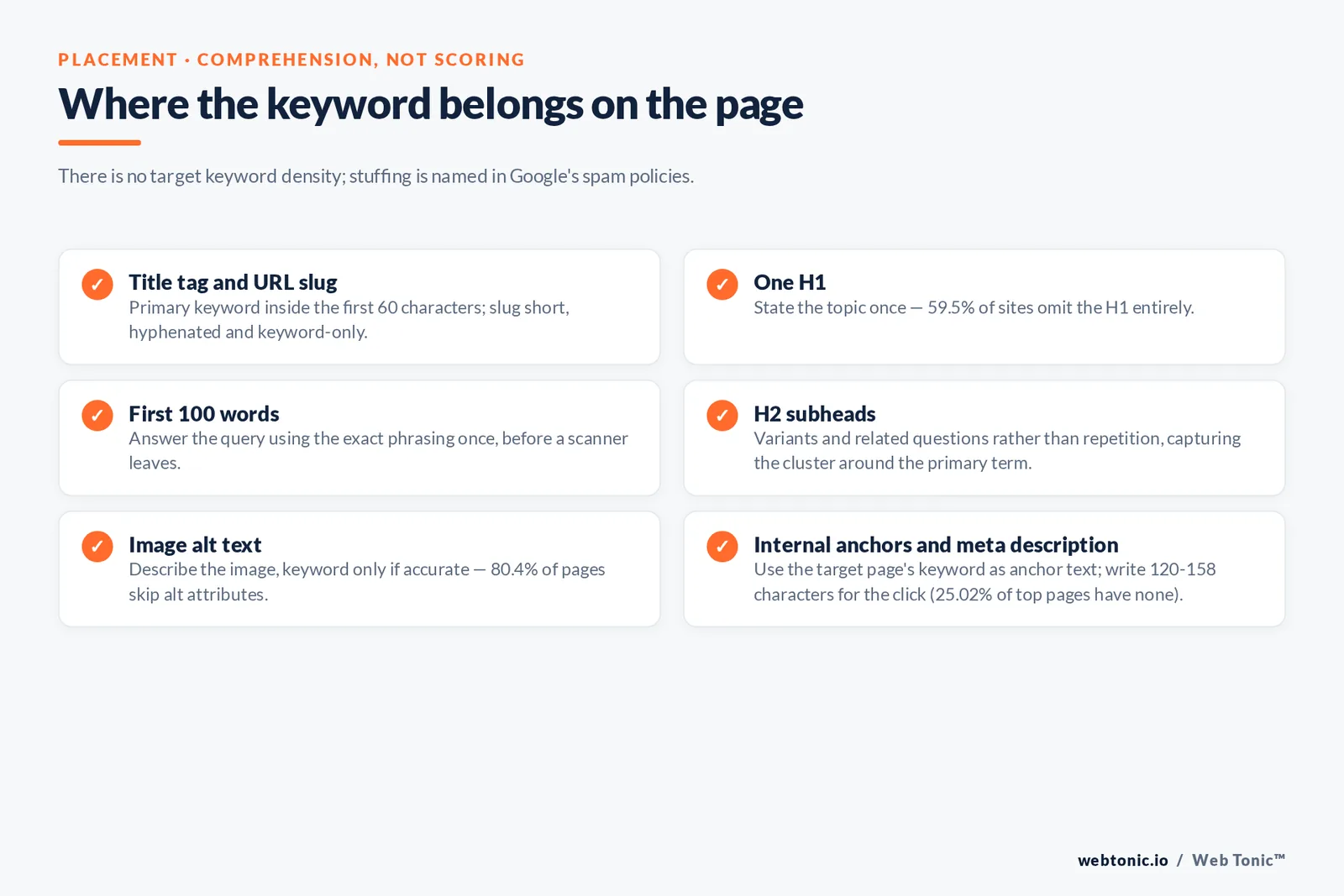
Placement is a comprehension aid, not a scoring lever. Use the keyword where a reader would expect it and nowhere else.
| Location | Rule | Why it matters |
|---|---|---|
| Title tag | Primary keyword within the first 60 characters | Strongest single relevance signal a page controls |
| URL slug | Short, hyphenated, keyword-only | Readable in results and in links people share |
| H1 | One H1 stating the topic — 59.5% of sites omit it | Confirms the page subject to readers and crawlers |
| First 100 words | Answer the query using the exact phrasing once | Sets the topic before a scanner leaves |
| H2 subheads | Variants and related questions, not repetition | Captures the cluster around the primary keyword |
| Image alt text | Describe the image; keyword only if accurate | 80.4% of pages skip alt attributes entirely |
| Internal link anchors | Use the target page's keyword as anchor text | Tells Google which of your URLs owns the term |
| Meta description | 120–158 characters written for the click | 25.02% of top pages have none, so it is easy ground |
There is no target keyword density. Keyword stuffing is explicitly listed in Google's spam policies, and because roughly 79% of visitors scan rather than read — per Nielsen Norman Group's reading research — repetition costs you the reader before it costs you the ranking. Write the sentence naturally, then move on.
Keyword strategy by business type
| Business type | Keyword focus | Page that carries it | Signal of success |
|---|---|---|---|
| Local service business | Service plus city, plus "near me" variants | One page per service and location | Calls and direction requests by city |
| Ecommerce | Category, attribute and comparison modifiers | Collection and product pages | Organic revenue per category |
| B2B or SaaS | Problem statements, alternatives, integrations | Use-case and comparison pages | Demo requests from organic search |
| Publisher | Question based clusters around a few pillars | Topic hubs and supporting articles | Top-10 keyword count per cluster |
| Marketplace | Long tail templated intent at scale | Programmatic category pages | Share of templated pages earning clicks |
| Personal brand or consultant | Branded terms plus 10–20 niche long tail keywords | Service pages and a small blog | Inbound enquiries naming the topic |
Mistakes that waste a keyword plan
Mistake 1 — chasing volume you cannot win. Head terms on a new domain absorb months and return nothing. Mistake 2 — cannibalising yourself by pointing three pages at the same query; consolidate into the strongest URL instead. Mistake 3 — ignoring intent and answering a "best" query with a sales page. Mistake 4 — writing for the tool, hitting a term count while saying nothing specific. Mistake 5 — treating the list as permanent, when 15% of daily searches are brand new phrasings. Mistake 6 — never revisiting page-two keywords, which are the cheapest ranking gains available on any established site.
One more shift worth planning for: AI Overviews reduce click-through on affected queries — one measurement found 58% lower CTR for the top organic result when an Overview appears — and roughly 61.5% of desktop searches now end without a click. That pushes value toward keywords where the answer requires a decision, a price or a person. If you would rather have this mapped and executed for you, our growth marketing team builds keyword-to-URL maps as the first deliverable of any SEO engagement, and data intelligence handles the reporting.
FAQ
What exactly is a keyword in SEO?
It is the phrase a person enters into a search engine, and on your side the phrase a page is built to answer. Most useful keywords are three to six words long, and each URL should have exactly one primary keyword plus the variants sharing its intent.
What is the difference between short tail and long tail keywords?
Short tail keywords are one or two words with very high search volume and extreme competition. Long tail keywords are longer, more specific, and individually low volume — but with 94.74% of all keywords drawing 10 or fewer searches a month, they represent most of the total demand and are far easier to rank for.
How many keywords should one page target?
One primary keyword and the close variants and questions that share its search intent. Pages that rank in the top 10 typically also rank for around 1,000 related terms, which happens by covering the topic thoroughly rather than by inserting extra head terms.
How do I find keywords for free?
Combine Google Search Console (queries you already appear for), Keyword Planner (volume ranges), Google Trends (seasonality) and autocomplete plus People Also Ask (real phrasing). Cross-check volumes, since Keyword Planner overestimates them 54.28% of the time.
Does keyword density still matter?
No. There is no target percentage, and keyword stuffing is named in Google's spam policies. Use the phrase once in the title, once early in the body and wherever it reads naturally, then focus on covering the question completely.
Sources: Google Search Central (how Search works, SEO starter guide, creating helpful content, spam policies); Google Search Console; Google Keyword Planner; Google Trends; Ahrefs SEO statistics, keyword research and long tail keyword research; Semrush search intent guide; First Page Sage Google click-through rates by ranking position, 2026; Nielsen Norman Group reading behaviour research; Statcounter Global Stats, July 2026.