Table of contents

Twenty scattered blog posts on the same broad subject compete against each other, confuse Google about which page actually deserves to rank, and rarely add up to more than the sum of their parts. Hub and spoke SEO fixes that by organizing content the way a bicycle wheel is built: one central hub page, and a set of spoke pages radiating out from it, all linked together in both directions.
This guide breaks down what the hub and spoke model actually is, why it outperforms scattered content, and exactly how to structure, sequence, and interlink a cluster that compounds instead of competing with itself.
Key takeaways
- Hub and spoke content drives roughly 30% more organic traffic than standalone posts and holds rankings 2.5x longer.
- HubSpot's own internal case study saw organic traffic jump from 500 to nearly 190,000 monthly visitors, a 37,900% increase, after restructuring content into topic clusters.
- Well-structured clusters earn roughly 3.2x more AI citations than single, unconnected pages, making the model just as relevant for AEO (Answer Engine Optimization) as for classic Google rankings.
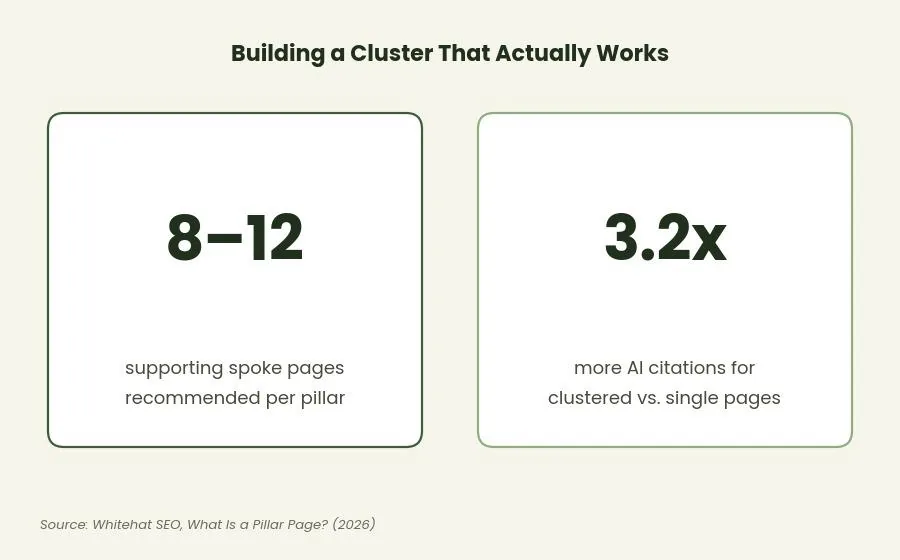
- 8-12 supporting spoke pages per pillar is the commonly recommended range, though some programs scale to 20-30 for very broad head topics.
- Internal links passing through the hub-and-spoke structure are a confirmed Google ranking signal, per Google's own Search Central documentation, not just a navigational nicety.
What the hub and spoke model actually is
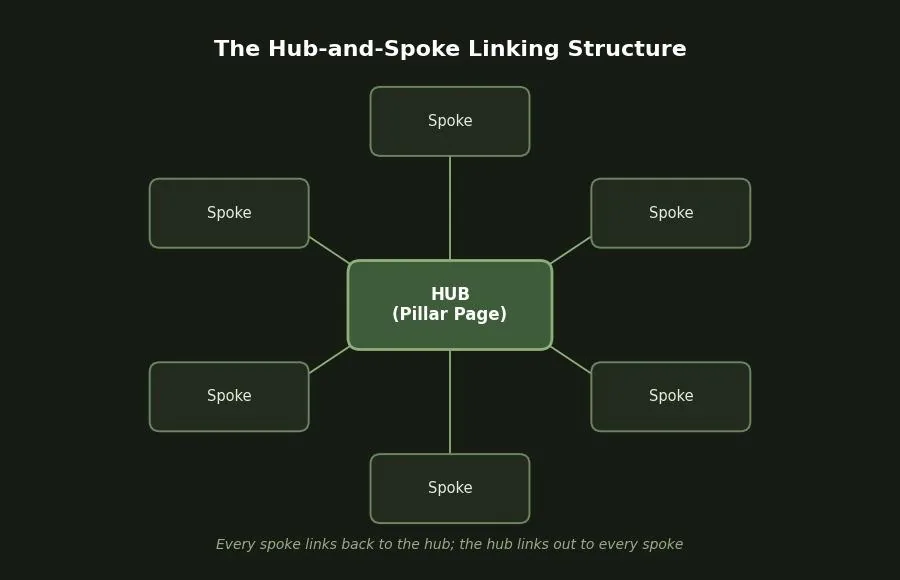
The hub is a comprehensive pillar page covering a broad topic at a high level. It doesn't try to answer every question in exhaustive detail. Instead, it introduces the subject, covers the key sub-topics, and links out to a dedicated spoke page for each one. Every spoke, in turn, links back to the hub. HubSpot's own guide to topic clusters confirms this is the same structure marketers often call "hub and spoke": a pillar page plus supporting content, connected by deliberate internal links in both directions.
Picture a wheel: the hub is the center, and each spoke radiates outward, still connected to the hub at its base. Rankmax's guide to pillar content uses the same image, and it's the clearest way to think about why the structure works: authority flows both ways, from hub to spoke and back again.
Why the structure outperforms scattered content

Google's algorithms evolved years ago from matching individual keywords to understanding the semantic context and search intent behind a query. A site with one long article on a subject signals expertise on one narrow slice of it. A site with a hub and a dozen interlinked spokes signals comprehensive coverage of the entire topic, and Google rewards that coverage with better rankings across the whole cluster, not just one page. This is also the foundation of AEO: the same interconnected structure that earns classic rankings is what AI systems read to judge whether a site demonstrates real topical expertise, not just a single relevant mention.
The clearest evidence for this comes from HubSpot itself. After restructuring its own blog into topic clusters, one of its case studies documented organic traffic growing from 500 to nearly 190,000 monthly visitors, a 37,900% increase, according to HubSpot's own account of the strategy. That's an extreme case, but the underlying pattern shows up consistently at a smaller scale too: clustered content drives roughly 30% more organic traffic and holds rankings 2.5x longer than standalone posts. Whitehat's 2026 pillar page guide synthesizes multiple independent studies on the model and lands on the same range.
The technical reason it works: internal link equity
TrustBasedSEO's guide to the hub-and-spoke model points to the underlying mechanism: internal links pass PageRank, and Google's own Search Central documentation confirms PageRank remains part of its core ranking systems today, not just an assumption from the SEO industry. When one spoke earns an external backlink from a news site or industry directory, some of that authority flows back to the hub through the internal link. The hub gets stronger, and because the hub links out to every other spoke, the whole cluster rises together, not just the page that happened to earn the backlink.
Conductor's topic cluster guide frames the hub's role slightly differently but consistently: a hub page serves primarily as a navigational resource for users while doubling as the concentration point for that internal-link authority in Google's eyes.
Building your first cluster
A structured build sequence prevents the most common failure mode: publishing a hub with nowhere to link and no spokes to strengthen it.
- Pick a head topic broad enough to support multiple spoke pages, but specific enough that you have genuine expertise and a real business claim to it.
- Research sub-topics using People Also Ask boxes, autocomplete suggestions, and keyword tools. Each distinct question with real search volume is a candidate spoke.
- Group by sub-topic to avoid cannibalizing your own rankings with two spokes competing for the same query.
- Publish spokes first, then the hub, or ship the hub with the first 6-8 spokes together. A pillar with nothing to link to fails at launch.
- Interlink deliberately: every spoke links back to the hub, the hub links out to every spoke, and related spokes cross-link to each other. Each spoke should also carry a clear CTA back to the hub or to a logical next step, not just a passive mention buried in the footer.
Hub and spoke tool
Plan your first cluster
Enter a pillar topic and a target number of spokes to see a realistic content and timeline plan.
Your cluster plan
8-12 supporting spoke pages per pillar is the commonly recommended starting range, according to Whitehat's pillar page guide, though ambitious programs targeting very broad head terms scale up to 20-30 spokes over time.
Comparing hub-and-spoke to a traditional content silo
| Factor | Traditional scattered content | Hub-and-spoke model |
|---|---|---|
| Internal linking | Ad hoc, often missing entirely | Deliberate, bidirectional between hub and every spoke |
| Ranking pattern | Competes with your own pages for the same terms | Whole cluster strengthens together |
| Google's read on expertise | One page, one narrow signal | Comprehensive topic coverage across many connected pages |
| AI citation likelihood | Lower; single pages lack surrounding context | Roughly 3.2x higher for well-structured clusters |
| Typical outcome | Individual posts rank inconsistently, if at all | Rankings that compound and hold longer over time |
Figures reflect 2026 industry benchmarks aggregated from HubSpot, Whitehat SEO, and Conductor; actual results vary by topic competitiveness and execution quality.
Common hub and spoke mistakes
- Publishing the pillar before any spokes exist. A hub with nowhere to link fails immediately, since it has no supporting pages to distribute authority to or draw context from.
- Letting spokes go thin. A spoke that doesn't substantively cover its sub-topic weakens the entire cluster's credibility. Digital Applied's 2026 guide to SEO content clusters flags thin spokes as one of the most common structural failures.
- Missing return links. Every spoke needs a contextual link back to the hub using anchor text that includes the hub's target keyword, not just a generic "read more."
- Duplicating spoke content on the pillar. The hub should introduce and summarize, not repeat what the spokes already cover in depth.
- Never measuring cluster performance. Track organic clicks and impressions in Google Search Console segmented by pillar versus spoke pages, and pair that with session and conversion data in Google Analytics. Without this, you can't tell which spokes are pulling weight and which need a rewrite.
- Treating the cluster as a one-time project. The structure requires ongoing maintenance: new spokes as gaps emerge, refreshed statistics, and regular internal link audits. Unlike a PPC campaign, whose traffic disappears the day the budget stops, a well-maintained cluster keeps earning search visibility long after the last spoke was published.
Frequently asked questions
How is hub and spoke different from a topic cluster or pillar-cluster model?
They're the same underlying structure described with different vocabulary. Hub and spoke, topic cluster, and pillar-cluster all refer to one central page linking out to supporting sub-topic pages that link back to it.
How long should a hub (pillar) page be?
Most effective pillar pages run 2,000-5,000 words. Long enough to cover the topic's full landscape at a high level, but not so deep that it duplicates what the spoke pages will cover in detail.
Should I publish the hub or the spokes first?
Spokes first, or at minimum the hub alongside its first 6-8 spokes. A hub published with nothing to link to has no internal authority to distribute and typically underperforms.
How many spoke pages does a hub need?
8-12 is a common starting range for most topics. Very broad head topics with genuine business relevance can scale to 20-30 spokes over time, but quality and depth matter more than hitting a specific count.
Does hub and spoke structure help with AI search visibility too?
Yes. Well-structured clusters earn roughly 3.2x more AI citations than single, unconnected pages, since AI systems use the same interconnected context to determine whether a site demonstrates real topical expertise.
Turning scattered content into compounding authority
Hub and spoken SEO isn't a formatting trick. It's a structural decision about how your site's authority flows, from spoke to hub and back again, so that every new page you publish makes the ones around it stronger instead of competing with them for the same rankings. The sites still publishing isolated, one-off posts are leaving most of their potential ranking surface unbuilt, while the ones organizing content into deliberate clusters are the ones compounding traffic and holding their rankings longer, in classic search and in AI answers alike.
If you're ready to turn scattered blog content into a structured system that builds topical authority over time, Web Tonic's growth marketing team builds pillar pages and content clusters as part of a full SEO strategy, designed to compound rather than just accumulate.
More from Web Tonic: growth marketing services, data & analytics, performance creative.
Sources: blog.hubspot.com · rankmax.com.au · whitehat-seo.co.uk · trustbasedseo.com · conductor.com · digitalapplied.com