Table of contents
Key Takeaways
- Email marketing returns $36–$42 for every $1 spent, compared to $8 for Google Ads — the highest ROI channel available to restoration companies (Omnisend / PipelineOn 2026).
- Restoration company email campaigns average a 24% open rate, while home services broadly achieve 28–35%, beating the 19.21% all-industry benchmark (MarketingLTB / PipelineOn / WebFX).
- A single dormant-customer reactivation campaign generates $4,000–$12,000 from a list of just 1,000 past customers at a $400 average ticket (Service Labs Group / PipelineOn 2026).
- Personalized email campaigns increase referral engagement by 29% for restoration firms, driving repeat insurance and property-manager work (MarketingLTB 2026).
- Weather-alert emails drive 40% more emergency calls compared to relying on organic demand alone (Restoration Marketers 2026).
- Automated email sequences cost just $108–$312 per year for a fully operational system covering 4–6 campaigns to up to 2,000 contacts (Tygart Media 2026).
Email Marketing Benchmarks for Water Damage Restoration
Restoration email marketing outperforms cross-industry averages because the audience is warm — past customers who know you, trust you, and are statistically likely to face water issues again. The table below consolidates benchmarks from multiple verified sources for restoration and home services email campaigns.
| Metric | Restoration / Home Services | All-Industry Avg. |
|---|---|---|
| Open rate | 24–35% | 19.21% |
| Click-through rate | 2–4% | 2.62% |
| Click-to-open rate | 8.5–11% | 10.5% |
| Reply rate (B2B outreach) | 5–12% | 3–5% |
| Unsubscribe rate | 0.15–0.30% | 0.26% |
| ROI per $1 spent | $36–$42 | $36 avg. |
| Welcome email open rate | 68.6–80% | 50–60% |
| Cost per contact | $0.05–$0.15 | $0.10–$0.20 |

Email Marketing ROI Compared to Other Channels
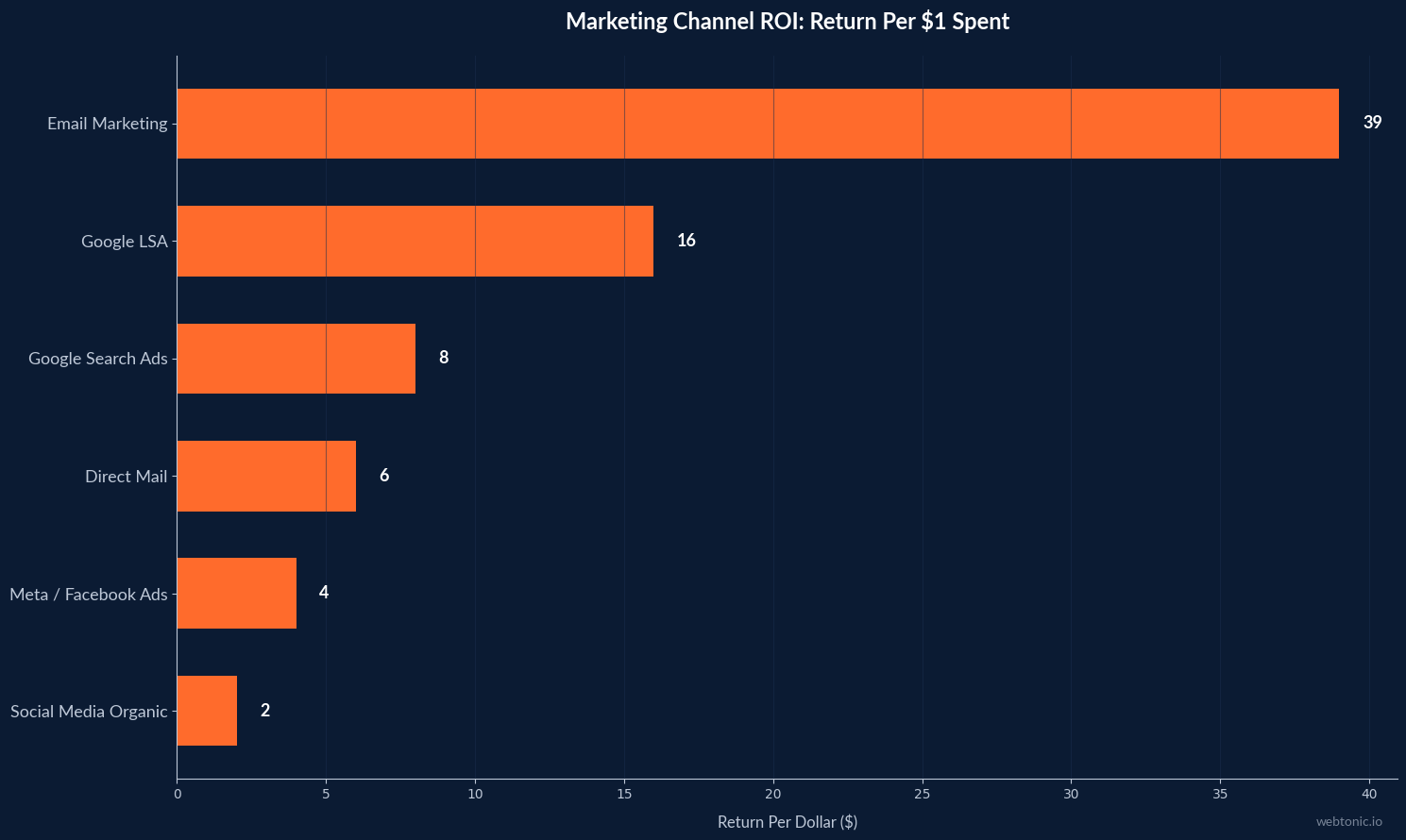
Email marketing generates between $36 and $42 for every dollar spent, according to Omnisend's February 2026 benchmarks via PipelineOn — a 3,600% to 4,200% ROI. Compare that to Google Ads at roughly $8 per dollar, social media ads at $2–$5, and direct mail at $5–$7. For home service professionals specifically, Planet 8 Digital confirms the $36–$45 range across their contractor client portfolio.
| Channel | Return Per $1 Spent | Cost Per Lead |
|---|---|---|
| Email (reactivation) | $36–$42 | $0.05–$0.15/contact |
| Google Ads (Search) | ~$8 | $91–$251/click |
| Google LSA | $13–$19 ROAS | $95–$280/lead |
| Meta / Facebook Ads | $2–$5 | $32–$58/lead |
| Direct Mail | $5–$7 | $1–$3/piece |
The cost advantage is even more significant when you consider list ownership. Your email list is an asset you control — unlike Google or Facebook, where an algorithm change can double your costs overnight. Restoration companies that build and maintain clean email lists create a marketing asset that appreciates over time. For paid channel cost comparisons, see our Google Ads cost guide.
Dormant Customer Reactivation Campaign Performance
On a list of 1,000 dormant customers, expect 15–25% open rates and 1–3% booking within 30 days. At a $400 average ticket, one reactivation campaign generates $4,000–$12,000. Send it quarterly and you are looking at $16,000–$48,000 annually from a single automated sequence (Service Labs Group / PipelineOn 2026).
One HVAC contractor generated $60,000 from a single "we miss you" campaign to 1,200 dormant customers (PipelineOn). For restoration companies specifically, past flood or water damage customers represent high-value reactivation targets — they have experienced the problem before, maintain insurance relationships, and are statistically likely to encounter water issues again within 5–7 years in the same property.
Repeat customers account for 39% of contractor annual revenue (ServiceTitan survey, 1,000+ contractors). Nearly three-quarters of business volume comes from word-of-mouth referrals. Restoration companies that pair reactivation emails with referral incentives recover marketing investment faster than those chasing cold leads exclusively. Learn more about growth marketing automation for service businesses.
Weather-Alert and Seasonal Email Campaigns
Restoration companies that send pre-storm weather alerts see 40% more emergency calls compared to relying on organic demand alone (Restoration Marketers 2026). These campaigns work because they position your company as the trusted expert before the crisis, not just another contractor competing for attention during the flood.
Effective weather-alert sequences include specific preparation steps — shut off the main water valve, move valuables upstairs, check sump pump batteries — and a clear call-to-action for post-storm assessment. Water damage spikes with winter freeze-and-thaw, spring flooding, and severe storm events (Get X Media 2026), making seasonal campaigns essential for pre-positioning your brand ahead of demand surges.
The best restoration companies build a seasonal email calendar that aligns with regional weather patterns: freeze-prevention tips in October, pipe-insulation reminders in November, spring flood preparedness in March, and hurricane preparation in late summer for coastal markets. Each email establishes expertise and keeps your company top-of-mind when the emergency occurs.
Email Automation and Drip Campaign Statistics
A fully operational email automation system costs $108–$312 per year for 4–6 campaigns sent to a warm, segmented local database of up to 2,000 contacts (Tygart Media 2026). That investment is trivial relative to the revenue potential, yet most restoration companies under-invest in automation infrastructure.
Segmented email campaigns generate 760% more revenue than generic blasts (Mailchimp benchmarks via PipelineOn). For restoration companies, effective segmentation includes: past water damage customers, mold remediation customers, insurance adjusters, property managers, and commercial facility managers. Each segment receives tailored content — a property manager does not need the same seasonal tips as a homeowner who experienced a one-time basement flood.
Restoration companies see 300–500% ROI on personalized follow-up campaigns within the first year of implementation (Restoration Marketers 2026). Custom field mapping from job management systems — importing damage type, claim status, and completion dates — enables hyper-relevant follow-ups that generic newsletters cannot match. A customer whose basement flooded last February should receive a "one-year checkup" email offering a moisture assessment, not a generic spring newsletter.
Email Open Rate and Engagement Deep Dive
Home services email open rates run 28–35%, significantly above the 19.21% all-industry benchmark (PipelineOn / WebFX 2026). Restoration-specific campaigns average 24% (MarketingLTB), though well-segmented lists with past customers typically outperform this average. Small business lists under 1,000 contacts — typical for most restoration companies — achieve higher engagement rates because the audience knows the sender personally.
Welcome emails achieve open rates between 68.6% and 80%, making them the single most impactful template to get right from day one (Service Direct). For restoration companies, the welcome email should set expectations for future communication, include your 24/7 emergency contact number, and offer a home water-risk assessment or seasonal maintenance checklist as an immediate value-add.
Click-through rates for home services emails range 2–4%, with the best performers reaching above 5% on targeted seasonal campaigns. The key driver of click-through performance is relevance — emails tied to weather events, seasonal maintenance windows, or upcoming policy renewal dates consistently outperform generic newsletters. For broader paid media cost comparisons, see our Facebook Ads pricing guide.
Email List Building and Maintenance for Restoration Companies
The foundation of email marketing success is a healthy, permission-based contact list. For restoration companies, the primary list-building channels include post-job contact collection, website opt-in forms offering seasonal maintenance checklists, referral partner onboarding, and community event sign-ups. Every completed restoration job should automatically add the customer to a segmented email list with their damage type, service date, and property details.
36% of home services businesses report their biggest email challenge is optimizing metrics — including open rates, bounce rates, deliverability, and click-through performance (Service Direct). This suggests most restoration companies under-invest in list hygiene, which directly impacts deliverability and sender reputation. Monthly list cleaning — removing hard bounces, unsubscribes, and addresses inactive for 12+ months — keeps engagement metrics healthy and prevents spam filter penalties.
For restoration companies operating in multiple service areas, geographic segmentation is essential. A property manager in Miami needs hurricane preparation content in August, while one in Minneapolis needs freeze-prevention guidance in October. Location-based segmentation ensures every email feels relevant rather than generic, which directly improves open rates and reduces unsubscribes. Companies that implement geographic plus damage-type segmentation consistently outperform those sending uniform content to their entire list.
Building referral partner lists requires a different approach than customer lists. Insurance adjusters, property managers, and plumber partners should receive quarterly industry updates, market condition reports, and joint marketing opportunities rather than the seasonal homeowner content that makes up customer-facing campaigns. These B2B relationships often generate the highest lifetime value per contact in a restoration company's email database. For strategies on building multi-channel lead pipelines, see our email marketing agency guide.
Email Marketing Best Practices for Restoration Companies
- Segment your list by customer type — homeowners, property managers, insurance adjusters, and commercial clients need different content and frequencies.
- Send weather-alert campaigns before storms — companies that do see 40% more emergency calls than those relying on organic demand.
- Automate dormant-customer reactivation — quarterly campaigns to past customers generate $16,000–$48,000 annually from a single automated sequence.
- Personalize with job data — import damage type and completion dates from your CRM for hyper-relevant follow-ups that deliver 300–500% first-year ROI.
- Nail the welcome email — 68.6–80% open rates make it the single most impactful template; set expectations and include your emergency contact number.
- Keep lists clean — small business lists under 1,000 contacts achieve higher engagement rates; remove bounced and inactive addresses monthly.
- Track email-attributed revenue — not just open rates, but booked jobs and revenue directly tied to email campaigns through call tracking and UTMs.
- Maintain a regular cadence — monthly educational content between seasonal campaigns keeps your brand familiar without overwhelming subscribers.
Frequently Asked Questions
What is the average open rate for water damage restoration emails?
Restoration company emails average a 24% open rate according to MarketingLTB, while home services broadly achieve 28–35%. This significantly exceeds the 19.21% all-industry benchmark. Well-segmented lists with past customers typically perform above 35%, and welcome emails reach 68.6–80% open rates, making them the most important template to optimize.
How much revenue can email marketing generate for a restoration company?
A single reactivation campaign to 1,000 dormant customers generates $4,000–$12,000 at a $400 average ticket. Sent quarterly, that totals $16,000–$48,000 annually from a single automated sequence. Email returns $36–$42 per dollar spent — the highest ROI of any marketing channel. One HVAC contractor generated $60,000 from a single campaign to 1,200 contacts.
What types of email campaigns work best for water damage restoration?
The most effective campaigns include weather-alert pre-storm sequences that drive 40% more emergency calls, dormant-customer reactivation emails, post-job follow-ups with maintenance tips, seasonal preparation reminders aligned to regional weather patterns, and referral partner updates. Segmentation by customer type dramatically improves performance across all campaign types.
How much does email marketing automation cost for restoration companies?
A fully operational email automation system costs $108–$312 per year for 4–6 campaigns to up to 2,000 contacts according to Tygart Media. Popular platforms like Mailchimp or Constant Contact run $30–$75 per month. Compared to $1,900–$7,000 monthly Google Ads budgets, the investment is negligible relative to the $36–$42 per dollar return.
Is cold email outreach effective for restoration companies?
Cold email outreach to insurance adjusters and property managers shows 5–12% reply rates when lists are tightly segmented and personalized according to Origami.Chat. Replies often include future interest signals like scheduling a call next month, which are wins for relationship building. Personalized campaigns increase referral engagement by 29% for restoration firms.
Sources
PipelineOn — Email Marketing for Contractors
Planet 8 Digital — Email Marketing for Home Service Pros
MarketingLTB — Restoration Marketing Statistics 2026
Tygart Media — Restoration Email Automation Technical Guide
Origami.Chat — Water Damage Restoration Email Campaign
Service Direct — Water Damage Email Marketing
Get X Media — Restoration Marketing Benchmarks 2026