



Table of contents
Key Takeaways
- WordPress powers 50% of water damage restoration company websites in a 34-contractor benchmark study, matching jQuery and PHP usage (BorahLabs).
- WordPress runs 33.21% of all measurable web origins as of April 2026, and about 64% of all sites using a detectable CMS (GravityKit).
- 43.6% of small business websites use WordPress, more than 4× the next CMS (Wix at 9.5%) (ElevateWebDesign).
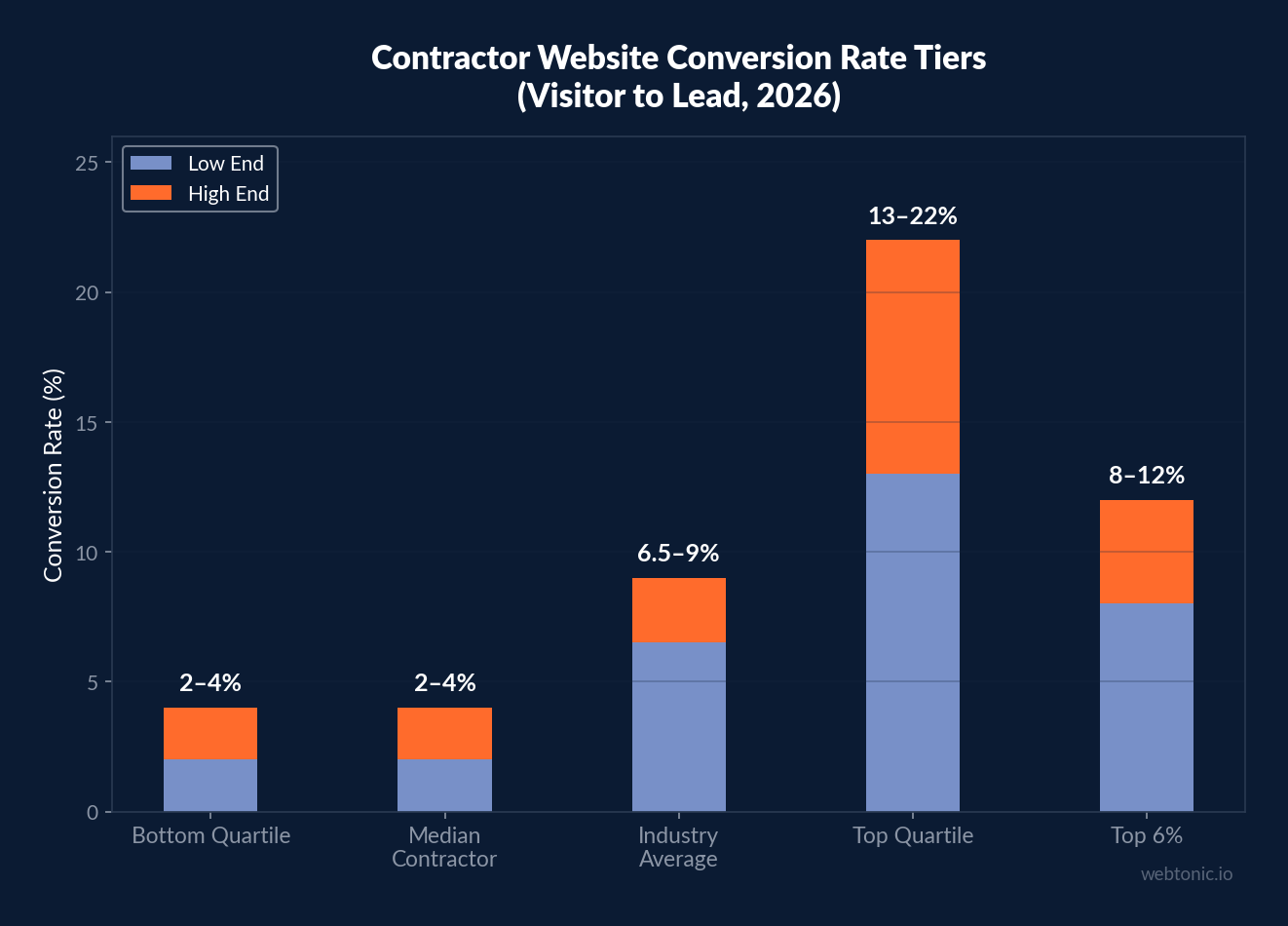
- The median contractor website converts 2–4% of visitors into a call or form, while the top 6% of sites hit 8–12% on the same traffic (PipelineOn).
- Every 1-second mobile load delay drops conversions by approximately 7% — a 5-second site loses 35% of leads versus a 1-second site (OnwardCraft).
- Home services website conversion rate averages 6.5–9%, with top-quartile performers reaching 13–22% (WhatEch).
- Well-tuned WordPress sites outperform poorly-built custom builds routinely — platform choice matters less than configuration and optimization (BorahLabs).
- WordPress holds 59.9% of all CMS-powered sites, more than every other CMS platform combined (BackToFrontShow).
WordPress Market Share and CMS Landscape
WordPress dominates the content management system landscape for water damage restoration companies and small businesses broadly. Understanding where WordPress sits in the CMS ecosystem helps restoration companies make informed decisions about their web platform strategy.
| CMS Platform | Overall Web Share | Small Business Share | CMS Market Share |
|---|---|---|---|
| WordPress | 33.21% | 43.6% | 59.9–64% |
| Wix | 3.2% | 9.5% | ~5% |
| Shopify | 4.74% | 4.0% | ~7% |
| Squarespace | 2.1% | 4.1% | ~3% |
| Webflow | 0.9–1.2% | 1.1% | ~1.5% |
| Custom / Other | ~55% | ~37.7% | N/A |
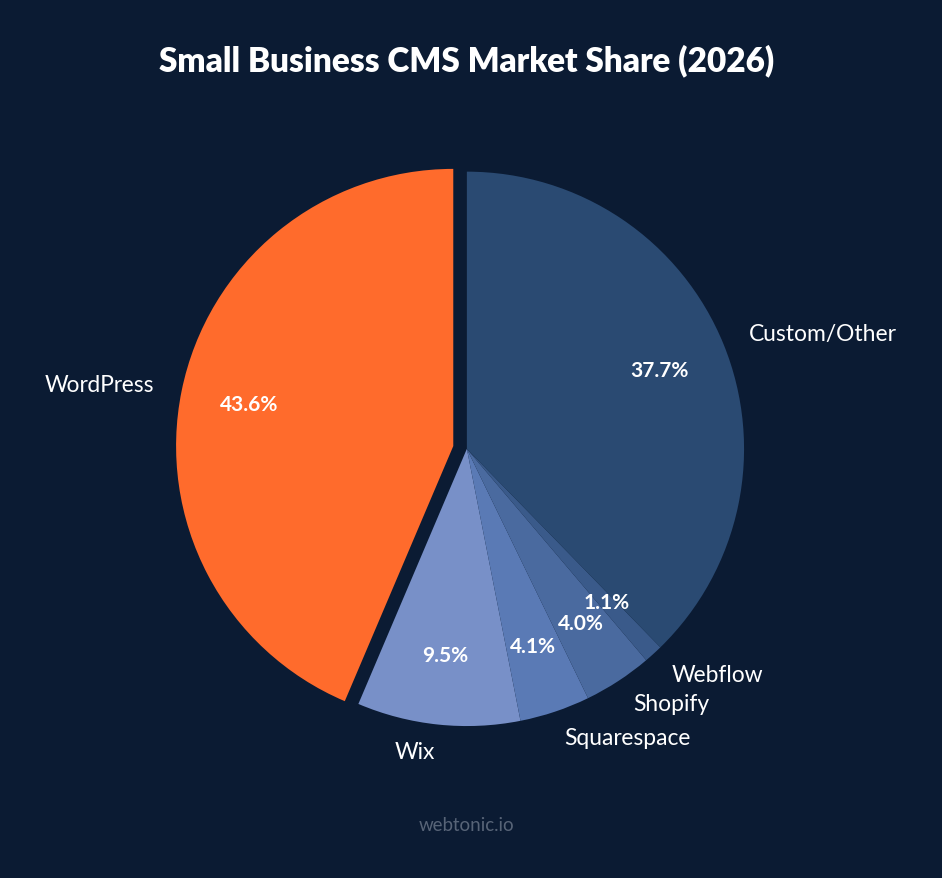
The data is striking: WordPress runs more websites than every other CMS combined. Among the 34 water damage restoration companies benchmarked by BorahLabs, 50% use WordPress — consistent with its dominance across home services. However, the key insight is that platform choice matters far less than implementation quality. Well-tuned WordPress sites regularly outperform poorly-built custom solutions.
Water Damage Restoration Website Performance Benchmarks
A restoration company's website is often the first point of contact during an emergency. Performance directly determines whether a panicked homeowner calls you or your competitor. These benchmarks reveal where the industry stands and where the biggest conversion gaps exist.
| Website Metric | Industry Average | Top Performers | Source |
|---|---|---|---|
| Visitor-to-Lead Conversion | 2–4% (median) | 8–12% (top 6%) | PipelineOn |
| Home Services CVR Average | 6.5–9% | 13–22% (top quartile) | WhatEch |
| Industry-Wide CVR Baseline | 7.8% | Varies by trade | WebFX |
| Mobile Speed Impact | -7% per second delay | <1.8s load time | OnwardCraft |
| Sales Cycle Length | ~60 days | Emergency: same-day | WebFX |
| Gross Margin Baseline | 33% | 40–50% (WDR) | WebFX |
The gap between median and top-performing websites is enormous. A top-6% restoration website converts at 8–12% — up to 6× the median 2% conversion rate (PipelineOn). On 1,000 monthly visitors, that's the difference between 20 and 120 leads from the same traffic. Smart data intelligence helps identify exactly where visitors drop off.
Website Speed and Its Impact on Lead Generation
For water damage restoration — where a homeowner standing in a flooded basement needs help immediately — website speed isn't a technical nicety; it's a business-critical factor that directly impacts revenue.
- Every 1-second of mobile load delay drops contractor site conversion by roughly 7%, so a 5-second site loses 35% of leads versus a 1.8-second site (OnwardCraft).
- Google factors page speed into ad costs — a slow WordPress site lowers your Google Ads Quality Score, making every click more expensive. You pay more to reach fewer people who convert at a lower rate (PipelineOn).
- For a contractor getting 1,000 monthly visitors, speed is the difference between 30 leads and 10 leads from the exact same traffic — a revenue impact that dwarfs the cost of WordPress optimization.
- 72% of mobile users don't rotate their phone — restoration company WordPress sites must be fully responsive and fast-loading in portrait orientation, which is the default browsing mode for emergency searches (FoundryCRO).
- Core Web Vitals compliance directly correlates with ranking position — WordPress sites with poor LCP (Largest Contentful Paint) and CLS (Cumulative Layout Shift) scores rank lower in Google's local search results, compounding the lead generation problem.
WordPress vs. Other CMS for Restoration Companies
The CMS decision impacts everything from SEO flexibility to maintenance costs. Here's how WordPress stacks up against the alternatives for water damage restoration companies specifically, based on the latest contractor comparison data.
| Factor | WordPress | Wix | Squarespace | Webflow |
|---|---|---|---|---|
| SEO Flexibility | Excellent (Rank Math/Yoast) | Limited structured data | Basic | Strong native controls |
| Local SEO Capability | Strong (plugins + schema) | Limited | Basic | Strong |
| Speed Potential | High (if optimized) | Medium | Medium | High |
| Maintenance Burden | High (updates + security) | Low | Low | Low-Medium |
| Lead Gen / CRO Tools | Extensive plugin ecosystem | Built-in forms | Limited | Custom interactions |
| Cost (Typical Annual) | $500–$2,000+ | $200–$500 | $200–$500 | $300–$1,200 |
The critical takeaway from TZI Digital's comprehensive guide is that WordPress wins on SEO flexibility and plugin ecosystem breadth, but carries a higher maintenance burden than hosted platforms. For restoration companies focused on aggressive Google Ads strategy, WordPress's ability to build highly optimized landing pages gives it a genuine performance edge.
Conversion Rate Optimization on WordPress for Restoration
The data reveals specific website elements that separate high-converting restoration WordPress sites from underperformers. Implementing these conversion drivers can move a site from the median 2–4% to the top-tier 8–12% conversion bracket.
- 20+ real reviews visible above the fold — top-quartile home services sites prominently display social proof on every page. Google reviews embedded on WordPress increase trust signals immediately for emergency-seeking visitors.
- Specific service area statement on every page — restoration companies serving "the greater Phoenix metro area" outperform those with generic "we serve your area" copy by providing search relevance and user confidence.
- Click-to-call button fixed on mobile — in an industry where 60–70% of emergency searches happen on mobile, a persistent click-to-call button is the single highest-converting element. WordPress plugins like WP Call Button make this trivial to implement.
- Page load time under 2 seconds — given the 7% conversion loss per second of delay, WordPress optimization (caching, image compression, CDN) should be the first investment. A $50/year caching plugin can deliver more leads than a $5,000 redesign.
- Before-and-after project galleries — visual proof of work quality builds trust faster than text testimonials. WordPress gallery plugins with lazy loading keep pages fast while showcasing restoration work effectively through a strong performance creative approach.
- Schema markup implementation — WordPress SEO plugins make it easy to add LocalBusiness, Service, and FAQPage schema, which boosts visibility in rich snippets and Google's local pack where 60–70% of emergency clicks happen.
WordPress Plugin Ecosystem for Restoration Companies
WordPress's greatest advantage over competitors is its massive plugin ecosystem — there are over 60,000 plugins available, and restoration companies benefit from a curated stack that addresses their specific needs: lead capture, local SEO, speed optimization, and review management.
- SEO plugins (Rank Math / Yoast) — offer more advanced local SEO controls than any competing platform, including schema markup, XML sitemaps, and keyword optimization tools essential for ranking in emergency search queries.
- Page builders (Elementor, Beaver Builder) — enable non-technical restoration company owners to build and update service pages, landing pages, and location pages without developer involvement.
- Caching plugins (WP Rocket, LiteSpeed Cache) — critical for achieving the sub-2-second load times that prevent the 7% per-second conversion loss. These plugins alone can cut load times by 40–60%.
- Review plugins (WP Review Slider) — auto-pull Google and Facebook reviews onto WordPress pages, building the 20+ visible reviews that top-converting sites display.
- Form and CTA plugins (Gravity Forms, WPForms) — enable multi-step forms, conditional logic, and growth marketing integrations that simple Wix or Squarespace forms cannot match.
WordPress Security and Maintenance for Restoration Sites
WordPress's open-source nature means restoration companies must actively manage security and maintenance — a trade-off for its unmatched flexibility. The data reveals that security vulnerabilities and maintenance neglect are the primary reasons contractor WordPress sites underperform.
- WordPress sites require regular updates — core, theme, and plugin updates should be applied at least monthly. Outdated WordPress installations account for a significant share of hacked small business websites, potentially destroying a restoration company's search rankings overnight.
- Security plugins are essential, not optional — solutions like Wordfence or Sucuri protect against the most common attack vectors. For a restoration company, a hacked website means lost emergency leads during the exact moments homeowners are searching for help.
- Managed WordPress hosting reduces maintenance burden by 60–70% — services like WP Engine, Kinsta, or Flywheel handle automatic updates, daily backups, and security monitoring. Annual costs range from $300–$900 but save significant developer time and eliminate most security risks.
- SSL certificates are now table stakes — Google penalizes non-HTTPS sites in rankings, and Chrome displays security warnings that frighten potential customers. Most hosting providers now include free SSL through Let's Encrypt integration.
- Regular backup schedules protect against catastrophic data loss — WordPress backup plugins like UpdraftPlus or BlogVault automate daily backups to cloud storage, ensuring a restoration company can recover its site within hours rather than days after an incident.
Related reading
- Water Damage Restoration Landing Page Statistics (2026)
- WDR Shopify Stats & E-commerce Data
- 2026 Webflow Stats for Water Damage Restoration: Benchmarks That Matter
- Custom Web Development services at Web Tonic
FAQ
What percentage of water damage restoration companies use WordPress?
50% of water damage restoration company websites run on WordPress according to BorahLabs' 34-contractor benchmark. This is consistent with WordPress's broader dominance — it powers 43.6% of small business websites and 33.21% of all websites globally. The platform's flexibility, SEO capabilities, and extensive plugin ecosystem make it the default choice for home services businesses.
What is a good conversion rate for a restoration company WordPress site?
The median contractor website converts at 2–4%, while the top 6% of sites achieve 8–12% on the same traffic. The home services industry average sits at 6.5–9% for visitor-to-lead conversion. For water damage restoration specifically, the emergency nature of most searches means conversion potential is higher than average — top-quartile performers reach 13–22% through optimized page speed, prominent click-to-call, and strong review visibility.
Does website speed really affect lead generation for restoration companies?
Absolutely. Every 1-second of mobile load delay drops conversions by approximately 7%. For a restoration company getting 1,000 monthly visitors, the difference between a 2-second site and a 5-second site is roughly 20 lost leads per month — from the exact same traffic and ad spend. Additionally, Google factors page speed into Quality Score for paid ads, meaning slow WordPress sites pay more per click and rank lower organically.
Should a restoration company choose WordPress or Wix/Squarespace?
WordPress offers superior SEO flexibility, local SEO capabilities, and lead generation tools through its plugin ecosystem — critical advantages for restoration companies competing in local search. However, WordPress carries a higher maintenance burden (updates, security, hosting management). If you have a web developer or marketing agency managing your site, WordPress is the stronger choice. If you need a simple, low-maintenance site and don't compete heavily in local SEO, Wix or Squarespace can work — but you're trading performance ceiling for convenience.
What WordPress optimizations have the biggest impact on restoration leads?
The five highest-impact optimizations are: page speed under 2 seconds (caching plugin + CDN), mobile click-to-call button (persistent on all pages), 20+ Google reviews displayed above the fold, schema markup (LocalBusiness + Service + FAQPage), and specific service area statements on every page. These five changes alone can move a restoration WordPress site from the median 2–4% conversion rate to the 8–12% top-performer bracket.
Sources
borahlabs.us/insights/water_damage
gravitykit.com/wordpress-statistics/
elevatewebdesign.ca – Small Business CMS Statistics 2026
onwardcraft.com – Contractor Website Conversion Study
pipelineon.com – Contractor Website Conversion Rate
tzidigital.com – WordPress for Contractor Websites
foundrycro.com – Landing Page Video Benchmarks
latte.dev – Service Business Conversion Rate


