Table of contents

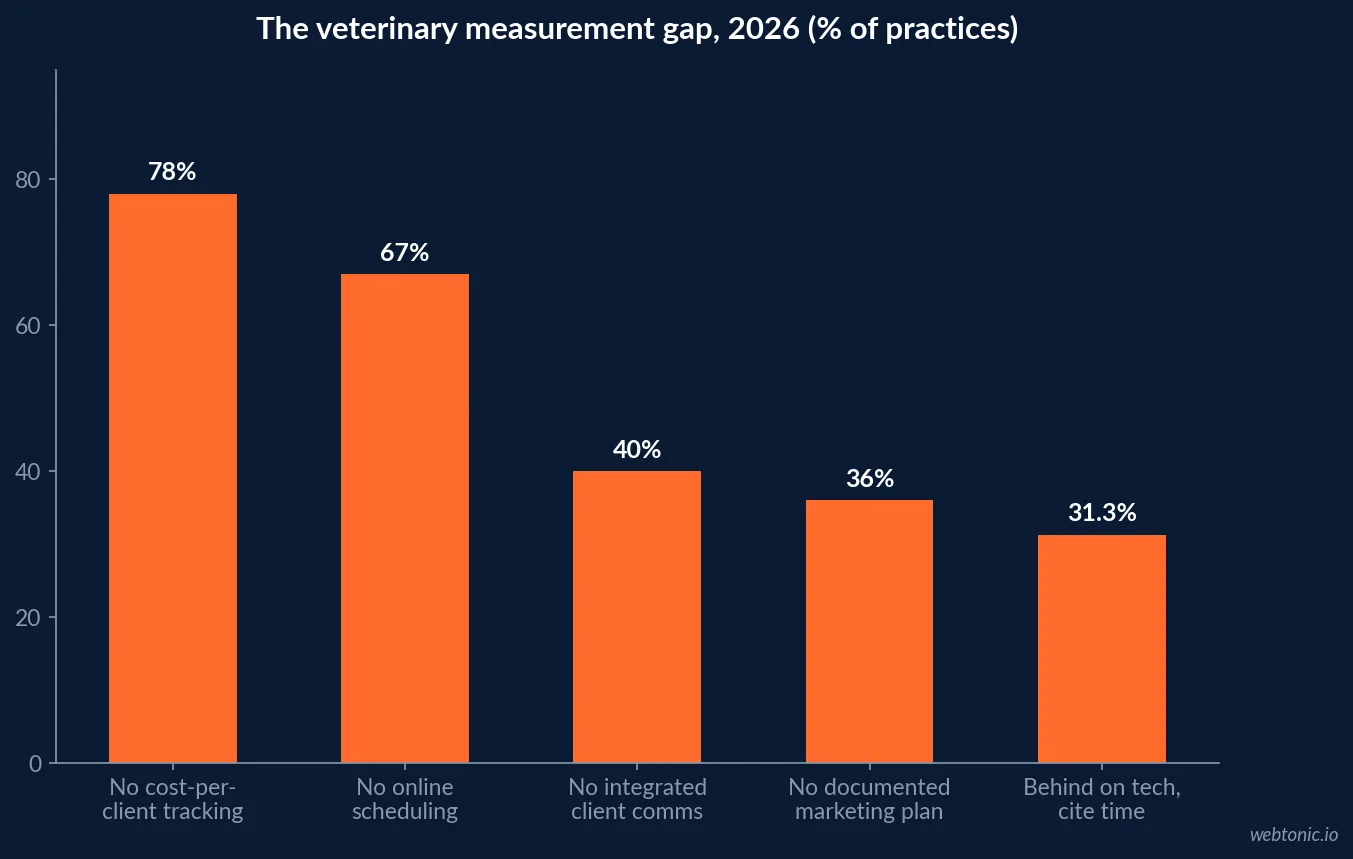
78% of veterinary professionals cannot say what a new client costs them. Meanwhile 58% of new-client interactions arrive by phone - the one channel most practices never tag. Veterinary marketing attribution in 2026 is not a modelling problem; it is a data-capture problem with a measurable price tag.
Key Takeaways
- 78% of veterinary professionals do not track cost per new client and 36% have no documented marketing plan (survey of 400 professionals).
- Phone calls are 58% of new-client interactions, versus 23% online bookings and 19% web forms.
- 76.5% of practices run a PIMS, but fewer than one in three offer online scheduling - the data exists and is disconnected.
- Practices using analytics and finance support grew 6.7% in 2025 versus a 2.6% industry average; sub-$2.5M practices grew 8.6%.
- Analytics adopters report 12-18% higher revenue per FTE veterinarian.
- Adding call tracking typically improves cost per booked patient by 20-40% within 60 days, at $50-$150 a month.
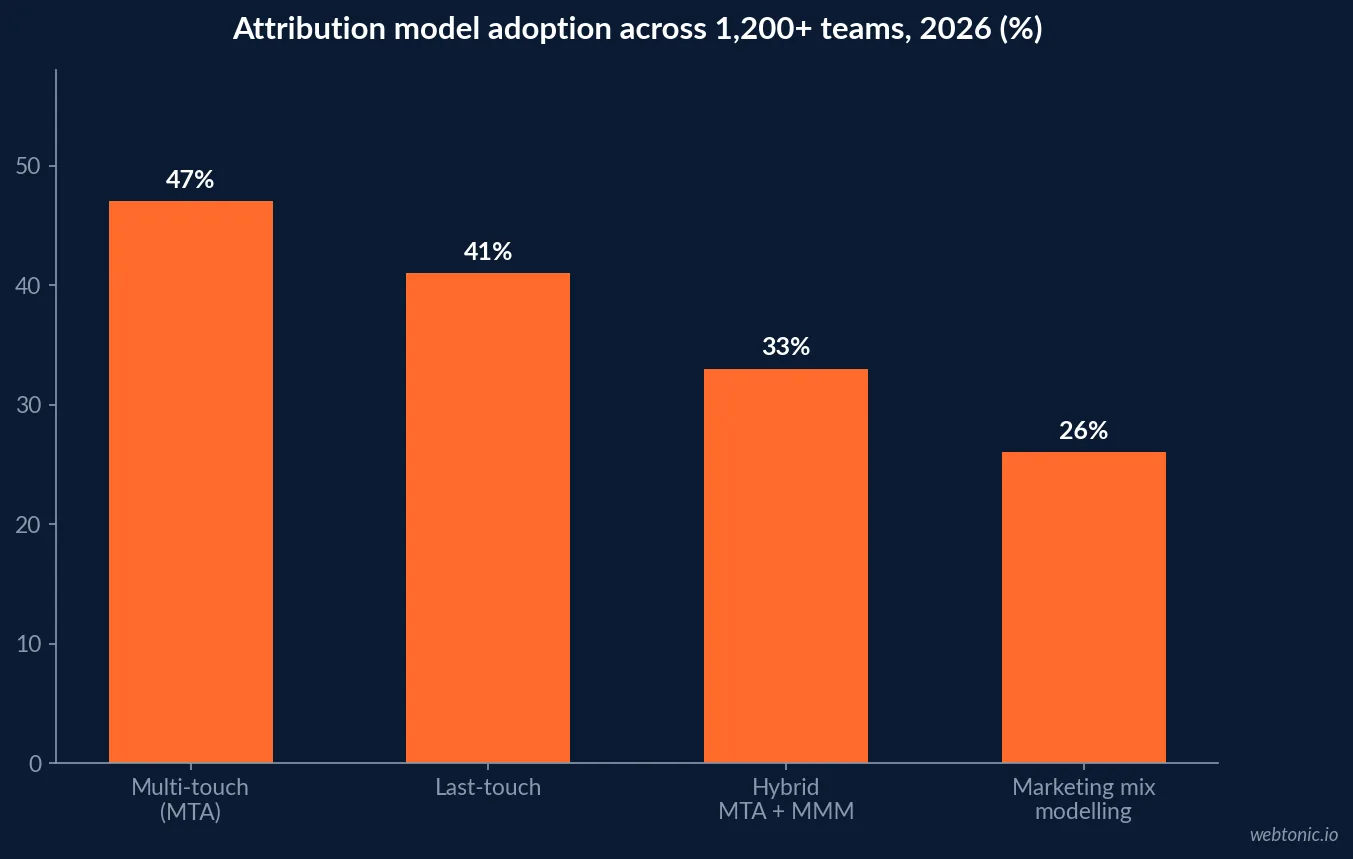
- Multi-touch attribution adoption is 47%, last-touch 41%, MMM 26% - and only 18% of MTA builds are rated highly accurate by their own teams.
- Mature attribution cuts wasted spend ~23% in year one; incrementality tests suggest 25-40% of paid-search conversions were not incremental.
- Models including offline touchpoints are 2.4x more predictive of revenue than digital-only models.
- 48% of agencies say AI-driven discovery is now their hardest attribution problem, and 55% say clients ask about revenue connection above all else.
The veterinary measurement gap, in numbers
Start with the uncomfortable baseline. The 2026 survey of 400 veterinary professionals summarised in CUFinder’s veterinary benchmark set found 78% do not track what a new client costs and 36% have no documented marketing plan. Adoption of measurement tooling is not the blocker: AVMA data compiled by Digitail shows 76.5% of practices run practice management software while only 59.9% use integrated client-communication software and fewer than one in three offer online scheduling or telehealth. Among owners who feel behind on technology, 31.3% blame time and 26.3% blame cost.
| Measurement gap | Share of practices | Consequence |
|---|---|---|
| No cost-per-new-client tracking | 78% | Budget decisions made on gut feel |
| No documented marketing plan | 36% | No baseline to measure against |
| Run a PIMS | 76.5% | Revenue data exists but sits unlinked |
| Use integrated client comms | 59.9% | Reminder impact unattributed |
| Offer online scheduling | Under 33% | Bookings default to untracked phone |
| Behind on tech, cite time | 31.3% | Needs done-for-you, not more dashboards |
| Behind on tech, cite cost | 26.3% | Call tracking at $50-$150/mo clears this |
The phone is the attribution problem
Veterinary demand is voice-first in a way most local categories no longer are. Analysis from Liine puts phone calls at 58% of new-patient interactions, with online bookings at 23% and web forms at 19% - and notes online bookings have more than doubled year over year, so the mix is moving but the phone still dominates. It also reports 57% of pet owners have had difficulty booking an appointment and nearly a third are likely to switch clinics over communication.
Untagged, that 58% simply does not exist to Google or Meta. Paid-media guidance from The Visible Vet describes the standard fix - dynamic number insertion, a 60-second call-duration threshold as the conversion event, form and booking-widget tracking, then offline conversion import from the PIMS - and reports a 20-40% improvement in cost per booked patient within 60 days for clinics that add it, at a setup cost of two to four hours and $50-$150 per month. Practical rule from the same source: calls under 60 seconds are usually wrong numbers; four-minute calls are bookings.
| New-client channel | Share of interactions | Default trackability | Fix |
|---|---|---|---|
| Phone call | 58% | None without DNI | Dynamic number insertion |
| Online booking | 23% | Partial (widget events) | Confirmation-page event |
| Web form | 19% | Good | Server-side conversion |
| Qualifying call threshold | 60 seconds | n/a | Count only calls over 60s |
| Call tracking cost | $50-$150/month | n/a | 2-4 hours to configure |
| Reported gain | 20-40% better cost per booked patient | Within 60 days | Reallocate by keyword |
What attribution maturity is worth
The strongest veterinary-specific evidence comes from practices that bought the analytics layer. iVET360’s 2026 benchmark report found analytics and finance clients averaged 6.7% revenue growth in 2025 against a 2.6% industry average, with practices under $2.5M in revenue growing 8.6% and larger clients 5.3% - in a year when transaction volume fell 4.7% nationally. Tooling analysis citing AAHA’s 2025 State of the Profession data, compiled by US Tech Automations, reports 12-18% higher annual revenue per FTE veterinarian among analytics users, 15-25% more reactivation opportunities identified per quarter, and 40-60% more revenue-recovery opportunities than PIMS reporting alone.
Those percentages become concrete quickly. The same analysis models a three-DVM practice with a 15% overdue rate sitting on $66,600 of dormant wellness revenue, and estimates annual leakage from undetected overdue patients at $18,000-$75,000 for that size of practice, of which 40-60% is recoverable. Reporting is not an overhead line in this market - it is a revenue channel.
| Attribution investment | Reported impact | Source basis |
|---|---|---|
| Analytics and finance support | 6.7% vs 2.6% revenue growth | 2026 veterinary benchmark report |
| Analytics tooling | 12-18% higher revenue per FTE DVM | AAHA 2025 State of the Profession |
| Call tracking | 20-40% better cost per booked patient | Veterinary paid-media practitioners |
| Reactivation analytics | 15-25% more opportunities per quarter | VetSuccess 2025 benchmarks |
| Mature attribution (cross-industry) | ~23% less wasted ad spend | Rockerbox attribution report |
| Data-driven vs last-click | +18% ROAS | Google attribution study |
| Offline touchpoints included | 2.4x more predictive of revenue | Nielsen annual marketing report |
Model adoption: the industry is running two models, badly
Cross-industry context matters because veterinary practices buy the same tools everyone else does. The 2026 attribution dataset from Digital Applied, covering 1,200-plus teams, puts multi-touch adoption at 47% (up from 31% in 2023), last-touch at 41%, MMM at 26% (up from 9%), and 33% running an explicit MTA-plus-MMM hybrid. It also measures a dark-funnel gap averaging 38% of B2B pipeline and finds attribution-capable teams spend 23% more on martech while producing 1.6x larger marketing-sourced pipeline.
The quality caveat is important for small practices tempted by sophistication. Analysis from MarqOps notes that while adoption sits near 41-47%, only 18% of implementations are rated highly accurate by the teams running them, 67% of B2B marketers still make decisions on last-touch data, and privacy changes have removed 30-40% of previously trackable conversions - of which machine learning recovers 60-75%. Teams that do switch report an 18% ROI lift, 22% better lead quality and 15% lower CAC.
Where the money leaks
Attribution failure is expensive in two directions: spend that never had to happen, and spend that gets cut because nobody could prove it worked. Attribution research collated by Empire325 reports that 72% of marketing leaders call attribution their number-one measurement challenge, that only 14% of companies have implemented a mature attribution model, that data-driven models outperform last-click by 18% in ROAS, that incrementality testing shows 25-40% of paid-search conversions are not incremental, and that mature attribution reduces wasted spend by about 23% in year one. Models that include offline touchpoints - calls, events, direct mail - are 2.4x more predictive of revenue.
Veterinary-specific waste has been measured too. A Q1 2026 benchmark study of UK veterinary groups by Clickthrough Marketing found average monthly paid-media wastage of £11,246 across the practice groups analysed, spent on audiences and terms unlikely to return - and recommends committing at least 10% of paid media budget to ongoing conversion testing. For context on where that budget should land instead, see our veterinary Google Ads statistics.
A practical measurement stack for a veterinary practice
Sequenced so each step pays for the next:
- 1. Tag the phone. Dynamic number insertion, a 60-second qualifying threshold, source-level reporting. Highest-leverage single change - 58% of demand becomes visible.
- 2. Instrument the site. Form submissions, booking-widget confirmations, click-to-call events. Mobile is 72.4% of veterinary traffic and the click-to-call rate is 18.3%, so treat taps as conversions.
- 3. Import outcomes. Push booked-and-arrived status and revenue from the PIMS back into the ad platforms so bidding optimises on paying clients, not raw leads.
- 4. Define one source of truth. A single dashboard with cost per new client, cost per booked patient, retention and reactivation. Unified dashboards enable budget reallocation 3x faster than manual monthly reports.
- 5. Add incrementality, not complexity. Geo holdouts or pause tests beat a bespoke multi-touch model at practice scale, given that only 18% of MTA builds are considered accurate.
- 6. Watch the new dark funnel. AI assistants now recommend clinics; 45% of consumers use AI tools for local recommendations, and that traffic arrives as direct or branded search.
Practices that also want the reporting layer specified in detail can start with our veterinary analytics benchmarks and landing page statistics.
The next attribution problem: AI discovery
Agency data suggests the ground is shifting again. The 2026 benchmark report summarised by AgencyAnalytics found 48% of agencies say tracking AI-driven discovery is their hardest attribution problem, 47% struggle to attribute across fragmented journeys, 45% lack visibility into which content influenced conversions and 44% say traditional models are losing reliability. Client pressure is rising in parallel: 55% say clients now regularly ask whether marketing connects to revenue, and 10% of agency leaders cite attribution clarity as a reason clients leave - a churn driver that barely registered a year earlier.
For a practice, the takeaway is modest and useful: expect a growing share of new clients to say "I found you online" with no traceable path, and instrument the things you can still see - calls, bookings, arrivals, revenue - rather than chasing a perfect path model.
Limits of this data
The veterinary figures come from mixed sample sizes: 400 professionals for the cost-tracking statistic, AVMA census data for PIMS adoption, vendor benchmark reporting for growth deltas. Vendor-reported uplifts (6.7% versus 2.6%, 12-18% per FTE, 20-40% cost-per-patient improvement) come from companies selling the service, and self-selection is real - practices that buy analytics tend to be better managed to begin with. The cross-industry attribution figures are B2B-weighted and not veterinary; treat model-adoption percentages as context, not a target. The UK wastage figure covers a specific set of UK practice groups and will not transfer to a single-site U.S. clinic. Directionally, though, every source points the same way: the practices that can measure a new client outgrow the ones that cannot.
Frequently Asked Questions
How many veterinary practices actually track marketing attribution?
Very few track it to the level that supports a budget decision. In a 2026 survey of 400 veterinary professionals, 78% said they do not track what a new client actually costs them and 36% had no documented marketing plan at all. That is not a tooling problem - 76.5% of practices run practice management software - it is a connection problem, because the software that holds revenue is not joined to the channel that produced the visit.
Why do phone calls break veterinary attribution?
Because they are the majority of the funnel. Phone calls account for roughly 58% of new-client interactions in veterinary practices, against 23% for online bookings and 19% for web forms. Unless calls are routed through dynamic number insertion and tagged by source, more than half of new-client demand is invisible to the ad platforms - so bidding algorithms optimise against the smaller, easier-to-measure slice. Call tracking software typically costs $50-$150 a month and takes two to four hours to configure.
What attribution model should a veterinary practice use?
For a single-site practice, a well-configured last-touch setup with call tracking and offline conversion import beats an elaborate multi-touch model with missing phone data. Multi-touch attribution adoption stands at about 47% across surveyed marketing teams, last-touch at 41%, and marketing mix modelling at 26% - and only 18% of multi-touch implementations are rated highly accurate by the teams running them. Fix data capture first, then add model sophistication.
What is measured marketing actually worth to a veterinary practice?
The reported deltas are large. Practices using dedicated analytics and finance support averaged 6.7% revenue growth in 2025 against an industry average of 2.6%, with sub-$2.5M practices growing 8.6%. Separately, practices using analytics tools show 12-18% higher annual revenue per full-time equivalent veterinarian, and clinics adding proper call tracking typically see a 20-40% improvement in cost per booked patient within 60 days.
How much veterinary ad spend is wasted for attribution reasons?
Enough to fund the fix several times over. Teams with mature attribution reduce wasted ad spend by about 23% in the first year, and incrementality testing suggests 25-40% of conversions credited to paid search would have happened anyway. A Q1 2026 benchmark study of UK veterinary groups measured average monthly paid-media wastage of £11,246 per practice group on audiences and terms unlikely to return.
Bottom line
If 78% of the industry cannot price a new client and 58% of demand arrives on an untagged phone line, the fastest available margin in veterinary marketing is measurement, not media. Tag the phone, import PIMS outcomes, keep one dashboard, then optimise. Our data intelligence team builds exactly that stack - get in touch if you want yours audited.
Sources
CUFinder - Veterinarians industry marketing benchmarks 2026
Liine - What is veterinary call tracking
The Visible Vet - Conversion tracking for vet Google Ads
iVET360 - 2026 Veterinary Industry Benchmark Report
US Tech Automations - Reporting and analytics tools for veterinary clinics
Digital Applied - Marketing attribution statistics 2026
MarqOps - Multi-touch attribution in 2026
Empire325 - Marketing attribution statistics 2026
Clickthrough Marketing - UK veterinary digital marketing benchmark Q1 2026
AgencyAnalytics - Marketing attribution in 2026
Digitail - Veterinary statistics that matter for 2026