Table of contents

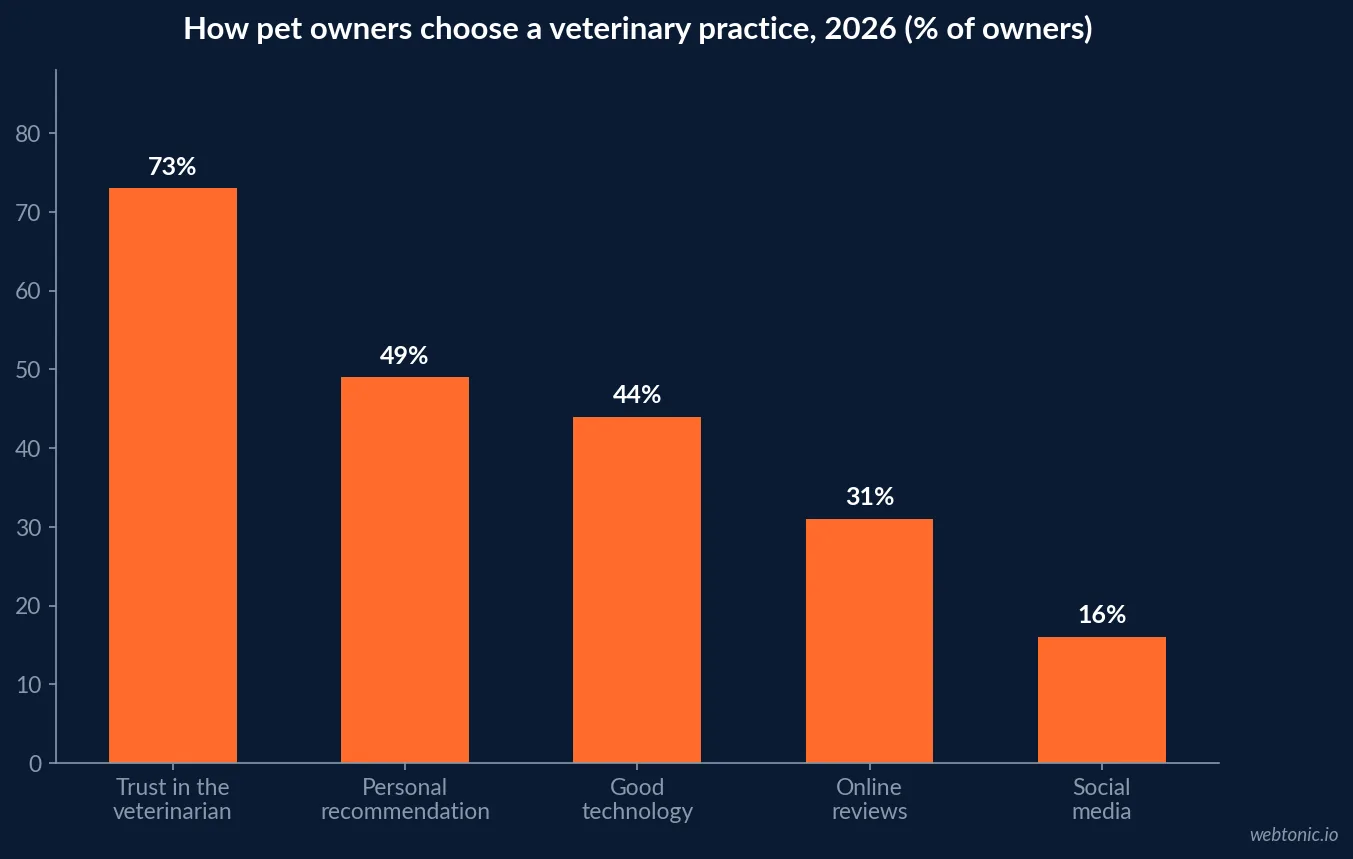
Ask a pet owner what decides where their dog gets treated and the answer is not price, hours or a logo: 73% rank trust in the veterinarian first. Ask an AI assistant to recommend a vet and the answer is a corporate brand - Mars Petcare’s three chains hold 27-30% of veterinary AI citations while roughly 80% of independent practices have none. Veterinary branding in 2026 sits in that gap.
Key Takeaways
- 73% of pet owners rank trust in the veterinarian as the most important factor when choosing a practice; good technology (44%) now outranks 24/7 hours and low prices.
- 49% choose a clinic on personal recommendation and 31% on online reviews - reviews are the second-strongest selection driver.
- 88% of pet owners under 35 always or often read reviews first, and they are 2.5x more likely than over-55s to choose a vet on reviews.
- 83% of owners say the website matters; a bad one is a deal-breaker for 36%, and 47% of under-35s.
- 35% of pet parents expect to switch clinics within a year - brand loyalty is unusually loose right now.
- Mars Petcare brands hold 27-30% of veterinary AI citation share (Banfield 11.5%, VCA 10%, BluePearl 6%); ~80% of independents have zero.
- Only ~33% of clinics invest in branding design, while 67% of owners value consistent branding across channels.
- 72.4% of veterinary web traffic is mobile and the average bounce rate is 54.8% - brand impressions are formed fast, on a phone.
- 97% of consumers read local reviews and 62% avoid businesses with incorrect information online.
- Industry revenue grew 2.6% in 2025 while transactions fell 4.7% - growth is coming from value per visit, not volume.
Veterinary brand benchmarks at a glance
The numbers below are the ones we use when auditing a practice brand. They come from pet-owner surveys, local-search research and industry benchmark reporting rather than from design opinion.
| Brand signal | 2026 benchmark | Why it matters |
|---|---|---|
| Trust ranked first | 73% of pet owners | The primary brand promise is competence and care, not personality |
| Personal recommendation | 49% choose this way | Referral is still the largest single acquisition path |
| Online reviews as driver | 31% of choices | Second-strongest driver; the substitute for word of mouth |
| Website considered important | 83% of owners | Brand credibility is judged on the site before the phone rings |
| Poor site is a deal-breaker | 36% (47% under 35) | Design debt directly removes a practice from the shortlist |
| Good technology in top three | 44% of owners | Booking and comms are now brand attributes |
| Consistent branding valued | 67% of owners | Consistency beats novelty across channels |
| Clinics investing in branding | ~33% | Low adoption keeps this a cheap differentiator |
| Annual client retention | 78% | 22% lapse each year - brand memory decays |
| Switching intent | 35% within a year | An unusually large pool of in-market owners |
Trust is the product, and the brand is the proof
Veterinary decisions are made on behalf of a family member who cannot advocate for itself, which is why the trust number is so lopsided. In the 2026 survey of 2,000 pet owners, 73% ranked trust in the veterinarian first - above availability, above price. Client satisfaction data from the American Veterinary Medical Association shows more than 60% of clients are extremely satisfied with staff friendliness, staff knowledge and quality of services, and about two-thirds are satisfied even on cost. In other words the sector delivers trust well once a client is inside; the brand problem is proving it to someone who has never walked in.
That proof is now mostly digital. The same research found 83% of owners consider the website important and a poor site is a deal-breaker for 36%, rising to 47% of owners under 35, as summarised in this review of veterinary web design research. Brand equity that never gets rendered on a phone screen does not count.
Reviews have replaced word of mouth as the brand asset
Referral still leads at 49%, but reviews are how referral scales. Local-search research compiled for veterinary owners by iVET360 puts review readership at 97% of consumers, with 71% reading on Google and 54% visiting a business website after reading positive reviews. It also flags that 62% of consumers avoid a business with incorrect information online and that a complete Google Business Profile makes a business 2.7x more likely to be seen as reputable.
Age changes everything here. 88% of pet owners under 35 always or often check reviews before choosing or switching, and under-35s are 2.5x more likely than over-55s to pick a vet on review strength, per the 2026 Pet Parent Research Report. A practice with 20 reviews from three years ago is not competing with one adding 10-15 reviews a month.
| Review metric | 2026 figure | Brand implication |
|---|---|---|
| Consumers who read local reviews | 97% | Reviews are the default trust check |
| Read reviews on Google specifically | 71% | Google Business Profile is the brand homepage |
| Visit the website after positive reviews | 54% | Reviews feed the site, not replace it |
| Under-35s who always/often check | 88% | Younger owners never arrive cold |
| Avoid a business with wrong info | 62% | NAP accuracy is a brand-safety issue |
| Complete profile reputability lift | 2.7x | Completeness reads as competence |
| Use AI tools for local recommendations | 45% | A new, harder discovery surface |
The consolidation problem: recognition is being bought
Brand recognition in veterinary medicine is concentrating. Census data cited in AVMA reporting and summarised by Digitail shows practices with 20 or more employees grew from 11.7% of establishments in 2012 to 19.6% in 2022, while the smallest practices shrank as a share of the market. Sector analysis from Hyde Park Capital puts 2025 practice revenue growth near 2.5% against visit volumes down roughly 3% - a consolidating, slower-growth market where scale buys share of voice.
The clearest evidence sits in AI answers. The Veterinary AI Visibility Index 2026 ran 65-plus consumer-intent prompts across four assistants and found Banfield at 11.5% citation share, VCA at 10% and BluePearl at 6% - 27-30% combined for Mars Petcare - while approximately 80% of independent U.S. practices had zero citation share in their own metro. One mid-sized regional group lifted its citation share 340% in six months using schema markup, verified reviews and service-specific content, which is the encouraging half of the finding: the moat is digital infrastructure, not brand spend.

Loyalty is loose: 35% expect to switch
Brand work usually gets justified on acquisition. In this market the retention case is stronger. 35% of pet parents say they are likely to change clinic within the next year, and when they do, cost matters less than trust (73%) and technology (44%). Benchmark data collated by CUFinder puts annual retention at 78% with a lapsed-client reactivation rate of only 8.5%, average dog-owner visits at 2.8 per year and cat owners at 1.6. With visit frequency that low, most clients see the brand a handful of times a year - reminders, invoices and follow-ups do more brand work than the signage does.
The economics reinforce it. iVET360’s 2026 benchmark report found revenue up 2.6% in 2025 while transaction volume fell 4.7% and average transaction charge rose 7.5%, with sick and urgent visits reaching nearly 37% of exams. Practices are charging more per visit to fewer, more anxious clients; that raises the bar on how the brand justifies price.
Where branding actually shows up: channels and consistency
Veterinary audiences are unusually generous to good content. CUFinder’s 2026 benchmark set puts Instagram engagement at 1.85% against a 0.60% cross-industry average, TikTok at 4.2% and email open rates at 38.4% versus roughly 21% across industries - with reminder emails reaching 65%. Survey data compiled by Marketing LTB adds the branding-specific layer: 67% of pet owners value consistent branding across channels, 74% trust clinics with strong online reviews, 49% trust clinics that post actively, and only 33% of clinics invest in branding design at all.
Practically, consistency means one name, one colour system, one photography rule (real team and real patients, not stock), and the same phone number and hours everywhere. If you are rebuilding the visual system, pair it with the creative benchmarks for veterinary ads so the brand assets survive contact with paid media.
| Channel | Veterinary benchmark | Cross-industry | Brand role |
|---|---|---|---|
| Instagram engagement | 1.85% | 0.60% | Warmth, team, patients |
| TikTok engagement | 4.2% | Under 1% for most B2B | Reach and personality |
| Facebook engagement | 0.45% | ~0.06-0.15% | Community and reviews |
| Email open rate | 38.4% | ~21% | Retention and recall |
| Reminder email open rate | Up to 65% | n/a | Highest-frequency brand touch |
| Mobile share of site traffic | 72.4% | ~58-65% | Design for the phone first |
| Average bounce rate | 54.8% | ~50% | Above 65% signals a problem |
What a defensible veterinary brand programme looks like in 2026
Ranked by the evidence above rather than by how satisfying the work feels:
- Fix the trust surface first. Google Business Profile completeness, accurate hours, 10-15 fresh reviews a month, and named team bios with credentials. This is where 97% review readership and the 2.7x reputability lift live.
- Treat the website as the brand. 83% weigh it, 36% reject over it, 72.4% see it on a phone. Speed and booking are brand attributes now - see our veterinary landing page benchmarks.
- Make the name and mark ownable. Brand protection guidance in Today’s Veterinary Business notes a legally protected, distinctive name or logo increases practice valuation and negotiating power, while a weak or unprotected brand reduces buyer willingness - relevant in a consolidating market.
- Build for AI answers, not just blue links. Schema, service pages, verified reviews and third-party mentions are what moved one group’s citation share 340%. Independents starting from zero have the most to gain.
- Industrialise consistency. One asset library, one tone guide, one photo standard across site, GBP, social and print - 67% of owners notice.
- Use reminders as brand media. With 1.6-2.8 visits a year and a 65% reminder open rate, that sequence is your highest-frequency impression.
Veterinary branding versus other local health categories
Two things make veterinary branding unlike dentistry or med spa work. First, spend is emotional but constrained: the American Pet Products Association put U.S. pet industry spend at $158 billion in 2025, projected near $165 billion in 2026, yet AVMA reporting shows 81% of veterinarians say clients are more price-sensitive than in 2024 (up from 72%). Second, the category is trust-first rather than outcome-first, so aspirational brand codes underperform proof codes: credentials, faces, response times and reviews.
The practical consequence is a brand system that looks quieter than a med spa’s and works harder: legible typography, high-contrast calls to action, real photography, and social proof placed at every decision point. If you are pairing brand with demand capture, our veterinary local SEO statistics and social media benchmarks cover the distribution side.
Limits of this data
Three caveats worth stating. The pet-owner survey figures (73% trust, 83% website, 36% deal-breaker, 88% under-35 reviews) come from a 2,000-respondent UK and Australia sample; U.S. behaviour is similar in direction but the regional splits differ - 75% of UK owners and 72% of Australian owners check reviews. The AI citation-share figures are a single-quarter snapshot of 65-plus prompts across four assistants, and model outputs move; treat 27-30% and ~80% as magnitudes, not constants. And channel benchmarks like 1.85% Instagram engagement or a 54.8% bounce rate are aggregates across practice types - an emergency hospital and a cat-only clinic will not share a baseline. Measure your own before adopting anyone’s.
Frequently Asked Questions
What matters most to pet owners when choosing a veterinary practice in 2026?
Trust, by a wide margin. In a 2026 survey of 2,000 pet owners, trust in the veterinarian was ranked the most important factor by 73% of respondents, ahead of good technology at 44% and ahead of both round-the-clock hours and low prices. Personal recommendation is the most common single reason for choosing a clinic (49%), with online reviews second at 31%. For a brand programme that means the job is not decoration - it is making an unfamiliar practice feel trustworthy before anyone speaks to a human.
Do pet owners actually read reviews before picking a vet?
Almost universally. Local-search research puts review readership at 97% of consumers for local businesses, with 71% reading reviews specifically on Google. In veterinary medicine the generational split is sharp: 88% of pet owners under 35 always or often check reviews before choosing or switching a clinic, and under-35s are two and a half times more likely than over-55s to pick a vet on the strength of reviews. In the UK 75% of owners check reviews and in Australia 72% do.
How much does a clinic website affect brand perception?
It is a gatekeeper. 83% of pet owners say a practice website matters in their selection process, and a poor website is an outright deal-breaker for 36% of owners - rising to 47% among owners under 35. Because 72.4% of veterinary site traffic arrives on a phone and the average bounce rate is 54.8%, most brand impressions are formed on a small screen in under a minute.
Are corporate veterinary groups out-branding independent practices?
In the surfaces that increasingly mediate discovery, yes. An index of 65-plus consumer-intent prompts across ChatGPT, Claude, Perplexity and Google AI Overviews found Mars Petcare's three brands - Banfield (11.5% citation share), VCA (10%) and BluePearl (6%) - collectively captured 27-30% of all veterinary AI citations, while roughly 80% of independent U.S. practices had zero citation share in their own metro. Structurally, practices with 20 or more employees grew from 11.7% of U.S. veterinary establishments in 2012 to 19.6% in 2022.
How much should a veterinary practice spend on branding?
Marketing overall runs about 2-5% of revenue in the sector, and branding is a slice of that rather than a separate budget. Only about 33% of clinics invest in dedicated branding design, which is precisely why consistency is still a differentiator - 67% of pet owners say they value consistent branding across channels. The higher-leverage spend for most independents is not a new logo: it is review velocity, a fast mobile site and accurate listings, since 62% of consumers avoid a business whose information online is wrong.
What to do with this
The 2026 veterinary brand brief writes itself: prove trust faster than a corporate group can buy it. That means review velocity, a fast mobile site with real booking, credentials shown rather than implied, and enough structured content that AI assistants can cite you at all. If you want that mapped to your market, our performance creative team runs veterinary brand audits, or you can just get in touch.
Sources
Vetstoria - Veterinary Industry Trends 2026 (2,000 pet owners)
Vetstoria - 2026 Pet Parent Research Report
5WPR - Veterinary AI Visibility Index 2026
iVET360 - Local SEO statistics for veterinary practices 2026
iVET360 - 2026 Veterinary Industry Benchmark Report
CUFinder - Veterinarians industry marketing benchmarks 2026
Marketing LTB - Veterinary marketing statistics 2026
Slate Rock - Veterinary clinic web design research
Today's Veterinary Business - Protecting your practice brand
AVMA - Client satisfaction stays strong
APPA - U.S. pet industry reaches $158 billion
Digitail - Veterinary statistics that matter for 2026
Hyde Park Capital - State of the pet and veterinary industries