Table of contents
Veterinary Facebook ads average a $0.61 CPC and 1.68% CTR—significantly outperforming cross-industry averages on cost efficiency. But the creative approach matters as much as the channel: clinics using video testimonials with real pets and staff consistently outperform stock-image campaigns by wide margins.
Key Takeaways
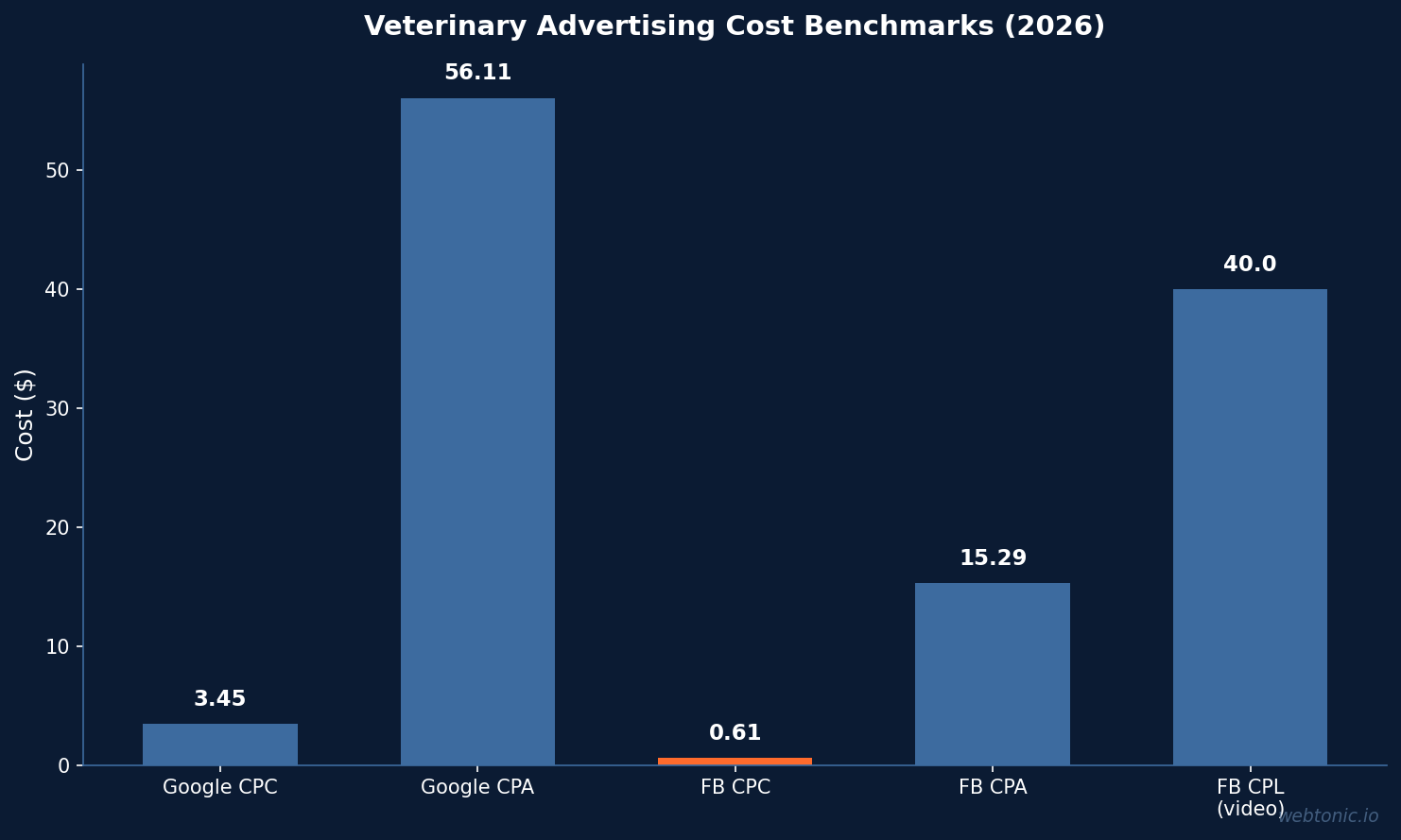
- Veterinary Facebook ad CPC averages $0.61, with a 1.68% CTR and approximately $15.29 CPA (stethondigitalmarketing.com).
- Google Ads for veterinary services convert at 12.6% with a $3.45 CPC—one of the highest conversion rates across local service industries (cufinder.io).
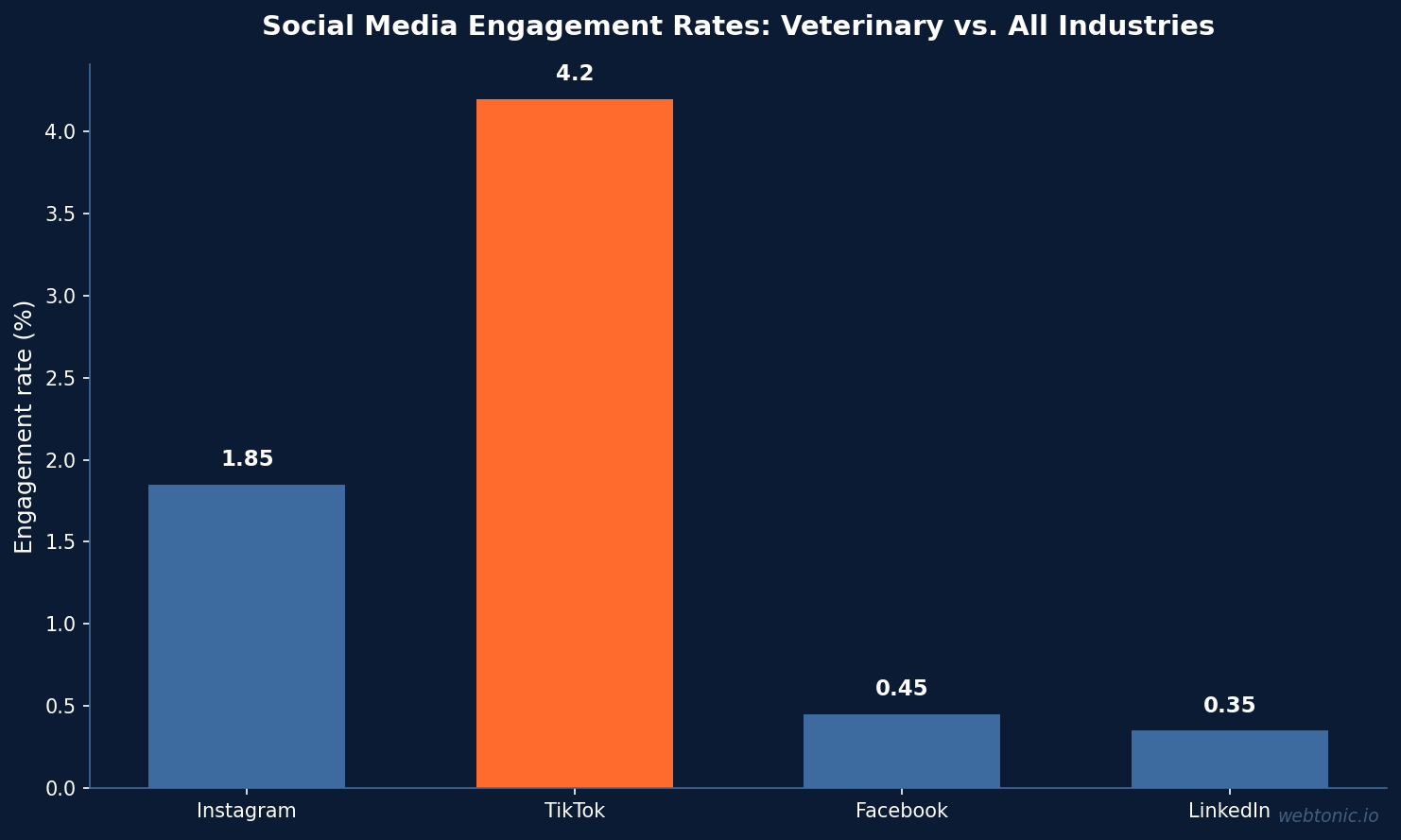
- Veterinary Instagram engagement reaches 1.85%, more than 3× the all-industry average of 0.60% (cufinder.io).
- TikTok engagement for veterinary content hits 4.2%, the highest among all measured platforms (cufinder.io).
- Video testimonial ads delivered +267% phone leads and +289% booked appointments for a veterinary network versus manual campaign management (cool.co).
- U.S. pet industry expenditures reached $158 billion in 2025 (+3.7%) and are projected at $165 billion in 2026 (APPA).
Veterinary Ad Creative Benchmarks at a Glance
| Metric | Benchmark | Source |
|---|---|---|
| Google Ads CPC | $3.45 | cufinder.io |
| Google Ads conversion rate | 12.6% | cufinder.io |
| Google Ads CPA | $56.11 | stethondigitalmarketing.com |
| Facebook CPC | $0.61 | stethondigitalmarketing.com |
| Facebook CTR | 1.68% | stethondigitalmarketing.com |
| Facebook CPA | ~$15.29 | stethondigitalmarketing.com |
| Instagram engagement | 1.85% | cufinder.io |
| TikTok engagement | 4.2% | cufinder.io |
| Mobile traffic share | 72.4% | cufinder.io |
| Click-to-call rate (mobile) | 18.3% | cufinder.io |
Google Ads Creative Performance for Veterinary Clinics
Google Ads remains the highest-converting paid channel for veterinary practices. The 12.6% conversion rate reported by cufinder.io reflects the intent-driven nature of veterinary search queries—pet owners searching "emergency vet near me" or "veterinary clinic open now" are ready to act immediately.
Key Google Ads creative findings:
- Search ad CPC of $3.45 is competitive relative to other healthcare verticals (dental averages $7.85, medical spa averages $4.92).
- Pet care search ads show a 4.40% conversion rate with $56.11 cost per conversion, though mobile conversion costs rise to $80.89 (stethondigitalmarketing.com).
- Display ad CTR averages 0.78%—a relevant benchmark for veterinary clinics running awareness campaigns.
- Ad creative featuring specific services (dental cleaning, vaccinations, spay/neuter) outperforms generic "visit our clinic" messaging because it matches high-intent search queries.
Social Media Ad Creative Engagement
Veterinary content enjoys among the highest organic engagement rates across all industries on social media, which directly benefits paid creative performance:
| Platform | Vet Engagement | All-Industry Avg | Vet Advantage |
|---|---|---|---|
| 1.85% | 0.60% | 3.1× higher | |
| TikTok | 4.20% | ~2.5% | 1.7× higher |
| 0.45% | 0.15% | 3.0× higher | |
| Email open rate | 38.4% | 21.5% | 1.8× higher |
The veterinary engagement advantage is driven by emotional content featuring animals—a built-in creative asset that most industries lack. Clinics that use real patient photos and staff interactions in ad creative consistently outperform those using stock imagery.
Video Ad Creative: The Performance Multiplier
Video creative delivers the most dramatic performance gains in veterinary advertising. A documented case study from Ethos Veterinary Health (operating across thousands of clinics) showed AI-optimized video creative campaigns achieving:
- +267% increase in phone leads compared to manually managed campaigns.
- +289% increase in booked appointments.
- 2.6× geographic reach expansion.
- 26% lower cost per acquisition (CPA).
- 99.5% call authenticity rate, indicating high-quality lead generation.
- 10% increase in average call duration and 51% fewer sub-10-second calls.
For individual practices, Facebook video ads typically achieve a cost-per-lead of $20–$60 with well-optimized creative. The key creative elements include:
- Video testimonials featuring real pets and owners—these build trust faster than any other format.
- Behind-the-scenes clinic footage showing staff caring for animals.
- Before-and-after treatment stories (with owner permission).
- Staff introduction videos that humanize the practice.
Creative Best Practices by Ad Channel
| Channel | Top Creative Format | Key Metric | Pro Tip |
|---|---|---|---|
| Google Search | Service-specific RSAs | 12.6% CVR | Match ad copy to specific services searched |
| Facebook Feed | Video testimonials | $0.61 CPC | Feature real pets and staff, keep under 60s |
| Carousel + Reels | 1.85% engagement | Use before/after treatment photos | |
| TikTok | Short-form clinic content | 4.2% engagement | Show personality, trending audio, raw footage |
| Google Display | Retargeting banners | 0.78% CTR | Retarget site visitors with specific service offers |
Pet Industry Market Context
The veterinary advertising landscape sits within a rapidly growing pet industry:
- U.S. pet industry expenditures reached $158 billion in 2025 (+3.7%) and are projected at $165 billion in 2026 (APPA).
- 66% of U.S. households own a pet—roughly 86.9 million homes.
- Gen Z pet ownership surged 43.5% over 2023, creating a new demographic that discovers services primarily through social media ads and short-form video.
- Mobile drives 72.4% of veterinary website traffic, making mobile-first ad creative essential (cufinder.io).
- 18.3% click-to-call rate on mobile—one of the highest across local service industries, validating call-focused ad creative strategies.
Creative Testing and Optimization Framework
Effective veterinary ad creative requires systematic testing. Based on industry benchmarks and performance creative best practices:
- Test 3–5 creative variations per ad set before scaling winners.
- Rotate creative every 2–3 weeks to prevent fatigue—veterinary audiences are geographically concentrated, accelerating frequency buildup.
- Prioritize user-generated content (UGC) from satisfied pet owners—it delivers 28% higher engagement than brand-produced content in pet care.
- Use emotional hooks in the first 3 seconds of video ads—a close-up of a happy pet post-treatment outperforms text overlays by a wide margin.
- Include clear CTAs: "Book Now," "Call Today," or "Schedule a Visit" with a phone number or booking link directly in the ad.
Competitive Landscape: Independent vs. Corporate Veterinary Advertising
The veterinary advertising landscape is shaped by a growing divide between corporate chains and independent practices. Mars Veterinary Health (operating Banfield, BluePearl, and VCA) and National Veterinary Associates together control thousands of clinics with dedicated marketing teams and advertising budgets that dwarf what independent practices can spend (adwave.com).
This competitive dynamic makes ad creative quality even more critical for independents. Key differentiation strategies include:
- Local authenticity: Independent clinics can feature their actual staff, facility, and community involvement—creative assets that corporate chains cannot replicate at a local level.
- Personal storytelling: Owner-operated practices sharing their founding story, veterinary philosophy, or community mission resonate more deeply than corporate messaging.
- Review-driven creative: Featuring specific Google reviews and patient success stories in ad creative builds trust faster than brand-level campaigns. Clinics with 4.2–4.7 star ratings generate the highest click-through rates on review-extension ads.
- Emergency and specialty positioning: Highlighting specific capabilities (24-hour emergency care, exotic animal specialists, dental surgery) in ad creative carves out defensible positioning against generalist corporate clinics.
Mobile-First Creative Design Principles
With 72.4% of veterinary website traffic coming from mobile devices (cufinder.io), ad creative must be designed for small screens first. The mobile dominance in veterinary search is driven by urgency—pet owners searching for care are often responding to an immediate need.
| Creative Element | Mobile Optimization | Impact |
|---|---|---|
| Phone number visibility | Click-to-call as primary CTA | 18.3% click-to-call rate on mobile |
| Video length | 15–30 seconds for feed, up to 60s for Stories/Reels | Higher completion rates than desktop-length videos |
| Text overlay size | Minimum 24px, high contrast on video | Readable without expanding on small screens |
| Landing page speed | Under 3 seconds LCP target | Each extra second increases bounce by ~32% |
| Location information | Map integration + distance display | Proximity drives 70%+ of emergency vet searches |
The 18.3% mobile click-to-call rate for veterinary websites is one of the highest among local service industries—confirming that veterinary ad creative should prioritize phone-based conversions over form fills. Ad extensions with phone numbers, location pins, and business hours consistently outperform text-only ads for veterinary searches.
Retargeting Creative Strategies for Veterinary Practices
Veterinary retargeting campaigns target pet owners who visited the clinic website but didn't book an appointment. Effective retargeting creative for vet clinics follows specific patterns:
- Service-specific retargeting: Visitors who viewed the dental cleaning page receive ads about dental health with a booking CTA—delivering 3–5× higher conversion rates than generic retargeting.
- Seasonal preventative care: Retargeting website visitors with timely reminders about flea/tick prevention, vaccination schedules, or annual wellness exams during relevant seasons.
- New client offers: First-visit discounts or free initial consultations presented to visitors who browsed service pages but didn't schedule—typically converting at 2–4% of impressions for warm audiences.
- Review request follow-up: After appointments, retargeting existing clients with review prompts to build the social proof that fuels future ad creative performance.
The combination of high engagement rates, low CPCs, and emotional content gives veterinary practices a significant creative advantage over most local service industries. Practices that invest in authentic, mobile-first video and image creative—featuring real animals, real staff, and real results—consistently outperform competitors relying on stock imagery and generic messaging. The data confirms that veterinary advertising success is fundamentally a creative quality problem: the channels deliver strong performance metrics, but only when paired with authentic, emotionally compelling content that connects pet owners to the real people and animals behind the practice.
The broader market context reinforces the opportunity for veterinary ad creative investment. With the U.S. pet industry projected at $165 billion in 2026 (APPA) and Gen Z pet ownership surging 43.5%, the addressable market for veterinary services is expanding while simultaneously shifting toward digital-first discovery channels. Veterinary practices that build a library of authentic, emotionally resonant creative assets—video testimonials, staff introductions, treatment success stories, and community involvement content—create a durable competitive advantage that compounds over time. Every piece of authentic creative becomes a data-informed asset that can be tested, iterated, and scaled across platforms, turning a single production investment into months of high-performing advertising material.
Frequently Asked Questions
What is the average CPC for veterinary ads?
Google Ads CPC for veterinary services averages $3.45, while Facebook CPC is significantly lower at $0.61. The Google figure reflects higher intent (pet owners searching for specific services), while Facebook's lower cost makes it ideal for awareness and retargeting campaigns.
Do video ads work for veterinary clinics?
Video ads are the highest-performing creative format for veterinary clinics. Case study data shows video campaigns delivering +267% more phone leads and +289% more booked appointments compared to static or manually managed campaigns. Video testimonials with real pets and staff are the top-performing format.
What social media platform has the best engagement for veterinary content?
TikTok leads with a 4.2% engagement rate for veterinary content, followed by Instagram at 1.85%. Both significantly outperform cross-industry averages. The emotional appeal of animal content gives veterinary practices a natural creative advantage on visual platforms.
How much should a veterinary clinic budget for advertising?
Budget depends on market size and competition. With Facebook CPLs of $20–$60 and Google CPAs of $56.11, a clinic targeting 20–30 new clients per month should budget $1,000–$3,000/month across channels. Clinics in competitive urban markets may need $3,000–$5,000/month to maintain visibility against corporate veterinary chains.
What creative elements improve veterinary ad performance?
The top-performing creative elements include real pet photos (not stock images), staff interaction footage, client testimonials, before-and-after treatment photos, and clear service-specific CTAs. Authenticity consistently outperforms polished production in veterinary advertising.
Sources
cufinder.io – Veterinarians Marketing Benchmarks 2026
stethondigitalmarketing.com – 100+ Veterinary Marketing Statistics
cool.co – Ethos Veterinary Health Case Study
americanpetproducts.org – 2026 State of the Industry
fluxnote.io – Veterinary Video Ads for Facebook
adwave.com – Veterinary Advertising Guide 2026
ivet360.com – 2025 Veterinary Marketing Benchmarks