Table of contents
No LinkedIn Ads benchmark is published specifically for trucking and logistics, so the honest starting point is what the platform costs for the B2B buyer this industry is actually trying to reach - freight brokers, shippers and supply chain officers - using the closest verified cross-industry B2B ad-spend data available. That data points toward narrower, more precise targeting as the direction logistics LinkedIn budgets should move, not broader reach.
Key Takeaways
- LinkedIn's cost per lead was $202 in a 2026 B2B benchmark, the second-highest of four channels tracked.
- That benchmark covered 153 B2B advertisers and $57.6M of 2025 spend, producing 211,000 leads.
- Facebook cost $145 per lead and Instagram $138 in the same dataset - both cheaper than LinkedIn.
- Google Ads cost $524 per lead, the most expensive of the four channels tracked.
- LinkedIn's click-through rate was 0.67%, with a $9.39 cost per click and $63.19 CPM.
- The B2B buyer journey now averages 211 days, per LinkedIn's own research.
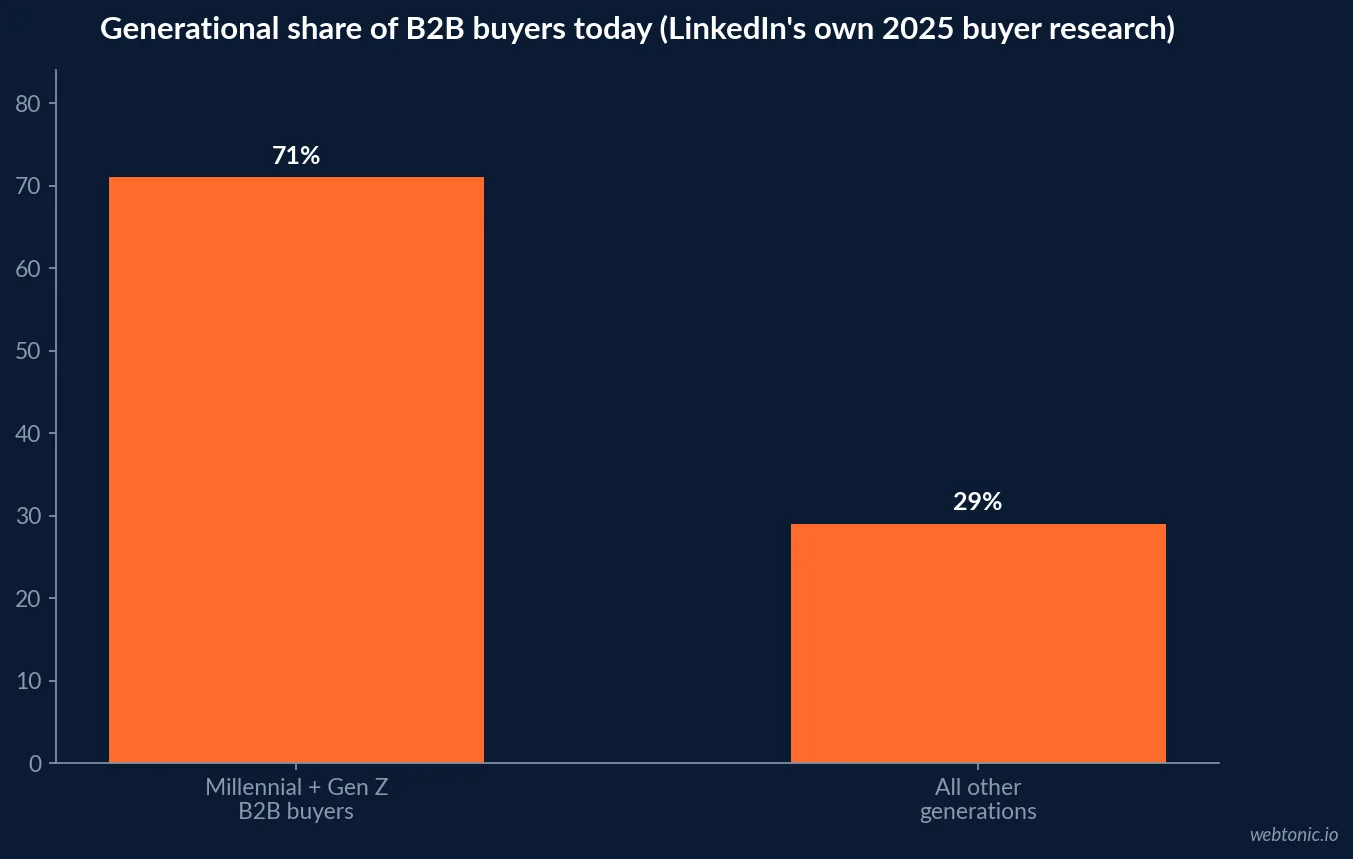
- Millennials and Gen Z now make up 71% of B2B buyers, per the same LinkedIn data.
- C.H. Robinson manages about 37 million shipments a year for 75,000 active customers - the buyer scale LinkedIn campaigns are reaching into.
- Trucks moved 72.7% of U.S. freight tonnage in 2024, and the sector's freight bill hit $906 billion.
- DAT's rate data is built from $1 trillion in freight invoices, the market context a logistics buyer already has open in another tab.
- ATA's last published driver-shortage estimate is 80,000, relevant context for capacity-focused ad messaging.
Why there is no trucking-specific LinkedIn benchmark
LinkedIn does not publish cost data segmented by advertiser industry, and third-party B2B benchmark studies group advertisers by function and spend tier rather than by vertical - transportation and logistics buyers are present in these datasets, but not broken out separately. That makes the honest move to use the closest verified cross-industry B2B figures and say plainly that they are not trucking-specific, rather than inventing a number that sounds more precise than it is.
| What exists | What it is | Whether it is trucking-specific |
|---|---|---|
| Metadata's 2026 B2B Advertising Benchmark | 153 advertisers, $57.6M 2025 spend, 211,000 leads | No - all-industry B2B |
| LinkedIn's own B2B buyer research | Buyer-journey and demographic research | No - all-industry B2B |
| Recotap and similar ad-tool benchmark posts | Secondary aggregation of ad platform data | Some cite a transportation/logistics row, unverified sample size |
| A named trucking-specific LinkedIn CPL study | Does not exist in the sources reviewed | N/A |
What LinkedIn actually costs, per the closest verified data
Metadata's 2026 B2B Advertising Benchmark - drawn from 153 B2B advertisers who spent $57.6M in 2025 and produced 211,000 leads, published as an open dataset - found LinkedIn costing $202 per lead at a 0.67% click-through rate, with a $9.39 cost per click and $63.19 CPM. In the same study, Facebook came in at $145 per lead and Instagram at $138, both cheaper than LinkedIn; Google Ads was the most expensive of the four at $524 per lead.
Read plainly, LinkedIn is not the cheapest way to generate a raw B2B lead - it is the platform priced for reaching a specific senior title, which is a different value proposition than lead volume.
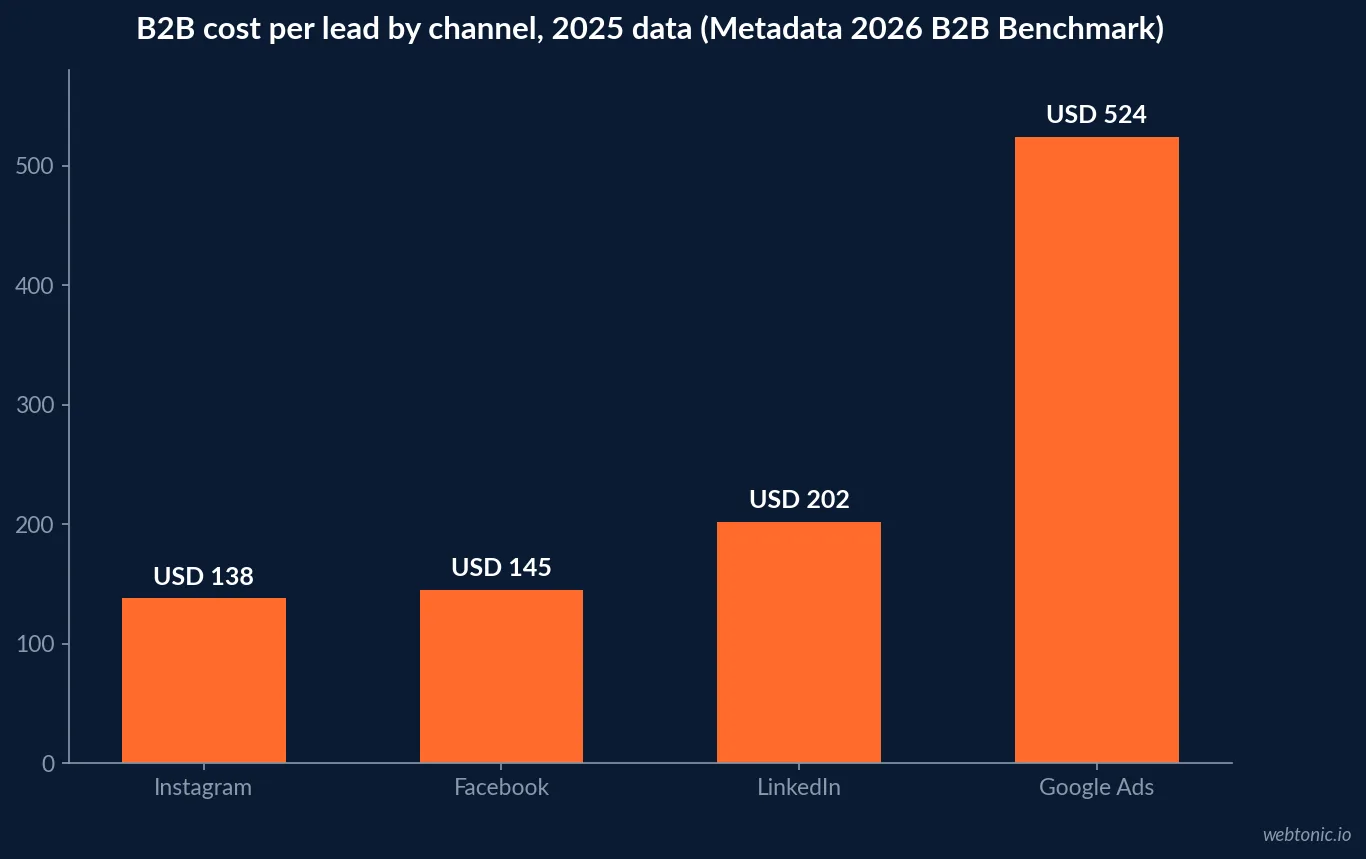
| Channel (Metadata 2026 B2B benchmark) | Cost per lead | CTR | CPC | CPM |
|---|---|---|---|---|
| $202 | 0.67% | $9.39 | $63.19 | |
| Google Ads | $524 | - | - | - |
| $145 | 0.79% | $1.95 | $15.50 | |
| $138 | - | - | - |
Why the buyer justifies the premium
The reason LinkedIn's cost per lead is defensible for logistics advertisers despite being pricier than Facebook or Instagram is who the platform can actually target. LinkedIn's own targeting infrastructure supports filtering by job title, function, seniority, skills and group membership - precise enough to put an ad in front of a VP of supply chain or a director of logistics specifically, a level of precision a general-audience platform cannot match. That is the trade this industry is making: a higher cost per lead for a buyer who is actually authorized to sign a carrier or 3PL contract.
LinkedIn's own research reports the B2B customer journey now averages 211 days and that millennials and Gen Z now represent 71% of B2B buyers - both relevant to a logistics sales cycle that is rarely closed on the first touch, and both arguments for a longer nurture sequence rather than a single lead-gen push.
The freight market the ad budget is selling into
A logistics LinkedIn campaign is competing for the attention of buyers who already have market data at their fingertips. DAT's RateView is built from $1 trillion in verified freight invoices, and C.H. Robinson reports managing roughly 37 million shipments a year for 75,000 active customers across more than 450,000 contract carriers. On the industry-wide side, American Trucking Associations puts trucks at 72.7% of U.S. freight tonnage moved in 2024, generating an estimated $906 billion freight bill, with a driver shortage last estimated at 80,000 in an October 2021 release.
An ad claiming capacity, reliability or on-time performance is being read by a buyer who can check that claim against a market rate tool in the next browser tab, which raises the bar for what a LinkedIn ad can credibly say without a number behind it.
| Freight market fact (verified year) | Figure | Source |
|---|---|---|
| Share of U.S. freight tonnage moved by truck | 72.7% (2024) | American Trucking Associations |
| U.S. trucking freight bill | $906 billion (2024) | American Trucking Associations |
| Freight invoices behind DAT's rate data | $1 trillion | DAT Freight & Analytics |
| Shipments managed annually, C.H. Robinson | ~37 million, for 75,000 active customers | C.H. Robinson investor relations |
| ATA's last published driver shortage estimate | 80,000 (Oct. 2021) | American Trucking Associations |
Where the budget is actually heading: narrower, not broader
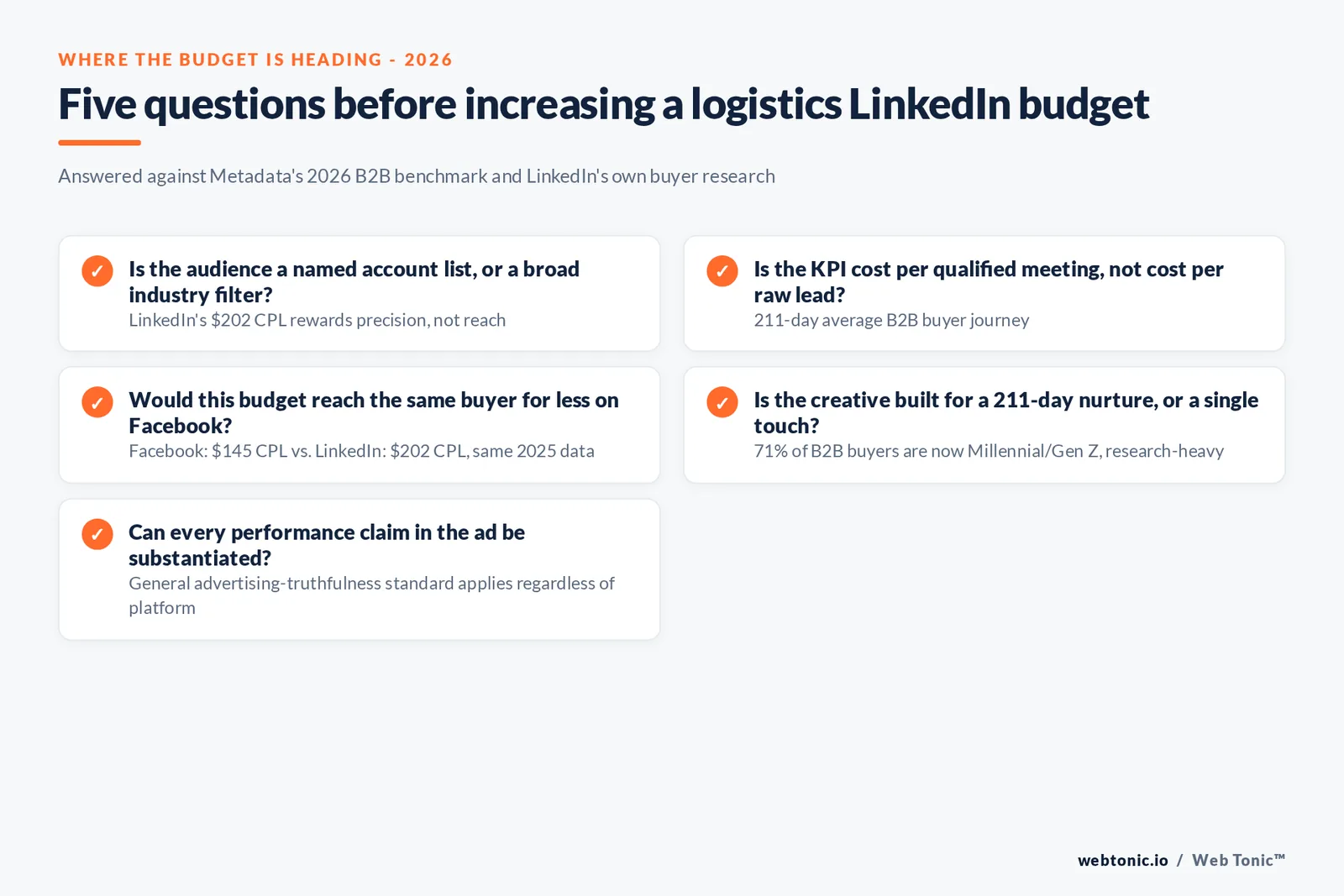
Given a $202 cost per lead against a 211-day buyer journey, the defensible direction for a logistics LinkedIn budget is toward account-based targeting - named shipper accounts, specific supply-chain titles, retargeting website visitors who match a target account list - rather than a broad "logistics decision makers" audience. LinkedIn's targeting depth is the platform's advantage; running it like a broad-reach channel spends premium-priced clicks on an audience a cheaper platform could have reached just as well.
| Targeting approach | Fit for LinkedIn's cost structure | Fit for a broad logistics audience |
|---|---|---|
| Named account list (ABM) | Strong - matches the platform's precision and cost | N/A |
| Job title + seniority filter (e.g. VP Supply Chain) | Strong - the platform's core advantage | Weak - too narrow for broad reach goals |
| Broad "logistics" interest/industry targeting | Weak - pays LinkedIn CPL for reach a cheaper channel offers | Better suited to Facebook/Instagram at $138-$145 CPL |
| Retargeting site visitors matching a target account list | Strong - narrow audience, high intent | N/A |
What a compliance review still needs to check
Freight-brokerage and 3PL ad claims sit under the same general advertising-truthfulness standard as any other B2B claim - a LinkedIn ad promising capacity, on-time percentages or coverage that the sales team cannot back up with real data is a legal and reputational risk independent of the platform it runs on. Consumer-facing review and testimonial rules, including the FTC's 2024 rule banning fake reviews and testimonials, apply less directly to B2B lead-gen ads than to consumer reviews, but the underlying principle - do not publish a claim, testimonial or case-result figure the business cannot substantiate - governs any logistics company's paid social presence regardless of audience.
| Compliance check | Why it applies to a logistics LinkedIn campaign |
|---|---|
| Substantiate any on-time %, capacity or coverage claim | A false B2B performance claim is actionable regardless of platform |
| Do not publish a client testimonial without consent and accuracy | Governed by the same truthfulness principle behind the FTC's 2024 rule |
| Keep driver-recruiting creative separate from shipper-facing creative | Different audiences, different legal frameworks (EEOC vs. general advertising law) |
What LinkedIn's format mix means for a logistics campaign
Metadata's benchmark measures cost by channel, not by ad format within LinkedIn, but the platform's own buyer research is useful for choosing formats: with 71% of B2B buyers now in the millennial/Gen Z cohort and a 211-day research window, a single-touch lead-gen form ad is competing against a buyer who has already read several vendor comparisons before ever filling one out. Thought-leadership and content-led formats that show up earlier in that 211-day window are a better fit for the buyer LinkedIn's own data describes than a cold lead-gen form aimed at someone who has not started researching yet.
What this looks like next to the Google Ads and paid-search side of the budget
Metadata's benchmark puts Google Ads at $524 per lead in the same 2025 dataset - well above LinkedIn's $202 - which reframes the usual "LinkedIn is expensive" objection. Against paid search, LinkedIn is the cheaper B2B channel in this specific dataset; it is only expensive relative to Facebook and Instagram, platforms that were not built for job-title-level targeting in the first place. Budget conversations that pit LinkedIn against Facebook without naming the audience difference are having the wrong argument.
Sequencing a LinkedIn budget increase
Given the 211-day buyer journey and the $202 cost per lead, a defensible sequence starts small: test a named-account list against a single service line, measure cost per qualified meeting rather than cost per raw lead, and only widen the account list once that ratio holds. Scaling a broad "logistics" audience before that ratio is proven multiplies the platform's premium cost across an audience that has not been shown to convert yet.
Reporting it honestly
Report a logistics LinkedIn campaign against the $202 B2B benchmark cost per lead, not against a trucking-specific number that does not exist, and expect a longer path to a closed deal given the 211-day average B2B buyer journey. Judging a LinkedIn account-based campaign on 30-day lead volume alone will read as underperformance when it is actually on pace for a B2B sales cycle. Our growth marketing team builds that reporting structure before a campaign launches, our paid search practice can pressure-test whether Google Ads' $524 cost per lead is really the better fit for a given service line, and if the current LinkedIn setup is running broad-reach targeting at LinkedIn's premium cost, talk to us about narrowing it.
Frequently Asked Questions
Is there a published LinkedIn Ads benchmark specific to trucking and logistics?
Not from LinkedIn itself or from any trucking trade body. The closest verified figures are B2B-wide paid media benchmarks that include transportation and logistics buyers inside a broader B2B advertiser pool - Metadata's 2026 benchmark, built from 153 advertisers and $57.6M of 2025 spend, is the clearest of these, and it is not trucking-specific. Any 'LinkedIn cost per lead for freight brokers' figure circulating without a named study behind it should be treated as unverified.
Who is the actual buyer for a trucking or logistics LinkedIn ad?
Freight brokers, shippers, supply chain officers and procurement leads - the people who decide which carrier or 3PL to work with - not drivers. LinkedIn's own targeting data supports job title, function, seniority and group-membership filtering precise enough to reach a VP of supply chain or a director of logistics specifically, which is the platform's real advantage for this industry: reaching a narrow, senior B2B buyer that general search or social cannot target as precisely.
How much does a B2B lead cost on LinkedIn compared to other channels?
Metadata's 2026 B2B Advertising Benchmark, built from 153 advertisers and $57.6M of tracked 2025 spend across 211,000 leads, put LinkedIn's cost per lead at $202 - the highest of the four channels in that dataset (Google Ads $524 was higher still, while Facebook came in at $145 and Instagram at $138). LinkedIn's click-through rate in the same data was 0.67%, with a cost per click of $9.39.
Why would a logistics company pay more per lead on LinkedIn instead of switching to Facebook?
Because the buyer being targeted is different, not because LinkedIn is simply more expensive for the same audience. LinkedIn's own published research finds B2B buyers now take an average of 211 days to complete a purchase journey and do most of that research before ever speaking to sales, and that millennials and Gen Z now make up 71% of B2B buyers - a precision-targeting platform earns a premium reaching that specific, senior audience, which a broader consumer-facing platform is not built to isolate.
Where are logistics LinkedIn budgets actually heading, based on the data?
Toward more precise account-based targeting rather than broad reach, because the cost data supports narrowing, not widening. With LinkedIn's cost per lead already the second-highest tracked in Metadata's B2B study, spending broadly against a generic 'logistics' audience wastes budget against a platform priced for precision. The more defensible direction is targeting named accounts and specific titles - the segment LinkedIn's own targeting data shows it can isolate - rather than running an industry-wide campaign.
Sources
Metadata - B2B Advertising Benchmarks 2026
Federal Trade Commission - Final rule banning fake reviews and testimonials, 2024
LinkedIn Marketing Solutions - B2B buyer trends, 2025
DAT Freight & Analytics - RateView Analytics
C.H. Robinson - Investor Relations overview
American Trucking Associations - Economics and Industry Data
American Trucking Associations - Driver shortage estimate, October 2021