Table of contents
No published study benchmarks influencer or UGC marketing for accounting firms, so this report pairs 2026 IRS filing-season data with cross-industry creator rates and the rules that govern how tax practitioners advertise. Every cross-industry figure is labelled as such.
Key Takeaways
- 74.7 million 2026 returns were e-filed by tax professionals to 1 May.
- Self-prepared e-filings reached 65.6 million, up 1.7%.
- IRS.gov visits hit 554.4 million, up 61.3% year on year.
- The average 2026 refund was USD 3,273, up 11.1%.
- US financial brands spent an estimated USD 2.2 billion on creators in 2025 (IAB).
- 58% of finance and health brands name proving ROI as their top creator challenge.
- Entrepreneur and Business creators average USD 295 per collaboration (Collabstr).
- 80% of Collabstr collaborations cost under USD 300 (cross-industry).
- 87.49% of marketers expect influencer budgets to rise in 2026 (IMH).
- 79% of enterprise marketers struggle to measure influencer ROI (Linqia).
- No accounting-specific engagement rate, cost or ROI benchmark exists.
The filing season is the campaign calendar
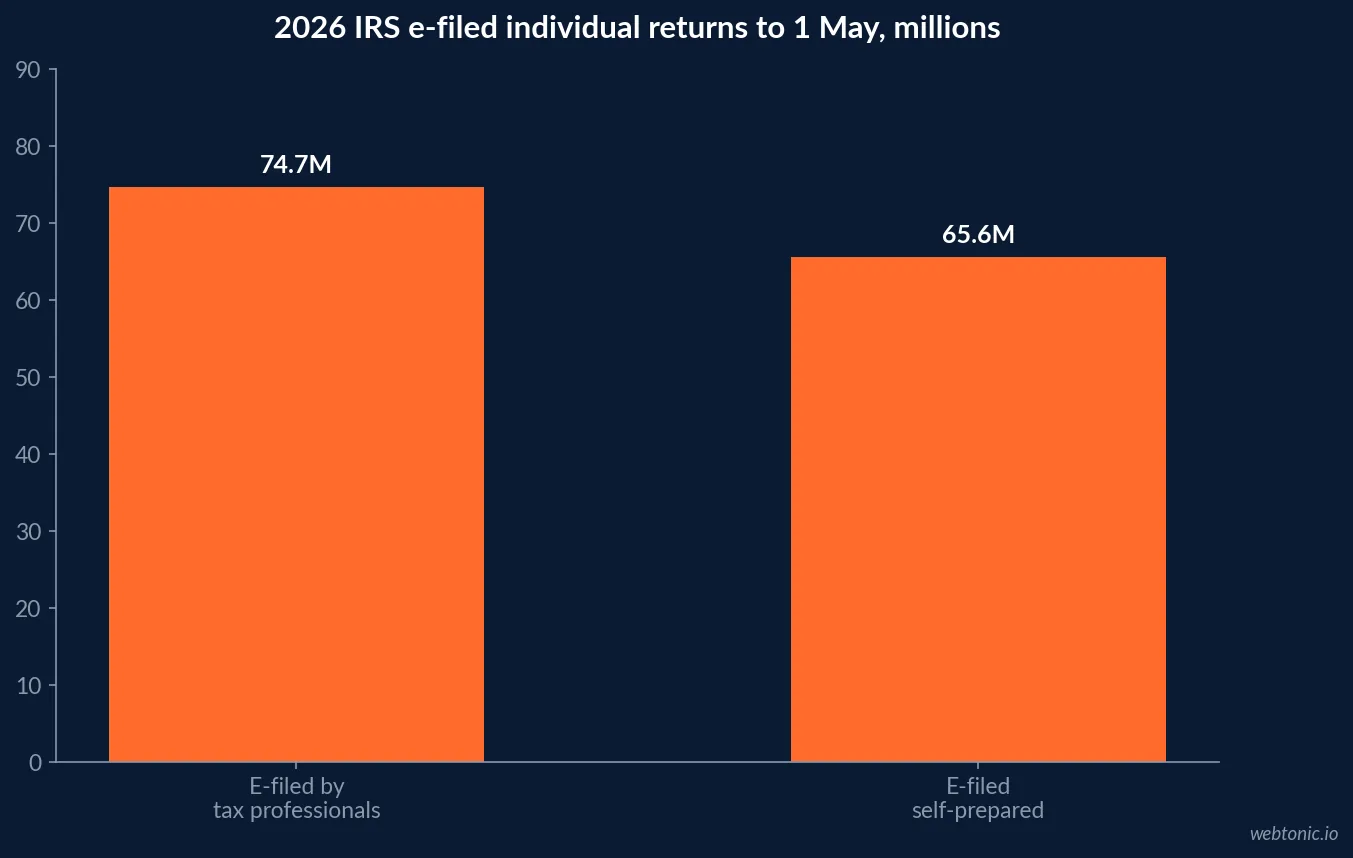
For tax firms the question is not whether demand exists but when it peaks. The IRS filing season statistics to the week ending 1 May 2026 show 143,667,000 individual returns received and 140,234,000 e-filed. Of those, 74,678,000 came from tax professionals, up 0.3%, while 65,557,000 were self-prepared, up 1.7%. Paid preparers still file more than half of all e-filed returns, but the self-prepared share is the part that grew.
That split is the creative brief. Creator content for a firm has two jobs: make the case for professional help to people who might file alone, and reassure existing clients who are anxious about deadlines, notices and refunds.
| IRS filing metric (to 1 May) | 2025 | 2026 | Change |
|---|---|---|---|
| Total returns received | 144,762,000 | 143,667,000 | -0.8% |
| E-filed by tax professionals | 74,445,000 | 74,678,000 | +0.3% |
| E-filed, self-prepared | 64,478,000 | 65,557,000 | +1.7% |
| IRS.gov visits | 343,761,000 | 554,375,000 | +61.3% |
| Average refund | USD 2,947 | USD 3,273 | +11.1% |
Search behaviour spikes before creators are briefed
The strongest demand signal in the IRS data is not returns but visits: 554.4 million IRS.gov visits to 1 May, against 343.8 million a year earlier. People are researching before they file, which is exactly the moment an explainer from a credible creator can land.
The practical consequence is lead time. Briefing creators in March means content is live for the final weeks only. Firms that brief in December have content in market for the whole of February and March, when refund questions and document checklists dominate.
What the creator market spends on financial brands
The IAB 2025 Creator Economy Ad Spend and Strategy Report estimates US creator ad spend at USD 37 billion in 2025 and projects USD 44 billion in 2026. Its category split puts financial brands at USD 2.2 billion, behind retail at USD 12.3 billion and CPG at USD 5.5 billion. Accounting sits inside that financial bucket; the IAB does not break it out.
The same report flags the hardest part: 58% of finance and health and wellness brands cite proving ROI as their top challenge, which the IAB links to regulatory as well as performance pressure. That is the honest starting point for any accounting firm budgeting creator work.
| US creator ad spend, 2025 (IAB) | Estimate | What it tells a tax firm |
|---|---|---|
| All categories | USD 37 billion | Creator spend is mainstream, not experimental |
| 2026 projection | USD 44 billion | Competition for creator attention keeps rising |
| Retail | USD 12.3 billion | Largest buyer of creator inventory |
| Financial | USD 2.2 billion | The nearest category to accounting |
| Tech | USD 1.9 billion | Tax software brands compete here too |
Creator rate cards for finance and business niches
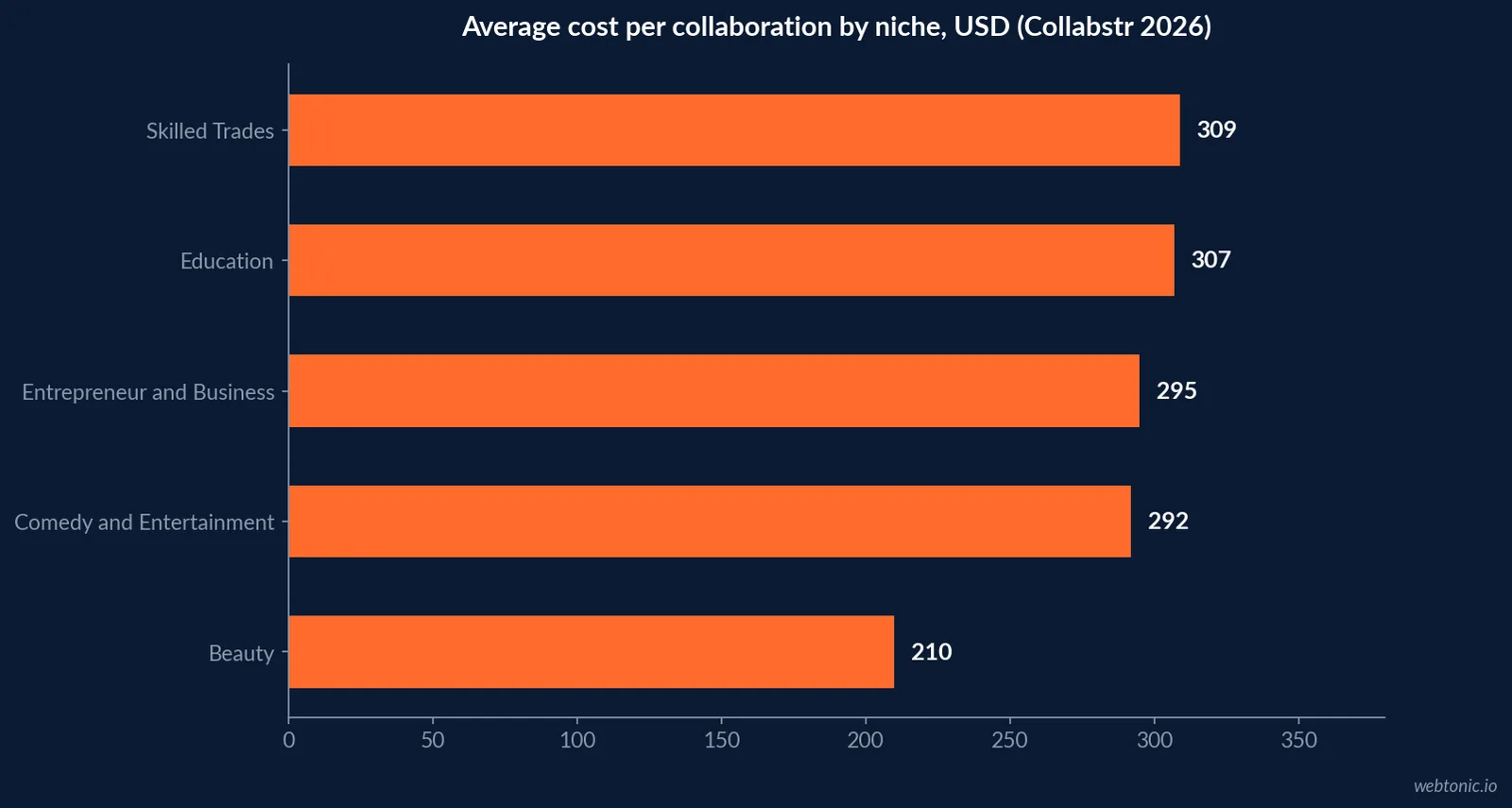
Collabstr's 2026 Influencer Marketing Report analysed more than 21,000 collaborations and 200,000 creators on its marketplace. It lists Entrepreneur and Business among the five most expensive niches at USD 295 per collaboration, alongside Skilled Trades at USD 309 and Education at USD 307. Tax and money explainers usually sit in the business or education niche, so expect to pay toward the top of the marketplace.
These are marketplace figures, weighted toward small brands, and they are not specific to accounting. A credentialed creator - a CPA or enrolled agent with an audience - is a scarcer profile than the averages describe, and a firm should expect to negotiate usage rights separately.
| Collabstr niche (2026 report) | Average per collaboration | Relevance to tax content |
|---|---|---|
| Skilled Trades | USD 309 | Most expensive niche on the platform |
| Education | USD 307 | Tax explainers and how-to content |
| Entrepreneur and Business | USD 295 | Small-business tax and bookkeeping |
| Comedy and Entertainment | USD 292 | Deadline humour formats |
| Beauty (cheapest niche) | USD 210 | Reference point for the low end |
Circular 230 sets the advertising floor
Anyone who practises before the IRS is bound by Circular 230 (31 CFR Part 10). Section 10.30 bars any public communication containing a false, fraudulent or coercive statement, or a misleading or deceptive one. It also stops enrolled agents from using the term "certified" or implying an employment relationship with the IRS.
For creator content that matters in practice. A creator saying a firm "guarantees" a bigger refund, or presenting an enrolled agent as IRS-certified, puts the practitioner on the hook, not just the creator. Section 10.30 also allows published fee information - fixed fees, hourly rates, fee ranges - which gives firms a compliant way to be specific in scripts.
FTC disclosure rules for paid finance creators
The FTC Endorsement Guides (16 CFR 255) require any material connection between an endorser and an advertiser to be disclosed clearly and conspicuously, including payment and free or discounted services. Section 255.2 adds that a consumer testimonial about a key attribute is read as representing what customers generally achieve, so an outsized refund story needs substantiation or a clear statement of typical results.
The FTC's Disclosures 101 for Social Media Influencers guide spells out the creator side: disclose in the post itself, not only in a profile. The consumer review rule (16 CFR 465) separately bans fake reviews and paying for reviews that express a particular sentiment - relevant for firms that reward clients for posting about them.
| Rule | What it covers | Creator-content consequence |
|---|---|---|
| 31 CFR 10.30(a)(1) | False, misleading or coercive claims | No refund guarantees in scripts |
| 31 CFR 10.30(a)(1) | 'Certified' for enrolled agents | Credential lines need exact wording |
| 31 CFR 10.30(b) | Published fee information | Fixed fees or ranges can be stated |
| 16 CFR 255.5 | Material connections | Paid or gifted creators must disclose |
| 16 CFR 465.4 | Buying reviews | No rewards tied to positive sentiment |
Budget intent and measurement, cross-industry
Influencer Marketing Hub's 2026 benchmark surveyed more than 600 respondents: 87.49% expect their influencer budget to rise and only 5.55% expect a cut, with 72.22% planning increases of 50% or more. The same survey reports 66.3% run programmes entirely in-house. None of these figures is broken out for professional services.
Linqia's 2026 survey of more than 200 enterprise marketers is the counterweight: 79% struggle to measure ROI and 48% call attribution their biggest gap. For a tax firm, whose conversion is a booked appointment rather than a checkout, tracking codes and dedicated booking links matter more than views.
Platform mechanics that suit a firm
Two native formats let a firm pay to extend creator content without reposting it. TikTok Spark Ads run organic posts - a firm's own or a creator's, with their authorisation - as ads, with engagement credited to the original post; each ad account supports up to 10,000 Spark Ads and videos up to 10 minutes. LinkedIn Thought Leader Ads sponsor a public post from an employee, creator or other member once they grant permission, which suits partners explaining business-tax changes to owners.
Neither platform publishes accounting-specific performance data, so treat the first season as a test with a small set of creators and a single booking metric.
| Format | Who posts | Fit for a tax or accounting firm |
|---|---|---|
| TikTok Spark Ads | Firm or authorised creator | Consumer refund and deadline explainers |
| LinkedIn Thought Leader Ads | Partner, employee or creator | Business-owner tax updates |
| UGC licensed for paid social | Creator, content delivered to firm | Reusable across ads and site |
| Client testimonials | Real clients | Must follow 16 CFR 465 and 255.2 |
The long view on creator supply
Goldman Sachs Research estimated in 2023 that the creator economy could grow from roughly USD 250 billion to USD 480 billion by 2027. More creators means more finance explainers competing for the same January audience - and more reason to brief early and credential carefully.
Collabstr's data points the same way: UGC campaigns rose from 15% to 35% of its engagements in a year, and over 40% of UGC campaigns come from companies spending under USD 5,000. Small firms are already buyers.
One caution on reading these numbers together: the IRS figures describe filing behaviour, the Collabstr and IAB figures describe creator pricing and spend across many industries, and nothing links them causally. A firm that wants its own benchmark should record cost per booked consultation by creator for one full season and compare it with the same season's paid search and referral costs.
How a firm should plan one filing season
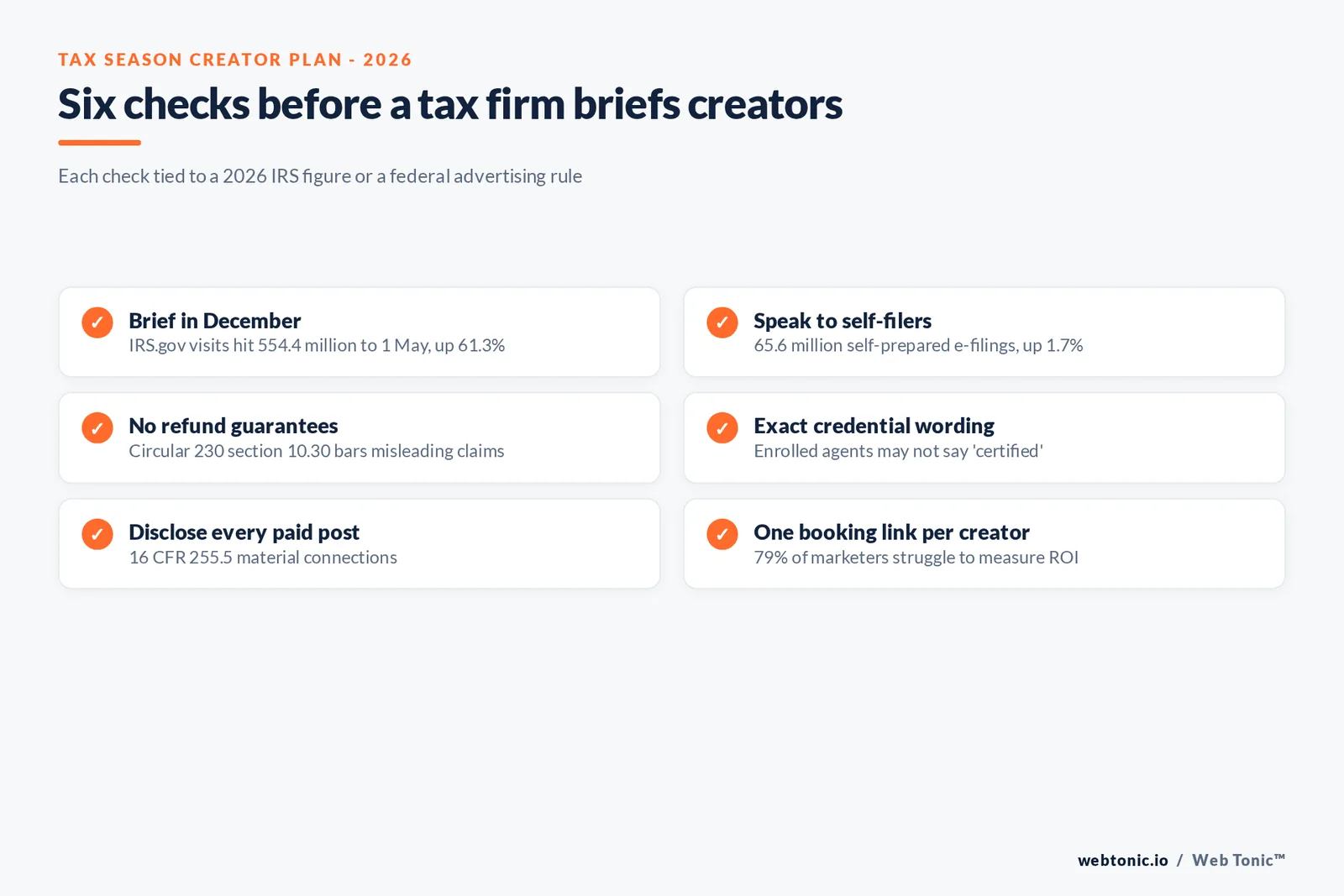
- Brief creators in December so content is live from the first week of filing.
- Split content between self-filers weighing professional help and existing clients.
- Run every script past Circular 230 section 10.30 and your state board's rules.
- Require in-post disclosure from every paid or gifted creator.
- Measure booked consultations through one tracked link per creator.
For the wider channel picture see our influencer and UGC marketing statistics hub, the channel-level influencer marketing statistics, and our tax and accounting SMS marketing data for deadline reminders. Our performance creative team can help build the content plan, or get in touch.
Frequently Asked Questions
Is there an influencer marketing benchmark for accounting firms?
No. None of the 2026 influencer surveys we reviewed (Influencer Marketing Hub, Linqia, Collabstr) publishes a separate engagement rate, cost or return figure for CPA or tax firms. The closest industry signal is the IAB 2025 estimate of USD 2.2 billion in US creator ad spend by financial brands, a wider category than accounting. Everything else on this page is cross-industry data and is labelled that way.
What does a creator cost for an accounting or tax campaign?
Cross-industry marketplace data is the best available guide. Collabstr reports that 80% of the 21,000-plus collaborations it analysed in its 2026 report cost under USD 300, and that the Entrepreneur and Business niche - where most finance and tax creators sit - averaged USD 295 per collaboration, among the five most expensive niches on the platform.
Can a CPA or enrolled agent use testimonials and creator content?
Yes, within limits. Circular 230 (31 CFR 10.30) bars any public communication with a false, fraudulent, coercive, misleading or deceptive statement, and stops enrolled agents from calling themselves 'certified'. The FTC Endorsement Guides require any material connection with a creator to be disclosed clearly, and the FTC consumer review rule (16 CFR 465) bans fake or bought reviews. State boards of accountancy can add their own rules, so check yours before a campaign.
When should a tax firm run creator content?
Inside the filing window. IRS cumulative statistics to 1 May 2026 show 143.7 million individual returns received, 74.7 million of them e-filed by tax professionals, and 554.4 million IRS.gov visits, up 61.3% on 2025. Content that goes live after April competes with far less search and filing activity.
Which platform suits accounting creators best?
It depends on the client. For consumer returns, short-form video on TikTok and Instagram reaches people where Collabstr sees most demand. For business clients, LinkedIn Thought Leader Ads let a firm sponsor a partner's or a creator's own public post. No study compares these platforms for accounting firms specifically.
Sources
IRS - Filing season statistics, week ending 1 May 2026
eCFR - 31 CFR Part 10 (Circular 230)
eCFR - 16 CFR Part 255, FTC Endorsement Guides
eCFR - 16 CFR Part 465, consumer reviews and testimonials
FTC - Disclosures 101 for Social Media Influencers
IAB - Creator Economy Ad Spend and Strategy Report 2025
Collabstr - 2026 Influencer Marketing Report
Influencer Marketing Hub - Influencer Marketing Benchmark Report 2026
Linqia - 2026 State of Influencer Marketing
TikTok - About Spark Ads
LinkedIn - Thought Leader Ads
Goldman Sachs - The creator economy could approach half a trillion dollars by 2027