Table of contents
52% of tax and accounting professionals name efficiency their top priority for 2026, and a deadline-reminder text is one of the cheapest efficiency levers a firm can buy. This page prices the SMS line item from carrier and platform rate cards and states the compliance rules that actually govern a client text - no Web Tonic pricing anywhere.
Key Takeaways
- 52% of tax professionals cite efficiency as their top strategic priority for 2026, up from 44%.
- 51% cite lack of time and resources as the top barrier to more automation.
- 47% cite implementation cost as the second-largest barrier.
- EZ Texting's entry tier starts at USD 25 a month for 500 monthly credits.
- SimpleTexting's entry tier is USD 29 a month for 500 credits, plus a USD 10 number fee.
- Raw carrier SMS costs USD 0.0083 a segment on Twilio's own U.S. rate card.
- A2P 10DLC standard brand registration is a USD 44 one-time fee, plus USD 15 per campaign vetting.
- Monthly 10DLC campaign fees run USD 1.50 to USD 10 after that, per Twilio's own page.
- The Campaign Registry's own brand fee is USD 4 to USD 4.50 depending on entity type.
- Podium's bundled Core plan is USD 399 a month, Pro is USD 599.
- Weave's base plan starts at USD 199 a month, plus bundles from USD 149.
- The FCC's one-to-one consent rule was VACATED in January 2025 - never budget compliance around it.
- 47 CFR 64.1200 requires a working STOP opt-out on every text notification.
- 65% of firms expect revenue growth in the coming year, funding the case for the spend.
Why this is a budget question, not an adoption question
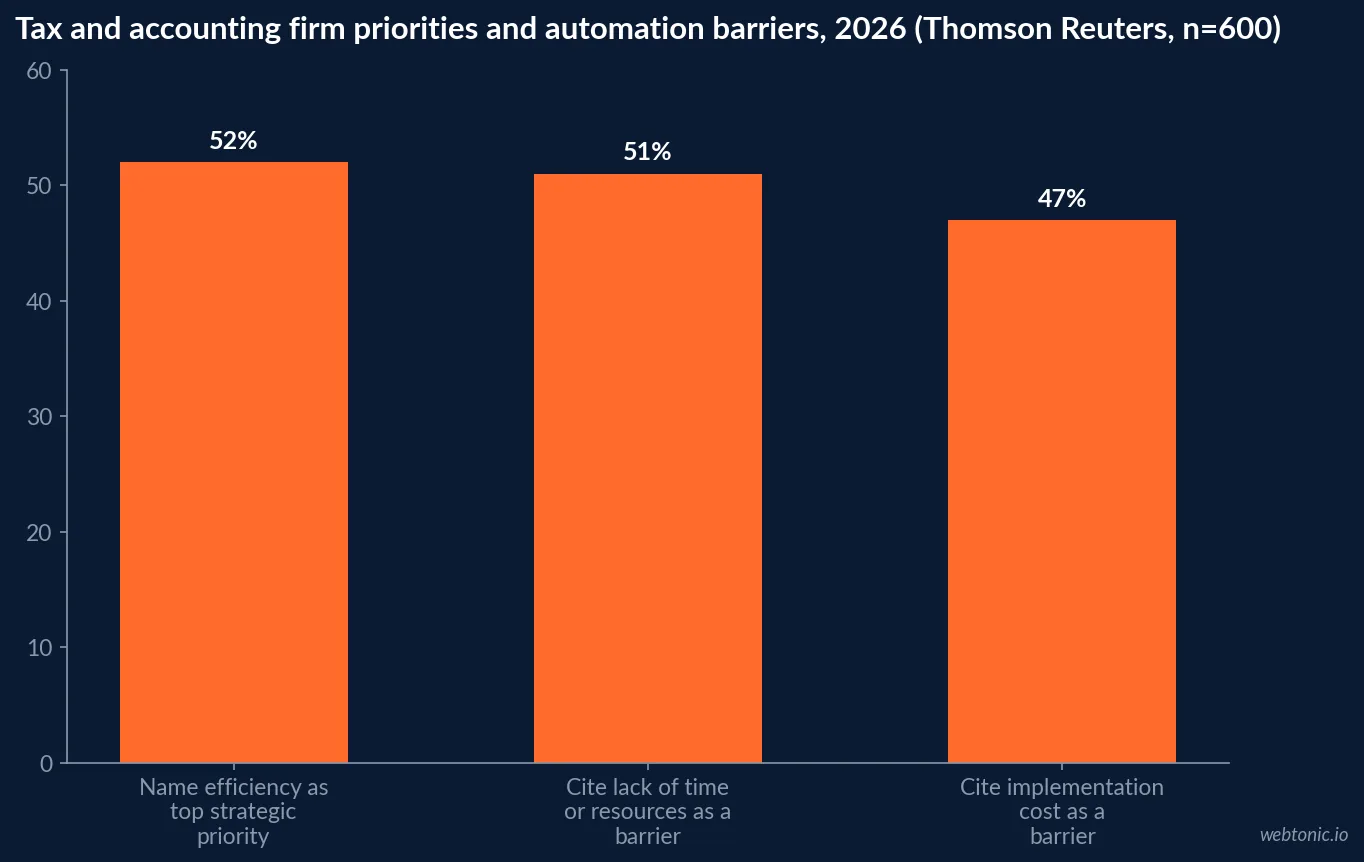
Thomson Reuters' 2026 State of Tax Professionals Report, surveying 600 tax, audit and accounting professionals worldwide, found 52% naming efficiency their top strategic priority - up from 44% the prior year - while 51% cited lack of time and resources and 47% cited implementation cost as the two biggest barriers to further automation. That is a capacity and budget problem, not a skepticism problem, which is exactly why a line-item SMS budget is more useful here than another adoption survey.
| Priority or barrier (2026, own source) | Share | Source | Budget implication |
|---|---|---|---|
| Name efficiency as top strategic priority | 52% | Thomson Reuters 2026 (n=600) | SMS reminders are an efficiency line item, easy to justify |
| Cite lack of time/resources as automation barrier | 51% | Thomson Reuters 2026 | Budget for setup time, not just the subscription |
| Cite implementation cost as automation barrier | 47% | Thomson Reuters 2026 | Entry-tier plans exist specifically to clear this bar |
| Expect revenue growth in the coming year | 65% | Thomson Reuters 2026 | Growth confidence is what funds the new line item |
The rate card: what each platform actually charges
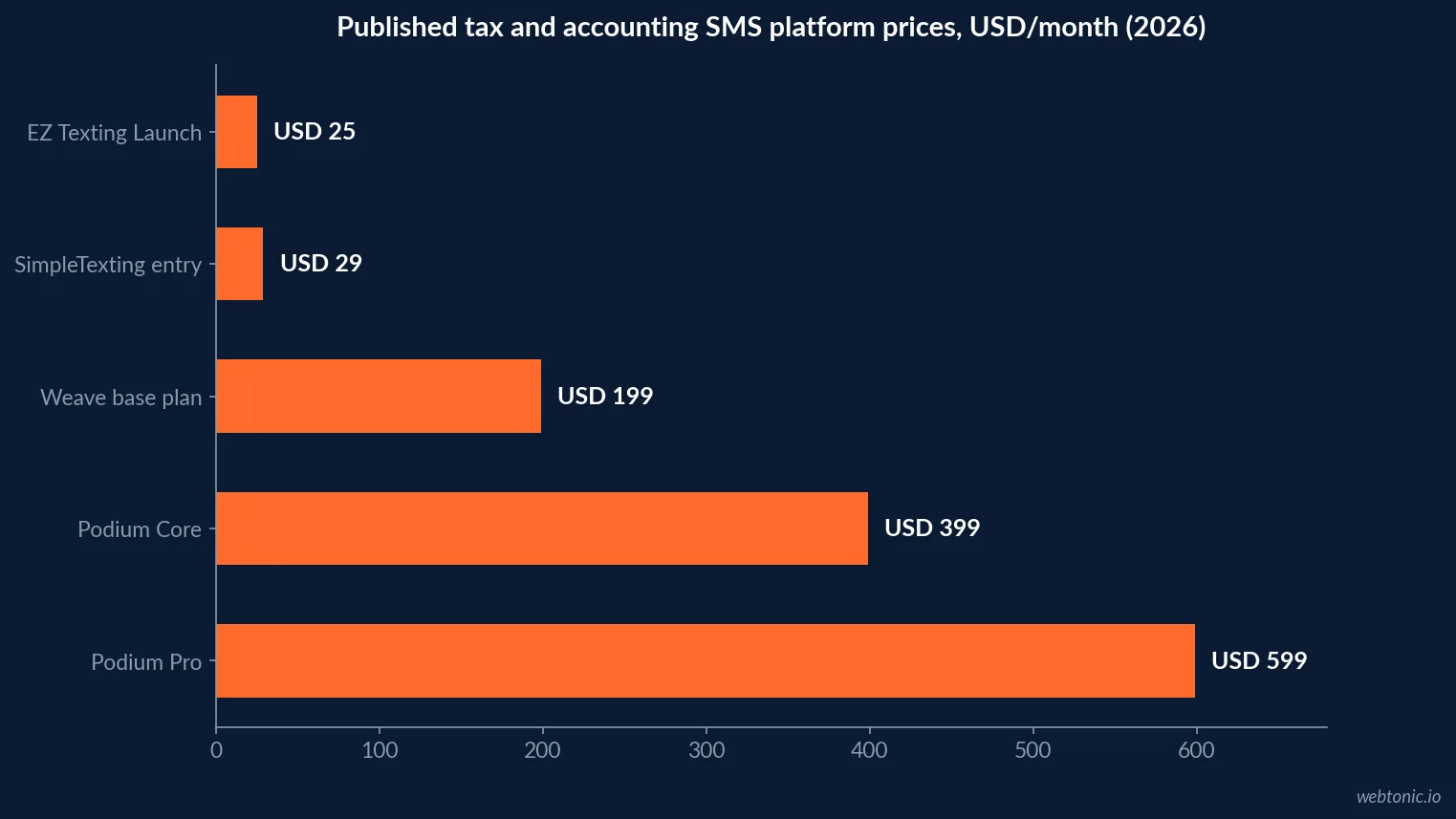
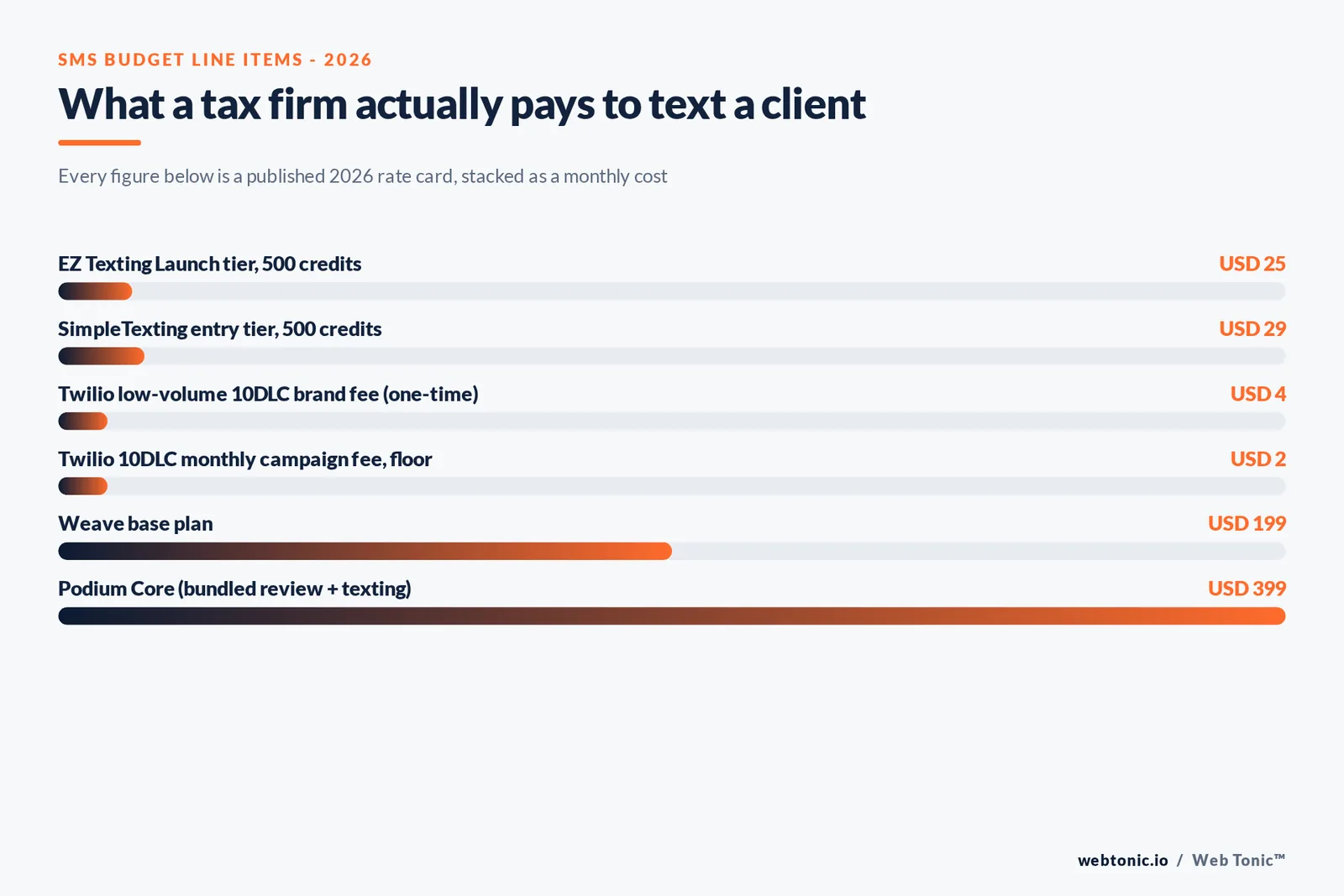
At the raw carrier level, Twilio's own U.S. SMS pricing page lists outbound messages at USD 0.0083 per segment on long codes, toll-free numbers and short codes alike. Almost no firm buys that directly; the budget line is the bundled platform plan. EZ Texting's own pricing page starts its Launch tier at USD 25 a month for 500 monthly credits with overage at USD 0.04 per credit, scaling to a Boost tier at USD 75 with overage down to USD 0.035. SimpleTexting's own pricing calculator lists its entry tier at USD 29 a month for 500 credits plus a USD 10 local-number fee and a one-time USD 4 carrier registration, with overage at 5.5 cents a credit.
Firms that want texting bundled with review requests and call handling are budgeting for a different category of spend. Podium's own pricing data lists Core at USD 399 a month and Pro at USD 599, and Weave's own pricing page starts its base plan at USD 199 a month before add-on bundles from USD 149.
| Line item (2026, own pricing page) | Monthly cost | What it covers | Fits best |
|---|---|---|---|
| Twilio raw SMS | USD 0.0083/segment | Carrier-level per-message cost | Firms building on their own API stack |
| EZ Texting Launch | USD 25/mo (500 credits) | Bulk texting, workflows, keywords | Solo to small-firm deadline reminders |
| SimpleTexting entry tier | USD 29/mo (500 credits) | Two-way texting, autoresponders | Solo to small-firm deadline reminders |
| Weave base plan | USD 199/mo | Texting, missed-call text-back, scheduling | Single-office firm wanting an all-in-one line |
| Podium Core | USD 399/mo | Texting, review management, basic automations | Multi-partner or multi-office firm |
| Podium Pro | USD 599/mo | Everything in Core, automatic lead routing | Firm actively running client acquisition campaigns |
The fee that catches firms off guard: 10DLC registration
Every bulk-sending firm needs A2P 10DLC registration before carriers will deliver texts reliably at volume, and it is billed separately from the platform subscription. Twilio's own 10DLC page lists standard registration at a USD 44 one-time brand fee plus USD 15 per campaign for one-time vetting and USD 1.50 to USD 10 per campaign per month ongoing; low-volume standard registration - the category most single-office firms qualify for - drops the brand fee to USD 4. The Campaign Registry's own published fee schedule separately lists brand registration from USD 4 to USD 4.50 by entity type. Budget the one-time fee into the setup month and the monthly campaign fee as a permanent line, since it recurs whether or not a single text goes out that month.
| 10DLC fee (own source) | One-time | Monthly | Applies to |
|---|---|---|---|
| Twilio standard brand registration | USD 44 | USD 1.50-10/campaign | Firms with a business EIN, higher volume |
| Twilio low-volume standard | USD 4 | USD 1.50-10/campaign | Most single-office CPA and tax firms |
| TCR brand registration (non-sole-prop entities) | USD 4.50 | n/a | LLCs, corporations, non-profits |
| TCR campaign fee, low volume | n/a | USD 1.50-2.00/mo | Low-throughput reminder campaigns |
The compliance rules a budget line has to build in
Get the consent rule right, since it is easy to invert. The FCC's 2023 order would have required a consumer to give consent separately to each individual sender rather than one blanket checkbox - the one-to-one consent rule. In Insurance Marketing Coalition v. FCC, decided January 24, 2025, the 11th Circuit Court of Appeals ruled the FCC exceeded its TCPA authority and vacated Part III.D of the 2023 order. That rule is not in force in 2026 - do not budget compliance work around a requirement that was struck down.
What remains fully in force: 47 U.S.C. Section 227's underlying consent requirement for autodialed and prerecorded messages, and 47 CFR 64.1200's requirement that every text carry a working opt-out, honored exclusively through a STOP reply. CTIA's own Messaging Principles and Best Practices is the wireless industry's voluntary layer on top, and it is what most 10DLC campaign vetting is actually checked against before a carrier approves higher throughput.
Sizing the send for tax-season peaks
The IRS's own filing season statistics show individual filing activity concentrated in a window that opens in late January and clusters through the mid-April deadline. A firm sizing its monthly credit pack for that peak, then downgrading or drawing down rollover credits the rest of the year, avoids paying a peak-season rate on a twelve-month contract. SimpleTexting's own plans allow unused monthly credits to roll over to the following month - one mechanical lever for smoothing that seasonal spike without over-committing on volume in the off-season.
Putting the full-year number together
A realistic first-year SMS budget for a small firm layers three items: the platform subscription (USD 25-USD 75 a month for an entry tier), the one-time 10DLC brand fee (USD 4-USD 44 depending on entity type), and the ongoing monthly campaign fee (USD 1.50-USD 10). None of that requires the multi-hundred-dollar bundled platforms built for multi-office review management, unless the firm is already buying that bundle for another reason. Our data and analytics practice can model the reminder-to-retention math before a plan is chosen, our growth marketing practice can map the wider campaign around it, and our team can walk through the 10DLC paperwork; see also our guide on what paid search costs for the channel most firms fund alongside SMS.
Frequently Asked Questions
What should a small tax or accounting firm actually budget for SMS in 2026?
Start from the platform tier, not a percentage of revenue - no published survey breaks out an SMS-specific share of accounting marketing budgets. On rate cards alone, EZ Texting's own pricing page starts its Launch tier at USD 25 a month for 500 monthly credits, and SimpleTexting's own pricing calculator lists its entry tier at USD 29 a month for 500 credits plus a USD 10 local-number fee and a one-time USD 4 carrier registration. A one-to-three-partner firm sending deadline and document-request reminders to a few hundred clients across tax season fits inside either entry tier; a multi-office firm bundling texting with review management and call routing is pricing a different, more expensive category - Podium's own pricing data lists Core at USD 399 a month and Pro at USD 599.
Is there a one-time or recurring registration fee to budget for separately?
Yes, and it is easy to miss on a first quote. US carriers require A2P 10DLC registration before a business can send bulk texts reliably. Twilio's own 10DLC page lists standard registration at a USD 44 one-time brand fee plus USD 15 per campaign for vetting and USD 1.50 to USD 10 per campaign per month after that; low-volume standard registration drops the brand fee to USD 4. The Campaign Registry's own fee schedule separately lists brand registration from USD 4 to USD 4.50 by entity type. Budget the one-time fee in the setup month and the monthly campaign fee as a permanent line item, not a rounding error.
How much does each individual reminder text cost to send?
At the raw carrier level, Twilio's own U.S. pricing page lists outbound SMS at USD 0.0083 per segment - under a cent - on long codes, toll-free numbers or short codes alike, before any 10DLC fees. Bundled platform plans convert that into a credit system instead: EZ Texting bills SMS at one credit each with overage priced from USD 0.03 to USD 0.04 depending on tier, and SimpleTexting bills overage at 5.5 cents a credit. The effective per-message cost inside a plan is almost always higher than the raw carrier rate because it is subsidizing the platform, not just the segment.
Can a tax firm text sensitive client information, like a refund amount or a document request?
Handle it as a compliance question before a budget question. 47 CFR 64.1200 requires every text to carry a working opt-out, honored exclusively through a STOP reply, and the underlying TCPA consent requirement at 47 U.S.C. Section 227 still applies to any automated message. The FCC's 2023 one-to-one consent rule - which would have required separate consent per sender rather than one blanket opt-in - was vacated by the 11th Circuit in Insurance Marketing Coalition v. FCC, decided January 24, 2025, so do not tell a client that rule is currently in force. Practically, keep reminder texts limited to scheduling and generic document-request language; route anything containing an account number, a refund figure or a Social Security number to a secure client portal instead of a text thread.
Does tax-season timing change what a firm should budget for texting?
Volume, not rate, is what should flex. The IRS's own filing season statistics show the bulk of individual returns filed in a compressed window each year - filing season opens in late January and the deadline clusters activity into February through mid-April - so a firm sending deadline and document-request reminders should size its monthly credit pack for that peak window rather than an annual average, then downgrade the plan or draw down a rollover-credit balance for the rest of the year. SimpleTexting's own plans allow unused credits to roll over to the following month, which is one lever for smoothing that seasonal spike without paying peak-month rates all year.
Sources
Thomson Reuters Institute - 2026 State of Tax Professionals Report
Twilio - U.S. SMS pricing
Twilio - A2P 10DLC registration pricing
The Campaign Registry - Fees and pricing
EZ Texting - Pricing
SimpleTexting - Pricing
Weave - Pricing
Podium - Pricing
11th Circuit Court of Appeals - Insurance Marketing Coalition v. FCC, Jan. 2025
Cornell LII - 47 U.S. Code Section 227 (TCPA)
eCFR - 47 CFR 64.1200, delivery restrictions
CTIA - Messaging Principles and Best Practices
Internal Revenue Service - Filing season statistics by year