Table of contents
Budget the line items separately: a sponsored post, a standalone UGC asset and a usage-rights buyout price differently, and most buyers are increasing all three this year. This page prices each against the marketplace and survey data that actually publish a number, not an aggregator round-up.
Key Takeaways
- Average Instagram sponsored-post price is USD 215, per Collabstr's 2026 marketplace data.
- Average YouTube sponsorship price is USD 311, same source.
- Average Twitch sponsorship price is USD 398, the highest of the platforms Collabstr tracks.
- Standalone UGC content averages USD 195 a piece, excluding posting rights.
- 80% of Collabstr campaigns come in under USD 300 total.
- 87.49% of buyers plan to increase influencer budgets this year, Influencer Marketing Hub's 2026 survey found.
- Only 5.55% plan to decrease spend, same survey.
- 62% of enterprise marketers report increasing budgets, per Linqia's 2026 survey of over 200 enterprise marketers.
- One-third of those increasing plan to spend over USD 5 million in 2026, same Linqia survey.
- Brands allocate an average 23% of total marketing budget to creators, Aspire reports.
- 60% of organizations spend more than EUR 100,000 a year on influencer marketing, Kolsquare's 2026-2027 study found.
- The creator economy could reach USD 480 billion by 2027, up from an estimated USD 250 billion, per Goldman Sachs research.
- Visual UGC drives the most purchase trust for 33% of ecommerce marketers, more than double AI-generated visuals at 16%, per Nosto's survey.
- FTC disclosure rules (16 CFR 255) apply regardless of budget size, with no dollar threshold that exempts a campaign.
The rate card: what a single piece of content costs
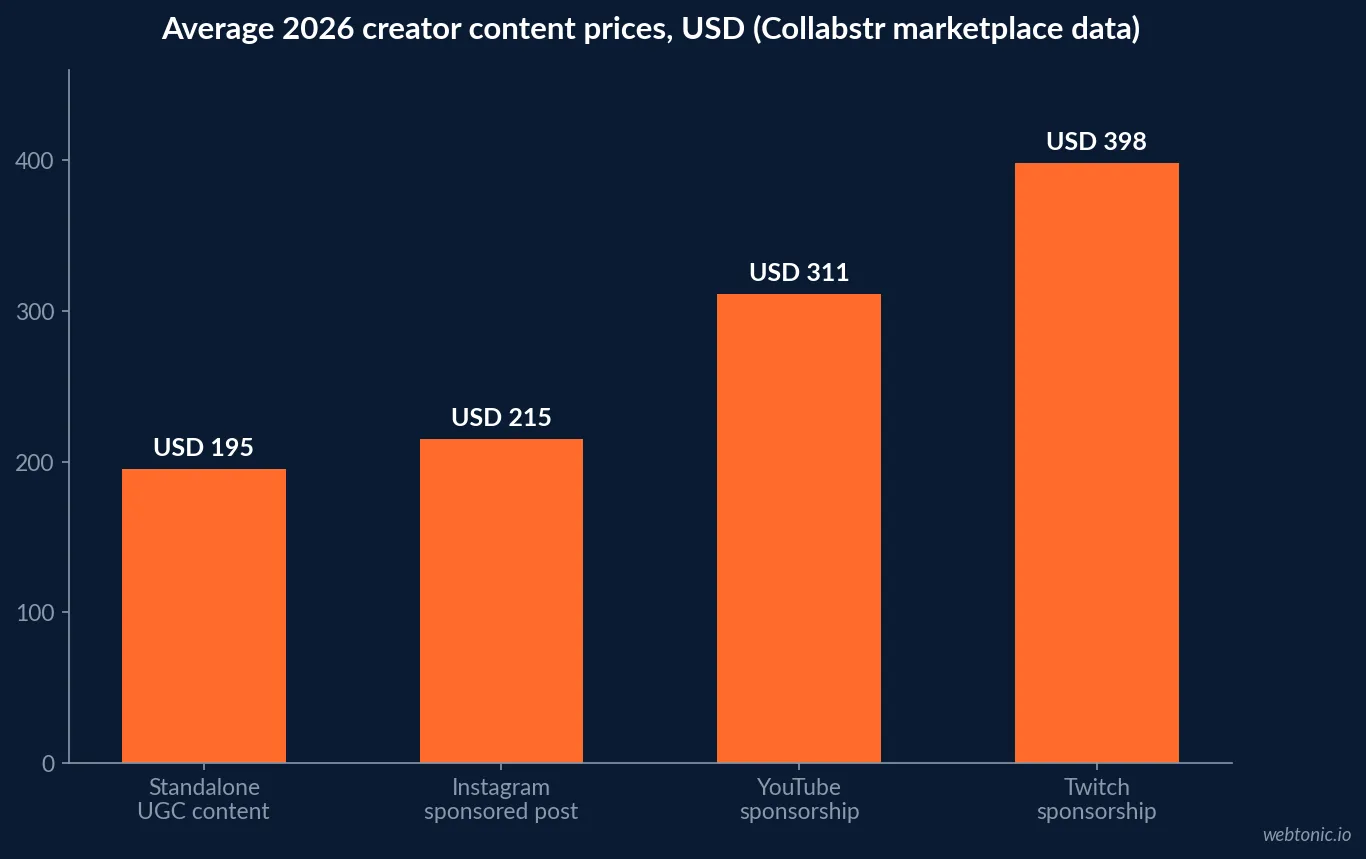
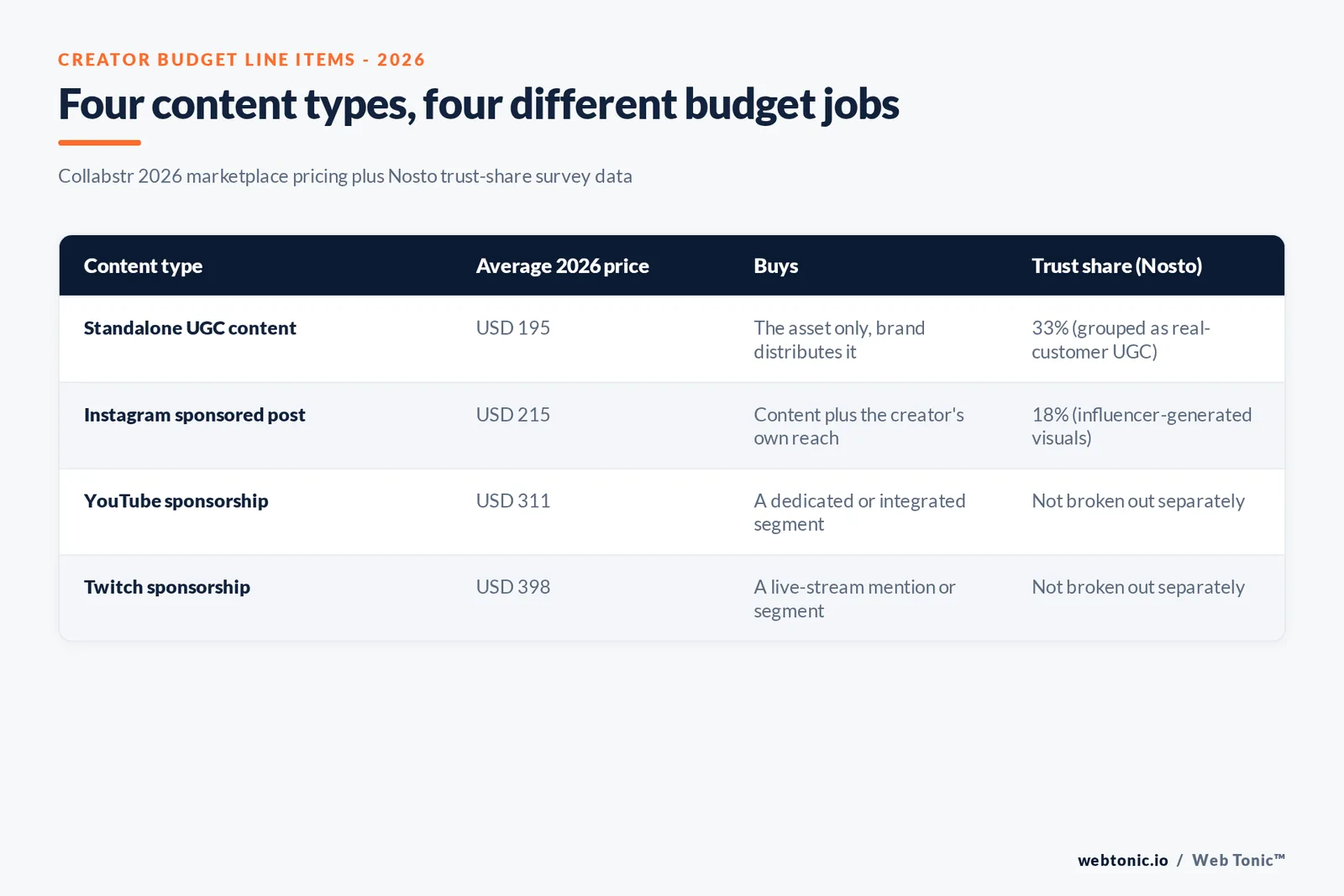
Collabstr's 2026 Influencer Marketing Report, built from more than 472,000 pricing packages and 21,000 completed collaborations on its marketplace, publishes average asking prices by platform: USD 398 for Twitch, USD 311 for YouTube, and USD 215 for Instagram. Its separate UGC price calculator page puts the average price for standalone UGC content - content without the creator's own distribution attached - at USD 195. Collabstr also reports that 80% of campaigns on its platform come in under USD 300 total, which sets a realistic floor for a small-brand test budget rather than the celebrity-tier numbers that dominate press coverage.
| Content type | Average price | What it includes | Source |
|---|---|---|---|
| Twitch sponsorship | USD 398 | Live-stream mention/segment | Collabstr 2026 report |
| YouTube sponsorship | USD 311 | Dedicated or integrated segment | Collabstr 2026 report |
| Instagram sponsored post | USD 215 | Post with creator's own reach | Collabstr 2026 report |
| Standalone UGC content | USD 195 | Content asset only, no posting rights | Collabstr UGC price calculator |
| Typical campaign total | Under USD 300 (80% of campaigns) | Small-brand test budget range | Collabstr 2026 report |
Where the total budget is heading this year
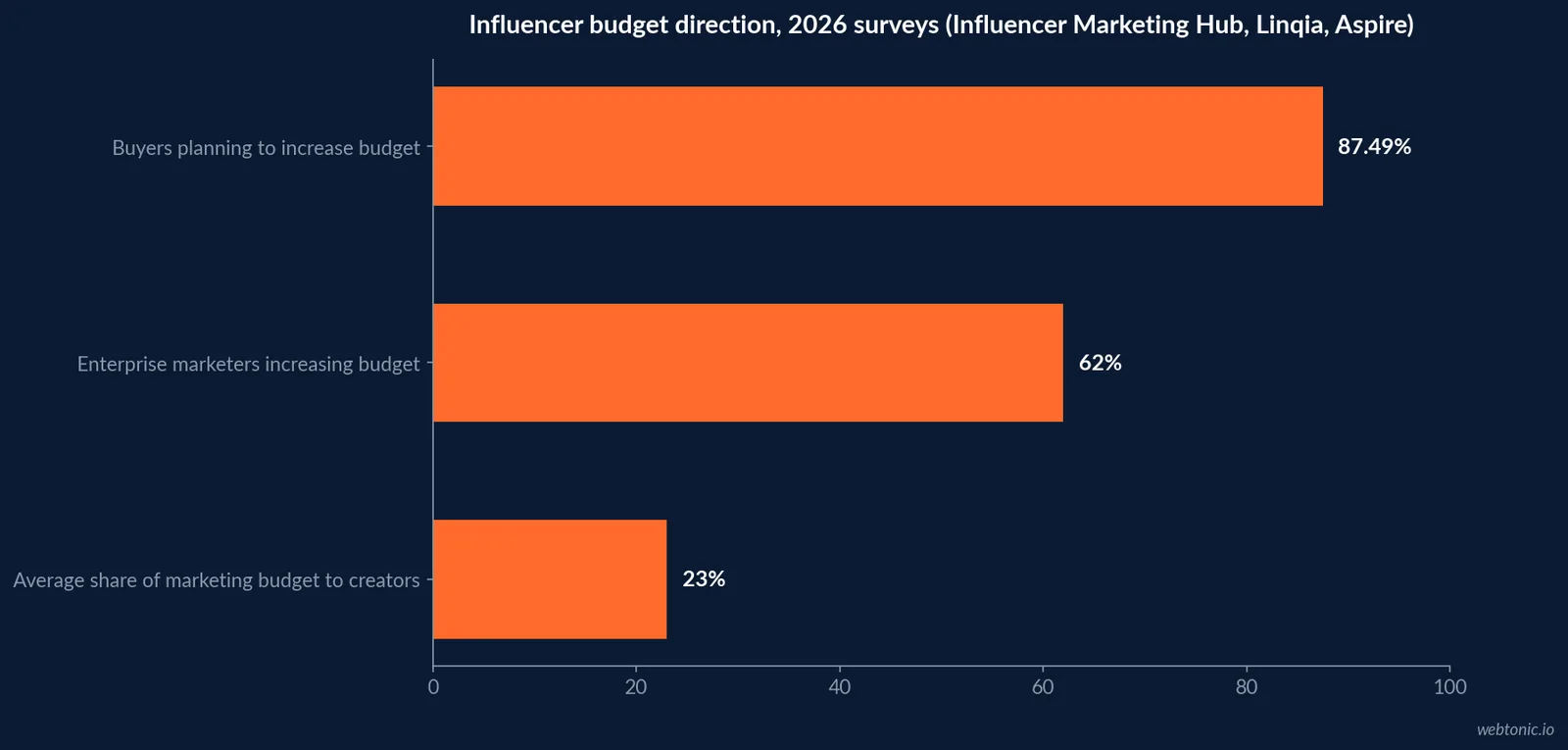
Two separate 2026 surveys agree on direction. The Influencer Marketing Hub's 2026 Benchmark Report found 87.49% of respondents expect their influencer budget to increase this year, against only 5.55% expecting a decrease. Linqia's 2026 State of Influencer Marketing report, surveying more than 200 enterprise marketers, found 62% reporting increasing budgets, 32% flat and 5% decreasing, with a third of the increasing group planning to spend more than USD 5 million in 2026. Aspire's analysis reports brands allocated an average 23% of total marketing budget to creator partnerships last year, a share it frames as continuing to climb.
| Metric | Figure | Survey | Sample |
|---|---|---|---|
| Buyers planning to increase budget | 87.49% | Influencer Marketing Hub 2026 Benchmark Report | Marketing professionals, 2026 survey |
| Buyers planning to decrease budget | 5.55% | Influencer Marketing Hub 2026 Benchmark Report | Same survey |
| Enterprise marketers increasing budget | 62% | Linqia 2026 State of Influencer Marketing | 200+ enterprise marketers |
| Of those, planning USD 5M+ spend | ~33% | Linqia 2026 State of Influencer Marketing | Same survey |
| Average share of marketing budget to creators | 23% | Aspire analysis | Aggregate brand data |
| Organizations spending EUR 100k+/yr | 60% | Kolsquare 2026-2027 market study | European organizations |
Why the budget keeps growing: the market context
Goldman Sachs research estimates the creator economy's total addressable market could roughly double from an estimated USD 250 billion to USD 480 billion by 2027. On the demand side, Nosto's ecommerce marketer survey found that visual user-generated content is what generates the most purchase trust for 33% of ecommerce marketers - more than double the 16% who say the same of AI-generated visuals - which is the case for keeping UGC as a separate line item from influencer sponsorships rather than folding both into one "creator" budget bucket.
| Content trust driver (ecommerce marketers) | Share naming it as most trusted | Source |
|---|---|---|
| Real-customer visual UGC | 33% | Nosto ecommerce marketer survey |
| Professional images/video | 24% | Nosto ecommerce marketer survey |
| Influencer-generated visuals | 18% | Nosto ecommerce marketer survey |
| AI-generated visuals | 16% | Nosto ecommerce marketer survey |
The compliance line item most budgets skip
The FTC's Disclosures 101 guidance and its underlying Endorsement Guides (16 CFR Part 255) require any material connection between a brand and an endorser - payment, free product, or an affiliate relationship - to be disclosed clearly and conspicuously in the post itself, not buried in a bio or behind a "more" link. There is no budget threshold that exempts a small campaign: a USD 195 UGC buy carries the same disclosure duty as a USD 5 million enterprise program. Building a disclosure review step into every creator brief costs staff time, not a line-item fee, but it is the cheapest insurance a program has against an FTC inquiry.
Our performance creative team prices influencer and UGC line items against a brand's own funnel data rather than a flat percentage-of-budget rule, and treats disclosure review as part of every brief, not an afterthought.
Usage rights: the line item most buyers under-budget
A creator's asking price on a marketplace like Collabstr typically covers organic posting on the creator's own account, not the right for the brand to run the content as a paid ad or repost it on owned channels indefinitely. Extended usage rights and paid-whitelisting rights are negotiated separately and add to the base rate above - buyers who budget only the organic post price and then need the content as a Spark Ad or Meta Advantage+ creative later often find themselves back at the negotiating table paying a second fee for rights they assumed were included. Building a usage-rights line into the initial brief, even at a flat percentage add-on to the base rate, is cheaper than renegotiating after the content is already live.
| Rights tier | What it typically includes | When it's needed | Budget impact |
|---|---|---|---|
| Organic-only | Creator posts on their own account, brand does not reuse | Awareness-only campaigns | Base rate only |
| Paid whitelisting / Spark Ads | Brand runs the content as an ad from the creator's handle | Performance/direct-response campaigns | Add-on fee, negotiated per use |
| Owned-channel usage | Brand reposts on its own social or site | Content that becomes always-on creative | Add-on fee, often time-limited |
| Exclusivity | Creator agrees not to work with competitors | Category-defining partnerships | Largest add-on, scales with reach |
Related reading on paid creative and social spend
Buyers weighing influencer and UGC line items against other paid social spend can read our Facebook Ads pricing guide and the live influencer marketing statistics hub for platform-level benchmarks. For teams building a full paid-social agency shortlist, our best Facebook Ads agencies roundup covers the buy-side partners that typically manage whitelisted creator content in-platform.
Sizing a first-quarter test budget
For a buyer with no existing influencer or UGC line item, Collabstr's data on campaign size offers a practical starting point: since 80% of campaigns on its marketplace come in under USD 300 total, a first-quarter test of five to ten creator relationships at the UGC or Instagram tier can be run for roughly USD 1,000 to 3,000 in content fees before any paid amplification. That is a small enough number to approve without a full annual commitment, and large enough to generate a usable content library and a real read on which creator profiles convert for the brand's own funnel.
Scaling beyond that test should follow the budget-share data above - Aspire's 23% of total marketing budget is a reasonable target only once a brand has its own cost-per-result number from the test, not a figure to commit to on day one.
| Test budget component | Suggested allocation | What it validates | Source basis |
|---|---|---|---|
| 5-10 UGC content pieces | USD 1,000-2,000 | Content quality and turnaround time | Collabstr average pricing |
| 3-5 Instagram sponsored posts | USD 650-1,100 | Organic reach and engagement by creator tier | Collabstr average pricing |
| Usage-rights add-on for top performers | 10-30% of base fee | Whether whitelisting improves paid performance | Industry-typical add-on range |
| Disclosure review time | Staff hours, not a fee | FTC compliance on every post | FTC Endorsement Guides |
Frequently Asked Questions
How much should a media buyer budget per influencer post?
Collabstr's 2026 report, drawn from more than 472,000 pricing packages and 21,000 completed collaborations on its marketplace, puts average asking prices at USD 398 for Twitch, USD 311 for YouTube, USD 215 for Instagram and USD 195 for standalone UGC content with no posting rights included. Those are marketplace averages across creator sizes, so a buyer should budget a range around each figure and expect established creators with larger followings to price well above the average.
What share of a marketing budget goes to influencer and UGC work?
Aspire's analysis reports brands allocated an average of 23% of total marketing budget to creator partnerships in the prior year, a share it describes as continuing to grow. Kolsquare's 2026-2027 market study reports 60% of organizations now spend more than EUR 100,000 a year on influencer marketing and 36% spend more than EUR 200,000, with the share spending under EUR 50,000 falling from 24% in 2025 to 16% in 2026 - directionally, budgets are moving up-market.
Is influencer marketing spend actually increasing this year?
The two major benchmark surveys agree on direction if not exact magnitude. The Influencer Marketing Hub's 2026 Benchmark Report found 87.49% of respondents expect their influencer budget to increase, against 5.55% expecting a decrease. Linqia's 2026 State of Influencer Marketing report, surveying over 200 enterprise marketers, found 62% reported increasing budgets, 32% flat, and 5% decreasing, with one-third of those increasing planning to spend more than USD 5 million in 2026.
How much does UGC-only content cost versus a full influencer sponsorship?
Less, on Collabstr's data: standalone UGC content averages USD 195 per piece, against USD 215 for a sponsored Instagram post and higher averages for YouTube and Twitch, because UGC pricing typically excludes the creator's own posting and reach - the brand buys the content asset and distributes it itself, usually as paid social creative or on a product page. That makes UGC the lower-cost line item when the budget need is creative supply rather than the creator's own audience reach.
What compliance cost does an influencer or UGC budget need to include?
Disclosure review time, not a line-item fee. The FTC's Endorsement Guides (16 CFR Part 255) require a material connection between a brand and an endorser to be disclosed clearly and conspicuously in each post, and the FTC's own 'Disclosures 101' guidance states that a disclosure buried only in an account bio, or visible only after a 'more' click, is not sufficient. Budgeting for a compliance review pass on every creator brief - not just the content fee - is what keeps a program out of FTC enforcement risk.
Sources
Collabstr - 2026 Influencer Marketing Report
Collabstr - UGC creator price calculator
Influencer Marketing Hub - Influencer Marketing Benchmark Report 2026
Linqia - 2026 State of Influencer Marketing
Aspire - 2026 Influencer Marketing Budgets
Goldman Sachs - The creator economy could approach half a trillion dollars by 2027
Nosto - How ecommerce marketers are embracing UGC to boost online sales
FTC - Disclosures 101 for Social Media Influencers
eCFR - 16 CFR Part 255, Endorsement Guides