



Table of contents

No study publishes an organic CTR or cost per lead for tax and accounting firms. What can be benchmarked is the click curve every firm ranks on, how far AI Overviews cut it, and what paid leads cost in the nearest categories. This page sets those numbers side by side, labelled by source.
Key Takeaways
- The first organic Google result averages a 27.6% CTR (Backlinko, about 4 million results).
- Position 1 is 10x more likely to be clicked than position 10.
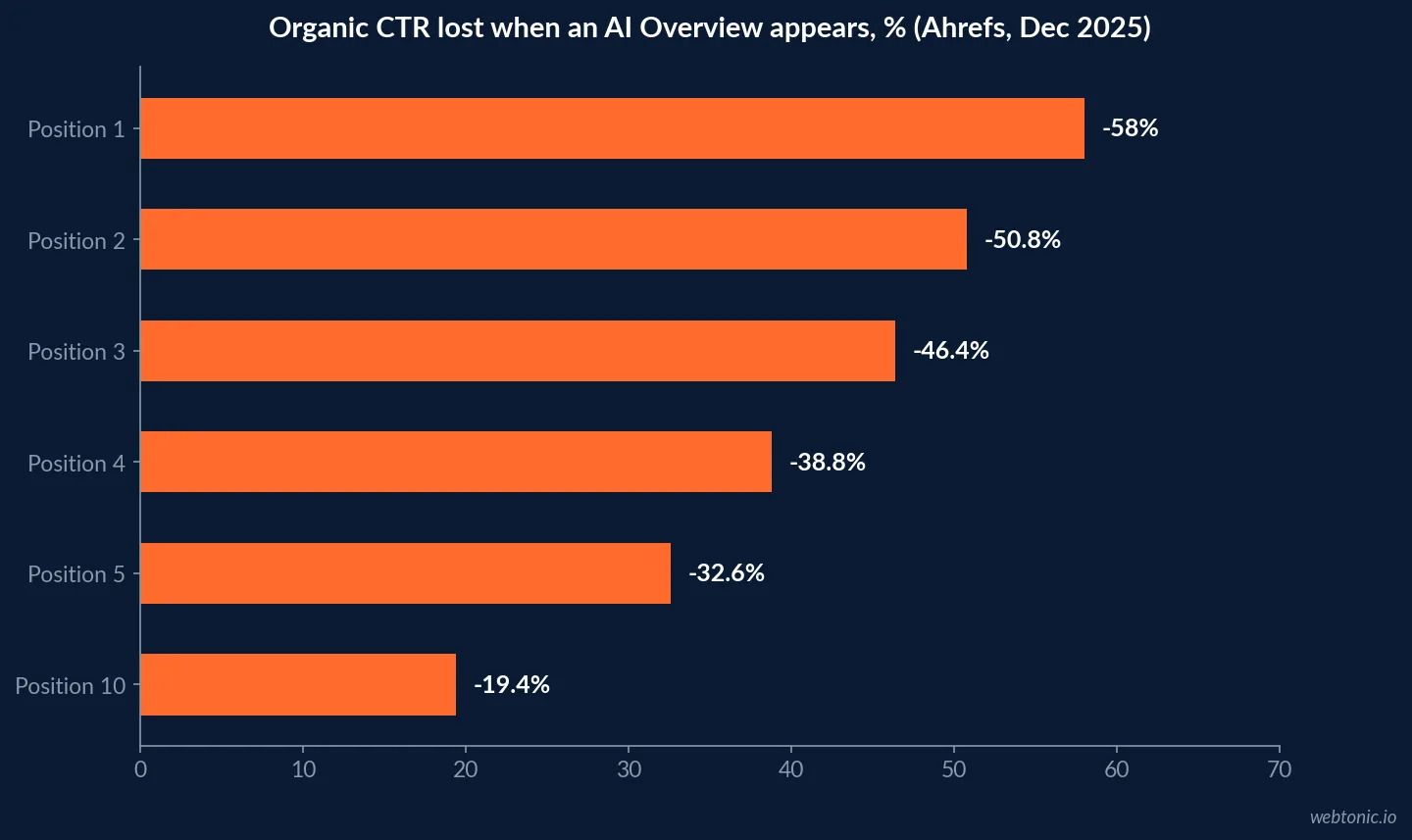
- An AI Overview correlates with a 58% lower CTR for position 1 (Ahrefs, Dec 2025 data).
- The drop is still 19.4% at position 10.
- 25.79% of Financials-sector searches triggered an AI Overview (Conductor).
- Finance and Insurance paid search averaged USD 83.93 per lead (WordStream 2025).
- Its paid conversion rate was 2.55%, the lowest WordStream reported.
- Tax professionals e-filed 73,898,000 returns by April 24, 2026 (IRS).
- AICPA MAP firms reported median net client fee growth of 6.7%.
Tax and accounting SEO benchmarks at a glance
| Benchmark | Value | Type | Source |
|---|---|---|---|
| Position 1 organic CTR | 27.6% | Organic, cross-industry | Backlinko CTR study |
| Position 1 vs position 10 | 10x | Organic, cross-industry | Backlinko CTR study |
| Position 1 CTR change with AI Overview | -58% | Organic, cross-industry | Ahrefs, Dec 2025 data |
| Searches with an AI Overview (Financials) | 25.79% | Sector proxy | Conductor 2026 |
| Finance and Insurance CPL | USD 83.93 | Paid comparator | WordStream 2025 |
| Business Services CPL | USD 103.54 | Paid comparator | WordStream 2025 |
| Organic CPL for tax firms | Not published | Gap | No study found |
Who is "enterprise" in tax and accounting?
Most accounting practices are small. The AICPA's Management of an Accounting Practice survey, the largest US benchmarking survey of public accounting firms, drew 81% of its responses from firms with revenue of USD 5 million and below. Those firms reported a median 6.7% rise in net client fees and net remaining per partner of USD 252,663 in fiscal 2024, up 11.9%.
Enterprise SEO in this industry therefore means the national tax-preparation chains, regional firms that have rolled up local practices, and franchised networks. They share one problem: dozens or thousands of office pages that must stay accurate through a short, intense season.
The organic click curve every tax page ranks on
Backlinko's own CTR study, published by Brian Dean in August 2019 and built on Backlinko's analysis of Search Console data for about 4 million Google results (page last updated April 2025), found the first organic result averages a 27.6% click-through rate and is 10 times more likely to be clicked than a result in the tenth spot. It also found branded queries push position-one CTR much higher, because they are mostly navigational.
That split is the first thing a multi-office tax brand should apply to its own data. "H&R Block near me" style searches behave nothing like "how to file a 1099." Averaging them hides both.
How AI Overviews bend the curve
Ahrefs compared 300,000 keywords, half with and half without AI Overviews, using December 2025 data. The presence of an AI Overview correlated with a 58% lower average CTR for the top-ranking page, up from the 34.5% it measured in April 2025. The effect shrinks lower down the page but never disappears.
| Organic position | CTR impact with an AI Overview (Ahrefs, Dec 2025 data) |
|---|---|
| 1 | -58.0% |
| 2 | -50.8% |
| 3 | -46.4% |
| 4 | -38.8% |
| 5 | -32.6% |
| 6 | -30.5% |
| 7 | -29.7% |
| 8 | -28.8% |
| 9 | -29.7% |
| 10 | -19.4% |
Tax is a heavy informational category: deadlines, deductions, forms, credits. That is exactly the query type AI Overviews answer in place. Office, appointment and pricing pages are less exposed, which is why enterprise firms should report CTR by page type, not as one site-wide number.
| Tax site page type | Example query | Exposure to AI answers (our reading, not a measured rate) |
|---|---|---|
| Informational guide | How do I file a 1099 as a freelancer | High: answered in place |
| Deadline or threshold page | When is the extension deadline | High: a single fact |
| Service page | Small business bookkeeping and tax prep | Medium: comparison intent |
| Office page | Tax preparer near me open Saturday | Low: local and navigational |
| Pricing or booking page | Tax prep appointment price | Low: transactional |
That reading is a planning assumption, not a statistic. Test it against your own Search Console data by comparing CTR on each page type before and after AI Overviews appeared for your core queries.
How often financial searches trigger AI answers
Conductor's 2026 AEO and GEO benchmarks report analysed 21.9 million Google searches and found 25.11% generated an AI Overview. It does not report tax separately. Its Financials sector, the closest proxy, came in at 25.79%. Conductor also noted that publishers such as NerdWallet held 6.73% of AI citations in Financials, ahead of traditional banks, which is a warning for firms that assume brand size wins AI answers.
| Conductor sector | Searches with an AI Overview |
|---|---|
| Health Care | 48.75% |
| Financials (closest tax proxy) | 25.79% |
| Utilities | 25.4% |
| All sectors analysed | 25.11% |
| Consumer Staples | 6.82% |
| Real Estate | 4.48% |
Paid CPL comparators for tax firms
Organic CPL is not published, so paid benchmarks are the only priced reference. WordStream's 2025 Google Ads benchmarks analysed more than 16,000 US campaigns from April 2024 through March 2025. Tax preparation falls between two of its categories, so both are shown. These are paid figures and should be labelled as such in any board deck.
| Paid search metric | Finance and Insurance | Business Services | All industries |
|---|---|---|---|
| Click-through rate | 8.33% | 5.65% | 6.66% |
| Cost per click | USD 3.46 | USD 5.58 | USD 5.26 |
| Conversion rate | 2.55% | 5.14% | 7.52% |
| Cost per lead | USD 83.93 | USD 103.54 | USD 70.11 |
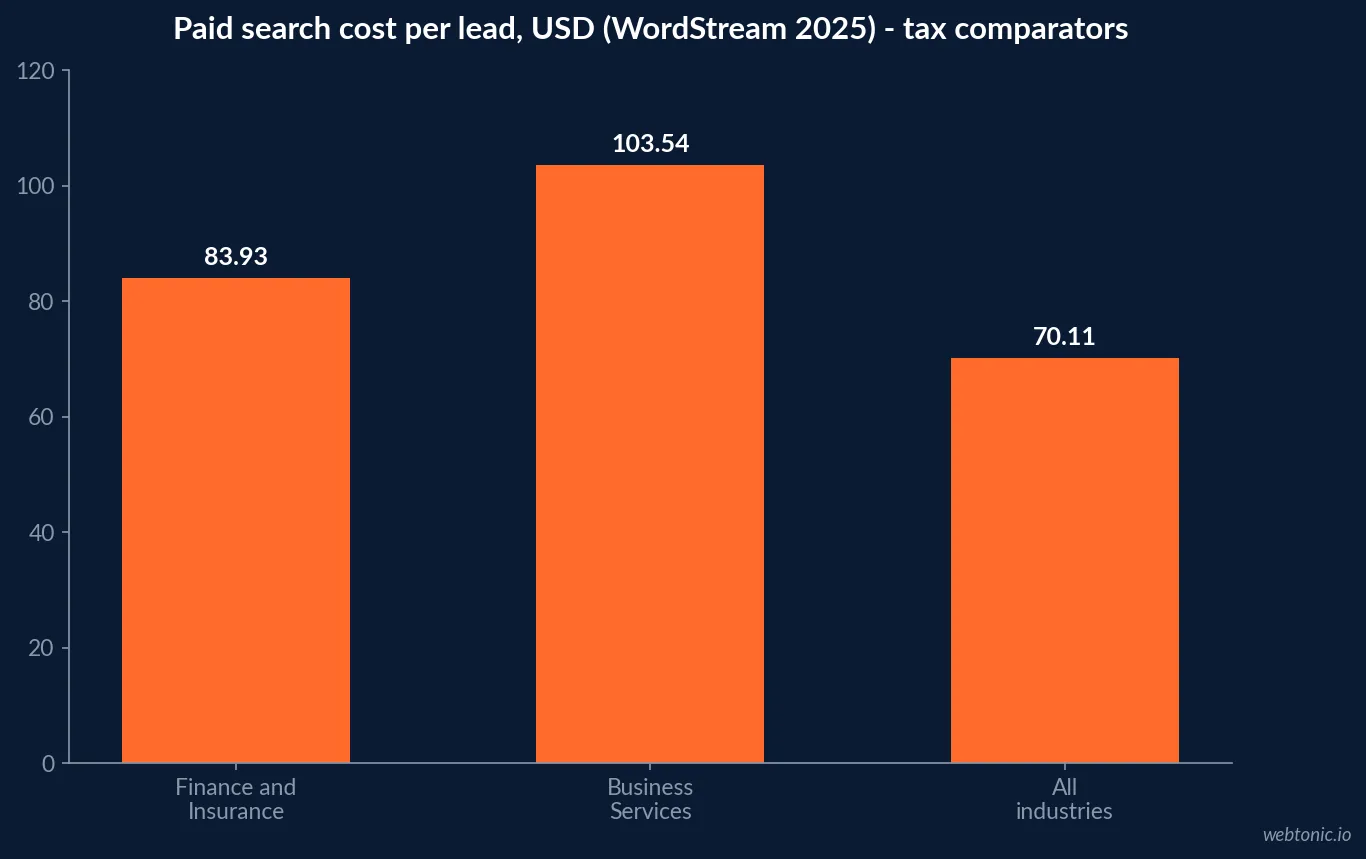
Finance and Insurance pairs a high paid CTR (8.33%) with the lowest conversion rate in the dataset (2.55%). Searchers click, compare and leave. An organic office page that answers price and availability questions up front is competing for the same hesitant visitor.
Filing season is the enterprise stress test
The IRS filing season statistics for the week ending April 24, 2026 show 142,225,000 returns received, 139,221,000 e-filed, 73,898,000 of those from tax professionals and 65,323,000 self-prepared. IRS.gov logged 534,164,000 visits, up 59.8% on the same point in 2025.
For a chain with thousands of offices, that concentration means seasonal hours, pop-up locations and closures must be pushed to every Business Profile and office page in bulk before demand arrives.
| IRS measure (to Apr 24) | 2025 | 2026 | Change |
|---|---|---|---|
| Total returns received | 142,566,000 | 142,225,000 | -0.2% |
| E-filed by tax professionals | 73,460,000 | 73,898,000 | +0.6% |
| E-filed, self-prepared | 64,099,000 | 65,323,000 | +1.9% |
| IRS.gov visits | 334,172,000 | 534,164,000 | +59.8% |
Office pages and profiles through a seasonal network
A national tax brand does not have a stable location list. It opens seasonal offices in January, shares space inside retail stores, extends hours in April and closes a share of sites in May. Every one of those changes lands in two places searchers see: the Business Profile and the office page. When the two disagree, the searcher finds a closed door, and the brand pays for it in reviews rather than in rankings.
Google Business Profile Help allows bulk verification once a business has 10 or more locations, managed through a spreadsheet in Business Profile Manager, and states that duplicate, suspended or disabled profiles do not count towards that minimum. For a franchised tax network, that points to one rule: the franchisor owns the organisation account and the master spreadsheet, and franchisees request changes rather than editing listings directly.
The office page itself should carry what the profile cannot: which services that office offers, whether it handles business returns, languages spoken, appointment types and the seasonal calendar. Those details are also what makes one office page genuinely different from the next, which keeps a large network on the right side of Google's doorway-page policy.
What zero-click means for tax content
Tax brands built large libraries of deadline, deduction and form explainers because those queries have volume every season. The click data above says that library now earns less per ranking than it did. The response is not to delete it but to change what it is for: a guide page should carry a clear next step to a nearby office or an appointment, so that the minority of visitors who do click have somewhere to go.
Measure those guides on assisted conversions and branded search lift, not on raw sessions, and keep the facts current each filing season. An out-of-date threshold on a page that an AI answer quotes is a compliance problem as well as an SEO one.
Circular 230 and claims at scale
Circular 230, section 10.30 prohibits a practitioner from using any public communication containing "a false, fraudulent, or coercive statement or claim; or a misleading or deceptive statement or claim" on any IRS matter. For enterprise SEO the risk is replication: one overstated refund promise in a template becomes hundreds of indexed pages. Build claims review into the page template, not the individual page.
Measuring CTR across hundreds of office pages
Search Console's interface is too small for a network. Google's Search Console API documentation says performance data is limited to 50K rows per day per search type per property, which is enough for most firms if each office folder is its own property. Google's crawl budget guide is aimed at sites with 1 million+ pages, or 10,000+ pages changing daily, so crawl budget is rarely the tax-firm bottleneck; thin, duplicated office pages are.
And remember the ceiling: the SparkToro and Datos 2024 study found 58.5% of US Google searches end with no click at all.
Computing your own organic CPL
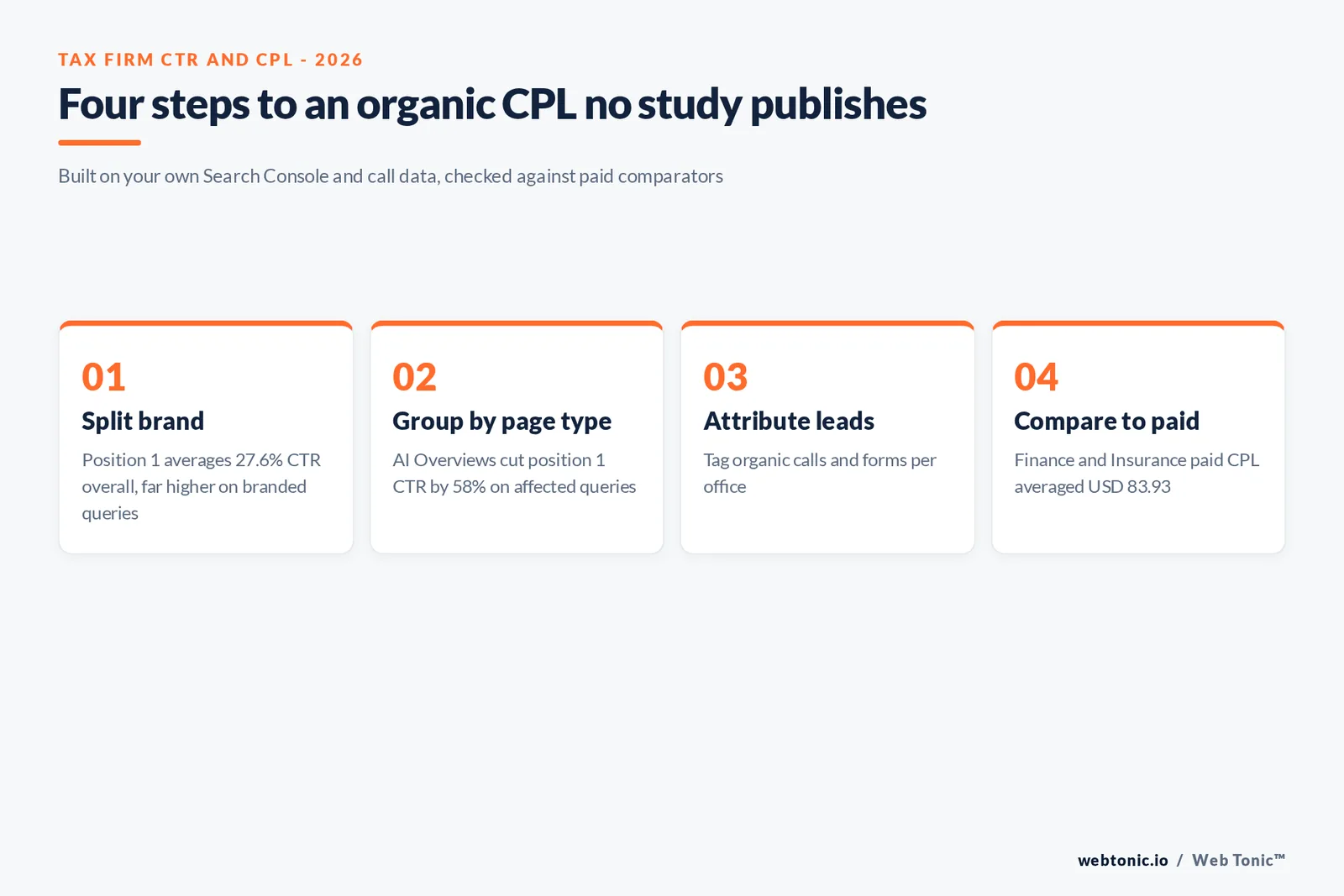
- Split branded from non-branded queries before reading any CTR.
- Group pages by type: office, service, informational guide.
- Attribute leads to organic with call tracking and form source fields.
- Divide total SEO cost by organic leads for the season, then compare with your paid CPL.
Our data intelligence team builds this reporting for multi-office firms. See also the enterprise SEO statistics hub and our tax and accounting CTV advertising data, or our note on why tax services are not eligible for Google Shopping.
Frequently Asked Questions
What is a good organic click-through rate for a tax firm?
No study publishes one for tax and accounting. Cross-industry, Backlinko's analysis of about 4 million Google results found the first organic result averages a 27.6% CTR and is 10 times more likely to be clicked than the tenth. Ahrefs' December 2025 data then shows the top result's CTR is 58% lower when an AI Overview appears. Your own Search Console CTR by position, split by branded and non-branded queries, is the only benchmark worth managing to.
What is the organic cost per lead for accounting firms?
It is not published anywhere we could find. The nearest priced benchmark is paid: WordStream's 2025 data puts Finance and Insurance at USD 83.93 per lead and Business Services at USD 103.54, against USD 70.11 across all industries. Compute organic CPL yourself by dividing SEO cost by organic-attributed leads.
Do AI Overviews show up on tax searches?
Often, for informational queries. Conductor analysed 21.9 million searches and found 25.11% triggered an AI Overview overall, and 25.79% in its Financials sector. Tax is not reported separately, so treat the Financials rate as the closest proxy, not a tax figure.
Are there advertising rules for tax preparers' websites?
Yes. Circular 230, section 10.30, bars practitioners from any public communication containing a false, fraudulent or coercive statement, or a misleading or deceptive statement or claim, on any IRS matter. That applies to service pages, office pages and review snippets alike, so claims such as guaranteed refunds need legal review before they are published at scale.
When do tax searches peak?
In filing season. IRS data shows 142,225,000 returns received by April 24, 2026, with tax professionals e-filing 73,898,000 of them and IRS.gov logging 534,164,000 visits, up 59.8% on the prior year. Enterprise firms should have office pages, hours and profiles right before January, not during March.
Sources
Backlinko - Google organic CTR study
Ahrefs - AI Overviews reduce clicks update
Conductor - 2026 AEO and GEO benchmarks report
WordStream - 2025 Google Ads benchmarks
IRS - filing season statistics, week ending April 24, 2026
AICPA - MAP survey: CPA firms report steady growth
eCFR - 31 CFR 10.30, Circular 230 solicitation rule
Google Search Console Help - Search Console API export
Google Search Central - crawl budget management
SparkToro - 2024 zero-click search study
Google Business Profile Help - verify profiles in bulk


