Table of contents
Enterprise SEO is not small-business SEO run at a bigger budget - it is a different discipline shaped by page volume, organizational complexity and crawl mechanics that never show up on a ten-page marketing site. This page organizes the current 2026 evidence by industry and by scale, so each benchmark is attached to the study that measured it rather than to a single average.
Key Takeaways
- Median organic traffic spans 4,417 to 102,910 monthly clicks across 25 industry categories.
- Sites over 5,000 pages get 132,889 median monthly clicks, against 12 for sites under 10 pages.
- That is an 11,074x gap between the smallest and largest page-volume tiers.
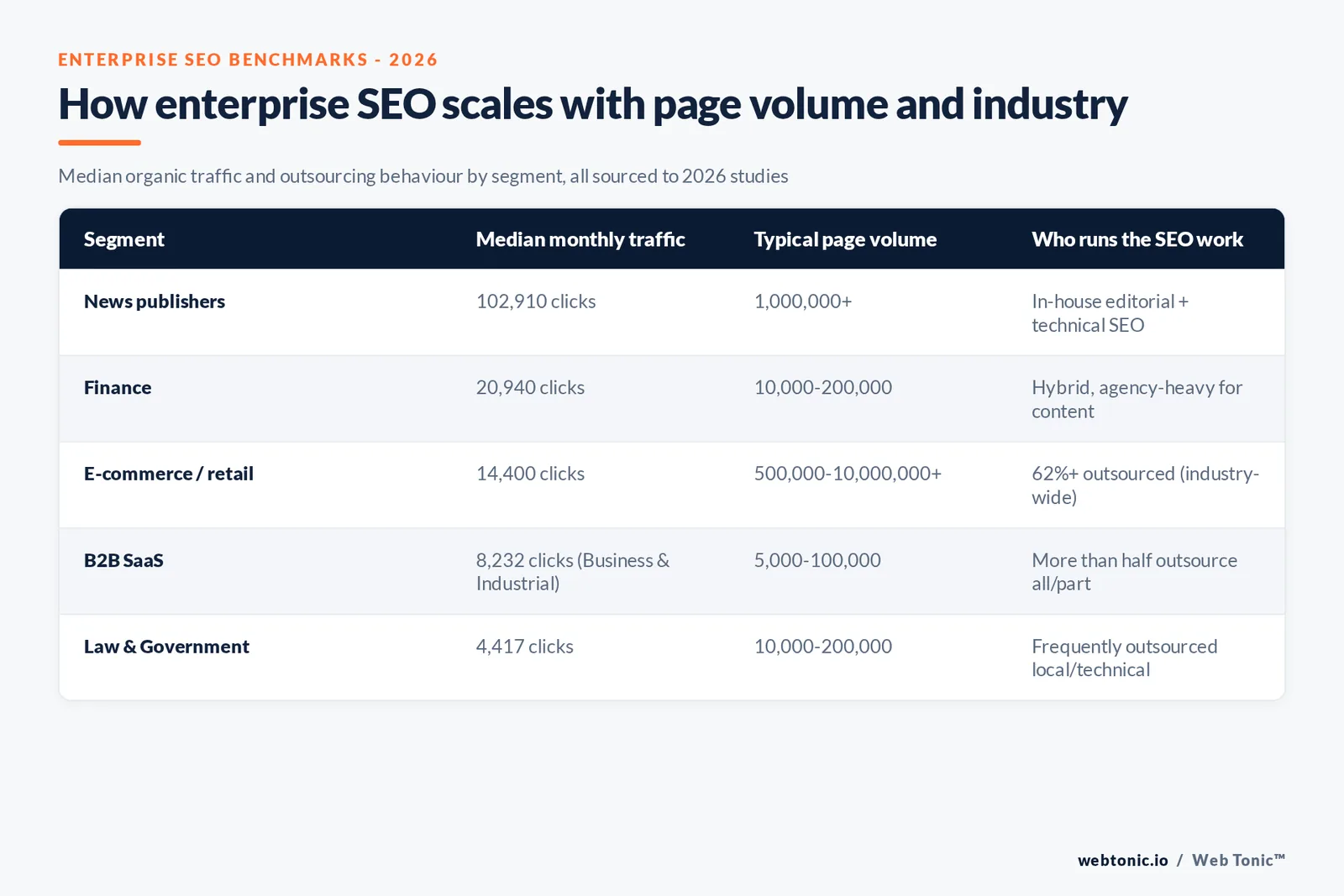
- E-commerce enterprises run 500,000 to 10 million-plus indexed URLs.
- B2B software enterprises run 5,000 to 100,000 pages on average.
- Healthcare systems run 50,000 to 500,000 pages across directories and service lines.
- Financial services firms run 10,000 to 200,000 pages.
- SEO captures 9.4% of mean marketing budget among owned and earned channels in 2026.
- That is up from 8.9% the year before, Gartner's largest owned/earned share.
- Digital channels reached 67.5% of total marketing expense in 2026, up from 54.9% in 2023.
- More than half of enterprises outsource all or part of SEO planning and execution.
- Only 17% rate their enterprise SEO program "very successful"; 28% call it not successful.
- 57% say SEO grew more effective in the past year; just 2% say it got less effective.
- 59.3% of SEO professionals cite algorithm volatility as their top challenge for 2026.
- 77.9% fear AI-generated answers will cut website clicks.
- 49.6% are responding by investing in E-E-A-T rather than retreating.
- 66.3% rate original content creation their highest-impact activity.
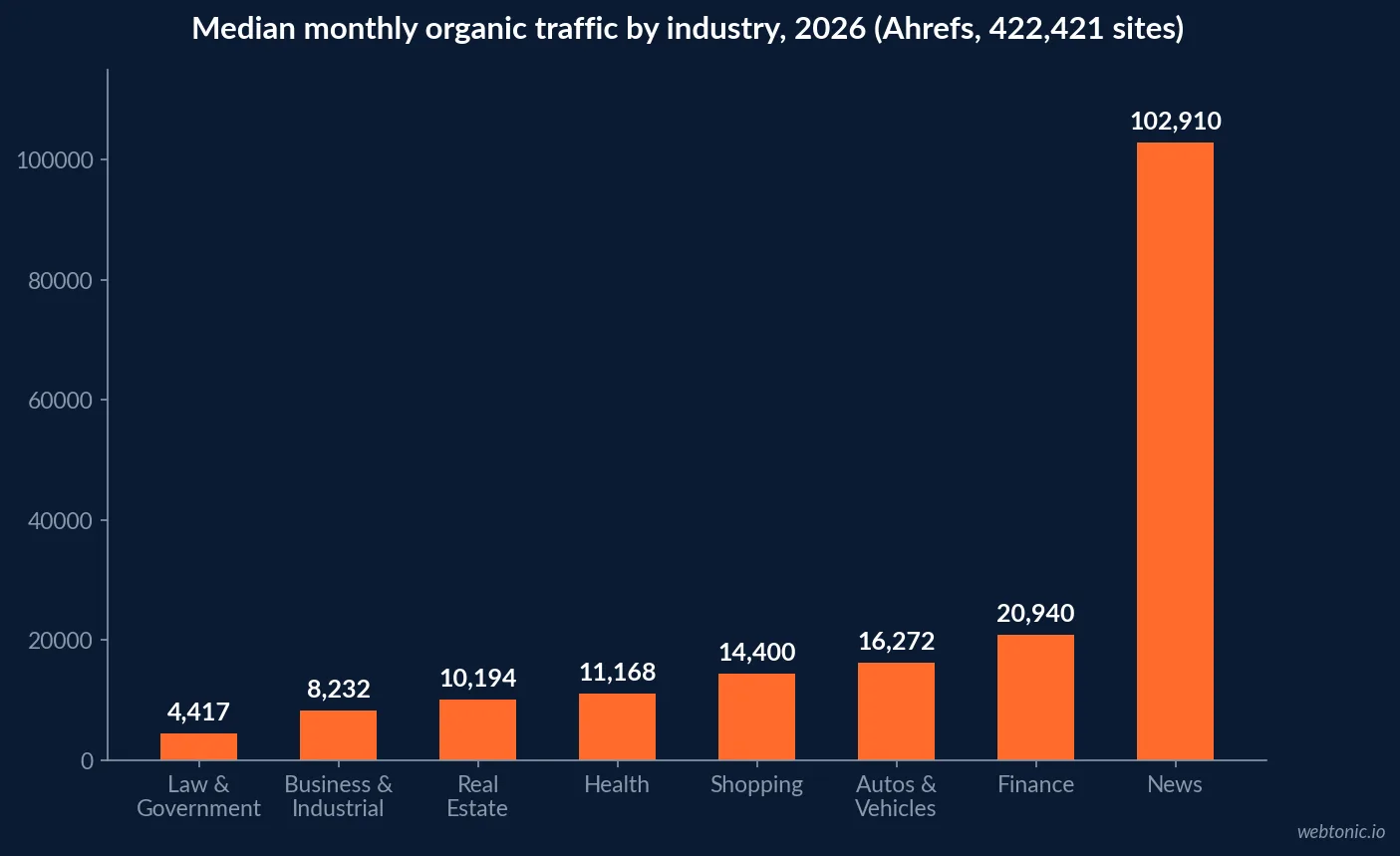
- News sites lead every industry at 102,910 median monthly clicks; Law & Government trails at 4,417.
The industry breakdown: median organic traffic by sector
Ahrefs' June 2026 study pulled anonymized Google Search Console data from 422,421 websites across 26 Google-defined industry categories and reported the median - not the mean - because a handful of giant sites inflate averages by as much as 40x in categories like Computers & Electronics. Medians below are the number a typical enterprise site in that vertical should benchmark against, not the outlier.
| Industry | Median monthly organic clicks | Mean monthly clicks | Sites in sample |
|---|---|---|---|
| News | 102,910 | 668,954 | 476 |
| Finance | 20,940 | 207,581 | 1,167 |
| Computers & Electronics | 18,650 | 1,193,902 | 516 |
| Autos & Vehicles | 16,272 | 129,713 | 776 |
| Travel & Transportation | 14,460 | 106,609 | 1,240 |
| Shopping | 14,400 | 191,175 | 2,245 |
| Health | 11,168 | 69,389 | 1,624 |
| Jobs & Education | 10,530 | 81,173 | 1,274 |
| Real Estate | 10,194 | 54,408 | 304 |
| Beauty & Fitness | 9,672 | 53,261 | 193 |
| Business & Industrial | 8,232 | 67,681 | 824 |
| Home & Garden | 8,148 | 46,269 | 1,341 |
| Law & Government | 4,417 | 28,516 | 251 |
Source: Ahrefs, Average Organic Traffic Benchmarks From Real Websites, June 2026. The mean-to-median gap is itself an enterprise-SEO signal: in Computers & Electronics and Finance, a small number of very large indexed sites are pulling averages far above what a typical enterprise competitor actually earns, which is why benchmarking against a peer's mean traffic overstates the target.
Why page volume, not headcount, defines "enterprise"
Ahrefs' companion breakdown by indexed page count shows the same 422,000+ site sample sorted by size instead of vertical, and the curve is exponential rather than linear:
| Indexed pages | Median monthly traffic | Mean monthly traffic | Websites in sample |
|---|---|---|---|
| 0-10 | 12 | 337 | 108,081 |
| 10-50 | 97 | 1,161 | 87,037 |
| 50-100 | 400 | 2,296 | 26,846 |
| 100-200 | 945 | 6,829 | 19,444 |
| 200-500 | 2,463 | 13,594 | 16,648 |
| 500-1,000 | 5,754 | 25,538 | 7,651 |
| 1,000-5,000 | 16,567 | 106,466 | 8,360 |
| 5,000+ | 132,889 | 1,034,397 | 3,583 |
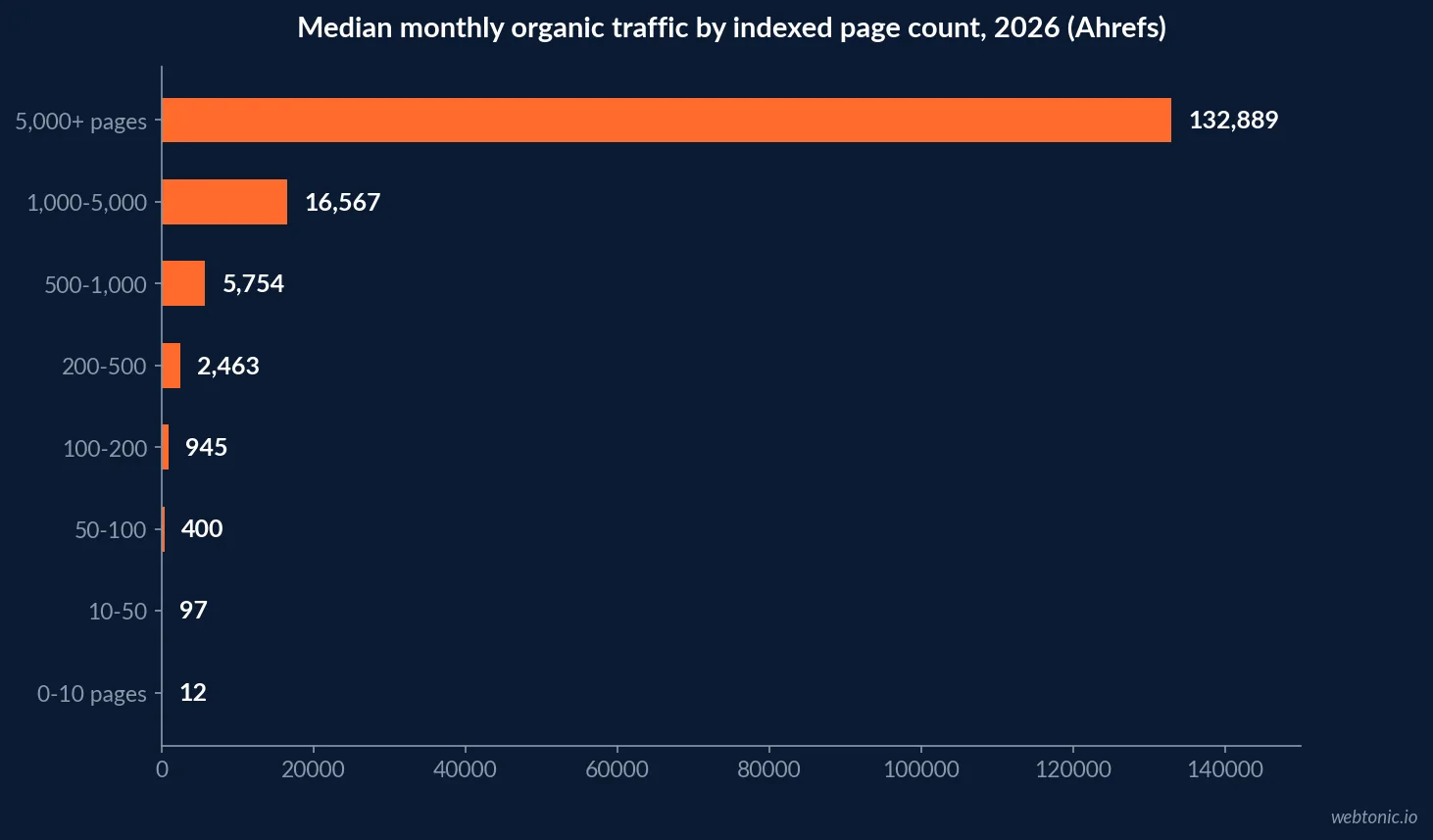
Ahrefs is explicit that this only holds when the pages are worth ranking: publishing 5,000 thin or duplicate pages does not reproduce the curve. That caveat is the actual definition of enterprise SEO work at scale - the discipline of keeping quality constant while volume climbs into the thousands, which Ritner Digital's 2026 crawl-budget analysis maps to real page counts by vertical:
| Vertical | Typical page volume | Primary driver of page count |
|---|---|---|
| E-commerce / large retail | 500,000 to 10,000,000+ | Product, variant and filtered-view pages |
| Media & publishing | 1,000,000+ | Continuous article and archive accumulation |
| Healthcare systems | 50,000 to 500,000 | Physician directories and service-line pages |
| Financial services | 10,000 to 200,000 | Product, regulatory and compliance content |
| B2B software / SaaS | 5,000 to 100,000 | Documentation, support and use-case landing pages |
| Multi-location retail / franchise | Scales with locations | One page per location |
Source: Ritner Digital, enterprise website page-volume analysis, 2026.
What enterprises actually spend on SEO
Gartner's 2026 CMO Spend Survey, conducted January through March 2026 among 401 CMOs and marketing leaders across North America, the UK and Europe, found SEO captured 9.4% of mean marketing budget among owned and earned digital channels - the single largest share in that group, ahead of email marketing, and up from 8.9% the year prior. Paid search advertising remained larger in absolute terms at 16% of the digital budget, with paid social close behind at 15.7%.
| Budget category | 2026 share | 2025 share | Direction |
|---|---|---|---|
| Digital channels, total marketing expense | 67.5% | 54.9% (2023 baseline) | Rising |
| Search advertising (paid) | 16.0% | 14.8% | Rising |
| Social advertising (paid) | 15.7% | 12.7% | Rising |
| SEO (owned/earned) | 9.4% | 8.9% | Rising, largest owned/earned share |
Source: Chief Marketer, reporting the 2026 Gartner CMO Spend Survey.
Build, outsource or hybrid: how enterprises staff it
Ascend2 partnered with Conductor to isolate the enterprise-only segment of its Search Engine Optimization Survey - 442 marketing, sales and business professionals overall, with organizations over 1,000 employees pulled out for a standalone report. More than half of large organizations outsource all or part of their SEO planning and execution, even though only 17% rate their program "very successful" and 28% call it "not successful." Content creation and frequent site updates were rated the most effective levers available; link building and keyword research at scale were rated the hardest to execute well - the same two activities that also require the deepest specialist bench, which is likely why outsourcing concentrates there.
The threat enterprise SEO teams are actually planning around
Search Engine Journal's fifth annual State of SEO report surveyed 371 search professionals across 52 countries in 2026. 59.3% named algorithmic volatility and SERP disruption their single greatest challenge, and a related 77.9% specifically fear AI-generated answers will reduce website clicks. The response is not retreat: 49.6% are increasing investment in Experience, Expertise, Authoritativeness and Trustworthiness (E-E-A-T) signals, and 66.3% rate original content creation their highest-impact activity of the past twelve months, ahead of content updates at 42.6% and technical SEO enhancements at 42.3%.
| 2026 SEO professional sentiment | Share reporting it |
|---|---|
| Cite algorithm volatility / SERP disruption as top challenge | 59.3% |
| Fear AI-generated answers will reduce clicks | 77.9% |
| Are increasing E-E-A-T investment in response | 49.6% |
| Rate original content creation highest-impact activity | 66.3% |
| Rate content updates positively | 42.6% |
| Saw a positive impact from technical SEO work | 42.3% |
Source: Search Engine Journal, State of SEO 2026.
Reading these benchmarks correctly
Three methodology notes matter before applying any number above to a specific enterprise site. First, Ahrefs measures Google Search Console clicks, not total visits from every channel - it is a directional organic-search comparison, not a full traffic audit. Second, every industry median sits well below its mean, sometimes by 40x, so comparing your site to a competitor's publicly estimated average traffic (rather than the industry median) will always make your program look worse than it is. Third, none of the studies cited define "enterprise" by revenue; page volume and organizational complexity are the workable proxy, and they are what should size the SEO team and the crawl-budget strategy, not headcount alone.
Where enterprise SEO budget competes against paid channels
An enterprise marketing leader defending a 9.4% owned/earned SEO line is doing so against paid search at 16% and paid social at 15.7% of the same digital budget. The case for holding that line rather than shifting it to paid media is the cost-per-click trend: Web Tonic's own 2026 Google Ads pricing guide tracks CPC inflation across the same period Gartner measured SEO's budget share rising, which is consistent with marketers hedging paid auction costs by reinforcing organic capacity instead of abandoning it. The same logic shows up on the social side, where Web Tonic's Facebook Ads ROI analysis documents a comparable spend-versus-return calculation enterprise teams are running channel by channel.
| Channel | 2026 share of digital budget | Typical buying model at enterprise scale |
|---|---|---|
| Paid search advertising | 16.0% | Managed in-house or via specialist agency |
| Paid social advertising | 15.7% | Increasingly agency-supported, per outsourcing data above |
| SEO (owned/earned) | 9.4% | 62%+ outsourced in whole or part industry-wide |
| Email marketing | Smaller owned/earned share | Predominantly in-house (91.6% per cross-market data) |
Building the enterprise SEO case internally
None of the figures above are a pitch deck on their own - they are a starting brief. A finance stakeholder asking why SEO deserves 9-10% of a marketing budget wants the industry median for the specific vertical, the page-volume tier the company's site actually falls into, and a staffing model that matches how similar organizations buy the work today. Teams sizing that case alongside their broader growth marketing program get a cleaner budget conversation than teams treating SEO as an isolated line item, because the underlying data - traffic medians, page-volume complexity, outsourcing norms - applies across every digital channel competing for the same dollars.
What this means for planning an enterprise SEO program
- Benchmark against your industry's median, not the mean, to avoid chasing an outlier's traffic.
- Size the technical program to your page-volume tier: a 5,000-page site needs a fundamentally different crawl and internal-linking strategy than a 200-page one.
- Expect to defend roughly 9-10% of the marketing budget for SEO specifically, separate from paid search.
- Plan for hybrid staffing - in-house ownership of strategy and content, specialist support for technical and link-building work.
- Budget for E-E-A-T and content-quality work now, since it is where the majority of the field is already reallocating effort against AI-answer risk.
Frequently Asked Questions
What counts as "enterprise SEO" versus regular SEO?
There is no revenue cutoff in any study cited here, but the practical marker is page volume and organizational complexity. Ritner Digital's 2026 analysis puts e-commerce enterprises at 500,000 to 10 million-plus indexed URLs, B2B software companies at 5,000 to 100,000, and healthcare systems at 50,000 to 500,000. Once a site crosses into the tens of thousands of pages, crawl budget, templated content quality and internal linking stop being a single person's job and become an enterprise SEO program with its own governance.
Does more organic traffic follow directly from having more pages?
Yes, but not proportionally. Ahrefs' June 2026 study of 422,421 sites found median monthly organic traffic rising from 12 clicks for sites under 10 indexed pages to 132,889 clicks for sites over 5,000 pages - an 11,000x spread. The relationship is exponential rather than linear, and Ahrefs is explicit that thin or near-duplicate pages at scale do not produce that curve; only pages worth ranking do.
How much of the marketing budget goes to SEO at large organizations?
Gartner's 2026 CMO Spend Survey, reported through Chief Marketer, found SEO captured 9.4% of mean marketing budget among owned and earned channels, up from 8.9% the year before - the single largest owned/earned line, ahead of email. It sits inside a broader shift: digital channels overall reached 67.5% of total marketing expense in 2026, up from 54.9% in 2023.
Do enterprises build enterprise SEO in-house or outsource it?
Ascend2's enterprise-only benchmark, produced with Conductor from interviews with organizations over 1,000 employees, found more than half outsource all or part of SEO planning and execution. Content creation and frequent site updates were rated the most effective tactics available to them, while link building and keyword research at scale were rated the most difficult to execute well.
What is the single biggest threat enterprise SEO teams report for 2026?
Algorithmic volatility and SERP disruption, cited by 59.3% of respondents to Search Engine Journal's 2026 State of SEO survey of 371 professionals across 52 countries. A related 77.9% said they specifically fear AI-generated answers reducing website clicks, which is why 49.6% report actively increasing investment in E-E-A-T signals rather than pulling back.
Sources
Ahrefs, Average Organic Traffic Benchmarks From Real Websites (2026)
Ritner Digital, enterprise website page-volume analysis (2026)
Chief Marketer / Gartner 2026 CMO Spend Survey
Ascend2 x Conductor, Inside Enterprise SEO
Search Engine Journal, State of SEO 2026
Moz, State of Enterprise SEO (historical baseline, 2017)