



Table of contents
WordPress powers 43.5% of all websites globally, and among UK accounting firms with a detectable CMS, that share climbs to 73%. For tax and accounting practices evaluating their web platform, the data reveals a clear picture: WordPress dominates the market but demands active management to perform well.
Key Takeaways
- WordPress powers 43.5% of all websites worldwide as of July 2026, maintaining its position as the dominant CMS (w3techs.com).
- 73% of UK accounting firms with a detectable CMS run WordPress, making it the overwhelming platform choice for the industry (Firmbase).
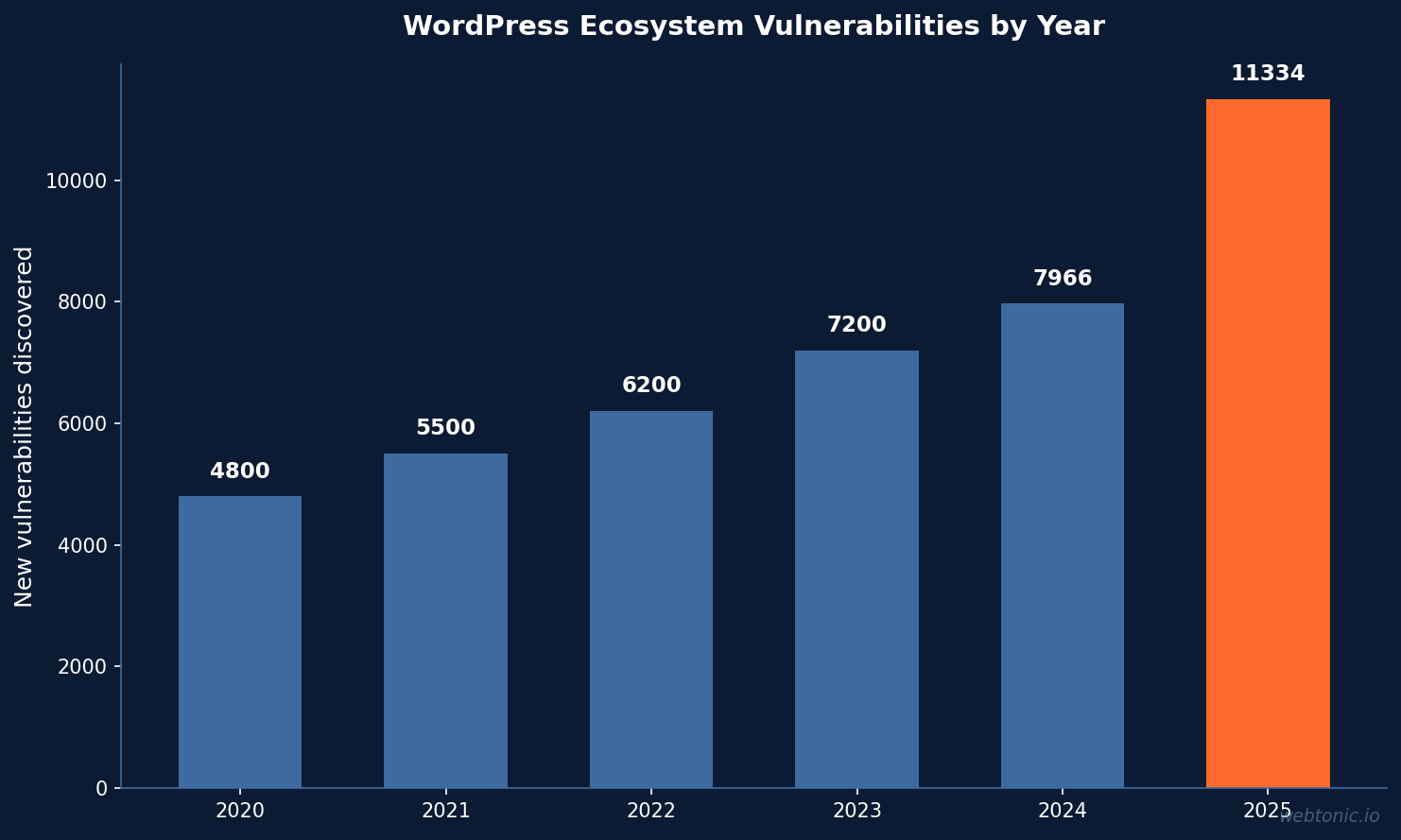
- 11,334 new vulnerabilities were discovered in the WordPress ecosystem in 2025—a 42% increase over 2024 (Patchstack).
- The average accounting website scores 59/100 on PageSpeed, with 70% scoring below 70—well below Google's performance threshold (Borah Labs).
- 52.8% of WordPress sites run at least one plugin with a known vulnerability at any given time (GuardingWP).
- WordPress redesigns for accounting firms have driven 280%+ traffic increases and conversion rate jumps from 1.5% to 5.7% (Zazmic).
WordPress Market Share and Adoption Benchmarks
| Metric | Value | Source |
|---|---|---|
| WordPress global market share | 43.5% of all websites | w3techs.com |
| WordPress CMS market share | 62.6% of CMS-powered sites | w3techs.com |
| UK accounting firms on WordPress | 2,281 firms (73% CMS share) | Firmbase |
| Top tech stack: jQuery | 52.1% of accounting sites | Borah Labs |
| Top tech stack: PHP | 41.2% of accounting sites | Borah Labs |
| WordPress detected (US sample) | 10.4% of accounting sites | Borah Labs |
| Google Analytics adoption | 9.5% of accounting sites | Borah Labs |
The difference between the Firmbase UK figure (73%) and the Borah Labs US figure (10.4%) reflects methodology: Firmbase counts only firms with a detectable CMS, while Borah Labs includes all accounting sites (many custom-built or using non-CMS solutions). Regardless of methodology, WordPress remains the default CMS choice when accounting firms choose a content management system.
WordPress Performance for Accounting Websites
Website performance is where most accounting firms on WordPress underperform. According to Borah Labs' analysis of 385 US accounting websites:
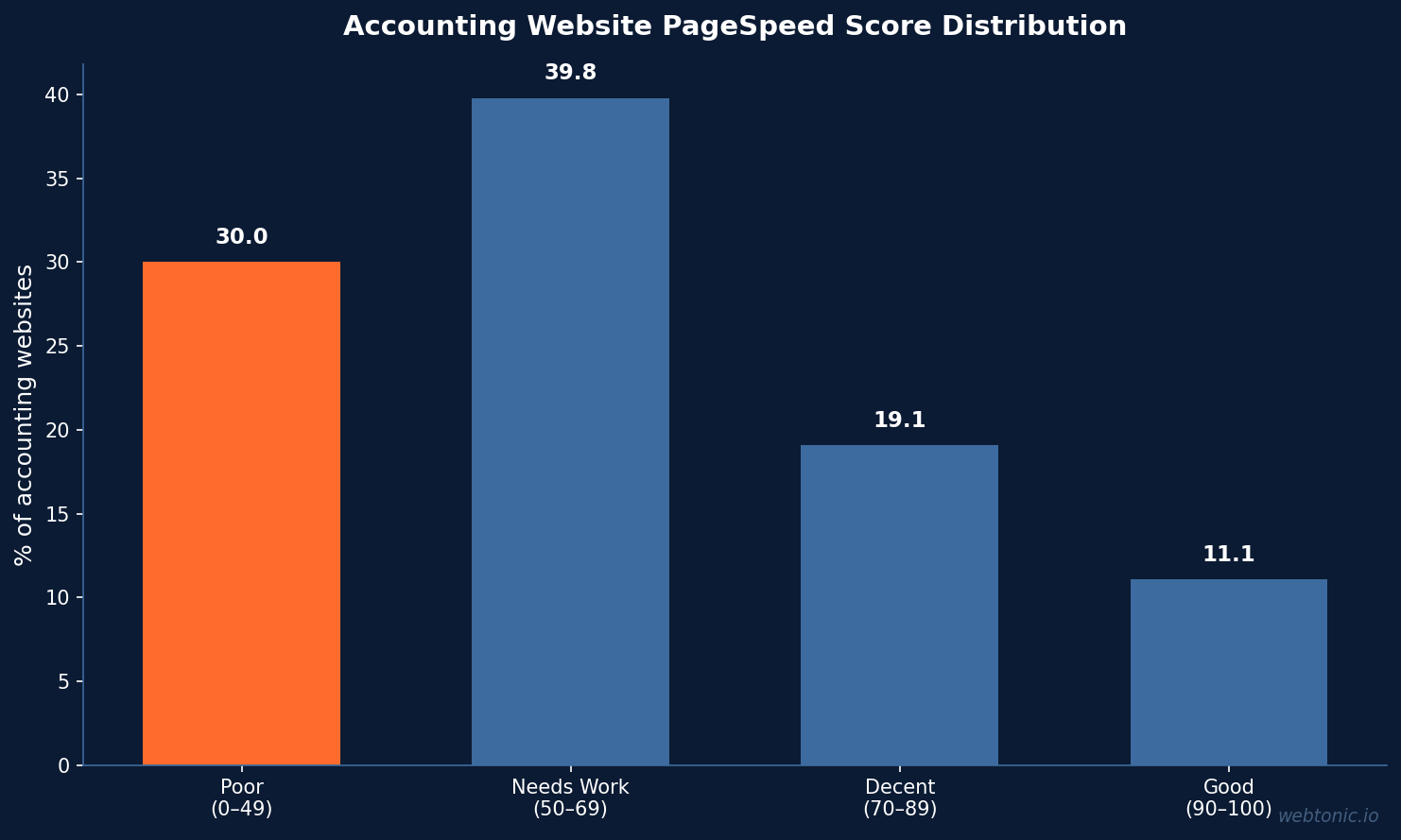
- Average PageSpeed score: 59/100—categorized as "needs work" by Google's standards.
- 30% score below 50 (poor), 39.8% score 50–69 (needs work), 19.1% score 70–89 (decent), and only 11.1% score 90–100 (good).
- 72.4% of sites have the Largest Contentful Paint (LCP) flagged as a critical issue.
- 50.3% contain broken links—132 broken links found across the sample.
- 86.7% declare a mobile viewport, but the remaining 13.3% render at desktop zoom on phones.
The performance gap creates a tangible SEO disadvantage. Google's data shows bounce rates climb sharply past a 3-second load time, and accounting firm SEO depends heavily on Core Web Vitals passing thresholds.
WordPress Security in the Accounting Sector
Security is the most critical concern for accounting firms running WordPress, given the sensitive financial data they handle. The 2026 Patchstack State of WordPress Security report reveals alarming trends:
| Security Metric | 2025 Data | YoY Change |
|---|---|---|
| Total new vulnerabilities | 11,334 | +42% vs 2024 |
| High-severity vulnerabilities | 1,966 (17%) | More than previous 2 years combined |
| Requiring active protection | 4,124 (36%) | Serious threat level |
| Unfixed at disclosure | 46% of all CVEs | — |
| Sites with vulnerable plugins | 52.8% | — |
| Hosting WAF block rate | Only 26% | — |
For accounting practices, these numbers carry outsized risk. 52.8% of WordPress sites run at least one plugin with a known CVE at scan time (GuardingWP). Additional findings from their 424-site audit:
- 48.9% leak their WordPress version through the generator meta tag.
- 42% are missing modern security headers (HSTS, CSP, X-Frame-Options).
- 48.8% still have XML-RPC enabled—an attack surface that should be disabled on accounting sites.
- Standard hosting WAFs block only 26% of vulnerability attacks (Patchstack pentest data).
SEO and Technical Configuration Gaps
Beyond performance and security, Borah Labs' audit uncovered widespread SEO configuration issues among accounting WordPress sites:
- Only 24.9% have a populated meta description—the text Google displays in search results.
- Only 16.6% declare a canonical URL—risking duplicate content penalties.
- Only 13.3% use Open Graph tags—controlling how links preview on social platforms.
- Only 12.2% publish JSON-LD schema—missing rich result opportunities (stars, hours, FAQ snippets).
- 42.8% have no sitemap, and 32.7% lack a robots.txt file.
These are basic WordPress SEO configurations that can be addressed with plugins like Yoast or Rank Math, yet the majority of accounting sites have not implemented them.
WordPress Redesign Impact: Case Study Data
When accounting firms invest in proper WordPress optimization, the results are significant. A documented case study by Zazmic of an accounting firm WordPress redesign showed:
- Monthly visitors grew from 700 to 1,800+ (157% increase).
- Conversion rate jumped from 1.5% to 5.7% (280% improvement).
- 1,260 filled contact forms post-redesign.
- 800+ ordered consultations directly attributable to the new site.
Platform choice matters less than configuration quality—Borah Labs notes that "well-tuned WordPress sites routinely outperform poorly-built custom builds." The key is active optimization, not the CMS itself.
WordPress vs. Alternatives for Accounting Firms
| Factor | WordPress | Wix / Squarespace | Custom Build |
|---|---|---|---|
| Global market share | 43.5% | ~5% combined | Varies |
| Accounting adoption | 73% (UK CMS share) | ~8% combined | ~19% |
| Plugin ecosystem | 60,000+ plugins | App marketplace | Custom integrations |
| Security responsibility | Self-managed | Platform-managed | Self-managed |
| Avg. PageSpeed (accounting) | 59/100 | 65–75/100 | Variable |
| SEO flexibility | Full control | Limited | Full control |
SSL and Security Configuration Gaps
Beyond plugin vulnerabilities, fundamental security configurations remain alarmingly absent across accounting WordPress sites. Borah Labs' audit reveals that 87.9% of accounting sites use SSL—but the remaining 51 sites operate without HTTPS, exposing visitor data at the browser level.
This is especially concerning for accounting firms handling sensitive financial information. Clients submitting tax documents, requesting consultations, or sharing financial details through unencrypted connections face real privacy risks. Additionally, Google Chrome displays explicit security warnings for non-HTTPS sites, increasing bounce rates among security-conscious visitors.
The social presence data adds another dimension to the picture:
- 55.8% of accounting firms link to at least one social platform from their website.
- Facebook is the most linked platform at 35.1% of sites, followed by LinkedIn at 25.8%.
- Only 9.5% use Google Analytics—meaning the vast majority of firms have no visibility into their website traffic, user behavior, or conversion performance.
- Cloudflare adoption sits at 8.1%, providing CDN and basic security services to a small fraction of accounting sites.
Content and SEO Performance Indicators
WordPress's greatest strength for accounting firms is its content management flexibility—but the data shows most firms underutilize it. The combination of missing meta descriptions (75.1%), absent canonical tags (83.4%), and no schema markup (87.8%) means most accounting WordPress sites are invisible to the search features that drive the highest-quality traffic.
For accounting firms specifically, implementing local SEO optimizations on WordPress can yield outsized results because so few competitors have done it. Key opportunities include:
- LocalBusiness schema markup—unlocks rich results showing hours, reviews, and location directly in search results. Only 12.2% of sites have any schema at all.
- City + service landing pages—WordPress's flexible page architecture allows firms to create optimized pages for each service area they target.
- Blog content for long-tail keywords—accounting firms that maintain active WordPress blogs with 30–50 topically relevant pages see compounding organic visibility (authorityspecialist.com).
- FAQ schema on service pages—addresses common client questions directly in search results, improving CTR without additional ad spend.
The performance data underscores a critical insight: WordPress is not the bottleneck—underinvestment in configuration and optimization is. The platform offers every tool needed for a high-performing accounting website; the gap lies in implementation, not capability.
WordPress Hosting and Infrastructure Considerations
Hosting quality directly impacts WordPress performance for accounting firms. The average PageSpeed score of 59/100 is often a hosting and configuration issue rather than a platform limitation:
- Shared hosting accounts for the majority of low-scoring sites—accounting firms on dedicated or managed WordPress hosting typically score 15–25 points higher on PageSpeed.
- HTTP/3 adoption reaches 10% among accounting sites (Borah Labs), indicating most firms haven't upgraded to the latest protocol that improves loading speed for first-time visitors.
- Nginx powers 6.4% of accounting sites—a faster alternative to Apache that many WordPress hosts now offer as default.
- Caching plugin implementation is the single most impactful performance improvement for WordPress accounting sites, often improving PageSpeed scores by 20–30 points without code changes.
For tax and accounting firms handling client acquisition through their website, the investment in proper WordPress hosting and optimization delivers measurable returns. The Zazmic case study demonstrated that moving from a poorly configured WordPress setup to an optimized one drove 157% more traffic and 280% higher conversion rates—returns that far exceed the cost of managed hosting and professional site optimization.
The WordPress ecosystem for accounting firms continues to evolve rapidly. As of 2026, PHP powers 41.2% of accounting websites and MySQL underpins 39.9% (Borah Labs)—both fundamental WordPress technologies. This deep integration means firms benefit from WordPress's constant community-driven improvements to these underlying technologies while also inheriting their security surface area. The key takeaway for accounting practice owners is straightforward: WordPress provides the most flexible, SEO-capable, and cost-effective platform available, but only when paired with professional configuration, active security monitoring, and ongoing performance optimization. Firms that treat their website as a static asset rather than an active marketing channel will continue to underperform regardless of which platform they choose.
Related reading
- Tax & Accounting Landing Page Statistics (2026)
- Tax & Accounting Shopify Statistics: 2026 Merchant and Platform Data
- Webflow for Tax and Accounting Firms: 60+ 2026 Statistics
- Custom Web Development services at Web Tonic
Frequently Asked Questions
Is WordPress a good choice for accounting firm websites?
WordPress is the most popular CMS for accounting firms, with 73% market share among UK firms with a detectable CMS. It offers unmatched flexibility and SEO control, but requires active performance optimization and security management—especially critical for firms handling sensitive financial data.
How secure is WordPress for tax and accounting websites?
WordPress security requires proactive management. 11,334 new vulnerabilities were discovered in 2025 (42% increase), and 52.8% of sites run at least one vulnerable plugin at any time. Accounting firms should implement managed security solutions, regular updates, and WAF protection beyond standard hosting.
What is the average page speed of accounting firm websites?
The average accounting website scores 59/100 on Google PageSpeed, with 70% scoring below 70. Only 11.1% of sites reach the "Good" threshold of 90+. This represents a significant competitive opportunity for firms that invest in performance optimization.
How much traffic improvement can a WordPress redesign deliver?
Case study data shows accounting firm WordPress redesigns can drive 157%+ traffic increases and conversion rate improvements from 1.5% to 5.7%. The key factors include improved page speed, mobile optimization, proper SEO configuration, and clear conversion pathways.
What WordPress plugins do accounting firms need?
Essential categories include SEO (Yoast/Rank Math), security (Wordfence/Sucuri), performance (WP Rocket/Autoptimize), analytics (Google Analytics integration), and accounting-specific tools (appointment booking, client portals). Only 12.2% of accounting sites currently use schema markup, which is a quick-win plugin addition.
Sources
w3techs.com – WordPress Market Share July 2026
firmbase.co – Accounting Companies Using WordPress UK
borahlabs.us – Accounting & Tax Website Benchmarks
patchstack.com – State of WordPress Security 2026
guardingwp.com – State of WordPress Security 2026
zazmic.ai – WordPress Redesign Case Study


