Table of contents

Key Takeaways
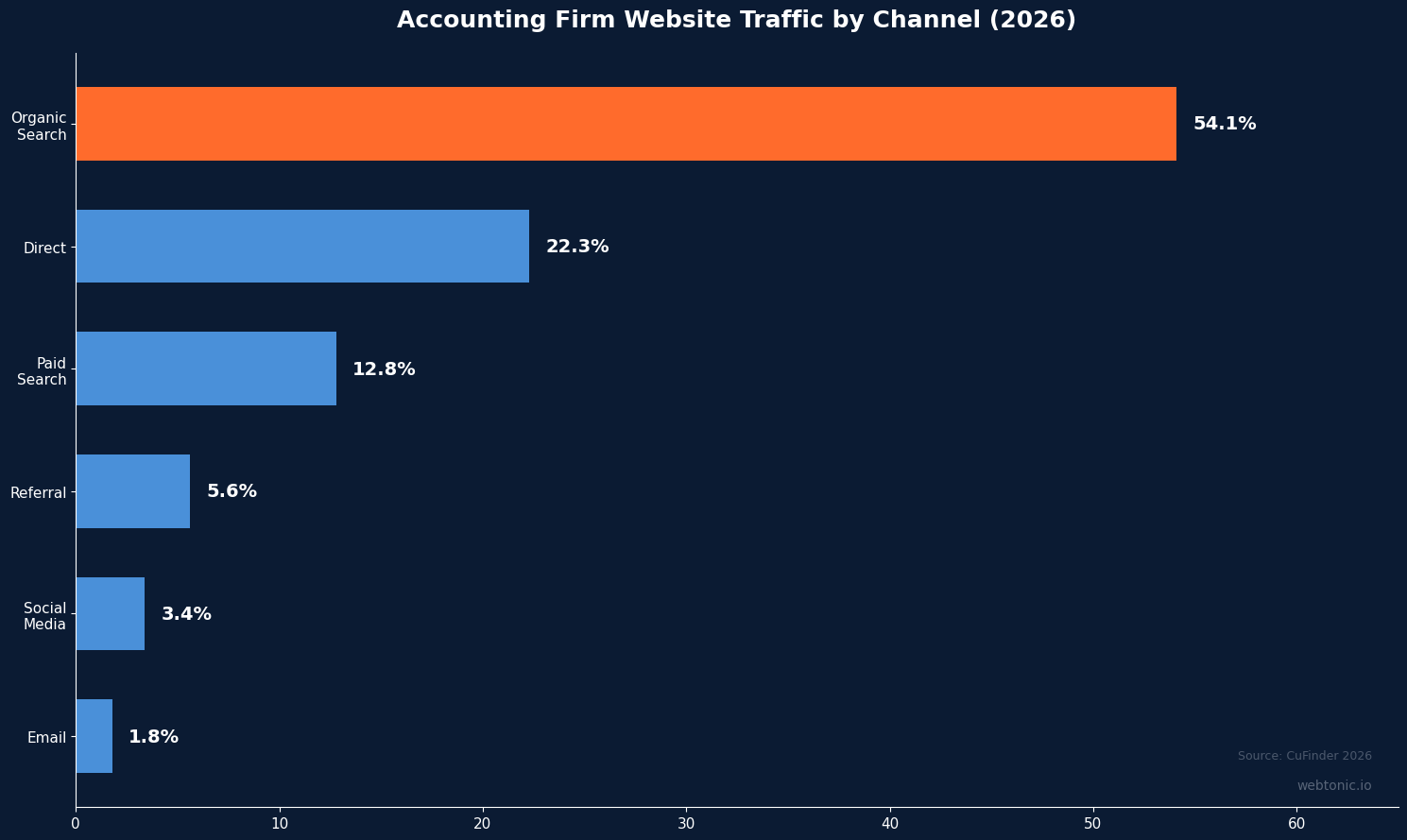
- 54.1% of all accounting firm website traffic comes from organic search, making SEO the single largest acquisition channel (CuFinder, 2026).
- Firms ranking in the top 3 organic positions capture 45–60% of clicks for high-intent queries like "CPA firm near me" (Authority Specialist, 2026).
- Organic search leads convert at 3–5× the rate of social media traffic for tax advisory services (Authority Specialist, 2026).
- Average keyword difficulty for terms like "CPA firm" and "tax accountant" in major metros is 40–70 on a 100-point scale (Authority Specialist, 2026).
- Ranking timelines for moderately competitive accounting keywords run 4–9 months with consistent content investment (Authority Specialist, 2026).
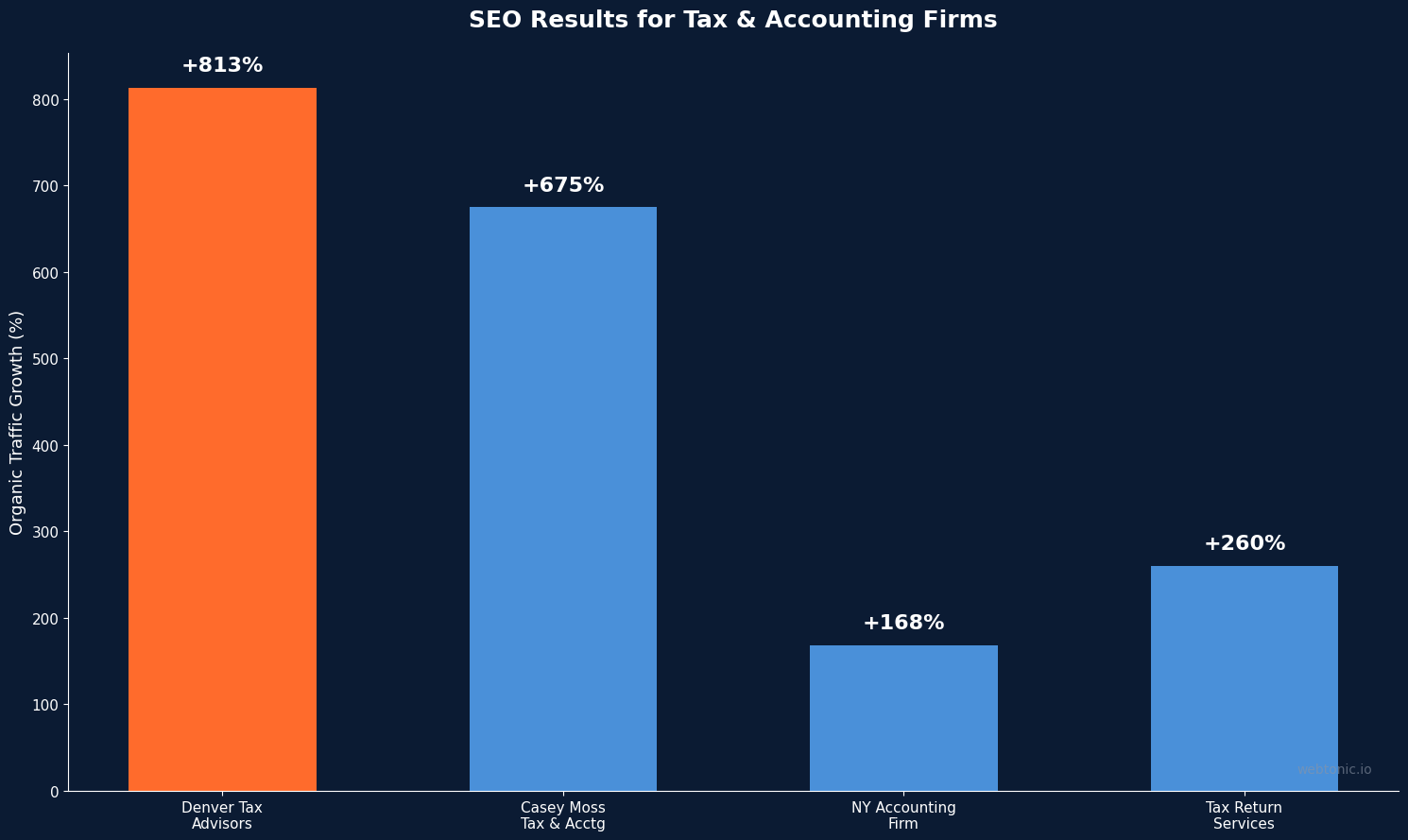
- Denver Tax Advisors grew organic traffic 813% and revenue by $283K through SEO-driven content creation (Firestarter SEO case study).
- Tax preparation service pages convert at roughly 2–3× the rate of advisory pages, reflecting higher commercial intent (Authority Specialist, 2026).
- Fewer than 30% of tax advisory sites deploy professional credentials schema correctly, leaving a major trust gap (Authority Specialist, 2026).
- AI-driven search summaries now influence 30–45% of informational tax queries, changing the organic click landscape (Authority Specialist, 2026).
- High-growth accounting firms invest 2.1% of revenue in marketing vs. 1.0% for average firms, and grow 29% vs. ~6% (Hinge Marketing / AAM study).
- Top-3 rankings for 20–30 relevant keywords generate $15,000–$40,000 in estimated monthly organic traffic value for tax preparation services (SoftScotch, 2026).
- Casey Moss Tax & Accounting saw +675% organic traffic and +93% organic revenue after one year of local SEO (Oddo Digital case study).
- Organic-originated leads for a mid-size accounting firm grew +312% YoY through authority-building SEO (Al-Frasha, 2026).
- Firms with 30–50 indexed topically relevant pages see compounding keyword rankings — authority builds non-linearly (Authority Specialist, 2026).
- Mobile search accounts for 55–65% of initial discovery queries for individual tax preparation services (Authority Specialist, 2026).
- SEO ROI for accounting firms ranges from 4:1 to 8:1 when measured over 12–24 months (Select Advisors Institute).
Accounting SEO Benchmarks at a Glance
| Metric | Benchmark | Source |
|---|---|---|
| Organic traffic share | 54.1% of total website traffic | CuFinder, 2026 |
| Top-3 click share | 45–60% for high-intent queries | Authority Specialist, 2026 |
| Organic lead CVR vs. social | 3–5× higher | Authority Specialist, 2026 |
| Keyword difficulty (metros) | 40–70 / 100 | Authority Specialist, 2026 |
| Ranking timeline (moderate KW) | 4–9 months | Authority Specialist, 2026 |
| Tax prep page CVR vs. advisory | 2–3× higher | Authority Specialist, 2026 |
| Organic CTR (top 3, high-intent) | 6–9% | Authority Specialist, 2026 |
| SEO ROI (12–24 months) | 4:1 to 8:1 | Select Advisors Institute |
| Mobile discovery share | 55–65% | Authority Specialist, 2026 |
| Schema adoption (tax sites) | <30% deploy correctly | Authority Specialist, 2026 |
Organic Search as the Dominant Acquisition Channel
For accounting firms and CPA practices, organic search is not just one channel among many — it is the primary driver of qualified website traffic. According to CuFinder’s 2026 industry benchmark report, 54.1% of all accounting firm web traffic originates from organic search. For CPA firms specifically, organic search contributes 48% of global traffic and 42% in the United States (CuFinder CPA benchmarks).
This dominance stems from the research-intensive nature of accounting services. Prospective clients research firms, verify credentials, and compare service offerings extensively before making contact. High-intent local queries like "CPA firm near me" and "small business accountant [city]" convert at meaningfully higher rates than broad informational searches, with tax preparation pages converting at roughly 2–3× the rate of advisory service pages (Authority Specialist, 2026).
The data confirms what many practitioners suspect: firms that neglect SEO are leaving their largest traffic source — and their most conversion-ready prospects — on the table. According to Select Advisors Institute, SEO ROI for accounting firms ranges from 4:1 to 8:1 when measured over a 12–24 month horizon, outperforming most paid channels on a cost-per-acquisition basis.
Keyword Landscape and Competitive Intensity
The accounting SEO landscape is defined by a clear split between high-competition head terms and accessible long-tail opportunities. Authority Specialist’s 2026 audit of 41 CPA firms found that terms like "CPA firm" and "tax accountant" in major metros frequently show keyword difficulty scores in the 40–70 range (on a 100-point scale), requiring meaningful domain authority to rank on page one.
Longer-tail, service-specific terms — such as "small business tax accountant [city]" or "nonprofit audit firm near me" — typically carry difficulty scores in the 15–35 range, making them realistic targets for newer or smaller practices. SoftScotch’s 2026 keyword analysis estimates that top-3 rankings for 20–30 relevant keywords translate to $15,000–$40,000 in monthly organic traffic value for tax preparation services.
According to Codinito’s cross-industry local SEO study, the average local-service CPC across all industries is $17.37 per click with average keyword difficulty at 42/100. Accounting keywords sit above this average, reinforcing the value of organic rankings that bypass per-click costs entirely.
| Keyword Type | Difficulty Range | Estimated Monthly Value | Ranking Timeline |
|---|---|---|---|
| Head terms ("CPA firm," "tax accountant" + metro) | 40–70 / 100 | $5,000–$15,000 | 6–12 months |
| Service-specific ("small business tax accountant [city]") | 15–35 / 100 | $2,000–$8,000 | 4–6 months |
| Long-tail ("nonprofit audit firm near me") | 5–20 / 100 | $500–$3,000 | 2–4 months |
| Informational ("how to file quarterly taxes") | 20–45 / 100 | $1,000–$5,000 | 3–6 months |
SEO Case Studies: Real Results for Tax and Accounting Firms
The theoretical case for accounting firm SEO is compelling, but the case study evidence makes it definitive. Here are documented outcomes from real tax and accounting practices:
Denver Tax Advisors went from 141 organic visitors in March 2019 to 1,287 in March 2021 — an 813% increase. Leads increased 665%, and the firm added $283K in annual revenue directly attributed to content-driven SEO (Firestarter SEO).
Casey Moss Tax & Accounting (Naperville, IL) achieved +675% organic traffic, +1,308% new organic users, and +93% organic revenue within one year of implementing local SEO. The firm reached first position in both the Google Map Pack and organic results for its primary keywords (Oddo Digital).
A mid-size accounting firm in New York increased organic sessions +168% and organic-originated leads +312% year-over-year through an authority-building SEO strategy focused on credentialed content and topical clusters (Al-Frasha, 2026).
A tax return services firm experienced a 260% increase in organic traffic and 190% increase in client inquiries from organic search within six months — notably reducing reliance on paid ads during tax season (SEO Digital Sight).
E-E-A-T and Authority Signals in Accounting SEO
Google’s emphasis on E-E-A-T (Experience, Expertise, Authoritativeness, Trustworthiness) has outsized implications for accounting and tax content, which falls squarely into the YMYL (Your Money or Your Life) category. Authority Specialist’s 2026 tax advisor audit found that firms with verified E-E-A-T signals — credentialed author bios, regulatory citations, professional schema markup — rank in the top 3 positions at roughly twice the rate of firms using generic content.
Despite this clear advantage, fewer than 30% of tax advisory websites deploy professional credentials schema correctly. This is one of the most accessible and underutilized authority signals in the industry. Firms that publish consistent, topically relevant content — maintaining at least 2 credentialed articles per month — tend to accumulate keyword rankings that compound over time rather than growing linearly. The threshold for this compounding effect appears at 30–50 indexed, topically relevant pages (Authority Specialist, 2026).
Authoritative content focusing on complex tax regulations retains visitors 20–30% longer than generic advice content, and video integration on tax service pages increases time on site by 40–50% (Authority Specialist, 2026). These engagement signals feed back into ranking algorithms, creating a virtuous cycle for firms committed to quality.
Local SEO and Map Pack Visibility
For accounting firms serving geographic markets, Google Map Pack visibility is the highest-impact SEO outcome — in many cases more impactful than organic positions 4–10. Authority Specialist’s analysis confirms that firms appearing in the top 3 local pack results capture 40–60% of regional search clicks.
Local pack visibility correlates most strongly with Google Business Profile completeness and review count, not website domain authority. This is consistent with broader local search data showing that proximity and prominence signals dominate local rankings.
Firms in saturated markets like New York, Chicago, and Los Angeles consistently require 6–12 months longer to reach page-one positions than comparable firms in mid-market cities (Authority Specialist, 2026). Planning realistic timelines based on market competitiveness is essential for setting client expectations and measuring ROI accurately.
AI Search and the Changing Organic Landscape
The rise of AI-powered search is reshaping how potential accounting clients discover and evaluate firms. AI-driven search summaries now influence 30–45% of informational tax queries, changing the distribution of organic clicks. AI models name a specific professional services provider in only 7% of answers on average, meaning brand visibility in AI responses requires deliberate optimization (Authority Specialist AI Study, 2026).
The AI Recommendation Index for tax advisors stands at 75.6% — how often ChatGPT, Claude, and Gemini tell buyers to hire a professional — significantly above the 14-industry average of 44.2%. This suggests that AI search traffic to accounting firm websites could accelerate as AI increasingly validates the need for professional tax help.
Firms that invest in structured data, schema markup, and credentialed content are positioning themselves for both traditional and AI-driven search discovery.
| AI Metric | Value | Context |
|---|---|---|
| AI Recommendation Index (tax advisors) | 75.6% | 14-industry avg: 44.2% |
| AI brand mention rate | 7% of answers | Professional services avg |
| Informational queries influenced by AI | 30–45% | Tax-related searches |
| ChatGPT hire-a-pro rate | 93% | Tax advisors |
| Claude hire-a-pro rate | 67% | Tax advisors |
| Gemini hire-a-pro rate | 67% | Tax advisors |
SEO Investment and Growth Benchmarks
The link between SEO investment and firm growth is well-documented. According to Hinge Marketing’s AAM study, high-growth accounting firms spend 2.1% of revenue on marketing compared to 1.0% for average firms, and grow at 29% vs. approximately 6%. SEO adoption among high-growth firms stands at 90.1%, with social-sourced leads reaching 37.5%.
These firms don’t just spend more — they spend differently. High-growth firms prioritize digital channels with compounding returns: SEO, content marketing, and social media. The result is a lower blended cost per acquisition that improves over time rather than resetting each month (unlike paid media).
Defiance Analytics found that multi-channel strategies including SEO drove +24% revenue growth compared to single-channel approaches. Industry data shows that accounting firms see year-one SEO ROI of 3:1 to 7:1, with returns accelerating in year two as content authority compounds.
Best Practices for Tax and Accounting Firm SEO
- Prioritize local SEO and Google Business Profile optimization — Map Pack visibility drives the highest-intent inquiries for firms serving geographic markets.
- Target service-specific long-tail keywords first — terms with 15–35 difficulty scores offer faster wins and higher conversion rates than head terms.
- Implement professional credentials schema — fewer than 30% of competitors do this correctly, creating an easy differentiation opportunity.
- Publish at least 2 credentialed articles per month — consistent content production drives the compounding authority effect that kicks in at 30–50 indexed pages.
- Build E-E-A-T signals into every page — credentialed author bios, regulatory citations, and case study evidence strengthen YMYL content rankings.
- Optimize for mobile-first indexing — with 55–65% of discovery queries on mobile, site speed and responsive design directly impact rankings.
- Separate tax preparation and advisory service pages — tax prep pages convert 2–3× higher; distinct landing pages capture more qualified leads.
- Set realistic timelines by market — 4–6 months in mid-markets, 6–12+ in saturated metro areas like NYC, Chicago, and LA.
FAQ
How long does it take for an accounting firm to see SEO results?
Most accounting firms see measurable organic traffic improvements within 4–9 months, depending on market competitiveness, starting domain authority, and content investment. Firms in saturated metros may require 6–12 months longer than those in mid-market cities. Case studies show that firms committing to consistent content creation (2+ articles/month) typically see compounding returns after the 30–50 indexed page threshold.
What is the average conversion rate for accounting firm SEO traffic?
Conversion rates vary significantly by page type and intent. Tax preparation service pages convert at roughly 2–3× the rate of advisory pages. High-intent local queries like "CPA firm near me" convert at the highest rates, while broad informational content converts lower but builds authority for downstream conversions. Industry-wide, professional services websites convert between 2–5%, with optimized landing pages reaching 6–10%.
Is SEO worth the investment for small CPA firms?
Yes. SEO ROI for accounting firms ranges from 4:1 to 8:1 over 12–24 months. Small firms often benefit disproportionately because they can target lower-competition long-tail keywords (difficulty 5–20) and local terms that larger firms overlook. Case studies show firms adding $150K–$283K in annual revenue through organic-driven lead generation.
How does AI search affect accounting firm SEO?
AI-driven search summaries now influence 30–45% of informational tax queries. While AI names specific providers in only 7% of answers, the high "hire-a-pro" recommendation rate (75.6% for tax advisors) drives users from AI summaries to organic search, benefiting firms with strong traditional SEO. Structured data and schema markup increase AI citation likelihood.
What keywords should accounting firms target first?
Start with service-specific + location keywords (e.g., "small business tax accountant [city]") in the 15–35 difficulty range. These convert highest and rank fastest. Once established, expand to head terms ("CPA firm" + metro) and informational content for authority building. Top-3 rankings for 20–30 relevant keywords can generate $15,000–$40,000 in monthly organic traffic value.
Sources
authorityspecialist.com/industry/professional/accounting-firm/seo-statistics
authorityspecialist.com/industry/financial/tax-advisors/seo-statistics
cufinder.io/blog/benchmarks/accounting
cufinder.io/blog/benchmarks/cpa-firm
firestarterseo.com — Denver Tax Advisors case study
oddodigital.com — Casey Moss Tax & Accounting case study
softscotch.com/seo-keywords-for-tax-preparation-services
codinito.com/state-of-local-seo-2026
al-frasha.com — accounting SEO authority case study
seodigitalsight.com — tax return services SEO case study