



Table of contents

Key Takeaways
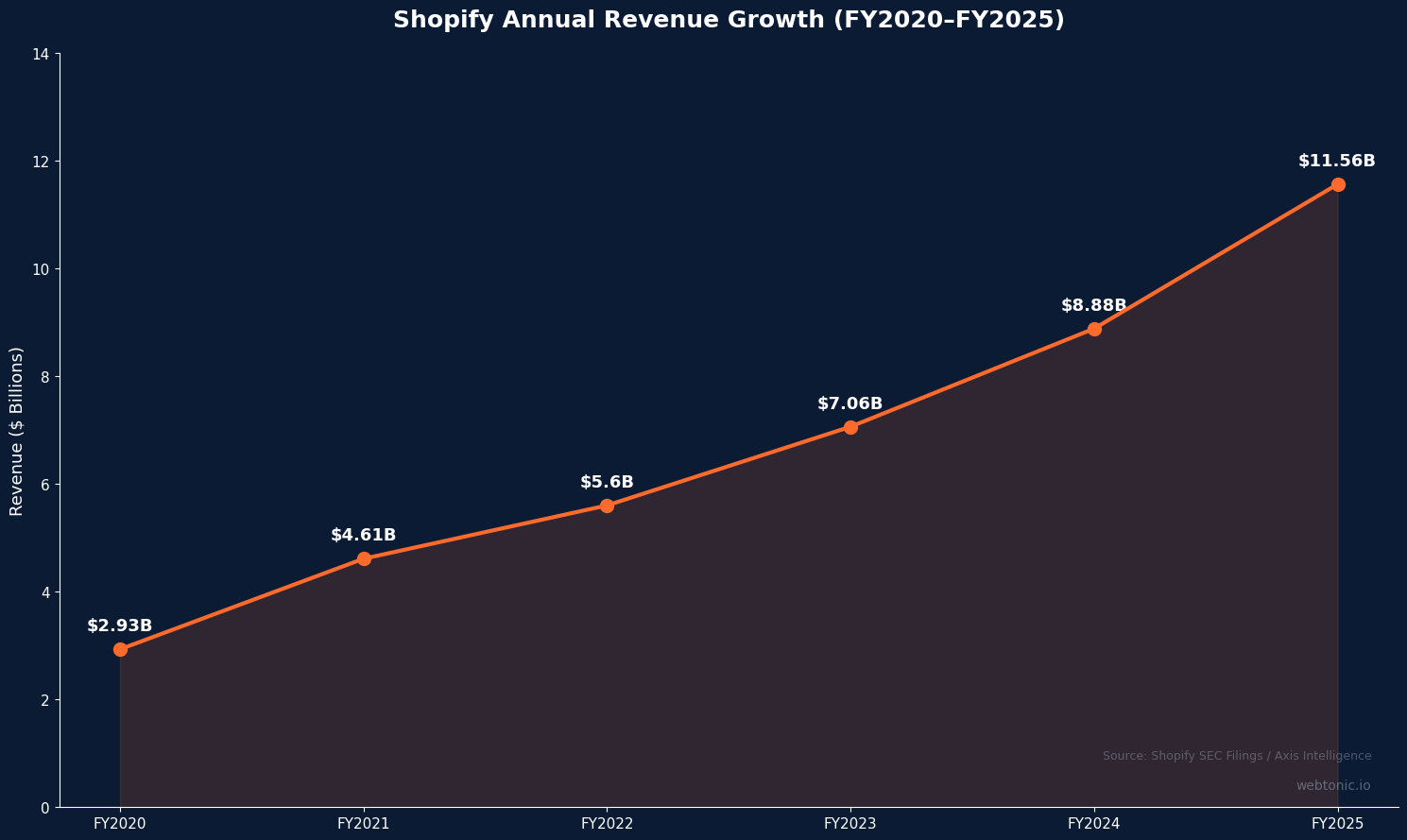
- Shopify generated $11.56 billion in revenue in FY2025, up 30% year-over-year, with merchant GMV reaching $378.4 billion (Axis Intelligence / Shopify SEC filings).
- Q1 2026 GMV hit $100.7 billion (+35% YoY) — the second consecutive quarter above the $100 billion threshold (Shopify Q1 2026 10-Q).
- Approximately 2.9 million live stores operate on Shopify, with 11% year-over-year growth in active stores (Store Leads, 2026).
- AI-driven order volume on Shopify grew nearly 13× year-over-year in Q1 2026, with AI-search orders converting at 2× the rate of general AI searches (Shopify Q1 2026 earnings).
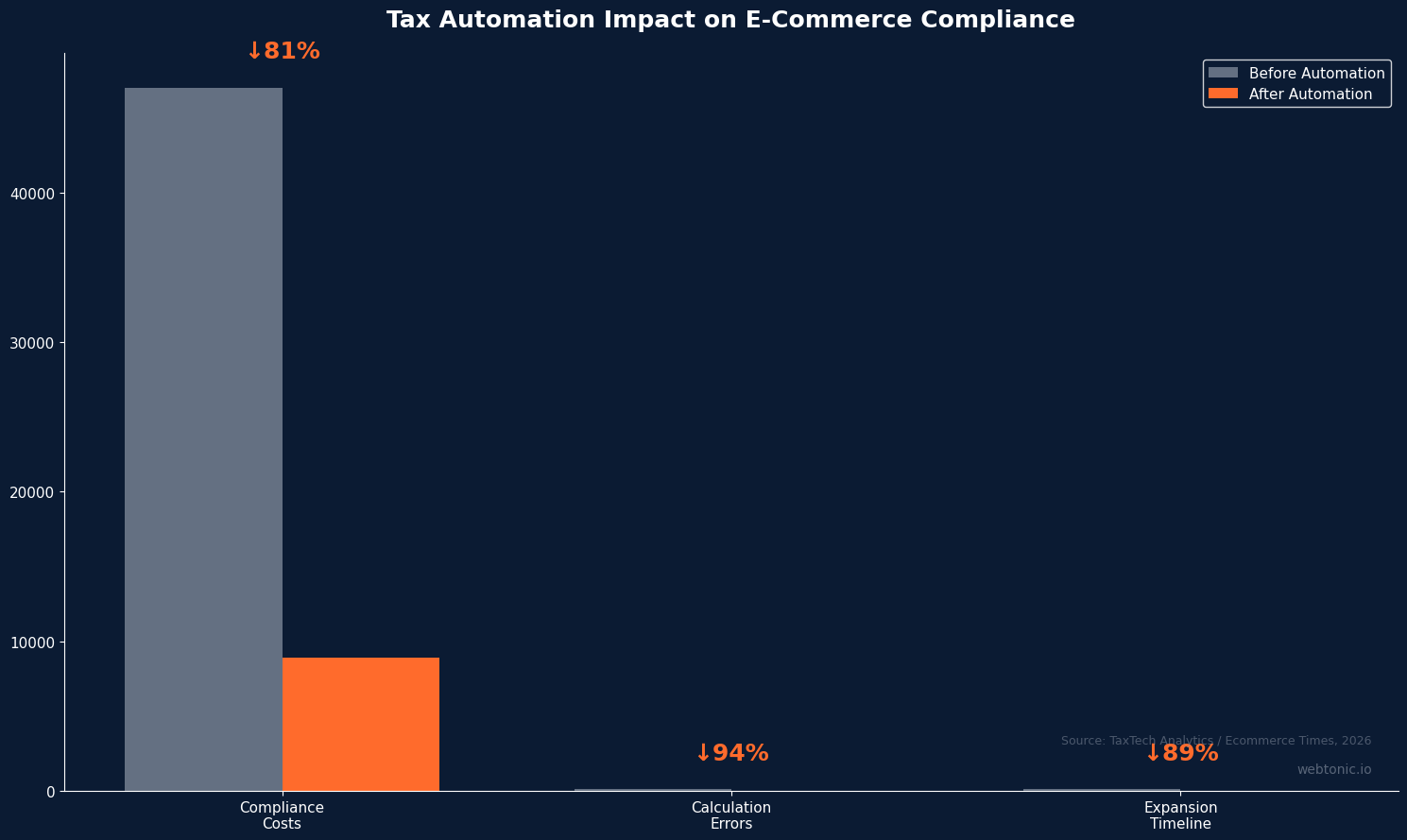
- Smart tax automation reduces e-commerce compliance costs by 81% — from $47,000 to $8,900 annually — while cutting errors 94% (TaxTech Analytics / Ecommerce Times, 2026).
- Avalara covers 13,000+ US tax jurisdictions at rooftop-level geocoding for Shopify merchants requiring enterprise-grade compliance (Eightx, 2026).
- Automated tax calculation for Shopify sales reduces compliance errors by 68% versus manual calculation (Avalara, 2024 via TK Turners).
- Average e-commerce bookkeeping cost ranges from $500 to $5,000+ per month depending on revenue band (Eightx, 2026).
- Shopify’s merchant solutions segment generated $8.8 billion in FY2025 — 76.2% of total revenue, up 35% YoY (Axis Intelligence).
- Shopify holds over 14% of the US e-commerce market by GMV and powers businesses in 175+ countries (Shopify / US Census Bureau).
- E-commerce merchants using automated tax systems process international expansion 89% faster due to streamlined tax setup (Ecommerce Times, 2026).
- BFCM 2025 generated $14.6 billion in four days on Shopify, peaking at $5.1 million per minute (Shopify).
- Shopify’s GMV-to-revenue take rate is 3.05% in FY2025, up marginally from 3.04% in FY2024 (Axis Intelligence calculation).
- Average Shopify store conversion rate is 1.4%, with top performers reaching 3.3% (StoreInspect, 2026).
- DTC e-commerce brands target 60–70% gross margins as a healthy benchmark, with CAC recovery within 90 days (LevelCFO).
- Shopify’s global market share is approximately 10.32% of all e-commerce sites, ranking fourth behind WooCommerce at 38.74% (Statista via Ecommercetrix).
Shopify Platform Benchmarks at a Glance
| Metric | Value | Source |
|---|---|---|
| FY2025 Revenue | $11.56 billion (+30% YoY) | Shopify SEC filing |
| FY2025 GMV | $378.4 billion (+29% YoY) | Shopify SEC filing |
| Q1 2026 GMV | $100.7 billion (+35% YoY) | Shopify 10-Q |
| Live stores | ~2.9 million | Store Leads, 2026 |
| US market share (by GMV) | >14% | Shopify + US Census |
| Global ecommerce share | ~10.32% | Statista |
| Free cash flow (FY2025) | $2.007 billion (17% margin) | Shopify SEC filing |
| BFCM 2025 GMV | $14.6 billion in 4 days | Shopify |
| Avg. store conversion rate | 1.4% (top: 3.3%) | StoreInspect, 2026 |
Shopify’s Growth Trajectory and Revenue Model
Shopify’s financial performance underscores its dominance in the e-commerce platform space — and its growing relevance for tax and accounting professionals. According to Axis Intelligence’s analysis of Shopify’s SEC filings, the platform generated $11.56 billion in revenue in FY2025, with a 30% year-over-year growth rate.
The structural shift in Shopify’s revenue model is particularly significant for accountants: merchant solutions (Payments, Capital, Markets) generated $8.8 billion — 76.2% of total revenue, growing 35% YoY. This means Shopify earns disproportionately more when merchants succeed, creating a revenue model aligned with merchant performance rather than simple subscription fees.
Axis Intelligence calculates Shopify’s GMV-to-revenue take rate at 3.05% in FY2025 (up from 3.04% in FY2024) — a metric neither Shopify nor analyst reports publish explicitly. This marginal rate expansion, driven by deeper Payments and Capital attachment, signals increasing platform monetization that accountants tracking Shopify-native businesses should factor into forecasting.
Tax Automation and Compliance for Shopify Merchants
Tax compliance is one of the most operationally complex and costly challenges for Shopify merchants — and one of the highest-value service opportunities for accounting firms. According to a 2026 study by TaxTech Analytics (via Ecommerce Times), smart tax automation reduces e-commerce compliance costs by 81% — from an average of $47,000 annually to just $8,900 — while cutting tax calculation errors by 94%.
The data reveals that automated tax calculation for Shopify sales reduces compliance errors by 68% versus manual calculation (Avalara data via TK Turners, 2026). Merchants using automated systems also achieve 89% faster international expansion timelines due to streamlined tax setup processes.
The tax automation ecosystem for Shopify has matured significantly. Eightx’s 2026 comparison maps the landscape: Avalara covers 13,000+ US jurisdictions at rooftop-level geocoding and wins at the enterprise level ($5–10M+ revenue), while TaxJar dominates the US mid-market with AutoFile and sub-$100 starting prices. Shopify Tax (native) handles basics for smaller merchants but lacks the multi-channel depth that growing businesses require.
| Tax Solution | Best For | Jurisdictions | Starting Price |
|---|---|---|---|
| Shopify Tax (native) | Small merchants, US-only | US states | Included in plan |
| TaxJar | US mid-market, AutoFile | US-focused | Sub-$100/month |
| Avalara AvaTax | Enterprise, multi-channel, B2B | 13,000+ US, global VAT/GST | Custom pricing |
| Vertex | Global enterprises, 195 countries | 195 countries | Enterprise pricing |
E-Commerce Bookkeeping and Reconciliation
For accounting professionals serving Shopify merchants, bookkeeping complexity scales with transaction volume and multi-channel selling. Eightx’s 2026 analysis of 35+ DTC and CPG engagements establishes that average e-commerce bookkeeping costs range from $500 to $5,000+ per month depending on revenue band.
The industry standard for Shopify-to-accounting integration is A2X, which automatically maps Shopify payouts — gross sales, fees, refunds, and sales tax — to the correct accounts in QuickBooks or Xero. This automation addresses the reconciliation challenge that manual Shopify bookkeeping creates: PayPal and Shopify Payments settlements don’t match daily sales, and multi-currency transactions compound the complexity.
For data-driven accounting practices, Shopify’s robust API ecosystem — including direct integrations with A2X, Bookkeep, Synder, and Link My Books — creates opportunities to build recurring service packages around automated reconciliation, reducing manual effort by 60–80% while improving accuracy.
Shopify Merchant Performance Benchmarks
StoreInspect’s 2026 study of 289,000 Shopify stores provides the largest public benchmark dataset for the platform. The average Shopify store conversion rate is 1.4%, with top-performing stores reaching 3.3%. This data helps accountants benchmark client performance and identify optimization opportunities.
DTC e-commerce financial benchmarks from LevelCFO and Northstar Financial Advisory provide additional context: healthy DTC brands target 60–70% gross margins, with CAC (customer acquisition cost) recovery within 90 days. Return rates averaging 20–30% for apparel and 5–10% for non-apparel significantly impact net revenue calculations that accountants must reconcile.
With approximately 135,000 new active Shopify stores added every week (3PL Insider, 2026), the addressable market for Shopify-focused accounting services continues to expand rapidly.
Shopify Revenue and Financial Trends for Accountants
Several financial trends in the Shopify ecosystem directly impact accounting practice. Subscription revenue grew to $2.75 billion in FY2025, but the faster-growing merchant solutions segment ($8.8 billion) means more of each merchant’s financial activity flows through Shopify’s ecosystem — payments, lending, fulfillment, and cross-border settlements. Accountants serving Shopify merchants must track these payment flows across multiple settlement timelines and currencies.
The BFCM 2025 results ($14.6 billion in four days, peaking at $5.1 million per minute) highlight the seasonal revenue concentration that defines Shopify merchant financials. Accounting firms should structure engagement models that account for Q4 revenue spikes, inventory buildups in Q3, and the cash flow implications of returns processing in January. Return rates of 20–30% for apparel and 5–10% for non-apparel directly affect revenue recognition and refund liability calculations.
With AI-driven order volume growing nearly 13× year-over-year on Shopify, the attribution complexity for multi-channel merchants is increasing. Accountants advising on marketing spend allocation need tools that reconcile Shopify’s native analytics with third-party attribution data to provide accurate customer acquisition cost calculations.
Cross-Border Commerce and Tax Complexity
Shopify’s cross-border capabilities create both opportunities and compliance challenges for accounting firms. The platform powers businesses in 175+ countries, and cross-border e-commerce transactions are projected to reach $7.9 trillion globally by 2027. For merchants selling internationally, tax compliance spans VAT, GST, customs duties, and economic nexus laws across dozens of jurisdictions.
Shopify Markets, the platform’s integrated cross-border solution, handles duties and import taxes at checkout for international orders. However, the accounting implications — multi-currency revenue recognition, foreign exchange gains/losses, and international tax reporting — require professional guidance that goes well beyond platform automation.
Economic nexus laws in the US now require merchants to collect sales tax once they exceed specific revenue thresholds in each state, creating ongoing monitoring obligations. Merchants using smart automation handle these thresholds automatically, while those relying on manual tracking risk non-compliance penalties.
Best Practices for Accountants Serving Shopify Merchants
- Implement automated reconciliation from day one — tools like A2X or Bookkeep reduce manual effort by 60–80% and eliminate the payout-to-sales timing mismatch.
- Monitor economic nexus thresholds proactively — automated tracking prevents the compliance gaps that trigger penalties across multiple states.
- Choose the right tax automation tier — Shopify Tax for basic needs, TaxJar for US mid-market, Avalara for enterprise and international.
- Build recurring service packages — monthly reconciliation, quarterly tax filing, and annual planning services create predictable revenue streams.
- Benchmark client performance against industry data — compare conversion rates, gross margins, and CAC recovery against the StoreInspect and LevelCFO benchmarks.
- Stay current on platform changes — Shopify’s evolving revenue model (3.05% take rate) and AI-driven features affect merchant financials.
- Advise on sales tax nexus early — as merchants cross state revenue thresholds, proactive compliance prevents costly penalties.
- Leverage Shopify’s API for custom reporting — automated financial dashboards reduce month-end close time by 40–60% for e-commerce clients.
Related reading
- Tax & Accounting WordPress Statistics (2026)
- Tax & Accounting Landing Page Statistics (2026)
- Webflow for Tax and Accounting Firms: 60+ 2026 Statistics
- Custom Web Development services at Web Tonic
FAQ
How many active Shopify stores are there in 2026?
As of mid-2026, there are approximately 2.9 million live Shopify stores, with an 11% year-over-year growth rate. Estimates including inactive stores range from 5.6 to 6.8 million. Roughly 135,000 new active stores are added every week, making Shopify’s merchant base one of the fastest-growing addressable markets for e-commerce accounting services.
How much does e-commerce bookkeeping cost for Shopify stores?
Average e-commerce bookkeeping costs range from $500 to $5,000+ per month depending on revenue band, transaction volume, and complexity. Small Shopify stores under $500K revenue typically pay $500–$1,500/month, while stores above $5M may require $3,000–$5,000+ for comprehensive accounting including tax compliance, reconciliation, and financial planning.
What is the best tax automation tool for Shopify merchants?
It depends on scale. Shopify Tax (native) works for small US-only merchants. TaxJar wins the US mid-market with AutoFile capabilities starting under $100/month. Avalara AvaTax is the enterprise choice, covering 13,000+ US jurisdictions with rooftop-level geocoding and full international VAT/GST support. Merchants above $5–10M revenue or with 20+ nexus states generally need Avalara-level solutions.
How much does tax automation save e-commerce businesses?
According to TaxTech Analytics, smart tax automation reduces compliance costs by 81% on average — from $47,000 to $8,900 annually — while cutting calculation errors by 94%. Merchants also achieve 89% faster international expansion due to streamlined tax setup. The ROI on tax automation typically pays for itself within the first quarter of implementation.
What is Shopify’s revenue share from merchants?
Shopify’s GMV-to-revenue take rate is 3.05% in FY2025, up marginally from 3.04% in FY2024. This means Shopify captures approximately $3.05 for every $100 in merchant sales, primarily through Shopify Payments, Shopify Capital, and Shopify Markets. The merchant solutions segment generated $8.8 billion (76.2% of total revenue) in FY2025.
Sources
axis-intelligence.com/shopify-statistics
storeleads.app/reports/shopify
ecommerce-times.com — smart tax automation study
eightx.co/blog/shopify-tax-vs-avalara-vs-taxjar
eightx.co/blog/average-bookkeeping-cost-by-revenue-band
acuity.co/shopify-accounting
storeinspect.com/blog/shopify-store-benchmarks
levelcfo.com/benchmarks/ecommerce
tkturners.com — Shopify accounting automation
3plinsider.com/research/how-many-shopify-stores


