Table of contents
The average US accounting and tax website takes 8.49 seconds to render its main content - six seconds past Google’s threshold - and fewer than half publish any structured data. Both numbers come from live measurement, not opinion.
Key Takeaways
- Average LCP is 8.49 seconds across 385 US accounting and tax sites, versus a 2.5s threshold.
- Average First Contentful Paint is 3.75 seconds against a 1.8s target.
- Cumulative Layout Shift averages 0.07 - the one metric the sector passes.
- Only 47.2% publish JSON-LD structured data; the rest are invisible to rich results.
- 86.9% have SSL - meaning 51 of 385 firm sites still trigger a browser warning.
- 10.2% deploy HSTS and 10.0% serve HTTP/3.
- jQuery is detected on 14.4% of sites and WordPress on 10.4%.
- 43.8% link to any social profile from the homepage - a weak entity signal.
- Only 51.3% of all web origins pass every Core Web Vital on mobile.
- Median accounting homepage scores 71 out of 100; 84.6% grade a C or lower.
- 41% of firm sites omit LocalBusiness schema entirely.
- Category scores: mobile 94.9, trust 91.5, local SEO 62.5 out of 100.
- Top-3 organic positions capture 45-60% of clicks on high-intent CPA queries.
- Ranking timelines average 4-7 months; map pack visibility in 60-90 days.
- Organic search is 48% of CPA firm traffic; paid search is 8%.
- Traffic splits 62% desktop / 34% mobile, but Google indexes mobile-first.
- Service-page bounce averages 42% - the pages where intent actually lives.
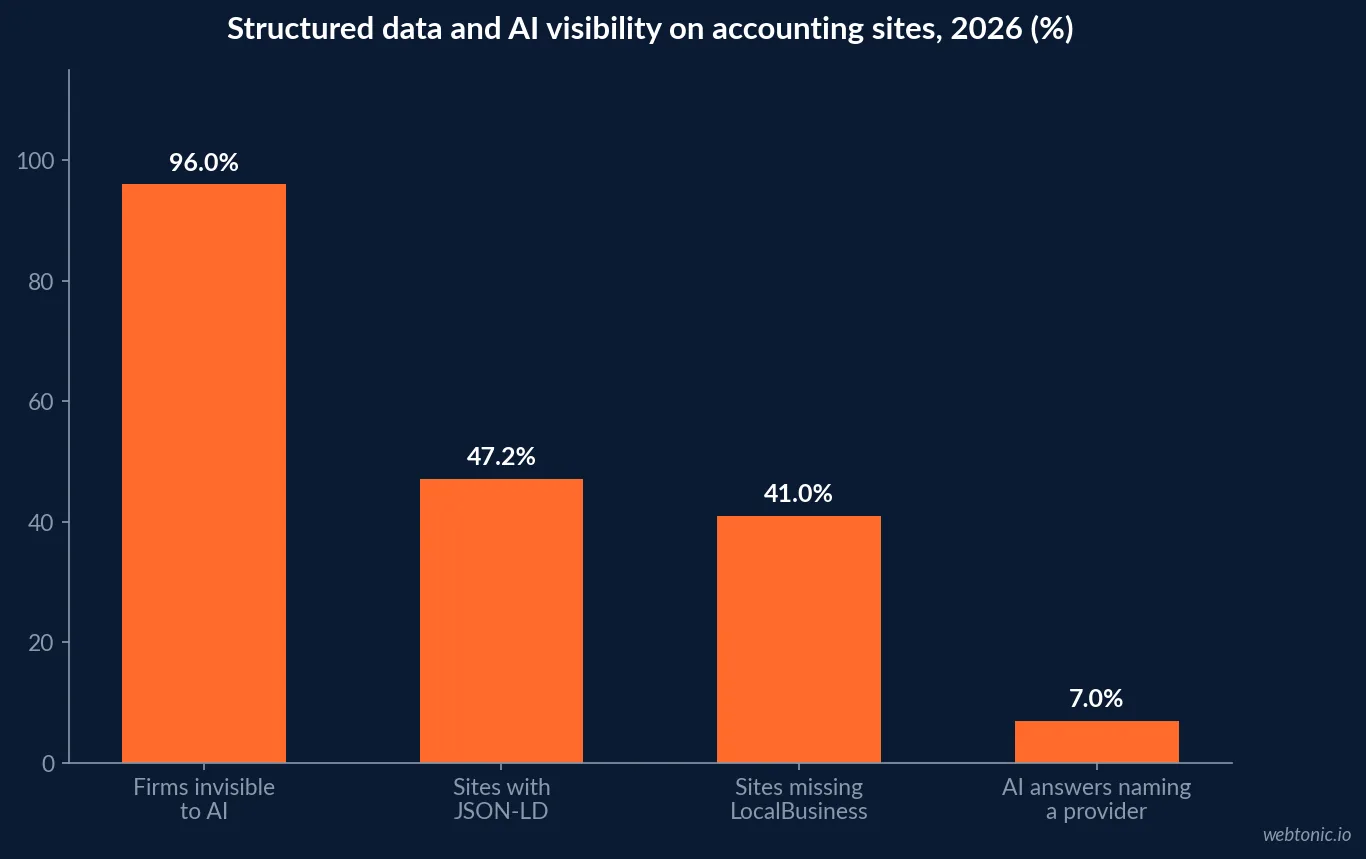
- 96% of 80 audited CPA firms were invisible to ChatGPT, Perplexity and Claude.
- Under 4% of firms have the structured data needed to be cited by AI engines.
- An estimated 42% of JavaScript content is never indexed by AI systems.
- AI models name a specific professional-services provider in only 7% of answers.
- FAQ rich results are now limited to authoritative government and health sites.
The Core Web Vitals baseline is bad, and it is measured
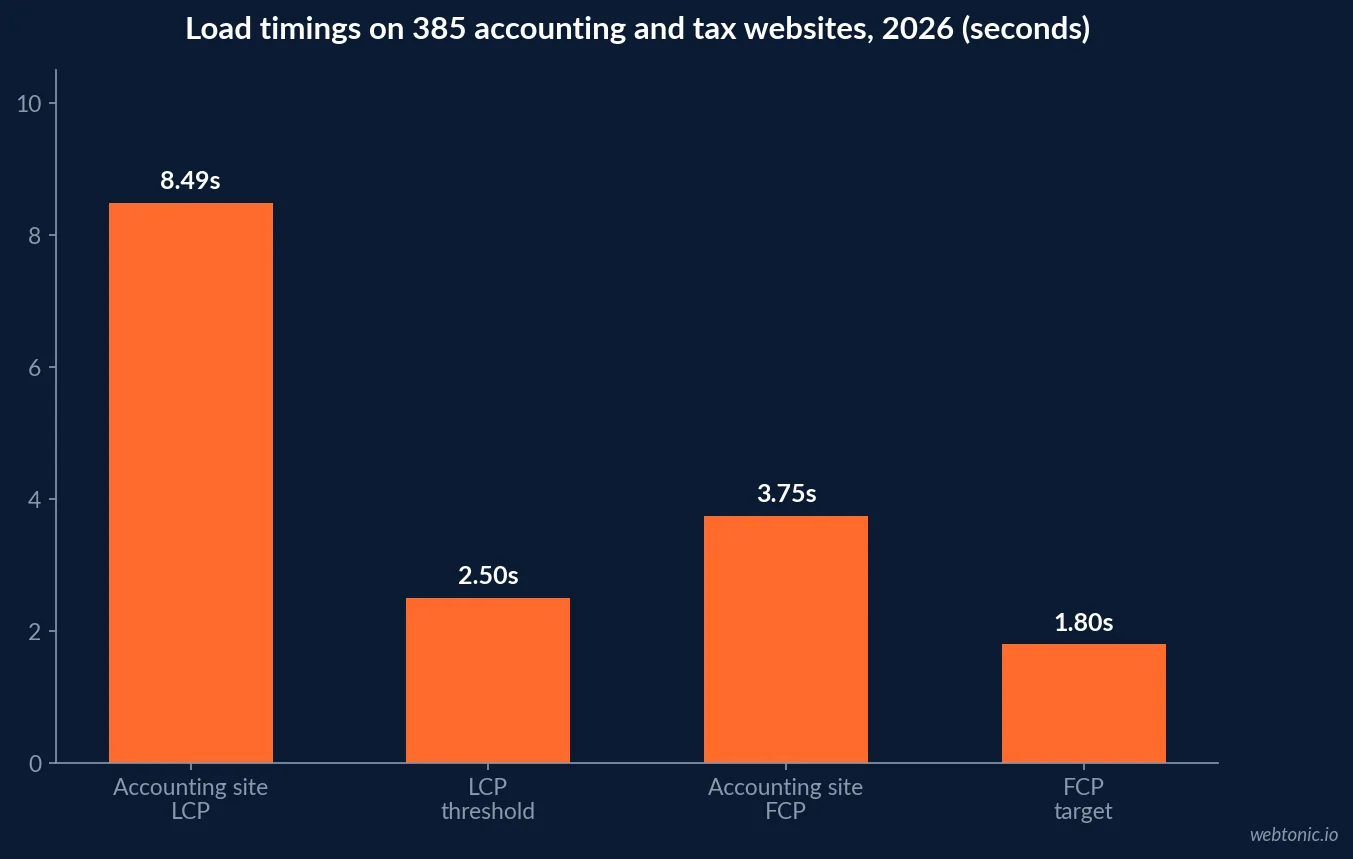
A July 2026 benchmark of 385 US accounting and tax websites found an average LCP of 8.49 seconds, First Contentful Paint of 3.75 seconds, CLS of 0.07 and SSL coverage of 86.9%. Six seconds past the LCP threshold is not a tuning problem; it is usually an unoptimised theme, uncompressed hero imagery and render-blocking scripts stacked on shared hosting.
The comparison that matters is not other accountants - it is the web. Roughly 51.3% of all origins pass every Core Web Vital on mobile, so a sector averaging 8.49s is not merely behind its peers, it is behind an unremarkable baseline. The good news is that CLS at 0.07 shows layout discipline exists; the failure is concentrated in loading, which is the most fixable category.
| Metric | Accounting and tax average | Google threshold | Gap |
|---|---|---|---|
| Largest Contentful Paint | 8.49s | 2.50s | +5.99s |
| First Contentful Paint | 3.75s | 1.80s | +1.95s |
| Cumulative Layout Shift | 0.07 | 0.10 | Passing |
| SSL coverage | 86.9% | 100% | 51 of 385 sites exposed |
| HSTS deployed | 10.2% | Best practice | Rare |
| HTTP/3 served | 10.0% | Best practice | Rare |
Structured data is the cheapest gap in the profession
Only 47.2% of the 385 sites publish any JSON-LD, and separate homepage grading found 41% of firm sites omit LocalBusiness schema, with a median homepage score of 71 out of 100 and 84.6% grading a C or lower. Category subscores tell the story: mobile 94.9 and trust 91.5 are fine, local SEO 62.5 is not.
The practical build is well documented. Guidance for the profession points to AccountingService or ProfessionalService as the LocalBusiness subtype, plus Service entries per practice area and Person markup for credentialed staff. One expectation needs resetting: FAQ rich results are now shown only for well-known government and health sites, so FAQPage markup is for machine comprehension, not for SERP real estate.
| Schema type | Purpose | Sector adoption | Priority |
|---|---|---|---|
| AccountingService / ProfessionalService | Entity identity, local eligibility | 59% have some LocalBusiness type | Highest |
| Organization + WebSite | Brand entity and sitelinks search | Partial | High |
| Service (per practice area) | Disambiguates tax vs audit vs advisory | Rare | High |
| Person (credentialed staff) | E-E-A-T and author verification | Rare | High for YMYL |
| BreadcrumbList | Cleaner deep-page SERPs | Partial | Medium |
| FAQPage | Machine comprehension only | Common | Low - no rich result |
What technical work buys in search visibility
Audits of the sector put the ceiling clearly: firms in the top three organic positions capture an estimated 45-60% of clicks on queries like "CPA firm near me", with local pack visibility correlating most strongly with Google Business Profile completeness. The same research puts competitive keyword timelines at 4-7 months with map pack entries often inside 60-90 days once crawl issues and citations are fixed.
The channel weighting justifies the work: organic search delivers 48% of CPA firm traffic against 8% for paid search, with 62% desktop / 34% mobile traffic and a 42% bounce rate on service pages. Note the trap in that device split: buyers convert on desktop, but Google evaluates the mobile render, which is where the 8.49-second LCP lives. Our accounting local SEO statistics cover the map pack side of the same problem.
| Search factor | 2026 data point | Technical dependency | Time to effect |
|---|---|---|---|
| Top-3 organic click share | 45-60% of clicks | Crawlable, fast service pages | 4-7 months |
| Local pack entry | Often 60-90 days | NAP consistency, LocalBusiness schema | 1-3 months |
| Organic share of traffic | 48% | Indexation coverage | Ongoing |
| Paid search share | 8% | Landing page speed | Immediate |
| Service-page bounce | 42% | LCP and content clarity | Weeks |
| Mobile evaluation | Mobile-first indexing | Mobile LCP, not desktop | Weeks |
The AI layer has already changed the technical brief
Two findings should reframe the roadmap. First, 96% of 80 audited US CPA firms were invisible to ChatGPT, Perplexity and Claude, and under 4% had the structured-data foundation needed to be cited. Second, models are conservative about naming anyone: measured studies show AI systems name a specific professional-services provider in only about 7% of answers, while telling accounting-firm buyers to hire a professional in 66.7% of cases.
Retrieval mechanics are technical, not editorial. Reddit alone accounts for 46.7% of Perplexity’s top-10 citations and pages with 19+ statistical data points earn 2-3x more AI citations, and an estimated 42% of JavaScript-dependent content is never indexed by AI systems. Server-render the content, keep headings answer-shaped, and make the firm’s entity consistent across schema, profile and citations. Our accounting dashboard data covers the reporting half of that equation.
A 90-day sequence that fits the tax calendar
Technical work in this profession has a deadline that content work does not: the filing season. With more than 60% of annual client acquisition landing between January and April, a site that is still being rebuilt in February is losing the only quarter that pays. The sequence below assumes an autumn start and a frozen codebase from the first week of January.
Order matters because the dependencies are real. Crawlability precedes indexation, indexation precedes ranking, and rendering speed changes the value of everything downstream including paid traffic. Schema goes early because it is days of work rather than weeks and because it is the single largest gap in the sector at 47.2% adoption.
| Window | Work | Owner | Verification |
|---|---|---|---|
| Days 1-14 | Crawl audit, redirect map, indexation review | SEO | Search Console coverage report |
| Days 15-30 | LCP work: imagery, scripts, caching, hosting | Developer | Field data, not lab scores |
| Days 31-45 | Schema build: AccountingService, Service, Person | SEO plus dev | Rich Results Test |
| Days 46-60 | Per-service page split and internal linking | Content | Indexed page count by service |
| Days 61-75 | SSL, HSTS, HTTP/3, security headers | Developer | Header inspection |
| Days 76-90 | Local entity cleanup and measurement setup | SEO plus ops | Map pack impressions |
The fix list, ordered by return
- Kill the LCP first - compress and resize hero imagery, defer non-critical scripts, enable caching. The 8.49s average is mostly assets.
- Fix the 13% without SSL - 51 of 385 sites still show a browser warning to a prospect handing over financial data.
- Ship LocalBusiness schema as AccountingService with address, phone, geo, hours and priceRange; 41% of competitors have none.
- Add Person schema for credentialed staff, with credentials and a profile link - the cheapest YMYL trust signal available.
- Server-render key pages so the 42% JavaScript indexation loss does not apply to your service copy.
- Audit indexation monthly in Search Console - orphaned service pages and stale seasonal landers are the usual culprits.
- Match content to the mobile render, since evaluation is mobile-first even though 62% of traffic is desktop.
- Give every service its own indexable page - tax prep, audit, payroll, advisory - rather than one accordion page.
- Deploy HSTS and HTTP/3; only about one site in ten has either.
- Finish before January, because 60%+ of annual acquisition lands in the measurable Jan-Apr window.
- Then buy traffic - our Google Ads strategy guide assumes the landing page already loads.
| Fix | Effort | Expected effect | Sector adoption today |
|---|---|---|---|
| Image and script optimisation | Low | Largest single LCP gain | Rare |
| SSL and HSTS | Low | Removes trust warnings | 86.9% / 10.2% |
| LocalBusiness + Service schema | Low | Rich result and AI eligibility | 47.2% any JSON-LD |
| Person schema for CPAs | Low | E-E-A-T for YMYL content | Rare |
| Server-side rendering | Medium | AI and crawler indexation | Rare |
| Per-service indexable pages | Medium | Long-tail capture | Partial |
Frequently Asked Questions
How slow are accounting firm websites really?
Measurably slower than almost any benchmark you would want to be compared against. Across 385 US accounting and tax sites measured in July 2026, average Largest Contentful Paint was 8.49 seconds against Google's 2.5-second 'good' threshold, and First Contentful Paint was 3.75 seconds against 1.8. Cumulative Layout Shift was the one healthy metric at 0.07. For context, only 51.3% of all web origins pass all three Core Web Vitals on mobile, so the profession is well below an already mediocre web average.
Does site speed actually change rankings for a CPA firm?
It is a tiebreaker, not a lever. Page experience signals influence ranking at the margin, but the bigger cost of an 8.5-second render is behavioural: visitors abandon before the homepage paints, and paid traffic pays for the abandonment twice. The stronger ranking factors for firms remain local relevance and authority - Google Business Profile completeness and citation consistency correlate most strongly with local pack visibility across audited practices.
What schema markup should an accounting firm publish?
Start with AccountingService or ProfessionalService as the LocalBusiness subtype, including address, phone, geo, hours and priceRange, then add Organization, WebSite, BreadcrumbList, Service entries per practice area, and Person markup for credentialed staff. Only 47.2% of accounting and tax sites publish any JSON-LD at all, so this is unusually cheap differentiation. Do not expect FAQ rich results: Google restricted those to well-known government and health sites, and the accordion is gone for everyone else.
How long does technical SEO work take to show results for an accounting firm?
Audited timelines put competitive service keywords at 4-7 months in mid-size metros, with local map pack visibility often appearing within 60-90 days. Technical fixes land faster than content: crawl and indexation repairs can change impressions within weeks, whereas authority-dependent rankings follow the longer curve. Plan the work so it completes before January, since tax season drives 60%+ of annual client acquisition.
Does technical SEO affect whether AI assistants recommend a firm?
Yes, and the gap is currently enormous. An April 2026 audit found 96% of 80 US CPA firms invisible to ChatGPT, Perplexity and Claude, with under 4% having done the structured-data work needed to be cited. AI assistants also read rendered content unevenly - an estimated 42% of JavaScript-dependent content is never indexed by AI systems - so server-rendered pages, clean headings and entity-consistent schema are now part of the technical brief, not an extra.
Sources
Borah Labs - accounting and tax website benchmarks, 385 sites, July 2026
Codivox - state of accountant websites 2026
Authority Specialist - accounting firm SEO benchmarks, 40 firms
Authority Specialist - accounting firm SEO timeline
Authority Specialist - accountant SEO and AI visibility data
AI SEO Shift - accounting firm schema markup guide
FAQ schema in 2026 and Google's rich result rollback
CUFinder - CPA firm traffic and channel benchmarks 2026
Pleiades Consultancy - AI search audit of 80 CPA firms
CiteMetrix - State of AI Search 2026
MYCPE ONE - technical SEO for accountants