



Table of contents
For tax and accounting firms, international SEO has a clear audience: US filers who live abroad, plus clients at home who prefer another language. IRS, FinCEN and FVAP data from 2021 to 2024, read alongside 2026 search-engine figures, size that audience; no study publishes an international search share for CPA firms.
Key Takeaways
- FVAP estimated 3.3 million US citizens living overseas in 2024, across 186 countries.
- That is a 15% increase since 2010.
- 437,655 returns carried Form 2555 for tax year 2021, slightly less than 0.3% of 160.8 million returns.
- Those filers reported USD 48.2 billion in foreign-earned income and excluded USD 28.5 billion.
- About 10.8 million returns claimed USD 29.5 billion in foreign tax credits for 2021.
- The UK (34,885) and Canada (34,884) led Form 2555 filings.
- FinCEN received 1,503,807 FBARs in calendar 2022 and about 1.6 million in FY2023.
- Filers abroad get an automatic 2-month extension, to June 15.
- Google holds 91.39% of UK search and 85.3% in Canada (Statcounter, Sept 2026).
- Spanish is 61.1% of non-English home language use in the US.
Who the international audience is for a tax firm
Most accounting practices serve a single state, so "international" splits into two very different jobs. The first is the expat market: US citizens and green-card holders who still file US returns from abroad and search for help from London, Toronto or Berlin. The second is domestic: clients in the US who would rather read about taxes in Spanish, Chinese or another language.
The expat market is unusually well measured, because the IRS, FinCEN and the Federal Voting Assistance Program all publish counts. That makes tax one of the few service industries where an international SEO plan can be sized from government data rather than guesses. What is not published is any figure for how many of those people search online for a preparer, or which firms they choose.
How big the overseas American population is
FVAP's 2024 report to Congress states that the 2024 Overseas Citizen Population Analysis "estimated that there were 3.3 million U.S. citizens living overseas in 2024", a 15 percent increase since 2010, distributed across 186 countries "with the largest populations in Europe and the Western Hemisphere, including Canada". The fastest growth since 2010 was in Oceania, at 46 percent.
FVAP describes the figure as a model estimate, so treat it as the outer boundary of the audience. The IRS and FinCEN figures below are narrower and grounded in actual filings.
| Expat market measure | Figure | Year | Issuer |
|---|---|---|---|
| US citizens living overseas (model) | 3.3 million | 2024 | FVAP |
| Countries with overseas citizens | 186 | 2024 | FVAP |
| Returns with Form 2555 | 437,655 | Tax year 2021 | IRS SOI |
| Returns claiming foreign tax credit | About 10.8 million | Tax year 2021 | IRS SOI |
| FBARs received | 1,503,807 | Calendar 2022 | FinCEN via Federal Register |
| FBARs, approximate total | 1.6 million | FY2023 | FinCEN |
Where expat filers live: Form 2555 by country
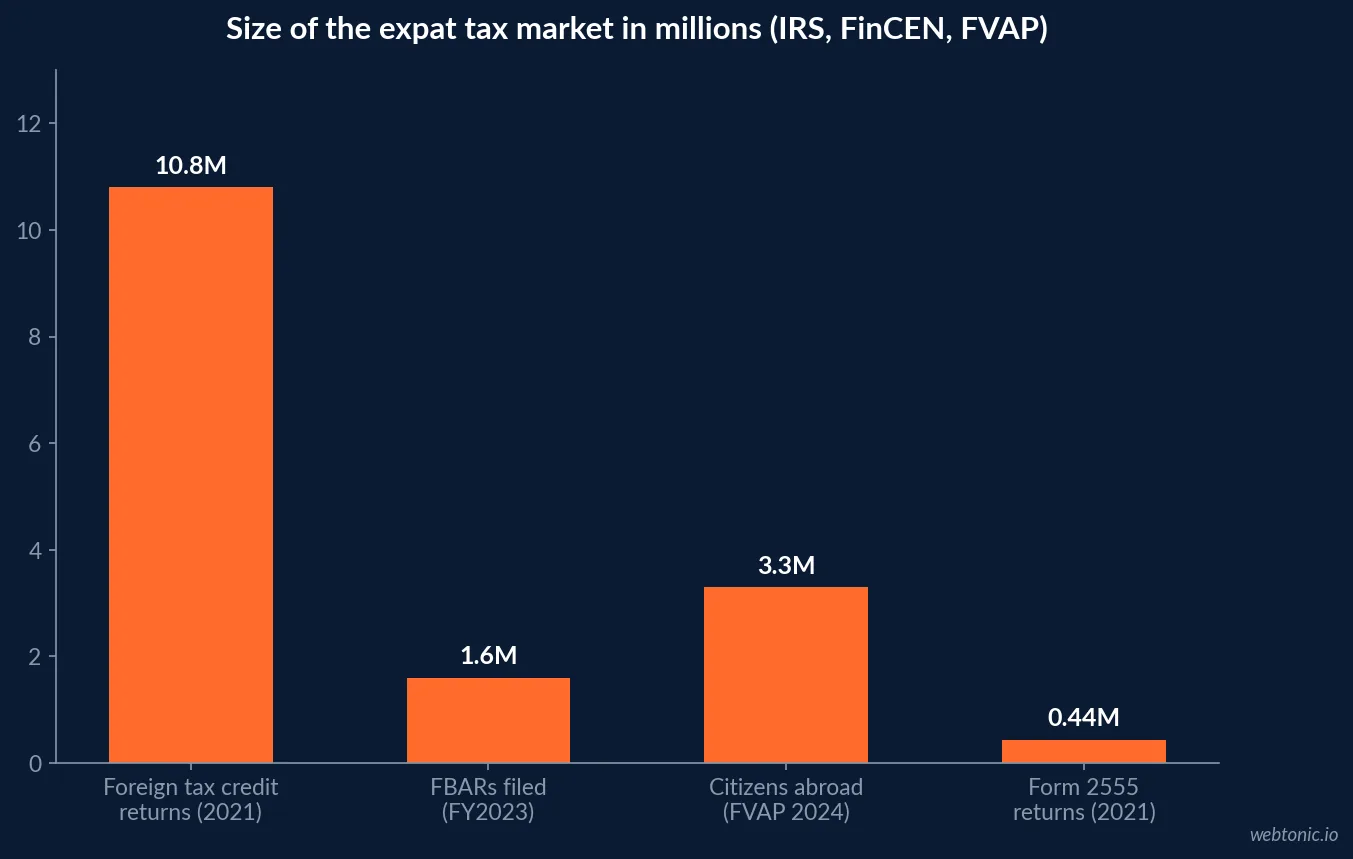
The IRS Statistics of Income study of foreign-earned income for tax year 2021 found that 437,655 of 160.8 million individual returns had a Form 2555 attached, "slightly less than 0.3% of the total", down 9.3% from 482,640 in 2016. Those taxpayers reported just under USD 48.2 billion in foreign-earned income, a 17.0% real decline from 2016, and claimed USD 28.5 billion as an exclusion.
The country table is a ready-made targeting list. Asia had the largest regional count at 145,083 returns, Europe 125,135 and North America 38,606. The underlying tables by country are on the IRS SOI foreign earned income page.
| Country of residence | Form 2555 returns 2016 | Form 2555 returns 2021 | Change |
|---|---|---|---|
| United Kingdom | 35,752 | 34,885 | -2.4% |
| Canada | 49,518 | 34,884 | -29.6% |
| Germany | 21,046 | 22,683 | +7.8% |
| China | 24,155 | 16,949 | -29.8% |
| France | 12,800 | 11,719 | -8.4% |
| Switzerland | 13,235 | 11,067 | -16.4% |
| Mexico | 6,027 | 3,722 | -38.2% |
The wider foreign-income market beyond expats
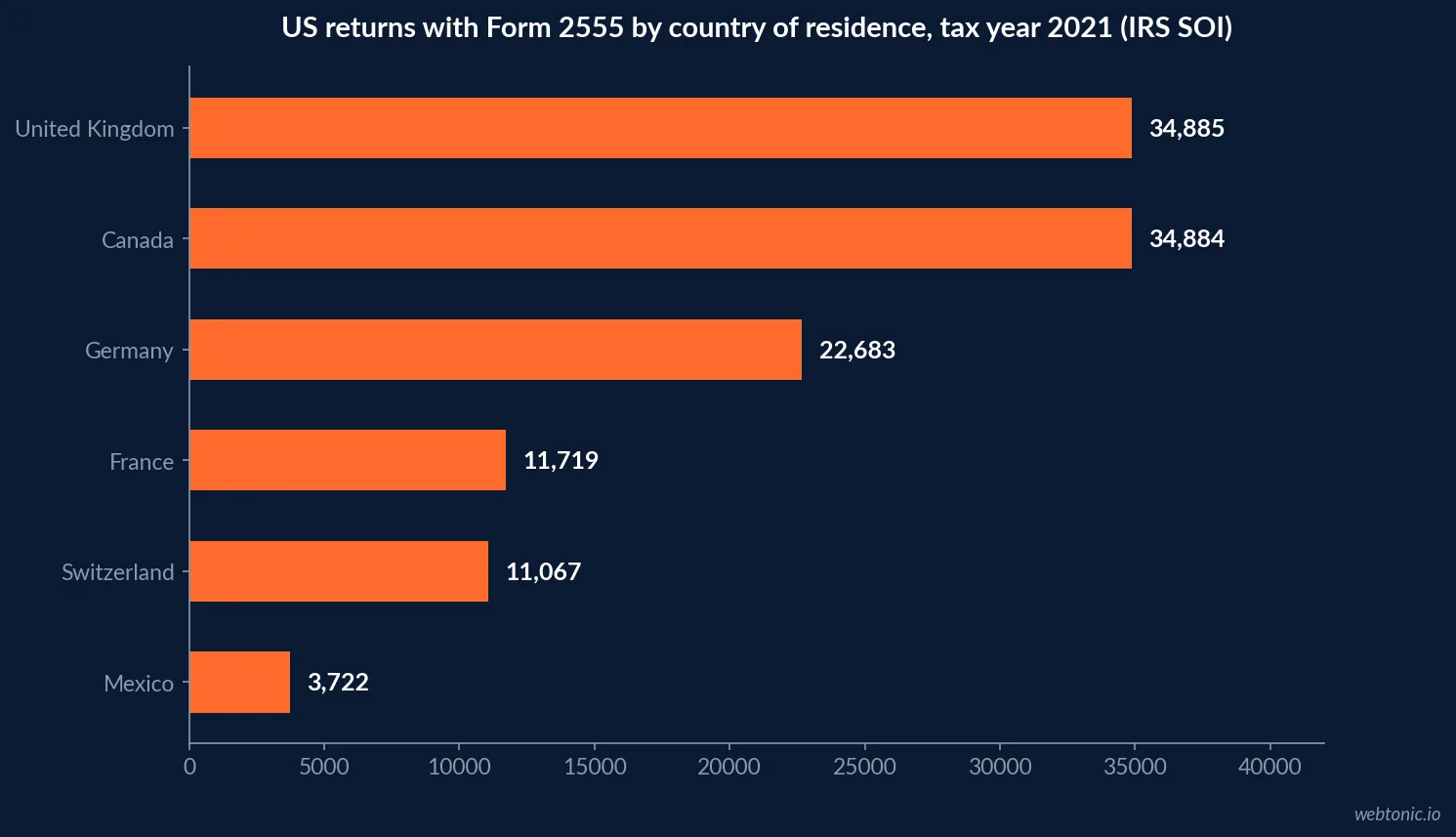
Foreign income is not only an expat issue. The same IRS study reports that US taxpayers claimed nearly USD 29.5 billion in foreign tax credits from approximately 10.8 million returns for 2021, based on USD 365.5 billion of foreign-source gross income, up 49.4% in real terms since 2016. Many of those filers live in the US and hold foreign investments, which makes them a domestic SEO audience searching for international expertise.
FinCEN's Year in Review for FY2023 adds the account-reporting side: approximately 1.6 million FBARs. A 2023 Federal Register notice gives the calendar-2022 figure: FinCEN "received 1,503,807 FBARs", of which 1,434,362 came from individuals and 69,445 from entities.
| Foreign-income measure (IRS SOI, 2021) | Figure | Change since 2016 | Audience it describes |
|---|---|---|---|
| Foreign tax credits claimed | Nearly USD 29.5 billion | +30.0% real | Investors and expats paying foreign tax |
| Returns claiming the credit | About 10.8 million | Not stated | Mostly domestic filers with foreign income |
| Foreign-source gross income on Form 1116 | USD 365.5 billion | +49.4% real | High-value advisory clients |
| Foreign-earned income on Form 2555 | Just under USD 48.2 billion | -17.0% real | Expats claiming the exclusion |
| Foreign-earned income exclusion claimed | USD 28.5 billion | -14.5% real | Core expat preparation work |
The split matters for content planning. The credit population is roughly twenty-five times the exclusion population, so a firm that writes only about living abroad misses the far larger group of US residents with foreign accounts, pensions or rental property. Those searchers rarely type "expat"; they search for the form name, the treaty or the country plus "US tax". Pages built around those terms reach both audiences without a single hreflang tag.
Deadlines and rules a ranking page has to get right
Expat pages live or die on accuracy. The IRS page for citizens and resident aliens abroad says filers living outside the US on the regular due date "are allowed an automatic 2-month extension", so a calendar-year return moves from April 15 to June 15, with a further extension to October 15 by filing Form 4868.
Marketing claims carry their own rule. Circular 230 section 10.30 prohibits "any form of public communication or private solicitation containing a false, fraudulent, or coercive statement or claim; or a misleading or deceptive statement or claim", and says enrolled agents "may not utilize the term 'certified'" for their designation. Every translated version inherits that rule.
| Topic | What the primary source says | Page element |
|---|---|---|
| Filing date abroad | Automatic 2-month extension to June 15 | Deadline box on every country page |
| Further extension | To October 15 with Form 4868 | FAQ answer, not a promise |
| FBAR volume | 1,503,807 filed in calendar 2022 | Separate FBAR service page |
| Advertising claims | No false, misleading or deceptive statements | Review translations, not just English |
| Credential wording | Enrolled agents may not say certified | Bio template per language |
Search engines in the countries expats file from
Google leads in every top Form 2555 country Statcounter covers. In September 2026 it held 91.39% in the UK, 85.3% in Canada and 87.84% in Germany. Japan is the outlier among expat destinations, with Google at 59.27% and Bing at 31.41%, and in China Baidu leads at 46.65%.
For a firm targeting Americans in Tokyo or Shanghai, Bing Webmaster Tools and Baidu visibility are not optional extras; Bing alone accounts for nearly a third of Japanese searches in the same dataset.
| Country | Form 2555 returns 2021 | Google share (Sept 2026) | Next engine |
|---|---|---|---|
| United Kingdom | 34,885 | 91.39% | Bing 6.08% |
| Canada | 34,884 | 85.3% | Bing 10.06% |
| Germany | 22,683 | 87.84% | Bing 6.49% |
| China | 16,949 | Not the leader | Baidu 46.65% |
| Mexico | 3,722 | 88.08% | Bing 9.43% |
English for many countries: the hreflang question
Expat content is mostly in English, so the international SEO problem is region, not language. Google's localized versions guide lets a firm tag regional English pages and recommends an x-default page "for unmatched languages". It also warns that "if two pages don't both point to each other, the tags will be ignored". Its multi-regional guide says Google uses visible content to judge language and recommends separate URLs per version rather than cookies.
The practical test: does the UK page discuss the UK treaty and pension issues, and the Canada page RRSPs and provincial filing? If yes, separate pages with en-GB and en-CA tags earn their place. If the copy is identical, one English page with an x-default tag is simpler and honest.
Domestic clients who search in another language
The US Census Bureau reported that 78.3% of people aged 5 and older spoke only English at home in 2018-2022; among the rest, Spanish accounted for 61.1%. Only 58.3% of Spanish speakers aged 18-64 spoke English "very well", the working-age group that files returns.
Business clients follow the same logic. CSA Research built its B2B language study on 1,116 business buyers in 33 countries and its consumer study on 9,909 consumers, and summarises the consumer result as 40% who will not buy in other languages. For a firm serving foreign-owned US subsidiaries, a Spanish, German or Japanese overview page can be the difference between being shortlisted or skipped.
A build order for a firm going after expat clients
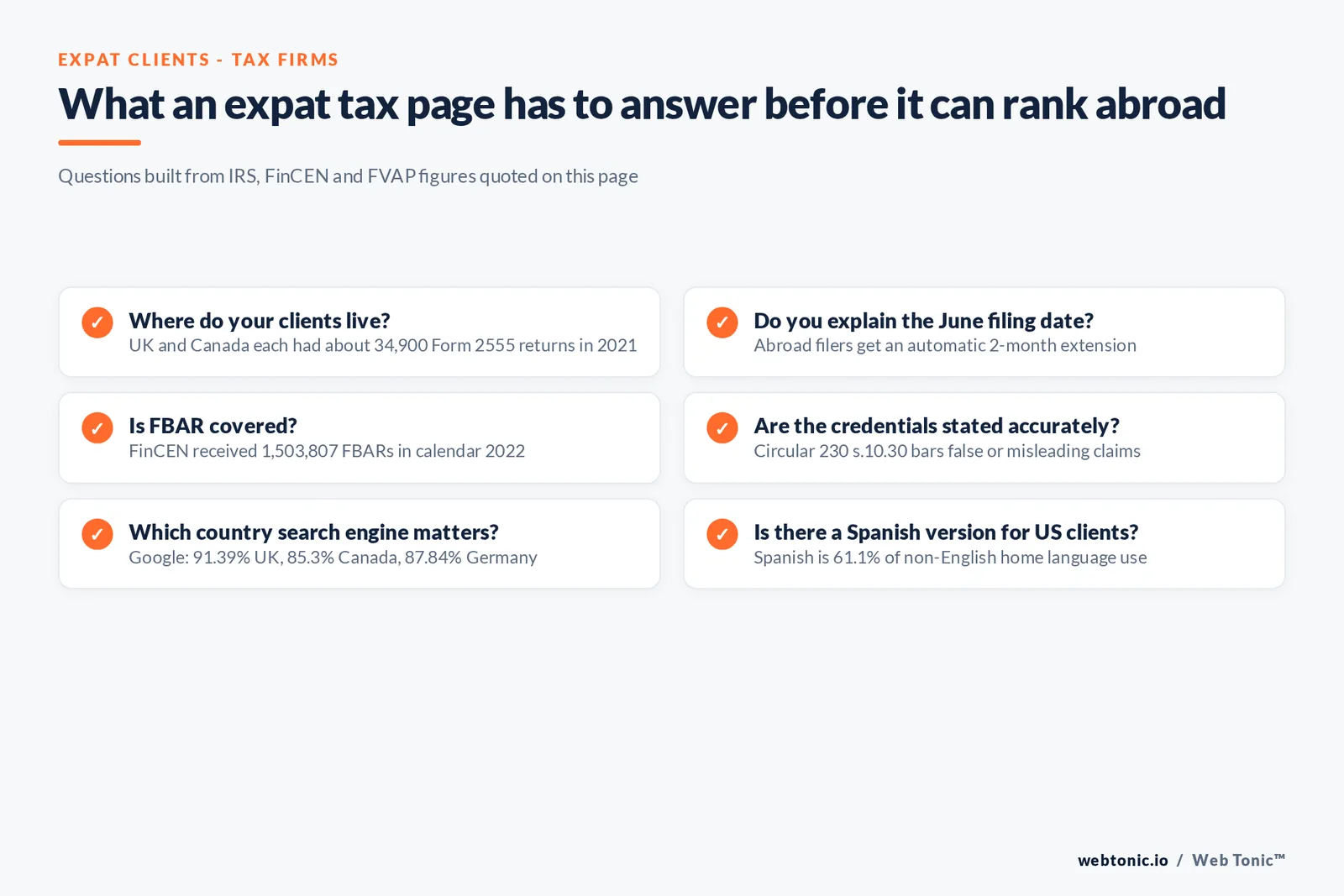
- One strong English expat hub with deadlines, FBAR and Form 2555 explained.
- Country pages for the UK and Canada first, the two largest Form 2555 populations at roughly 34,900 each.
- Regional hreflang tags only where content truly differs, plus an x-default hub.
- A Spanish page set for domestic clients, reviewed against Circular 230 like the English one.
- Bing and Baidu checks before targeting Japan or China.
Firms that run many office pages can compare this with our tax and accounting enterprise SEO data and tax app store figures, or talk to us about an expat content plan.
What these benchmarks leave out
None of the 2024 to 2026 sources measures search behaviour. There is no published share of expat filers who find a preparer through Google, no conversion rate for translated tax pages and no hreflang adoption rate among CPA firms. The IRS country data is also from tax year 2021, the latest SOI study, and FVAP's 3.3 million is a model. Plan with those limits in view.
Frequently Asked Questions
How many Americans abroad could need a US tax preparer?
FVAP's 2024 Overseas Citizen Population Analysis estimated 3.3 million US citizens living overseas, spread across 186 countries, a 15 percent increase since 2010. It is a model estimate, not a count. Narrower, filing-based measures are smaller: the IRS counted 437,655 returns with Form 2555 for tax year 2021.
Which countries should an expat tax firm target first?
IRS Statistics of Income data for 2021 puts the United Kingdom (34,885 Form 2555 returns) and Canada (34,884) at the top, followed by Germany (22,683), China (16,949), France (11,719) and Switzerland (11,067). Those counts reflect filers claiming the exclusion, not every American resident in those countries.
Do I need separate pages for UK and Canadian expats if both read English?
Only if the content differs. Google's localized-versions guide lets you tag English pages for specific regions, such as en-GB and en-CA, and recommends an x-default fallback. Separate pages make sense when the treaty, deadlines or pension rules discussed differ by country; identical copy with a new tag adds little.
What deadlines should an expat tax page state?
The IRS says US citizens and resident aliens living overseas on the regular due date get an automatic 2-month extension to file, moving a calendar-year return from April 15 to June 15, and can request a further extension to October 15 with Form 4868. FBARs are filed separately with FinCEN.
Are there advertising rules for tax firms' websites?
Yes. Treasury Circular 230, section 10.30, bars practitioners from using any public communication or private solicitation containing a false, fraudulent or coercive statement, or a misleading or deceptive one, and says enrolled agents may not use the term 'certified' to describe their designation. That applies to every language version of a page.
Sources
FVAP - 2024 Report to Congress
IRS SOI - Individual foreign-earned income and foreign tax credit, 2021
IRS - SOI tax stats, foreign earned income
IRS - US citizens and resident aliens abroad
FinCEN - Year in Review FY2023
Federal Register - FBAR information collection notice, 2023
eCFR - 31 CFR 10.30 Solicitation (Circular 230)
Google Search Central - Localized versions
Google Search Central - Multi-regional and multilingual sites
Statcounter - Search engine market share by country
US Census Bureau - Language spoken at home
CSA Research - Research for marketers


