Table of contents

A surrogacy agency website has to run two opposite funnels on one domain: intended parents comparing a $140,000 decision, and prospective surrogates evaluating an 18-24 month commitment. Webflow is unusually good at half that job. Here is the 2026 data on both halves.
Key Takeaways
- Webflow powers about 2.8% of websites in tracked platform surveys.
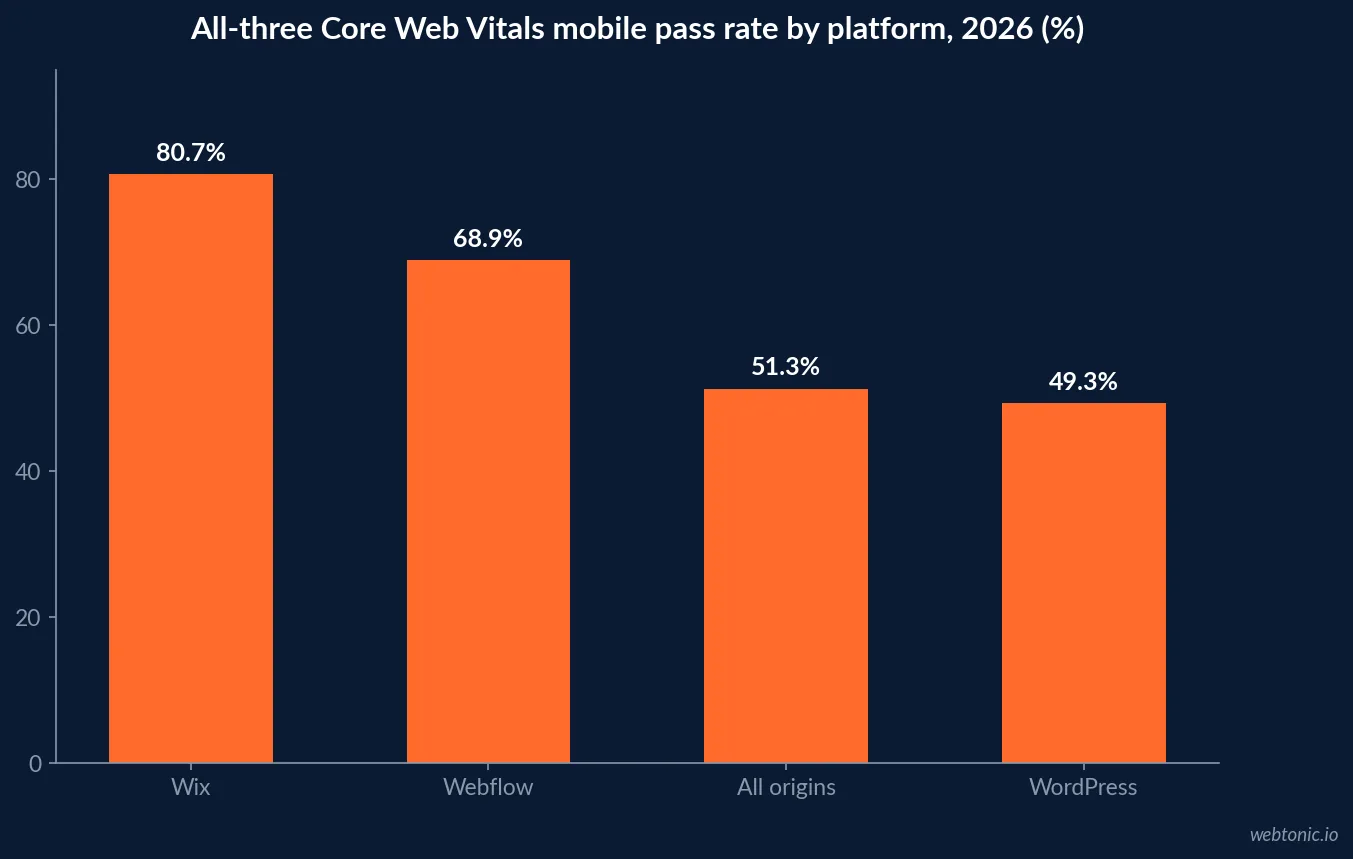
- 68.9% of Webflow origins pass all three Core Web Vitals on mobile, against 49.3% for WordPress and 51.3% across all origins.
- Wix leads platform CWV pass rates at 80.7%.
- Median Webflow LCP is about 1.8 seconds versus 2.8 seconds on WordPress.
- Webflow site plans run $14-$39 per month.
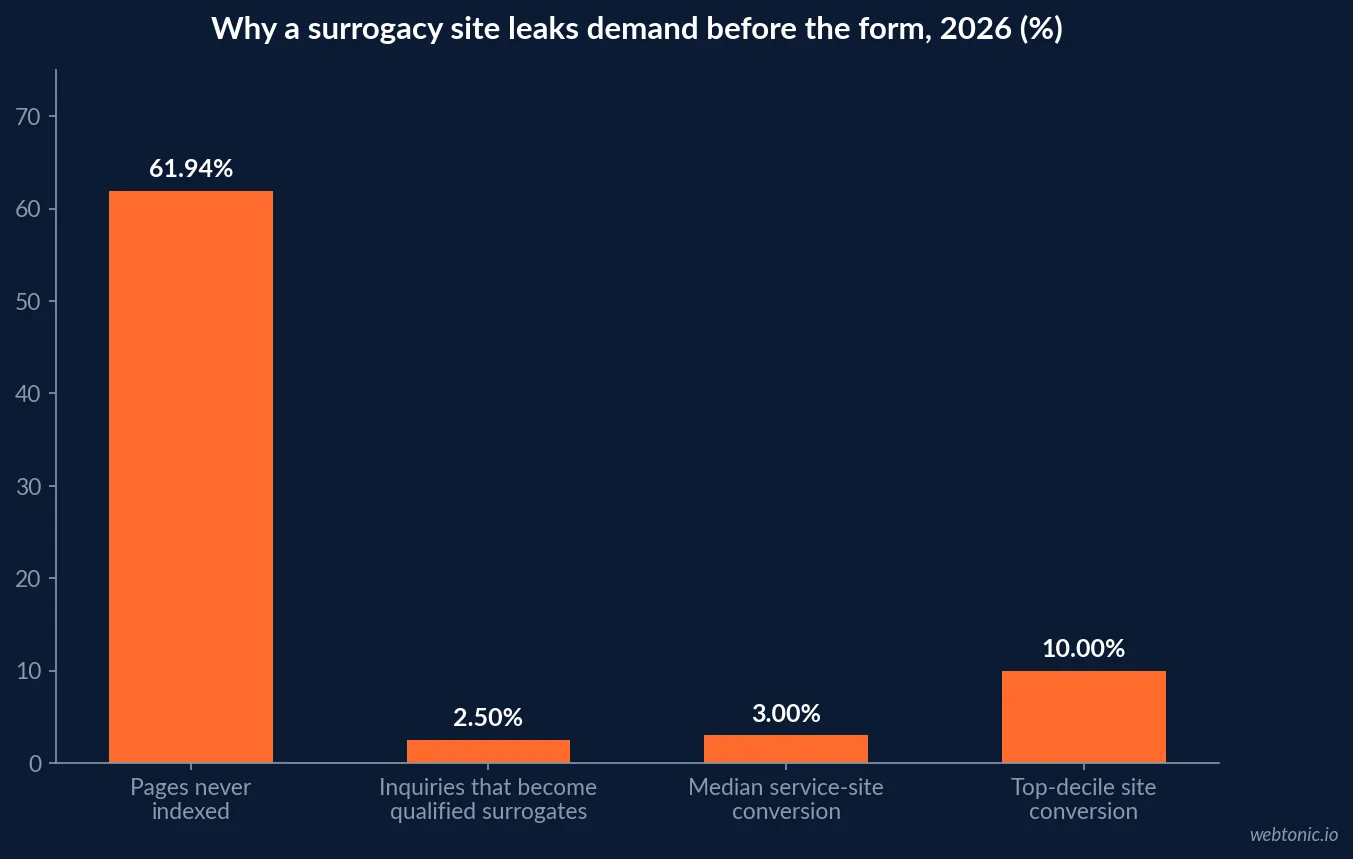
- 61.94% of 16 million studied pages were never indexed by Google.
- Bounce probability rises about 90% between a one and five second load.
- Service-business sites convert at 2-4%; the top 6% reach 8-12%.
- Fertility landing pages benchmark at 6.2% conversion.
- A US journey costs $140,000-$180,000, above $200,000 in California.
- Agency fees are $25,000-$50,000; IVF $20,000-$50,000; legal $8,000-$18,000.
- Surrogate base compensation runs $60,000-$110,000.
- Intended-parent cycles run 3-12 months; surrogate cycles 2-6 months.
- Only 2-3% of surrogate inquiries become qualified applicants.
- An intended parent supports an $800-$3,000 CPA on $120,000-$200,000+ journey revenue.
- 13 states plus DC are considered legally protective - geography is a content requirement.
- Fertility search converts at 6.8% from a $9.84 CPC.
Platform performance: where Webflow actually wins
Field data from the state of Core Web Vitals and 2026 Core Web Vitals statistics shows a wide spread between builders, and platform speed comparisons put Webflow a full second ahead of WordPress on median LCP.
| Platform | All-three CWV pass, mobile | Median LCP | Practical note |
|---|---|---|---|
| Wix | 80.7% | Fast | Strongest field data, least design freedom |
| Webflow | 68.9% | About 1.8s | Fast by default, no plugin decay |
| All origins | 51.3% | - | The web-wide baseline |
| WordPress | 49.3% | About 2.8s | Performance depends on plugin discipline |
Webflow holds about 2.8% of tracked websites per website builder market share data - a small share, but heavily weighted toward marketing sites where speed and design control both matter. Pricing sits at $14-$39 per month across site plans, per Webflow’s 2026 pricing update and independent pricing breakdowns.
The two-funnel problem
Almost every underperforming surrogacy website fails the same way: one navigation, one contact form, two audiences with opposite questions. Fertility and IVF marketing research is explicit that the two sides have different objections, different timelines and different proof requirements.
| Dimension | Intended parents | Prospective surrogates |
|---|---|---|
| First question | What does it cost and is it legal here? | How much and what is asked of me? |
| Decision cycle | 3-12 months | 2-6 months |
| Proof needed | Success rates, legal clarity, escrow security | Support structure, past-surrogate voices |
| Commitment | $140,000-$180,000 | 18-24 months of their life |
| Conversion event | Consultation booking | Screening application |
| Acquisition value | $800-$3,000 CPA | $1,500-$8,000 qualified |
In Webflow terms that means two page trees, two CMS collections, two form endpoints and two conversion events - not a shared "Contact us" page with a dropdown. The pipeline ratio between the two sides can run 30-50x, so mixing them makes both reports meaningless. Our surrogacy landing page benchmarks cover the page-level structure that follows from this split.
Indexation is the quiet leak
61.94% of pages in a 16-million-page study were never indexed by Google at all. Surrogacy sites are especially exposed because the standard SEO advice - build a page for every state, every clinic partner, every FAQ variant - produces exactly the thin, near-duplicate inventory that never gets crawled to completion.
| Page type | Typical count | Indexation risk | Fix |
|---|---|---|---|
| Core service pages | 6-12 | Low | Keep them deep and distinct |
| State law pages | 13-50 | Medium | Real statutory detail, not templated blurbs |
| Blog and guides | 50-300 | High if templated | Fewer, longer, sourced |
| Surrogate story pages | 10-100 | Low if genuinely unique | First-person, not rewritten |
| Clinic or partner pages | 10-80 | Very high | Consolidate into one comparison page |
Speed compounds the same loss on the demand side: bounce probability climbs about 90% as load time moves from one second to five. A page that is neither indexed nor fast is not a marketing asset. The crawl and rendering side is covered in our surrogacy technical SEO benchmarks.
The compliance boundary Webflow cannot cross
Surrogate screening collects health information: pregnancy history, BMI, medication use, mental-health screening. A general-purpose website CMS is not the right destination for any of it, and Webflow does not position itself as a platform for regulated health records. The correct architecture keeps Webflow as the marketing layer and pushes anything clinical into a dedicated intake system.
| Data | Belongs in Webflow? | Where it should live |
|---|---|---|
| Marketing content and stories | Yes | Webflow CMS |
| Name, email, state, timeline | Yes, as a pass-through | CRM |
| Pregnancy and medical history | No | Compliant intake or EMR platform |
| Screening results | No | Case management system |
| Escrow and financial detail | No | Escrow provider portal |
| Consent and legal documents | No | E-signature and document platform |
Practically: the Webflow form should capture the minimum needed to qualify and route, then hand off. That also protects the analytics layer, because a short form completes far more often than a long one - and with only 2-3% of inquiries reaching qualified status, volume at the top of the funnel is not optional.
Content depth beats page count
The pages that carry a surrogacy site are few and long. Intended parents arrive with three blocking questions - cost, legality, odds - and prospective surrogates with three of their own - compensation, screening, support. Six answers, six deep pages, each of which can reasonably run past 2,000 words with real numbers attached.
| Page | Audience | Must contain | Why it converts |
|---|---|---|---|
| Full cost breakdown | Intended parents | $140,000-$180,000 itemised | Removes the largest unknown |
| State legal guide | Both | Statutory position, not a map graphic | Qualifies or disqualifies fast |
| Success rates | Intended parents | 70-80% live birth per PGT-tested transfer | Sets realistic odds |
| Compensation page | Surrogates | $60,000-$110,000 plus allowances | The first thing searched |
| Screening criteria | Surrogates | Age, BMI, pregnancy history, location | Self-selects out 95%+ |
| Surrogate stories | Surrogates | First-person, unedited voice | 88% cite helping a family |
Notice that two of the six pages exist to reduce inbound volume. That is deliberate. When only 2-3% of inquiries become qualified applicants, a screening page that turns away unqualified visitors before they fill a form is worth more than a page that maximises submissions.
What Webflow does and does not solve
Platform choice removes a category of problems and touches none of the others. It is worth being precise about the boundary before an agency treats a rebuild as a growth strategy.
| Problem | Solved by moving to Webflow? | What it actually needs |
|---|---|---|
| Slow mobile pages | Largely yes | 68.9% of origins pass all three CWV |
| Plugin and update maintenance | Yes | Hosted platform, no plugin stack |
| Design consistency | Yes | Component and style system |
| Thin, unindexed pages | No | Fewer pages, more substance |
| Two audiences, one funnel | No | Information architecture decision |
| Health-data handling | No | Compliant intake platform |
| Weak lead-source data | No | CRM discipline and source questions |
Three of the seven rows are content and operations problems that survive any replatform. That is the usual reason a fast new site fails to move pipeline: the build fixed the delivery layer and left the funnel design untouched.
Conversion benchmarks worth building against
Service-business websites convert at 2-4%, with the top 6% reaching 8-12%, while fertility landing pages benchmark at 6.2% per fertility paid-media benchmarks. Webflow statistics compiled in 2026 platform research point the same direction: the build quality, not the platform badge, sets the outcome.
| Site quality tier | Conversion rate | What separates it |
|---|---|---|
| Bottom quartile | Under 1.5% | Gated pricing, one form, slow mobile |
| Median service site | About 3% | Clear service pages, single funnel |
| Strong dual-funnel build | 5-7% | Split audiences, transparent cost, fast pages |
| Top decile | 8-12% | Story depth, calculators, immediate booking |
| Fertility landing page benchmark | 6.2% | Focused single-intent page |
Moving a site from 3% to 6% doubles pipeline on the same media budget - and at an $800-$3,000 intended-parent CPA against $120,000-$200,000+ in journey revenue, per 2026 surrogacy cost and outcome data, that is the cheapest growth available to an agency.
A Webflow build checklist for surrogacy agencies
- Split intended parents and surrogates from the homepage, not from the menu.
- Publish full cost detail - $140,000-$180,000 itemised - rather than gating it.
- Publish compensation openly: $60,000-$110,000 base plus $200-$500 monthly allowance.
- Build state pages only where you can write real statutory detail.
- Keep total page count low enough to be crawled - 61.94% of pages never get indexed.
- Hold mobile LCP near 1.8 seconds; bounce risk rises 90% by five seconds.
- Keep clinical questions out of the CMS and in a compliant intake tool.
- Use separate conversion events per audience; the pipeline ratio is 30-50x.
- Feature first-person surrogate stories - 88% of agency surrogates cite helping a family.
- Target the 6.2% fertility landing-page benchmark before buying more traffic.
The website is the only asset in a surrogacy marketing program that serves both funnels at once, which is why it is the first thing we rebuild. Related reading: our surrogacy attribution benchmarks, social media benchmarks and performance creative work.
Frequently Asked Questions
Is Webflow a good platform for a surrogacy agency website?
For the marketing site, yes. Webflow passes all three Core Web Vitals on mobile for 68.9% of origins against 49.3% for WordPress, and its median LCP is about 1.8 seconds versus 2.8 seconds on WordPress. That matters because a surrogacy site is a long-consideration research destination visited many times before contact. What Webflow cannot do is act as the system of record for health information collected during surrogate screening - that belongs in a compliant intake platform, not in CMS collections.
What does Webflow cost for a surrogacy agency in 2026?
Site plans run roughly $14 to $39 per month depending on tier, which is negligible next to the economics: a single journey generates $120,000 to $200,000 in agency-adjacent revenue and an intended parent is worth an $800 to $3,000 acquisition cost. Build cost dominates platform cost by an order of magnitude, and the recurring saving comes from not maintaining plugins.
How should a surrogacy site handle two audiences?
With two complete, separately navigable funnels rather than two menu items. Intended parents and prospective surrogates want opposite information - cost, legality and success rates on one side, compensation, screening and support on the other - and their cycles differ, 3-12 months versus 2-6 months. Split from the homepage, keep separate landing pages, separate forms and separate tracking, and never send a surrogate applicant into an intended-parent nurture sequence.
Do fast surrogacy websites actually convert better?
Speed sets the ceiling, content does the converting. Bounce probability rises about 90% as load time goes from one to five seconds, and 61.94% of pages in a 16-million-page study were never indexed at all - so slow or thin pages lose the visit before conversion is even in play. Once traffic lands, a well-built service site converts around 3%, with top-decile sites reaching 8-12%; fertility landing pages benchmark at 6.2%.
What are the most common technical mistakes on surrogacy websites?
Four recur: gating cost information behind a form, publishing hundreds of thin location pages that never get indexed, collecting health-screening answers directly into a general-purpose CMS, and building a single contact form for two audiences with opposite qualification criteria. The last one is the most expensive, because it destroys the source data every downstream report depends on.
Sources
Core Web Vitals - State of CWV
Just Analytics - Core Web Vitals Statistics 2026
PageSpeed Matters - Platform Speed Comparison
Colorlib - Website Builder Market Share
Popupsmart - Webflow Statistics
Webflow - Plans and Pricing 2026
Web Nomads - Webflow Pricing Breakdown
Tandem - Fertility and IVF Marketing
Benchmarketing - Fertility Clinic Benchmarks
ACRC Global - Surrogacy Statistics 2026